No doubt. Local models are rapidly becoming capable enough for a huge share of everyday tasks.
If that continues, they could become one of the most underappreciated threats to the economics of the massive centralized AI compute buildout currently underway.
Stephen Wolfram has coined the phrase “computational irreducibility.” Wolfram’s point is that there are no shortcuts in predicting what a sufficiently complex system will do. If you want to know what a system will do ten steps ahead, in most cases, the best that you can do is run through all ten steps. This is a huge problem for AI safety because it implies that one might not be able to predict, even in principle, what an AI system will do until it has done it. I assume Anthropic knows this?
@JavierBlas@CopernicusEU Is there any informal or alternative indicator that can give us a sense of the actual volume of oil currently flowing into the global economy?
El flujo actual (real) de petróleo a la economía global es muy complicado de estimar ahora mismo. Las cifras oficiales más que darnos pistas, sirven para confundirnos y generar escenarios equivocados
New open-source satellite imagery from @CopernicusEU shows the Saudi oil terminal of Ju'aymah quite busy again, with 6 supertankers loading crude (plus another one at Ras Tanura). At least two of the tankers are different to the ones seen in a similar satellite photo on Sunday.
The main risks to equities is that the tightening cycle is tougher than the market currently expects. That is not a high hurdle as the market expects one of the shallowest tightening cycles on record. Fed tightening cycles almost inevitably end in recession and bear markets.
Limite reembolsable del 5% que se genera vendiendo la parte liquida de la cartera,normalmente la de más calidad.
Por que la de peor calidad suele ser iliquida en momentos asi.
Micron ($MU ) delivered exactly what AI bulls wanted and NQ futures jumped 2%.
Now comes the real test.
If the market can't push higher on great news, first come the nerves... then the rush to sell before the rally deflates.
The US household debt burden has almost never been this large:
US household total debt service is up to 30% of gross disposable national income, the highest since at least 2008.
This means the average American household is now spending nearly 1 out of every 3 Dollars they earn after taxes just to pay off debt.
This comes as household debt interest payments are up to ~10%, the highest in at least 18 years.
Furthermore, total US household debt surged +$197 billion in Q3 2025, to a record $18.6 trillion.
Meanwhile, principal amortization, or the portion of debt payments that goes toward paying down the actual loan balance, not interest, is up to ~18%, the highest since at least 2008.
The debt burden is squeezing consumer spending power.
It’s striking that the US dollar managed to weaken in 2025 despite significant foreign buying of US stocks. What will happen to the greenback if those equity inflows turn into outflows?
The lesson here is that no matter how cool the tech, if you don’t have a natural monopoly, Chinese competition will eventually drive your margins to zero. The applies to all of Tesla’s future businesses, including robotics, autonomous vehicles, and battery storage.
Few thoughts on retail investing since it’s popping up again on FinTwit:
- As I’ve said before, I think it’s probably the lowest ROI activity you can do if you’re trying to get rich. Focus on your career
- You should index 90% of your money
- You have zero edge day to day. Your advantages are that you have duration, no mandate, and nobody forcing you to sell
- It follows that the fewer trades you do, the better. The more trades you do, the worse you will do
- Process is the only thing that matters. How rigorous is your process? How do you reflect on what worked and what didn’t? Do you even know why it worked? Otherwise it’s just luck. For most people is still probably just luck.
- Your biggest enemy is yourself. You have no institutional guardrails to stop you from doing stupid things
- If you are thinking of it YTD you have already lost. That’s not your game, and is a recipe for failure. Trying to beat the market every single year will cause you to overtrade, where you have a structural and insurmountable disadvantage
- It’s OK to just do it for the love of the game. Because it’s the greatest game on earth!
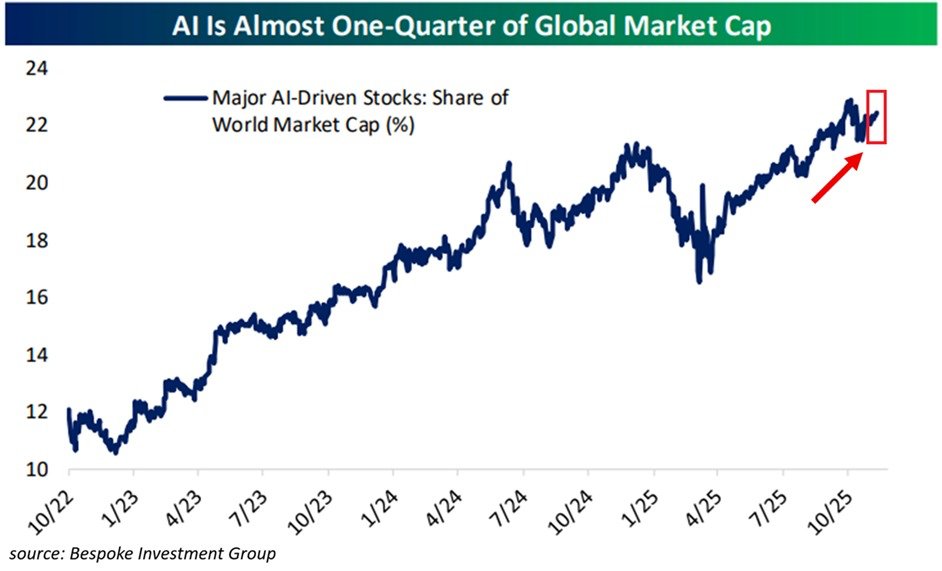
AI stocks are dominating the equity market:
AI-related stocks now reflect ~23% of global market cap, near an all-time high.
This percentage has doubled since November 2022, when ChatGPT was introduced.
These stocks have been a primary driver of the global bull market, which has added over $42 trillion in market cap over the last 3 years.
Meanwhile, in the US, AI-related names now reflect a record 46% of the S&P 500’s market cap.
By comparison, in November 2022, the figure stood at just 27%.
AI is redefining equity investing.
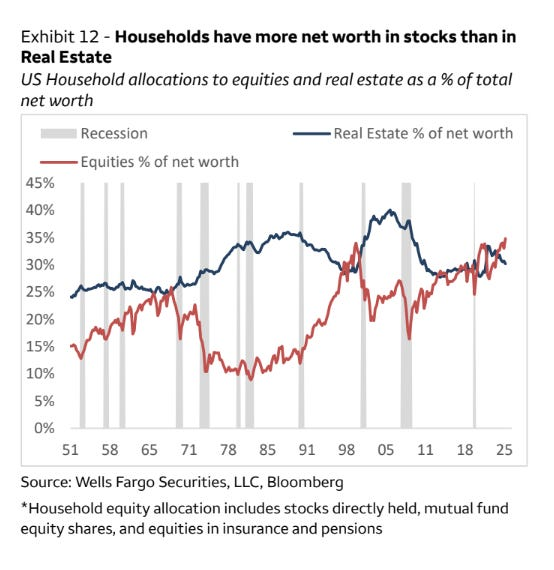
This is a very interesting chart, as household stock wealth being higher than real estate wealth has only happened in the late 60s and late 90s, the last two times the ensuing bear market lasted years.
Beary Burry
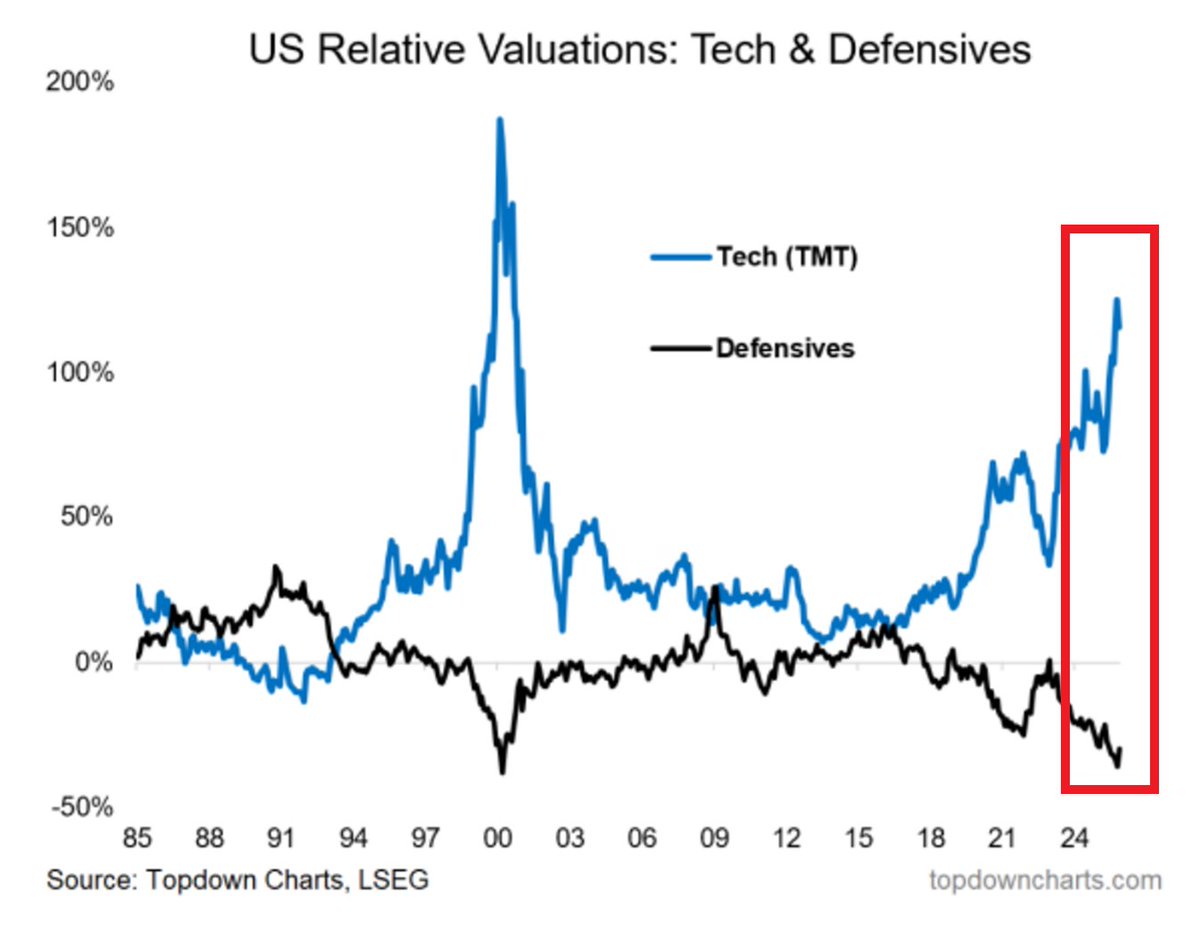
🔴This is the largest valuation gap since the 2000 Dot-Com Bubble:
US technology stocks now trade at their highest valuation premium relative to defensive stocks since the Dot-Com peak.
It has rarely been this cheap to own utilities or consumer staples relative to technology.
Will the gap close over the next few years?
The elephant in the room:
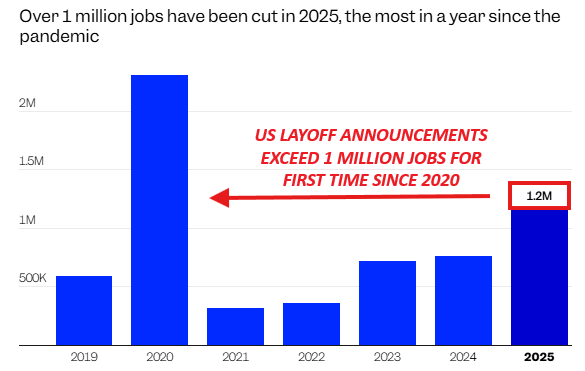
There have now been 1.2 MILLION job cuts announced in 2025. And, 60% of Americans say we are in a recession.
Yet, the S&P 500 has added +$17 TRILLION since April, nearing its 29th record high of 2025.
What's happening? Let us explain.
(a thread)
I highlighted back in May that surging Japanese bond yields were investors number 1 most important issue. And as JGB yields take another major leg up, I am still of that view.
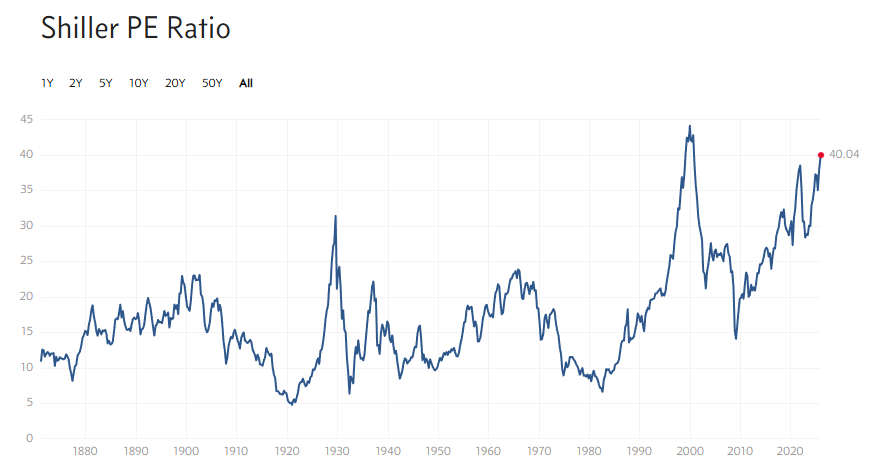
This is not a bull market.
This is a policy regime.
Ten forces. Validated. Coordinated. Unprecedented.
December 1: Fed ends Quantitative Tightening after draining $2.3 trillion since 2022. December 9: Another rate cut expected, pushing toward 3.5% while inflation runs at 3%. Negative real rates by design.
The deficit: 5.9% of GDP. The 50-year average is 3.8%. This has been exceeded only eight times since 1946, all during wars or crises. We are in neither.
The Magnificent 7 will deploy $571 billion in capital expenditure next year. Nvidia alone, at $4.4 trillion, exceeds the combined value of every publicly traded company in the United Kingdom.
Corporate buybacks hit $1 trillion at the fastest pace ever recorded. Birinyi projects $1.2 trillion for 2026. The companies have become their own structural bid.
Now layer the political accelerants. Trump proposes eliminating income tax entirely. $2,000 stimulus checks by mid-2026. The executive branch has made asset prices an explicit policy objective.
Read this architecture again.
Central bank providing liquidity. Treasury providing deficit stimulus. Corporations providing structural demand. Technology providing earnings growth. White House providing political commitment.
All five pillars. Simultaneously. At this scale.
The bears have a thesis. Valuations stretched. Deficits unsustainable. Inflation will reignite. All intellectually coherent. All fighting coordinated monetary, fiscal, and political power operating in alignment.
You do not fight the Fed. You do not fight the Treasury. You do not fight both operating with explicit White House backing.
The constraints being violated are real. Fiscal sustainability. Inflation targeting. Central bank independence. But constraints are long-term. Momentum is now.
The bill comes later.
The regime is here.