We don’t follow the noise.
We follow what changes next.
Markets move.
Technology shifts.
Behavior adapts.
Narratives come after.
Second Order exists to study the consequences most people notice late.
Something quietly changed in US housing.
The income needed to afford a home has stopped climbing and is beginning to ease.
That does not mean housing is affordable.
A typical buyer still needs roughly $117K of income, about $29K more than the typical household earns.
But the direction matters.
For years, higher prices and higher rates pushed the affordability gap wider.
Now incomes are catching up while financing pressure is starting to stabilize.
The first-order story is housing affordability flattening.
The second-order question is what happens if mortgage rates actually start falling.
A market that has spent years frozen by affordability could suddenly find buyers again.
Housing may be one of the clearest places to watch monetary policy transmit next.
Trump Media is unwinding parts of its https://t.co/1FMMMYwalg strategy.
The planned CRO treasury deals are being terminated, while Truth Social’s direct prediction-market integration is being scaled back to a marketing agreement.
Management says the reason is business priorities, not regulation.
But the timing is hard to ignore.
Washington is fighting over crypto ethics and conflicts of interest at the exact moment a Trump-linked company is reducing some of its direct crypto entanglements.
The first-order story is a corporate reset.
The second-order question is whether this removes one more political argument from the broader US crypto fight.
It won’t save the CLARITY Act by itself.
But it does change the optics.
$CRO $DJT $BTC
The US economy just lost 23,000 jobs.
Wall Street expected +83,000.
And May + June were revised lower by another 103,000.
The first-order reaction is obvious:
lower yields,
a weaker dollar,
less pressure for the Fed to hike.
But the second-order question is harder.
Markets wanted a softer labor market.
They did not want one that starts breaking.
For $BTC and $QQQ, this is the line to watch now:
weak enough to cool rates,
not weak enough to kill growth.
That balance just got much thinner.
The CLARITY Act delay is not automatically bearish.
But comparing it directly to the 2023 Bitcoin ETF delays misses the bigger point.
The ETFs were eventually approved after the legal and regulatory path became clearer. CLARITY is a political negotiation - and politics can still change the outcome.
What matters now is what happens during the delay.
If lawmakers use the extra time to resolve the fights over market structure, investor protection, stablecoins and ethics, September could bring back a stronger bill with a clearer path to passage.
That would matter far beyond one headline.
Regulatory clarity lowers the cost of committing capital, gives institutions more confidence to build in the US and removes one more reason to keep crypto exposure limited.
The delay itself is not bullish.
A better bill coming out of the delay could be.
That is the second-order trade the market will eventually have to price.
Trump is no longer talking about Bitcoin like a threat to the dollar.
He is talking about crypto as part of America’s financial strategy.
That shift matters.
For years, Washington treated $BTC as something to contain.
Now the conversation is about keeping capital, innovation and crypto infrastructure inside the US before someone else captures it.
The first-order story is political support.
The second-order effect is legitimacy.
Once Bitcoin becomes something governments compete to attract instead of suppress, the adoption curve changes.
$BTC does not need Washington to survive.
But Washington increasingly looks like it does not want to be left behind.
Michael Saylor said it cleanly:
“Bitcoin doesn’t need CLARITY. America needs clarity.”
That distinction matters.
$BTC will keep producing blocks whether Washington agrees on a market structure bill or not.
The cost of delay shows up somewhere else:
capital waiting,
companies operating in gray zones,
institutions moving slower,
and financial infrastructure being built where the rules are clearer.
Bitcoin can survive regulatory uncertainty.
The second-order question is how much opportunity America gives away while trying to resolve it.
The protocol keeps moving.
Policy is the part falling behind.
The $128M headline is not the real story.
BlackRock’s IBIT has now pulled in $606.8M across four straight sessions.
US spot Bitcoin ETFs have absorbed $763.6M over the same stretch.
And $BTC is still sitting near $64K.
The first-order signal is inflows.
The second-order signal is absorption.
Someone is still supplying enough Bitcoin to keep price contained despite persistent ETF demand.
If that supply runs out before the bid does, the move that follows could be much faster than the inflows suggest.
Watch the price after the sellers disappear.
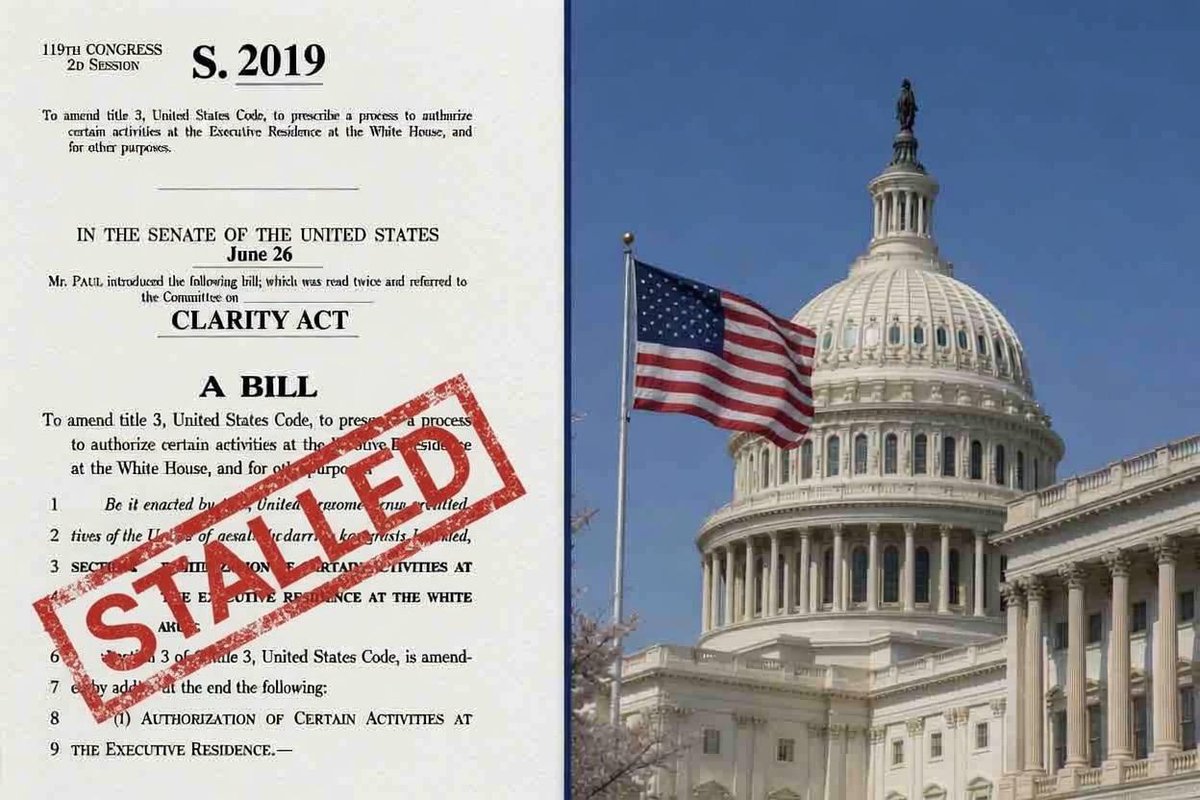
The CLARITY Act just slipped to September.
That sounds like a delay.
It is actually a change in the risk.
The Senate still plans to bring it back, but the bill now returns closer to the midterms, with unresolved fights over ethics, stablecoin rewards and law enforcement still on the table.
The first-order story is another month of waiting.
The second-order effect is political optionality shrinking with every week that passes.
For $BTC, $ETH and $COIN, regulation is no longer just about what the final rules say.
It is about whether Washington can agree on them before the calendar becomes the bigger problem.
BlackRock is not increasing its Ethereum exposure.
It is making the wrapper more efficient.
On October 6, ETHA will combine every three shares into one. The share price will roughly triple, while investor holdings and the fund’s total value remain unchanged.
The first-order story is a reverse split.
The second-order signal is operational maturity.
Crypto ETFs are now being optimized like established financial products, where spreads, execution and trading costs become part of the competition.
This is not another “BlackRock bought $ETH” headline.
It is Ethereum exposure becoming ordinary financial infrastructure.
$ETH $ETHA
Everyone is focused on whether the Clarity Act passes.
I'm paying attention to who's trying to slow it down.
When Wall Street starts raising concerns and politicians begin debating every detail, it tells you something important.
Crypto is no longer being treated like a niche experiment.
It's becoming part of the financial system, and every major player wants a say in what those rules look like.
Markets don't wait for perfect clarity.
They price in the direction long before the final vote.
That's why the debate itself may matter more than the outcome everyone is watching.
Today isn't about SpaceX.
It's about liquidity.
911M shares becoming eligible to trade doesn't guarantee selling.
It reveals whether demand is actually strong enough to absorb supply.
Anyone can rally on scarcity.
The real winners rally when supply arrives.
Bitcoin is not just breaking a trendline.
It is trying to break its relative weakness.
$BTC is pressing $65K while $QQQ trades lower, and spot ETFs have absorbed roughly $626M in three days.
The first-order signal is the breakout.
The second-order signal is demand showing up even without help from tech.
A clean hold above $65K changes the structure.
Then $67K stops looking like resistance and starts looking like the next test.
The easy path for the CLARITY Act just closed.
No cloture filing means there is no normal route to a Friday vote before the Senate recess.
The bill is not dead.
But every delay raises the political cost of bringing it back.
The first-order story is a missed deadline.
The second-order effect is another month of regulatory uncertainty for $BTC, $ETH and $COIN.
Markets can price strict rules.
They struggle to price rules that may never arrive.
BlackRock’s crypto ETFs just pulled in $247M in a single day.
$196.8M into Bitcoin.
$50.3M into Ethereum.
The headline is dip-buying.
The bigger signal is that regulated demand is no longer showing up in $BTC alone.
Capital is beginning to treat $BTC and $ETH as two parts of the same emerging asset class.
One day does not confirm the shift.
But this is how it starts.
Ethereum is debating whether too much staking can make the network less secure.
EIP-8363 would burn an increasing share of validator issuance as more $ETH is staked, reaching 100% at roughly half the supply.
The first-order story is lower issuance.
The second-order question is harder:
Does reducing the reward protect decentralization — or push solo stakers out first and leave more power with the largest providers?
This is not just tokenomics.
It is Ethereum deciding what kind of asset ETH should become:
a productive asset with yield,
or harder money with less dilution.
That debate matters more than today’s candle.