Why did it take Arabs another full generation after 1948 to adopt a "Palestinian" identity?
Because the identity was never primarily about a people. It was about a strategy.
For the first two decades after Israel's founding, the dominant Arab framework wasn't Palestinian nationalism. It was pan-Arabism. Nasser, the Ba'ath party, the Arab League. The operating theory was that "Arab" was the nation, and the various states were artificial colonial borders waiting to dissolve into one. A separate Palestinian identity would have undermined this project, not advanced it. If Arabs from Jaffa were a distinct nation, then Arabs from Damascus and Baghdad were too and pan-Arabism collapses.
So between 1948 and 1967, the residents of the West Bank were Jordanians. The residents of Gaza were under Egyptian rule. The displaced were "Arab refugees." The fight against Israel was an Arab fight, not a Palestinian one.
What broke this framework was 1967. Six days of catastrophic defeat ended pan-Arabism as a credible vehicle. Nasser was humiliated, the combined Arab armies were routed, and the dream of dissolving Israel through unified Arab power was over. A new vehicle was needed.
Enter the Palestinian national identity. Retooled, repurposed, weaponized. And the architects said so openly.
Zuheir Mohsen, PLO Executive Committee, 1977 (interview with the Dutch paper Trouw): "The Palestinian people does not exist. The creation of a Palestinian state is only a means for continuing our struggle against the State of Israel for our Arab unity. In reality today there is no difference between Jordanians, Palestinians, Syrians and Lebanese. Only for political and tactical reasons do we speak today about the existence of a Palestinian people, since Arab national interests demand that we posit the existence of a distinct Palestinian people to oppose Zionism."
Azmi Bishara, founder of Balad, former Knesset member, in a 1994 Israeli TV interview: "I don't think there is a Palestinian nation. I think there is an Arab nation. I always thought so... I think that until the end of the 19th century, Palestine was the south of Greater Syria." He went on to argue that Palestinian identity was a recent construction shaped by colonial borders and the conflict with Zionism, not an ancient nationhood. This from one of the most prominent Arab intellectuals inside Israel, who himself led a Palestinian-Arab political party.
Walid Shoebat, a former PLO operative who later went public: "Why is it that on June 4th 1967 I was a Jordanian and overnight I became a Palestinian? ...We considered ourselves Jordanian until the Jews returned to Jerusalem. Then all of the sudden we were Palestinians." Shoebat is a controversial figure with his own credibility disputes, but his autobiographical point about the timing is consistent with the historical record.
Hafez al-Assad to Yasser Arafat (recounted by Arafat himself and reported in Israeli and Arab press): "You do not represent Palestine as much as we do. Never forget this one point: There is no such thing as a Palestinian people, there is no Palestinian entity, there is only Syria. You are an integral part of the Syrian people, Palestine is an integral part of Syria. Therefore it is we, the Syrian authorities, who are the true representatives of the Palestinian people."
Joseph Massad, Columbia professor, sympathetic to the Palestinian cause, in The Persistence of the Palestinian Question (2006): acknowledges that Palestinian national identity in its current form crystallized in the 20th century in dialectic with Zionism, a serious academic admission, even from a pro-Palestinian scholar, that the identity is modern and reactive rather than ancient.
>>
@markames1969 It shows ignorance of resistance movements and the Warsaw Ghetto Uprising. Your other reply shows ignorance of al-Husseini and his plans and collaboration with Hitler. Also, ignorance of the Farhud. Some former Nazis lost the war against Israel with the Arab armies in 1948.
@markames1969 This shows ignorance of the British failures to help refugees before and during the war, including the reality of how many lives would have been saved from implementing the Balfour declaration or refugee movements when rhetoric British had the Palestinian Mandate. 1/3
@waqasahmad_x@Issybeatz_ Quite a false equivalence. Numbers are a way of understanding the universe and quantifying things, creative arts are a way of espressing the universe and the soul.
Made it my life’s mission to become the Taliban’s worst nightmare:
A highly educated Afghan woman.
First, Columbia University at the top of my class, and now Oxford University.
Give Afghan girls one chance and see what they can achieve.
@jwvansteenwyk@JamesLNuzzo This is seen as problematic by many too in terms of purity culture and religious interferences with women's reproductive rights.
@Q8Hashm@Proud_Aboki@raythewarchief That is a false equivalence. Islam has many claims that have been disproven by science. It also plaigarizes from Christianity, Judaism and Zorasrianism. It is a fact that Jesus was a Jew as all the first Christians were. Christianity was founded as reform Judaism.
still not quite over the fact that i watched 15 year olds get sued for millions of dollars for downloading twelve songs and now we all have to accept AI slop because every tech company in the known universe decided that IP laws don't exist now that they're inconvenient for them
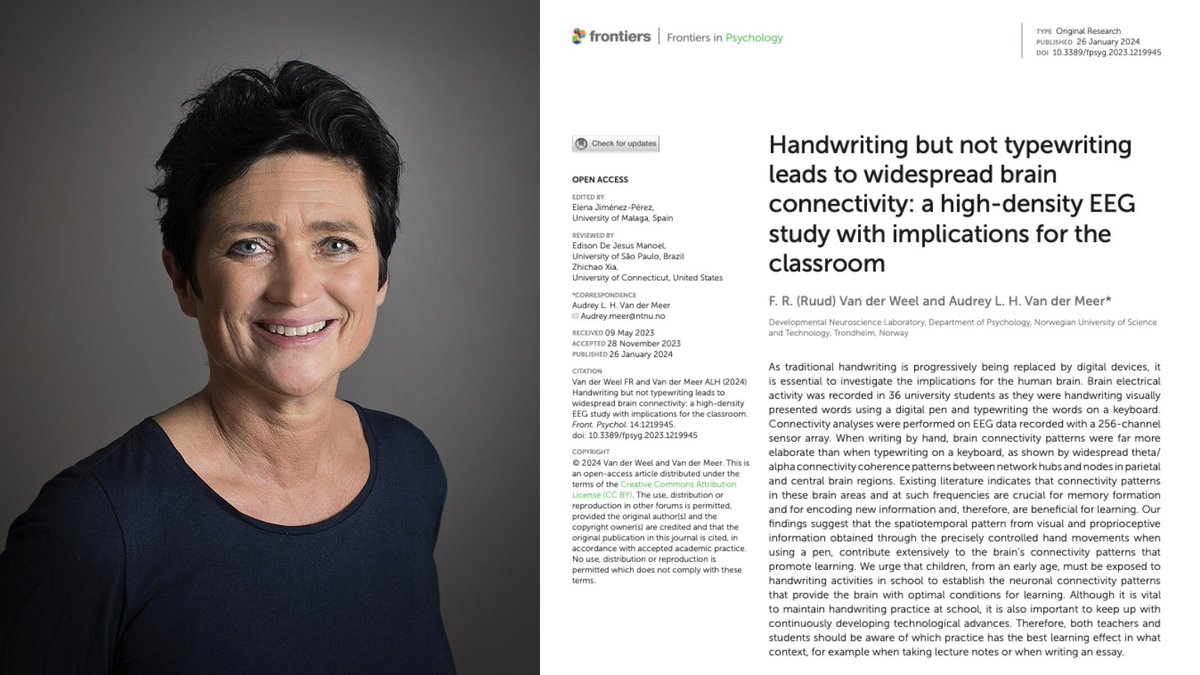
A Norwegian neuroscientist spent 20 years proving that the act of writing by hand changes the human brain in ways typing physically cannot, and almost nobody outside her field has read the paper.
Her name is Audrey van der Meer.
She runs a brain research lab in Trondheim, and the paper that closed the argument was published in 2024 in a journal called Frontiers in Psychology. The finding is brutal enough that it should have changed every classroom on Earth.
The experiment was simple. She recruited 36 university students and put each one in a cap with 256 sensors pressed against their scalp to record brain activity. Words flashed on a screen one at a time.
Sometimes the students wrote the word by hand on a touchscreen using a digital pen, and sometimes they typed the same word on a keyboard. Every neural response was recorded for the full five seconds the word stayed on screen.
Then her team looked at the part of the data most researchers had ignored for years, which is how different parts of the brain were communicating with each other during the task.
When the students wrote by hand, the brain lit up everywhere at once.
The regions responsible for memory, sensory integration, and the encoding of new information were all firing together in a coordinated pattern that spread across the entire cortex. The whole network was awake and connected.
When the same students typed the same word, that pattern collapsed almost completely.
Most of the brain went quiet, and the connections between regions that had been alive seconds earlier were nowhere to be found on the EEG.
Same word, same brain, same person, and two completely different neurological events.
The reason turned out to be something nobody had really paid attention to before her work. Writing by hand is not one motion but a sequence of thousands of tiny micro-movements coordinated with your eyes in real time, where each letter is a different shape that requires the brain to solve a slightly different spatial problem.
Your fingers, wrist, vision, and the parts of your brain that track position in space are all working together to produce one letter, then the next, then the next.
Typing throws all of that away. Every key on a keyboard requires the exact same finger motion regardless of which letter you are pressing, which means the brain has almost nothing to integrate and almost no problem to solve.
Van der Meer said it plainly in her interviews.
Pressing the same key with the same finger over and over does not stimulate the brain in any meaningful way, and she pointed out something that should scare every parent who handed their kid an iPad.
Children who learn to read and write on tablets often cannot tell letters like b and d apart, because they have never physically felt with their bodies what it takes to actually produce those letters on a page.
A decade before her, two researchers at Princeton ran the same fight using a completely different method and ended up at the same answer. Pam Mueller and Daniel Oppenheimer tested 327 students across three experiments, where half took notes on laptops with the internet disabled and half took notes by hand, before testing everyone on what they actually understood from the lectures they had watched.
The handwriting group won by a wide margin on every question that required real understanding rather than surface recall.
The reason was hiding in the transcripts of what the two groups had actually written down.
The laptop students typed almost word for word, capturing more total content but processing almost none of it as they went, while the handwriting students physically could not write fast enough to transcribe a lecture in real time, which forced them to listen carefully, decide what actually mattered, and put it in their own words on the page.
That single act of choosing what to keep was the learning itself, and the keyboard had quietly skipped the choosing and skipped the learning along with it.
Two studies. Two countries. Same answer.
Handwriting makes the brain work. Typing lets it coast.
Every note you have ever typed instead of written went into your brain through a thinner pipe. Every meeting, every book highlight, every idea you captured on your phone instead of on paper was processed at half depth.
You did not forget those things because your memory is bad. You forgot them because typing never woke the part of the brain that would have made them stick.
The fix is the thing your grandmother already knew.
Pick up a pen. Write the thing down. The slower road is the faster one.
And what happens if the West fails to correct course?
1. The standard becomes a weapon, not a principle. A moral framework applied to only one civilization stops being morality and becomes a targeting system. Every Western country and every ally identified as "Western-adjacent," Israel first among them, gets judged by rules no one else has to follow. The framework doesn't collapse from the contradiction. It just keeps firing in one direction until the target is gone.
2. Demographics decide what argument couldn't. Civilizations that believe their own existence is illegitimate don't reproduce, don't defend their borders, and don't transmit their values to the next generation. Europe is already living this. The population that replaces them will not inherit the guilt framework. It will inherit the institutions, and use them for entirely different purposes.
3. The Jews go first, and then everyone else. This is the pattern, and it is old. The delegitimization of Jewish indigeneity is never the endpoint; it's the test case. Once "you don't really belong here" works against the people with the longest documented claim to a specific land, it works against anyone. Europeans in Europe. Americans in America. The argument is portable. It always was.
4. The civilizations that kept their nerve inherit the century. China is not auditing itself over Tibet or Xinjiang. Turkey is not reexamining Anatolia. The Arab world is not reopening the conquest of North Africa. Iran is not apologizing for anything. While the West litigates its own right to exist, civilizations that never accepted the premise will simply fill the space economically, militarily, demographically, narratively. History does not pause for one civilization's introspection.
5. The achievements get repudiated along with the sins. A civilization that accepts a wholly negative account of itself eventually loses the ability to defend anything it built, including the parts the rest of the world actually wants. Rule of law. Scientific method. Individual rights. Pluralism. Free inquiry. These are not automatic. They were built by specific people in specific places, and they can be unbuilt. A West that no longer believes it deserved to produce them will not long continue to produce them.
6. And the framework dies with the civilization that hosted it. Here is the final irony. The very concepts the critics use: human rights, indigenous rights, anti-colonialism, universal dignity are Western inventions. They exist nowhere else as enforceable norms. When the West loses the confidence to defend itself, those concepts don't transfer to the successors. They disappear. The critics are sawing through the branch that holds the only court that would ever hear their case.
The double standard isn't just unfair. It's terminal. A civilization can survive enemies. It cannot survive deciding that its own existence is the problem.
The window to correct this is not infinite. It may already be narrower than it looks.
So what would it actually take for Western society to drop the double standard?
1. End the monopoly on guilt. The West is the only civilization that built a moral vocabulary for examining its own sins and then handed that vocabulary exclusively to its critics. Either every civilization gets audited by the same rules, or none do. Asymmetric guilt isn't morality; it's surrender dressed up as virtue.
2. Restore the universities. The framework that produced this double standard was built in humanities and area-studies departments over fifty years. It won't unbuild itself. It requires hiring committees, tenure decisions, curricula, and funding sources that reward honest comparative history rather than activist conclusions dressed as scholarship. That's a generational project, not a tweet.
3. Tell the rest of the story. Most Westerners genuinely don't know that Arabs conquered an empire stretching from Spain to India, that Turks displaced the Christian populations of Anatolia, that the Bantu expansion absorbed entire peoples, that Islamic slavery ran for twelve centuries and trafficked more Africans than the Atlantic trade. None of this is hidden. It just isn't taught. Mainstream history education has to stop ending the conquest chapter in 1945.
4. Reward intellectual courage. Right now, an academic, journalist, or politician who points out the selective application of "colonizer" pays a career cost. Someone who applies it conventionally pays none. Until that incentive structure flips, until not asking the obvious questions becomes the reputational risk, the asymmetry will reproduce itself automatically.
5. Recover confidence. A civilization that believes its own existence is a crime cannot apply standards evenly, because the conclusion is fixed before the analysis begins. Self-criticism is a strength. Self-loathing is a pathology that masquerades as a strength. Telling them apart is the precondition for everything else.
6. Accept that some allies won't like it. Honest comparative history will offend regimes the West currently treats as untouchable. Not just adversaries, but partners. Real intellectual consistency has a foreign-policy cost. The current double standard exists partly because that cost has been judged too high to pay. It isn't.
None of this happens by accident, and none of it happens quickly. Civilizations don't reform their moral vocabulary in an election cycle. But the alternative is a West that keeps applying its own highest standards exclusively to itself, until eventually it doesn't have the strength to apply them at all.
@KablamoJones@OzzyJellyEllie@Independent_ie Historically, Jews in Europe were only ever treated by the Christian majority as indigenous to the Levant & foreigners to Europe. Judaism & Hebrew are indigenous to the Levant.
G. Meir famously had at one time herself as a Palestinian. That last sentence is a false equivalence.
@PSCupdates Just FYI: The key figure associated with Coca-Cola operations in the West Bank is Zahi Khouri, a Palestinian-American entrepreneur who is a major local employer. Hundreds of Palestinian employees work at Coca-Cola's factories and distribution centers in the West Bank and Gaza.
@derJamesJackson If the Balfour declaration had been fulfilled and the 1937 Partition Plan accepted by the Arabs, or the British hadn't prevented immigration of Jews to try to appease Levantine Arabs, potentially millions of lives could have been saved from the Holocaust, including Anne's.
Yesterday, the world lost an outstanding physicist and a truly remarkable human being.
I first met Nuno a few years ago. He had studied physics at the same university I attended in Lisbon, and we were introduced by a mutual friend.
During a later visit to Boston, I reached out to see if he might be available to meet. Despite his recent promotion to Director of the Plasma Science and Fusion Center at MIT, and an understandably packed schedule, he did not hesitate to say yes.
I expected perhaps 15 minutes of his time in a hallway. Instead, the meeting turned into a 3-hour masterclass. Between cups of coffee and a flurry of back-of-the-envelope calculations, he gave me an unforgettable tour of the MIT fusion lab.
Nuno was one of those rare scientists who mastered his field so deeply that he could distill the most complex ideas into simple, elegant terms. Even as a world-class expert, he never forgot what it feels like not to know something; he could guide you up the "ladder of knowledge" step by step - a gift that reminded me of the greats, like Feynman.
His enthusiasm for the future of fusion was truly infectious. He had a rare blend of entrepreneurial drive and scientific rigor. I was so inspired that I remember ordering 4 books on the subject before I even got back to my hotel.
To the community of young Portuguese physicists, Nuno was a rare "local hero". He was a role model we could truly relate to - someone who once sat in the very same classrooms we did and proved that it was possible to reach the absolute pinnacle of the field.
Thank you, Nuno. You will be deeply missed. Rest in peace.