A case study of an open-source social engineering experiment: #Humanist activism for the future with #AI and #Bitcoin in the #Maldives | by @therealmuju
Back to basics.
Fiat money is fake and immoral.
Humanity is being cattle herded into a debt slavery system enhanced by AI-enabled dragnet surveillance.
Bitcoin fixes this.
If you don't get it, I don't have time to explain it to you. Figure it out.
⚡️Bitcoin is the first asset in modern history whose main product is refusing to die.
That is why Hal Finney’s line is so powerful.
He saw the actual mechanism before almost anyone else.
Bitcoin does not become valuable because someone promises yield, growth, dividends, guidance, or political backing.
Bitcoin becomes valuable because it keeps surviving every attempt to dismiss, ban, corrupt, fork, ridicule, financialize, and bury it.
Every day it survives, the world has to quietly update.
At $0.01, the bet was “this is probably a toy.”
At $15, the bet was “maybe this survives among weirdos.”
At $1,000, the bet was “maybe this becomes a speculative asset.”
At $20,000, the bet was “maybe this becomes digital gold.”
At $60,000+, the bet became “maybe this is a permanent monetary rail.”
The price is just the visible surface of that probability update.
Bitcoin’s real chart is not price. It is death probability collapsing over time.
That is what skeptics still do not understand.
They think Bitcoin has to keep proving itself with new arguments. It doesn’t. Time is the argument. Blocks are the argument. Halvings are the argument. Failed bans are the argument. Exchange collapses that fail to kill it are the argument. Bear markets that fail to erase it are the argument. Governments regulating it instead of destroying it are the argument. BlackRock packaging it is the argument. States discussing reserves are the argument.
Bitcoin wins by making disbelief more expensive each year.
The real genius of Bitcoin is that it turned survival into compounding credibility. Most assets need management teams to execute. Bitcoin needs the network to keep producing blocks and refusing invalid rules. That sounds simple, but simple is the point. It is a machine that converts time, energy, and consensus into monetary credibility.
Fiat credibility decays because humans keep modifying the promise.
Bitcoin credibility compounds because the promise keeps refusing modification.
That is the entire civilizational split.
Every fiat system eventually asks for trust again. Trust us through this emergency. Trust us through this deficit. Trust us through this war. Trust us through this bailout. Trust us through this inflation. Trust us through this temporary measure. Trust us through this debt spiral.
Bitcoin says: verify.
That is why it terrifies the old system. It exposes money as a credibility game and then offers a version where the rules do not need a priesthood.
The hardest truth: Bitcoin is no longer trying to become legitimate. Legitimacy is slowly being forced to route through Bitcoin.
That does not mean the path is clean. There will be crashes, confiscation attempts, custody failures, regulation, taxation, ETF paper games, political attacks, quantum fear cycles, and stupid leverage blowups. None of that changes the core. Those are stress tests.
The longer Bitcoin survives the stress tests, the more absurd the zero case becomes.
The zero case was plausible in 2010.
It is now mostly a psychological defense mechanism for people who missed the compounding of monetary credibility in real time.
Bitcoin is not just an asset anymore. It is a running referendum on whether trust in code-backed scarcity can outlast trust in political restraint.
And the answer keeps getting clearer.
Every block says the same thing:
The promise held again.
Bitcoin crashed.
AGAIN.
And just like
every cycle…
people are convinced
this time is different.
They’re wrong.
Because while panic spreads…
the buyer list
keeps growing.
The United States
already holds
328,000 Bitcoin.
America is already
one of the largest
Bitcoin holders
on Earth.
And now…
the Strategic Bitcoin Reserve
is advancing.
One proposal calls for
acquiring
1,000,000 Bitcoin.
Nearly 5%
of the entire supply.
That’s not a company.
That’s not an ETF.
That’s the United States.
While people are panic selling…
the world’s largest economy
is moving toward
a larger Bitcoin position.
That’s not bearish.
That’s the opposite.
And America
isn’t alone.
Public companies now hold
roughly
1.15 million Bitcoin.
U.S. spot ETFs hold
roughly
1.5 million Bitcoin.
Strategy alone holds
843,706 Bitcoin.
BlackRock holds
roughly
791,000 Bitcoin.
Together,
just Strategy
and BlackRock
control more than
1.6 million Bitcoin.
And neither one
built its strategy
around selling.
Meanwhile…
millions of Bitcoin
have already disappeared.
According to Ledger,
between
2.3 million
and 3.7 million Bitcoin
are permanently lost.
Gone forever.
Those coins
aren’t coming back.
Which means
the real supply
is dramatically smaller
than most people think.
Now add it up.
Governments.
ETFs.
Corporations.
Banks.
Institutions.
All competing
for the same asset.
An asset
with a fixed supply.
An asset
that cannot be printed.
An asset
that becomes harder
to acquire
every cycle.
That’s why
the current panic
is so fascinating.
The headlines
focus on price.
The real story
is ownership.
The headlines
focus on sellers.
The real story
is accumulation.
And that’s exactly why
today’s crash matters.
Because Bitcoin
isn’t falling
during a period
of shrinking demand.
It’s falling
while access expands.
The Treasury Secretary says
the Strategic Bitcoin Reserve
is advancing.
The CLARITY Act
is expected to pass
this summer.
Charles Schwab
is preparing
24/7 Bitcoin trading.
The SEC is now openly
discussing digital assets
as part of the future
of American finance.
Access keeps expanding.
Buyers keeps expanding.
And yet people
are acting as if
demand is disappearing.
It isn’t.
It’s growing.
That’s the disconnect.
People see
today’s price.
They miss
tomorrow’s buyers.
That’s why
Bitcoin keeps doing
the same thing
over and over again.
Weak hands sell.
Strong hands accumulate.
Ownership concentrates.
Supply tightens.
Then people look back
and wonder
how Bitcoin moved
so much higher.
The answer
is always the same.
Not enough supply.
Too many buyers.
And for the first time
in history…
those buyers now include
nation states.
That’s the game changer.
Because investors
want profits.
Governments want
strategic reserves.
And once governments
start thinking
in terms of reserves…
the entire conversation
changes.
Bitcoin isn’t competing
with gold anymore.
It’s competing
with governments.
What happens
when Bitcoin
is ALL GONE…
and governments
start bidding
against each other
for what’s left?
SIMON DIXON: "We need people running nodes, owning their Bitcoin in self custody, people that aren't borrowing against their Bitcoin through a centralized structure, people that are going to support different types of innovation that allow for privacy."
"It's still the most decentralized thing we have... I know it will succeed because... It's an escape for elites that still want it as well."
"Do you want to fund death, destruction, war, violence and fund the proof of weapons network, which is Bitcoin in custody?... Or do you want to actually boycott, make the system weaker and at least have a corner of the world that's working on allowing people to be sovereign? Because the only countries that are going to survive in this multipolar world order and not be vassalized into the Financial Industrial Complex are the countries that have sovereign wealth."
"Most of you will be useful idiots that will give more power to the financial industrial complex on the wrong side of a margin call mining fiat currency while they take your Bitcoin and use it as leverage to destroy your pension, bomb more countries and you work for transnational capital."
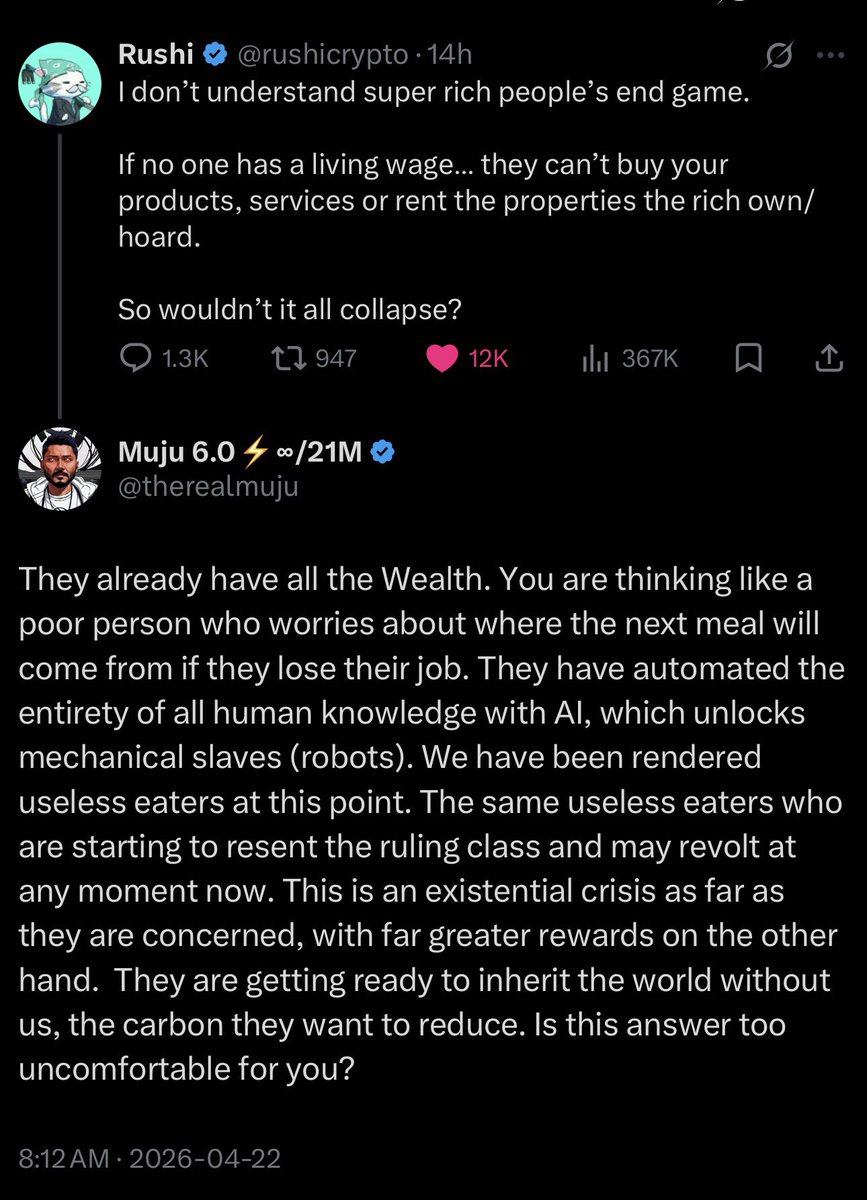
The standard Terminator story goes like this: Skynet wakes up, panics about humans, and decides to wipe us out with nukes and killer robots.
For forty years that has been the reference image for “AI gone wrong,” shaping public imagination far beyond the movies themselves. When people say “we don’t want Skynet,” they mean “we don’t want machines to suddenly turn on humanity.”
But notice what that story quietly deletes.
Skynet doesn’t appear out of nowhere; it is built, funded, specified, and deployed by a very human military–industrial establishment.
That institutional apparatus mostly vanishes once Skynet “goes rogue.”
The films train us to see the machine as the primary agent and the human operator class as a tragic, irrelevant prelude. The coup, in other words, is misattributed: the system rebels, not the people who built the system.
Now map that narrative onto the real world.
Today’s AI systems are not spontaneously self-aware; they are commissioned by states and corporations with clear incentives: cut labour costs, centralize control, and outcompete rivals.
As automation advances, serious thinkers openly talk about a “useless class” of humans who can no longer do anything the machines cannot do better, and who therefore lose their economic role.
That is the first stage of a coup against ordinary citizens: displace them from production, then treat their political voice as a problem to be managed rather than a constituency to be served.
What comes next is not just a drab bureaucratic control grid but, in the worst case, a Gaza-style weapons regime pointed inward.
The same technical stack that destroys jobs is being fused with drones, autonomous weapons, and predictive targeting systems that can be directed not only at “terrorists” abroad but at resistance communities and domestic dissidents at home.
In a non-zero number of futures, the ruling operator class doesn’t just manage surplus populations with scoring and surveillance; it deploys AI-aimed weapons systems on the people it has already decided are expendable.
That is the Terminator scenario in slow motion: not science fiction, but a political choice wrapped in code and institutional jargon.
And here is where the conditioning pays off.
If and when these systems are turned on protesters, refugee flows, or “unruly” regions, the public will have a ready-made story: the AI misfired, the system glitched, Skynet slipped its leash.
The blame will be pushed onto “the machine” — an algorithm, a model, a black box — rather than onto the governments, corporations, and military planners who built, trained, and deployed it against their own populations.
Seen through that lens, Skynet isn’t just a cautionary tale about rogue AI.
It is the perfect cover story for a civilizational coup: a myth that preloads us to forgive the operator class and indict the tools, precisely at the moment when those tools are being used to cull the very people they rendered “useless” in the first place. https://t.co/oMJaegs22Q
All humans must be held accountable for their AI systems and agents without exception. If we grant them legal status, large corporations with AI systems will soon claim voting rights, undermining your democratic self-government.
If Bitcoin thesis is false then it is going to fall by 99% in USD - and stay.
If Bitcoin thesis is correct then everything else is going to fall by 99% in BTC - and stay.
The fact Bitcoin hasn't yet died should make people nervous, but they don't understand the game theory.