A Linux server can be patched, restarted and still remain under an attacker's control
Microsoft found threat actors installing GSocket on compromised servers to preserve remote access after the original web application vulnerabilities had been fixed
GSocket is an open-source remote access tool that uses a shared public relay network
Here's what makes it difficult to track
The compromised server and the attacker both establish outbound connections to the Global Socket Relay Network
A shared secret lets the attacker reconnect to the server through that relay without knowing its IP address or hostname
There is no dedicated attacker-controlled C2 server to identify and block
The deployment can also disguise its process, hide files in memory-backed directories and establish persistence through cron jobs, systemd services and shell profiles
Microsoft observed GSocket-related detections increasing 356.2% between March and August 2026
Web applications and hosting environments accounted for 87.1% of attributable incidents, with PHP applications, cPanel hosting and Apache heavily represented
In a few incidents, attackers also attempted to exploit the Linux kernel's Dirty Frag (CVE-2026-43284) to escalate from the web server's account to root
This is why patching an exploited application is not the same as recovering a compromised server
You still need to investigate what ran after the initial breach, remove persistence, hunt for unauthorized remote access and verify that the attacker can no longer reconnect
I'm revisiting Microsoft Sentinel and documenting the process in a new blog series.
Part 1 covers deploying Sentinel through the Microsoft Defender portal and getting started with sample data.
#MicrosoftSentinel#Azure
https://t.co/9gOMi6WypD
Buying tools is the biggest trap in cybersecurity. Vendors know it and they prey on the uninformed to pad their wallets.
If you’re a IT Manager, Director, CISO or similar, this is what I recommend instead. (Bookmark/save this to refer back to it later)
1) Identify & document the problem you’re trying to solve.
If you can’t describe it without using tool names in your answer you don’t fully understand the problem.
This is literally the MOST important part. Yes it takes more than 5 minutes to flush this out.
Don’t do this alone either. That brings me to the next step.
2) involve stakeholders
I know some IT/security people want to think they’re the most important person in the room but chances are your business is not cybersecurity.
That means something else keeps the company going. Customers, clients, agents, insurers, patients, etc.
If you buy a tool that impacts stakeholders outside IT and it’s the first time they are hearing or seeing it, there will be frustrations as a result.
The best time to involve stakeholders is at the beginning, during the planning stages.
Continue reading steps 3-6 here 👇
https://t.co/hLQiNzYWUy
Stumbled across this today. Probably been there forever.
In Entra / External Identities under Lifecycle Management
Although it's presented as a Terms of Use for access to Admin portals, I'm leveraging it to force acceptance of our orgs IT Acceptable Use Policy every 180 days by targeting all Cloud Apps and excluding mobile devices.
Don't forget to exclude your glass break. Your users will also see it on their My Account page under Settings & Privacy.
https://t.co/0yczSBWYO5
@NathanMcNulty@ITguySoCal
TRACKED CHANGES: Law firm innovation chiefs left a private meeting with Anthropic unimpressed, per Bloomberg Law. “They need to wake up,” one said, citing two major dealbreakers: no hands-on training support and a minimum spend requirement just to negotiate custom privacy terms.
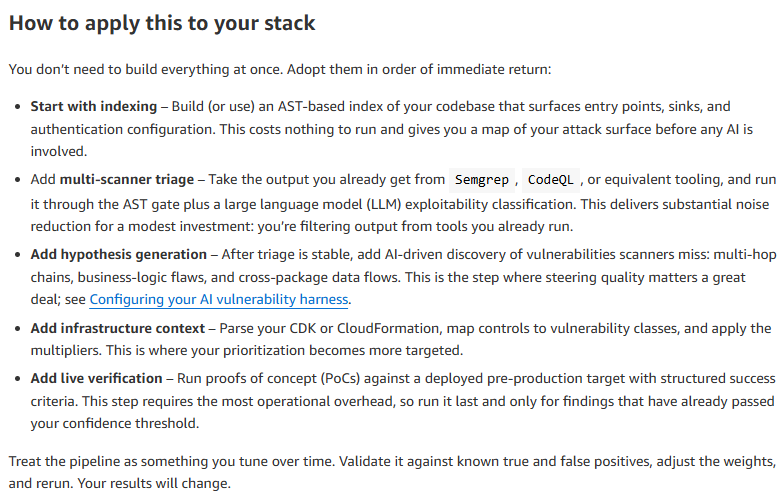
🪢 AWS Security Team's Writeup On Building your AI Vulnerability Harness
Part 1: https://t.co/nKk1AP6AXi
Part 2: https://t.co/NOUEKzdjax
Author: Nidhi Ramakant, Ievgeniia Ieromenko, and Justin Kontny