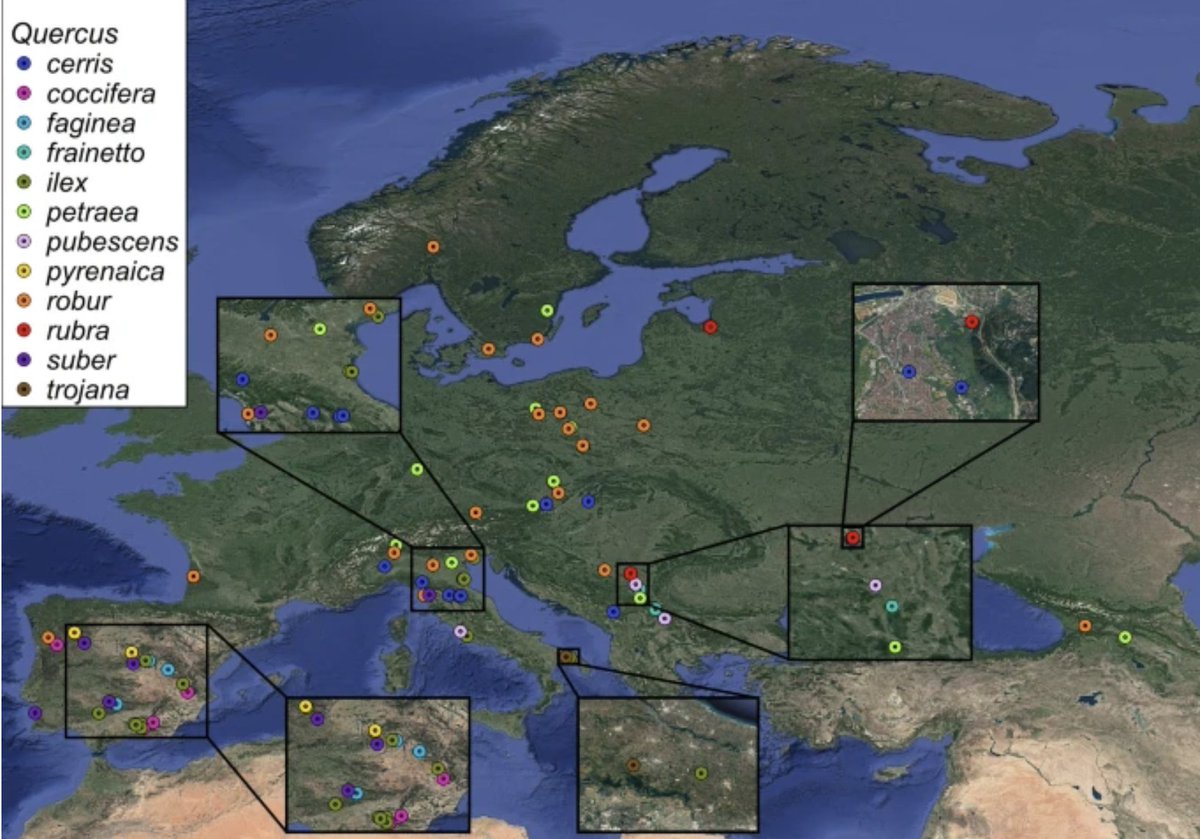
Improving the success of #Quercus forest ecosystem restoration 🌍 A collaborative European experiment. Coordinated at @canalugr @iista_es. Funded by @CienciaGob
🌳 This collaborative field experiment explores the seeding vs. planting dilemma for #Quercus along environmental gradients through an international network of participants, contributing to knowledge for improving #forest ecosystem restoration.
#ecologicalrestoration
NEW! You can now view the documents where we explain all the tasks carried out by our participants during the project. Take a look in the “Project brochures (communication with participants)” section: https://t.co/QMus6Lb8Bu
Today is the UN's International Earth Day. At Seeding vs. Planting, we continue to research more effective reforestation strategies that will help us improve the health of our planet and keep the Earth a healthy place for everyone. #UNDecadeofRestoration#ForestRestoration
There are approximately 500 species of the genus #Quercus. Although there are only about 22 species in #Europe, they occupy a large part of the continent and we are working with half of them. Take a look!
Did you know that the #Quercus genus has a great capacity for #resprouting? #Herbivory or fires don’t have to be lethal for these great survivors. In fact, in some contexts, #fire can give them some advantages 🔥
In Granada, mild temperatures and rain have already given us work in the field. Here is a plot with Holm oak (Quecus ilex) from cohort B, recently cleared of herbaceous plants.
We are still working on our database. In the meantime, here is a survey about the results. Do you think there will be significant differences in survival between seeding and planting?
Since the publication of the experiment protocol in 2021 #PlosOne, our team has produced 6 posters, 5 talks, 3 seminars, 1 database and its associated data-paper #AnnalsForestScience. You can see it all here: https://t.co/QMus6Lb8Bu
Acorn origin and characteristics define the viability of individuals. Thanks to the rigorously collected data from our participants, we created an open-access database on acorn germination potential. Please use it!: https://t.co/dfgZraVgNp
Want to know more about the 45 sites where this experiment is being replicated in 15 countries? Check out our gallery and meet our participants: https://t.co/CvGbmh3iwq 🌍
#EuropeanExperiment#Collaboration#FieldExperiment
Prior to #StatisticalAnalysis, we’re working with the database to check that:
No data is missing ✅
Measurements are in the correct units ✅
There are no anomalous data ✅
We are already receiving samples and temperature loggers from cohort A. We trust that such environmental data will in part explain plant responses and help us improve the capacity to test treatment effects.
Happy New Year from the Seeding vs. Planting team!
We have some good news to start the year 📢📢
We have received almost all the data from the first cohort, a great database from which we expect great results!
Seed germination is a key process for forest regeneration. We measured seed batch germination potential in 12 oak species –now available as a data paper. Feel free to use and share the data!
Well done @BioMery_ @seedvsplant
https://t.co/Z3ca6Sk6h8
🌱In these photos from our experimental site in Albacete, you can see the current state of our planted and sown #quercus: some thriving, others lost. Every observation and data point, from survival to mortality, is valuable to our #forest restoration #research.
🌿 When we went to take measurements in Aveiro, Portugal, near our experimental plot, we found this oak #Quercus growing in the middle of a rocky slope. Life always finds its way! 💪 #Resilience
🌱 Here’s Maria and Marino in Bragança, Portugal, measuring #photosynthesis with Li-cor 6800. Fieldwork like this helps us understand the performance of #oaks after restoration practices. 📊 #ForestResearch
🔥 What can we learn from unexpected events at field experiments? At our field site in Aveiro, Portugal, a fire burned our oaks and data loggers. Adversity or opportunity to address new questions? 🌳 #ForestResearch#Resilience
Lucky us! Olivia Lorente Casalini is joining our team with a COST Virtual Mobility Grant to meticulously review the databases for our European experiment and help prepare them for analysis.🌟 #ResearchTeam#DataAnalysis#Welcome
@BioMery_ presenting preliminary data on a seeding vs planting experiment at the PEN-CAFoRR Cost Action final meeting in Belgrade last week. Just wait for the final paper!