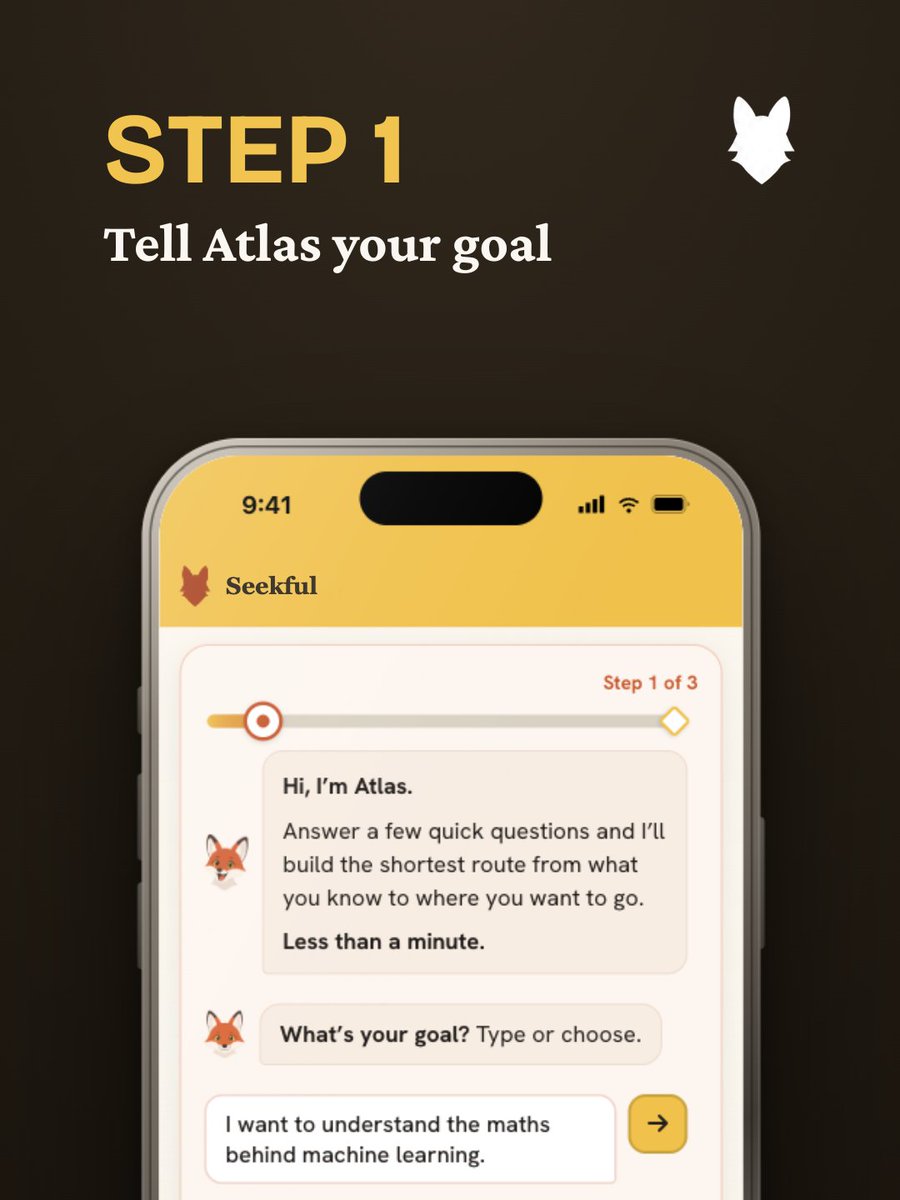
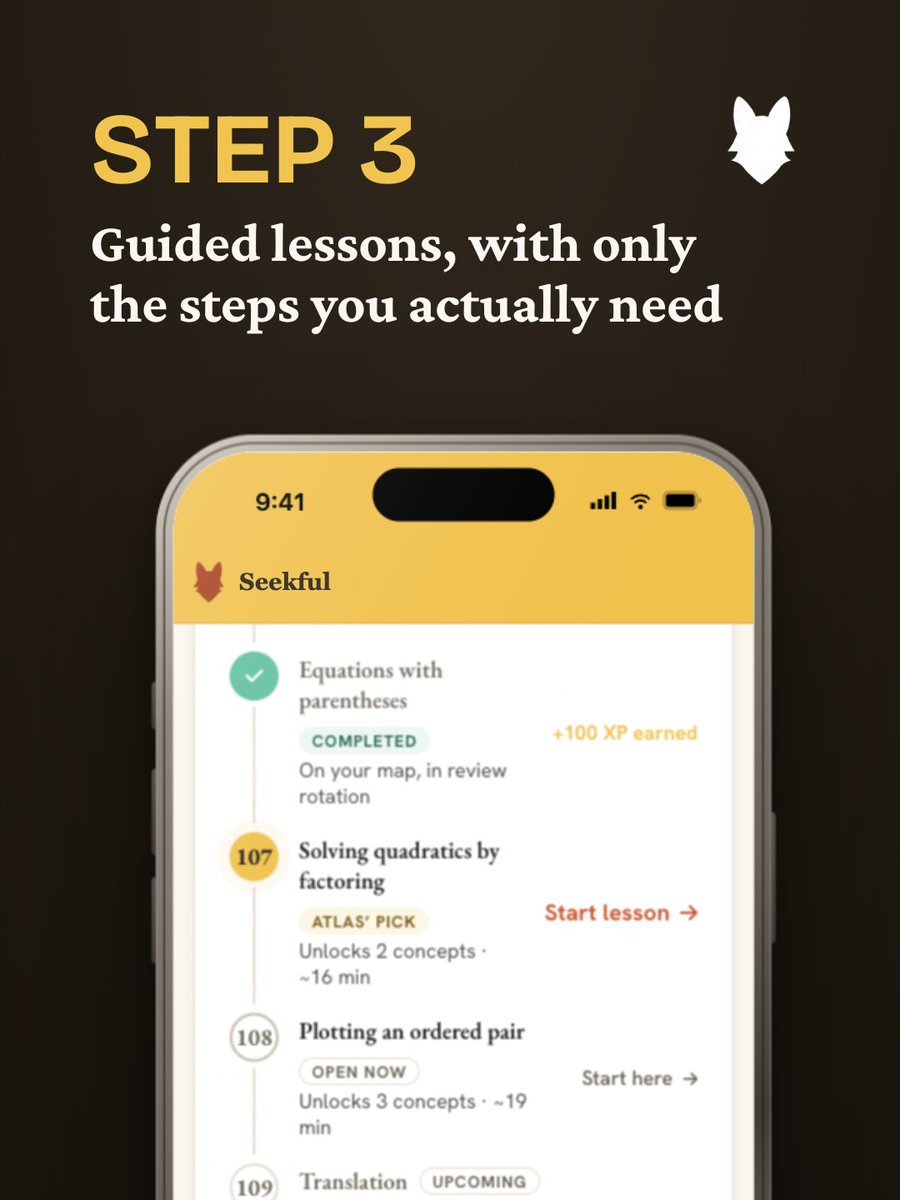
Tell Atlas your goal.
He maps the maths you already know, finds the prerequisite gaps holding you back, and builds the shortest route through only what you actually need to learn.
Your path through maths, built around you. 🦊
Why not both, Chris? :)
There’s good evidence that gaming can support things like spatial ability, visual attention and cognitive control.
I personally think the focus should be on letting kids play, while encouraging that curiosity to spill into the real world. Why does the car grip, skid or accelerate the way it does? Maths and physics give them the tools to keep following those questions.
Play and learning can, and should, reinforce each other.
@just_tanyaaa 100%. Maths is one of the easiest ways to give your brain a bit of resistance every day.
Even 10 focused minutes of solving something on Seekful beats another 10 minutes of passive scrolling.
This is basically the anti-brainrot thesis behind Seekful.
10 minutes a day of actually solving, recalling and thinking > another 10 minutes of scrolling.
You don’t need to become a mathematician. Just keep giving your brain something difficult to do.
https://t.co/gpVJApPgv3
@everfreebeing Relearning from scratch can be great. But chances are you don’t actually need to start at zero.
Better to figure out what stuck, where the gaps are, then rebuild from there.
That’s basically what we made Seekful for.
The biggest trap in maths is thinking recognition = understanding.
Seeing a solution and following it feels good. Rebuilding it yourself is where you find out what actually stuck.
That’s a lot of what we’re building Seekful around: solve, retrieve, get things wrong, come back later.
@janey_wayney13 0 👀
Also love the daily brain training angle. Maths is one of those things where a little practice compounds surprisingly fast, especially when you understand the method instead of just memorising answers.
A big part of why we’re building Seekful.
The underrated part of maths is learning that confusion isn’t failure. It’s usually just the point before something clicks.
That shift changes how you approach almost everything difficult.
A lot of what we’re building Seekful around is helping people stay in that gap long enough to actually understand what comes next.
@normalmadeline Most 'bad at math' is really one missing step from years ago that every later topic leans on. Go back, find that step, master it, and STEM gets a lot less untouchable. That's exactly the gap we built Seekful to find.
@babybeginner Geometry often gets taught as facts to accept rather than questions to answer. Once you see the problem each idea was invented to solve, it's the most visual part of mathematics. That's why at Seekful we start from the problem, not the theorem.
@fermatslibrary That quote is the case for learning in order. Seekful maps mathematics as 1,424 concepts and the 2,812 prerequisite links between them, because the links are what turn a heap of facts into a house.
@pickover The best bit is the order: he was counting rhythms, not chasing a famous sequence. The question came first and the math followed. That's the order we keep at @seekfulorg: start from something you want to understand, then learn the steps it actually needs.
@winexviv The line that stays with me: intelligent children who can't do basic mathematics. That's almost never ability. It's usually one step from years back that nobody went back for, and everything after it gets built on sand. Find the gap, fix it, and they move fast.
Most people who hate maths don’t hate maths. They hate the feeling of being lost in a subject where every new idea depends on three older ones nobody noticed they missed.
Fix the missing layer and maths suddenly feels very different. That’s basically why we built Seekful. G'day to you too, Kay!
@danysvnt Understanding is the bit nobody can hand you. You build it by recalling and using ideas yourself; anyone's explanation, human or AI, only gets you the first pass.
@birdxi1988 3 copies at half the size each step, so the dimension is log 3 / log 2 ≈ 1.585. Somewhere between a line and a surface, which is a lovely thing to work out by hand.
@MattRhoads1990 That's the asymmetry. AI speeds up people who already know the content because they can check it. Learners can't, so the effort of recall has to stay with them.
@ItzMeteoni The restrictions feel arbitrary because they're stripped of context. Most come from real counting problems: passwords, schedules, network routes. Nobody shows you that bit.
@beresearcher_ You need less math for data science than people fear: basic statistics, some probability, a bit of linear algebra. Learn each when a project needs it and it sticks much better.
@ellewschool Start one step below where it feels hard. take a problem you need to solve, list what it uses, and check each piece on its own. Fix the first shaky one, then move up. a little every day beats long sessions. Check out Seekful for this :)