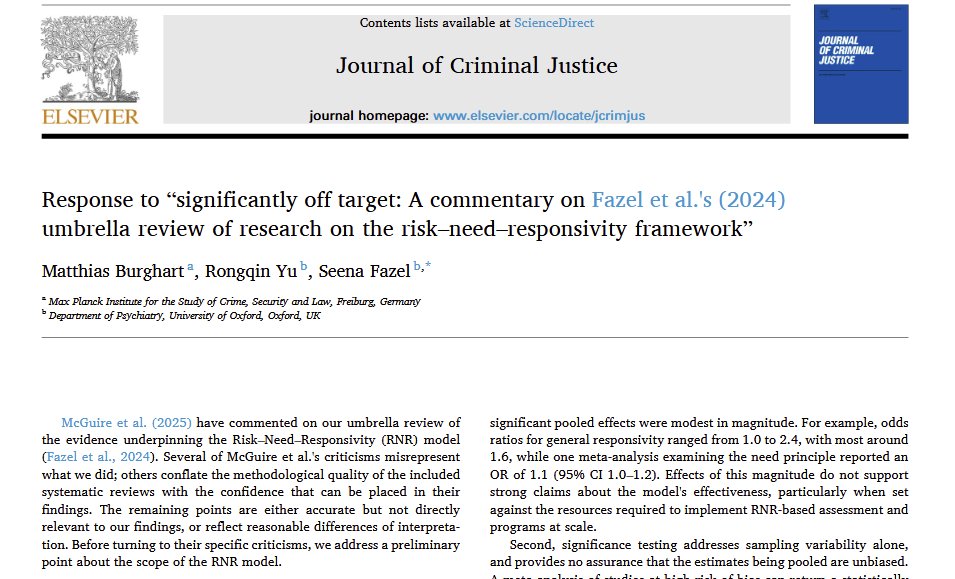
1/6 Scientific disagreement is a good thing. But criticism should accurately represent the work being criticised. We have published our response to a commentary on our umbrella review of the evidence behind the Risk–Need–Responsivity (RNR) model. #criminology#CrimTwitter
Researchers gave 2,000 unemployed people €560/month for two years and tracked them to see how they differed from otherwise eligible nonrecipients.
They didn't do any more or less crime. Nothing changed.
Forensic Psychiatry Research Society annual meeting on 16 November (10am-5pm) at Pembroke College, Oxford.
New research presentations in morning; risk assessment masterclass in afternoon (focus on methods and systematic reviews)
To register and book: https://t.co/QTPz0kjhVI
Our response to the critique of our RNR umbrella review. The title of McGuire et Al’s critique, ‘Significantly off target’, is perhaps more apt than intended, given how much weight it places on statistical sign. Not quite nominative determinism but not miles away.
1/6 Scientific disagreement is a good thing. But criticism should accurately represent the work being criticised. We have published our response to a commentary on our umbrella review of the evidence behind the Risk–Need–Responsivity (RNR) model. #criminology#CrimTwitter
1/6 Scientific disagreement is a good thing. But criticism should accurately represent the work being criticised. We have published our response to a commentary on our umbrella review of the evidence behind the Risk–Need–Responsivity (RNR) model. #criminology#CrimTwitter
Our conclusions are unchanged: some evidence supports components of RNR, but its quality, consistency and transparency are limited. Until higher-quality evidence exists, we do not think RNR should be introduced into new jurisdictions.
Original review #OA: https://t.co/1OAjDqBxUA
Performance good across discrimination + calibration 👇
Next steps include external calibration and examining clinical utility.
Limitations - potential predictors not available (e.g. impulsivity, symptoms, family support), underreporting of self-harm.
New paper! On self-harm risk after traumatic brain injury (TBI).
Development and internally validation of a clinical prediction model for self-harm after adolescent TBI.
Using population-linked health records on >34k people. 1/4
New findings on risk factors.
Comorbidity with psychiatric condition strong effect - highlights importance of liaison w/ mental health services.
Notable difference with other populations in effect of previous self-harm. Clear example of where multivariable models add value.
Forensic Psychiatry Research Society annual meeting on 16 November (10am-5pm) at Pembroke College, Oxford.
New research presentations in morning; risk assessment masterclass in afternoon (focus on methods and systematic reviews)
To register and book: https://t.co/QTPz0kjhVI
Excellent study - high quality qualitative work that complements accuracy studies for suicide risk assessment models.
And rarely done in the field despite lots of expert opinion that seems mostly anecdotal
New paper out in BMJ Mental Health (https://t.co/Mu5vZOPdvI) looking at clinicians’ perspectives on OxSATS (https://t.co/329WS67HJK), a suicide risk assessment tool designed for use after self-harm presentations to healthcare.
Many men already known to services and present with overlapping risk factors, incl. alcohol misuse, psychiatric disorders, gambling-related harm, and criminal justice involvement.
Open access: https://t.co/mkXCNkONnV