The big world hypothesis (Javed & Sutton 2024) is the idea that no matter how large and complex our algorithms get they will always be small compared to the world they interact with. A consequence of the big world hypothesis is that learning algorithms that are computationally efficient have an advantage over expensive algorithms.
I hadn't seen a concrete consequence of the big world hypothesis in the LLM stacks until last week, when someone mentioned that they have switched to RMSProp over Adam for training because it has fewer parameters and allows them to use a larger model.
It’s a mistake to think that increasing the efficiency of learning algorithms is not valuable just because computation keeps growing. More efficient algorithms will unlock many use cases that are not possible with current algorithms.
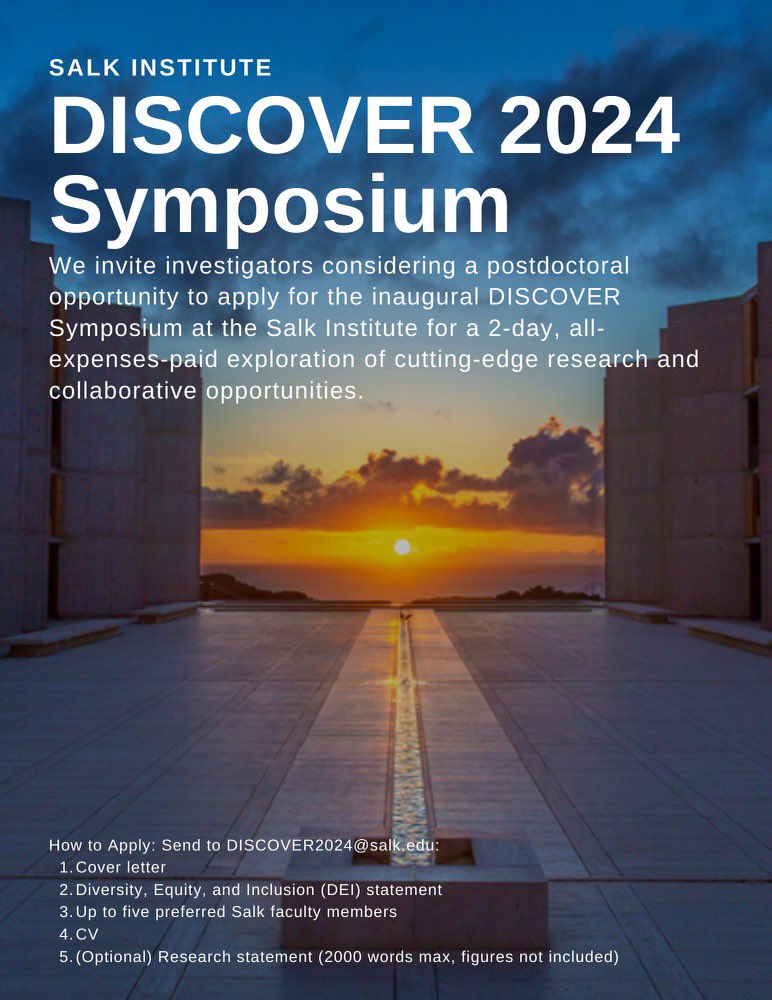
Thrilled to announce the launch of our pilot run for the inaugural DISCOVER Salk Postdoc Symposium, where we invite potential postdocs to visit @salkinstitute, meet faculty, take lab tours, join career development workshops and seed new collaborative opportunities that would be beyond a traditional postdoc interview — with the aim of supporting a diverse, equitable and inclusive training environment.
Thrilled to announce that I have completed my PhD in Neuroscience from McGill University. I am truly grateful to all my colleagues, friends and family for their support during four years of PhD.
If you are in DC for #SfN23. Stop by my poster tomorrow at 1 -2 pm to hear some exciting results on the role of Bdnf pathways in Smith-Magenis syndrome. Session Number: PSTR004
Presentation Number: PSTR004.05
Session Title: Molecular Mechanisms of Neurodevelopmental Disorders I
We're excited to be exhibiting at #SfN23! Be sure to stop by booth #339 where our team of epigenetic experts will be ready to share insights and cutting-edge solutions to help fuel your research.
📣 New to #SfN23!
Are you an early career neuroscientist with questions about professional development and training?
Join a lively conversation w/ top neuroscientists where no question is off-limits!
Spaces are limited! Learn more and register now.
🔗 https://t.co/6cD9afxDgP
At #SfN23, Bosiljka Tasic, Director of Molecular Genetics, will present "A suite of transgenic and enhancer AAV tools for targeting neural cell types in the cortex".
📆 Nov. 11, 1:15-1:30pm
📍 WCC 147B
More on our @SfNtweets activities 👉 https://t.co/ZyJsuMbFnv
Our #SfN23 programming kicks off THIS WEEK at our satellite event! We'll demonstrate how to access the #openscience resources available from Allen Brain Map incl. datasets, analysis tools, taxonomies, and standards.
Learn more & register 👉 https://t.co/ZyJsuMbFnv
@SfNtweets
Excited for #SfN23@SfNtweets this year! Come by my poster this Sat., Nov. 11, 2023 1:00 PM - 2:00 PM. to know more about molecular mechanisms of neurodevelopmental disorders.
Here, we showed that Smith-Magenis syndrome protein RAI1 regulates body weight homeostasis through hypothalamic BDNF-producing neurons and neurotrophin downstream signalling
https://t.co/Aiw05X37ok