@ylecun@PeteButtigieg Perhaps the scientific community should start researching stuff that makes money instead of ripping off the middle class taxpayer
I built a calculator to visualize the physical constraints of decarbonizing aviation ✈️: https://t.co/K7blaqrhvq
We know batteries won't work. We need liquid fuel (SAFs) for long-haul flights. But how much land does growing that fuel actually take?
I built this tool to understand the impact of my flights in units that I can actually relate to.
I tried to use the most up-to-date sources I could find and put all the methodology and sources in the second tab. Feedback is welcome, give it a try! 👇https://t.co/K7blaqqJFS
I built a calculator to visualize the physical constraints of decarbonizing aviation ✈️: https://t.co/K7blaqrhvq
We know batteries won't work. We need liquid fuel (SAFs) for long-haul flights. But how much land does growing that fuel actually take?
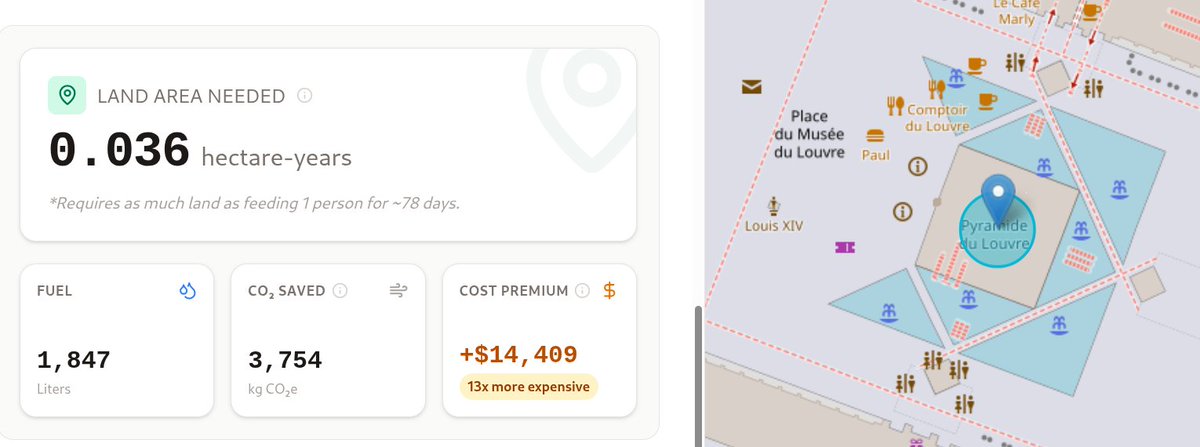
The tool also shows synthetic e-fuels (solar + electrolysis + air-captured CO₂). Solar is 50x more land-efficient than photosynthesis, but it requires massive infrastructure and is extremely expensive (10-13x more than fossil jet fuel).
The TACO cycle:
The markets want to price in TACO, but TACO needs Trump to see stocks tank.
So we get these cycles where Trump does stuff and nothing happens (because the market has priced in TACO) ... which encourages him to do more stuff until the markets actually thinks he may not TACO and prices start to fall ... which restores TACO.
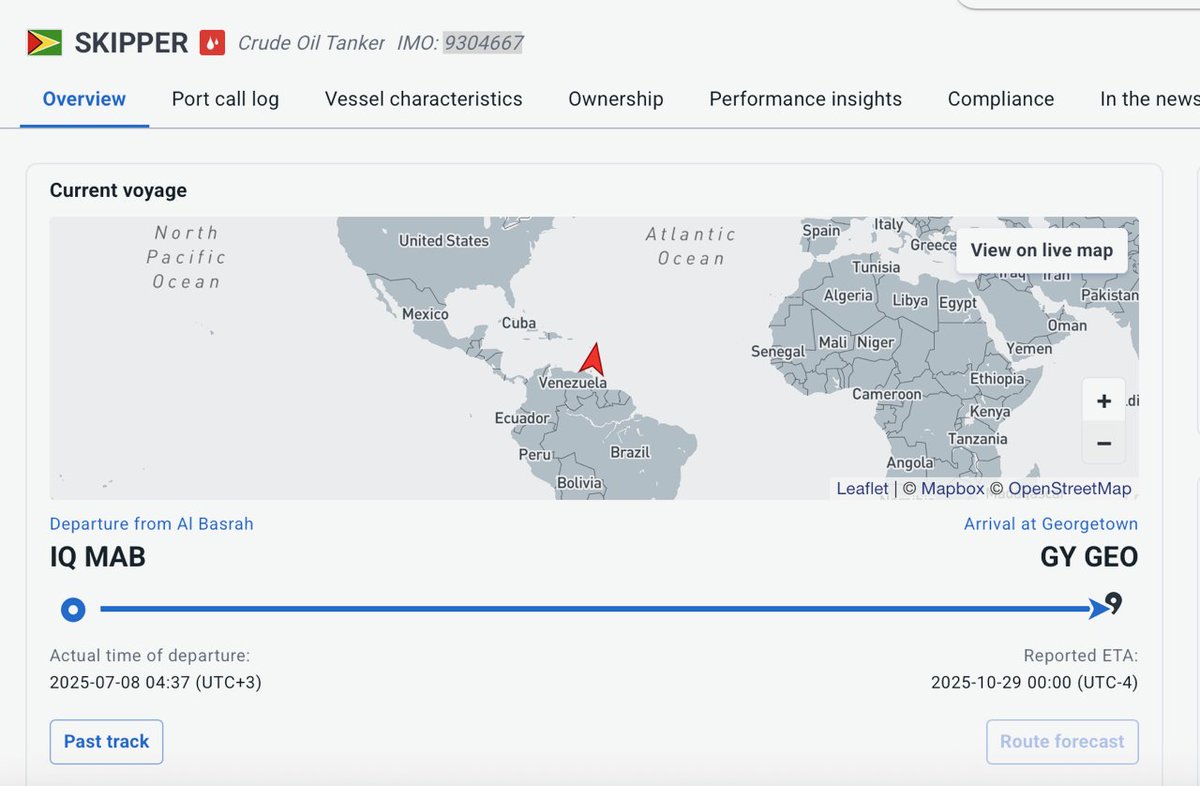
Yesterday, the U.S. seized the oil tanker Skipper off the coast of Venezuela (included pic). This seizure highlights the key role that the dark fleet plays in the global oil market.
Together with @YiliangLi_, Le Xu, and @FZanettiOxford, I have spent much of the last year thinking about this market:
https://t.co/vJiiUSdLxm
While I have posted about this work before, given the recent discussion on X about modern economics, data, and artificial intelligence, I want to revisit it, as I believe it is also a perfect example of the marvelous findings that can be documented using machine learning in economics and how the future of economics goes, to a large extent, through artificial intelligence.
Our punchline is that we designed a novel, powerful machine learning algorithm to show that dark oil tankers transported an estimated 9.3 million metric tons of crude oil per month between 2017 and 2023 (right now, before sending the paper back to the journal, we are extending the database to 2025).
Let that sink in: nearly 10 million tons of crude every month off the books, outside official trade flows.
And the economic impact? Surprisingly large for output and inflation in the U.S., the EU, and China.
Let’s start today with how we gather the data.
When oil sanctions hit, exporters don’t stop. They go dark:
— Disable AIS transponders
— Transfer oil ship-to-ship in open waters
— Reflag vessels under shady jurisdictions
— Use forged paperwork to mask identities
And here’s the twist:
Many of these tactics are quietly tolerated (sometimes even facilitated) by countries that don’t want to see tight energy markets or higher inflation. Nobody wants to rock the boat.
So, we built the most comprehensive dataset to track this:
✅ Over 2,150 oil tankers, essentially the entire global crude fleet.
✅ Trips tracked from 2017 to 2023.
✅ Satellite AIS data + metadata (vessel age, flag, etc.).
✅ ~330 million observations.
We then trained a machine learning model that detects sanction-busting trips with very high accuracy:
— Patterns in AIS gaps.
— Origins and destinations.
— Temporal clues like navigation anomalies.
— Vessel profiles.
This isn’t sample data — it’s population-level tracking.
We audited and validated the model using satellite images and independent checks.
For instance, the oil tanker Roma (IMO: 9182291) was classified as “dark” by the algorithm, and sure enough, we found imagery of Roma loading oil at Kharg Island (Iran) on August 20, 2022 (see second included pic).
You can’t argue with a photo.
This process gives us confidence in the entire classification and enables us to identify every trip that violates sanctions.
So what do we do with all these dark voyages?
We construct time series of:
📈 Oil exports that violate sanctions.
📉 Oil imports that violate sanctions.
🌐 Their origin and destination.
See the third and fourth included pics.
Tomorrow, I will discuss these results and how we use them in what I think is a rather creative econometric exercise.
P.d. By the way. Have you seen any “heterodox economist” doing anything like that? Of course not. The “heterodoxs” sit down and talk about the ontology of the oil markets, or what Sraffa would have said about the oil market, or even better, that mainstream economists do not look at the data (and write a whole book about that). Can you be any more empirical than this paper, where we actually look at every single oil tanker in the planet in real-time?
Let’s be honest: “heterodox economics” is just an excuse to be a low performer and not having to face your own shortcomings as as a researcher.
@GerardAraud C'est comme ça que fonctionnent toutes les grosses entreprises et c'est déjà vérifié par de la reconnaissance d'images. Avec Concur ça prend deux secondes de prendre une photo avec l'application et ça match automatiquement le reçu avec la dépense associée sur le compte.
It's time for climate finance to realize that decarb technologies in most industries (steel, cement, airline,...) are not economically viable without a carbon pricing mechanism. Financial engineering will not solve this. It's a distraction.
@Sonic_urticant@gabriel_zucman@lemondefr@DeBunKerEtoiles Pareil pour l'exclusion du crédit d'impôts, c'est explicitement justifié d'un point de vue méthodologique. L'argument étant que les impôts servent toujours à payer des "transferts" plus ou moins tangibles, et que si on inclut EITC/SNAP/CTC on ne sait pas où mettre la limite