THE EDUCATION OF A SENATOR is available now. Updates from former United States Senator Lamar Alexander. 7th generation Tennessean born and raised in Maryville.
“We’d like for you to be executive director of our presidential campaign,” President Ford told me in the Oval Office on Tuesday, October 14, 1975, but I said, “No.” After losing the 1974 governor’s race, my job, marriage, and budget would not have survived another campaign. My tune changed after Jimmy Carter defeated Ford and brought with him a crew from Georgia who knew even less about Washington, DC, than he did. Republican prospects improved and, with Honey’s approval, I ran again for governor.
In THE EDUCATION OF A SENATOR: FROM JFK TO TRUMP, I paint portraits of the presidents I worked with, tell stories about what I saw behind the scenes, and recount the lessons I learned about American politics and our country’s future.
THE EDUCATION OF A SENATOR: FROM JFK TO TRUMP is available now from @PostHillPress.
You can use this link to order: https://t.co/2zBcn6BcQQ
“What about my friends? I’d rather take ten exams than go to Australia for six months,” twelve-year-old Kathryn wailed when she heard that our family with three teenagers and a seven-year-old was moving to Australia after my two terms as governor. I write about our six months off in Chapter 27 of my new memoir, THE EDUCATION OF A SENATOR: FROM JFK TO TRUMP.
In March of 1988, eight months after we came home from Australia, Honey and I took a long walk after supper. It was 7 p.m. and still light in Nashville. The evening was cool, about like it was in Sydney at that time of year, although the seasons there were moving the other way. We wondered how much of our time in Australia we would remember in ten years.
Here is what we decided. We’ll never forget the adventures, but what we’ll treasure most is the memory that we were important enough to each other to actually manage to do it—to take six months off, while we still could, together. And Kathryn? Now, a mother with two teenagers and an eleven-year-old, her family has moved from New York to Oregon for their six months off.
In THE EDUCATION OF A SENATOR: FROM JFK TO TRUMP, I paint portraits of the presidents I worked with, tell stories about what I saw behind the scenes, and recount the lessons I learned about American politics and our country’s future.
THE EDUCATION OF A SENATOR: FROM JFK TO TRUMP is available now from @PostHillPress.
You can use this link to order: https://t.co/2zBcn6BcQQ
I always keep in mind this advice from Minnie Pearl: “I’ve gotten to the point in life where I’ve decided that if people aren’t nice, they’re not so hot in my book, no matter how big they are.” In my new memoir, THE EDUCATION OF A SENATOR: FROM JFK TO TRUMP, there are a lot of stories about Grand Ole Opry personalities. Minnie and Roy Acuff established an Opry culture of politeness. She would sign an autograph for the last fan remaining at the Saturday night performance. Minnie lived next door to the governor’s residence when we lived there.
One afternoon early in my term, Honey and I were standing on the back porch looking down at tour buses slowing down on Curtiswood Lane. “Honey, they’re stopping to see where the governor lives,” I said. “Lamar, they’re stopping at Minnie Pearl’s house next door,” Honey said. Minnie would tell about encountering an Iowa tourist who asked her, “Has anyone ever told you that you look a lot like Minnie Pearl?” “Yes, sir,” they have,” Minnie said. “I’ll bet it makes you mad, don’t it,” the tourist said. When I told that story while campaigning for president in Iowa in the 1990s, it seemed like everyone in the audience already knew and loved Minnie Pearl.
In THE EDUCATION OF A SENATOR: FROM JFK TO TRUMP, I paint portraits of the presidents I worked with, tell stories about what I saw behind the scenes, and recount the lessons I learned about American politics and our country’s future.
THE EDUCATION OF A SENATOR: FROM JFK TO TRUMP is available now from @PostHillPress.
You can use this link to order: https://t.co/2zBcn6BcQQ
Very few have accomplished as much and contributed as much to help Tennesseans as Martha Ingram did. She was the leader of elevating the performing arts, of the Vanderbilt University Board of Trust, and of one of our state’s most successful business enterprises. She did all of this with grace, a smile, and compassion for others. To the Ingram family, I extend my greatest respect for her life and my sympathy.
https://t.co/B8Ro81W4pE
"'Andy was the most beautiful boy on campus,' one of Dad’s classmates told me. Flo Rankin met Andrew Alexander in 1931 during her one semester at Maryville College. Both were from families that had lived for six generations in the Tennessee foothills of the Great Smoky Mountains. They saw each other only three more times before their marriage in 1939. I was born the next year. Both Andy and Flo became teachers.”
This is an excerpt from my new memoir, THE EDUCATION OF A SENATOR: FROM JFK TO TRUMP, where I paint portraits of the presidents I worked with, tell stories about what I saw behind the scenes, and recount the lessons I learned about American politics and our country’s future.
THE EDUCATION OF A SENATOR: FROM JFK TO TRUMP is available now from @PostHillPress.
You can use this link to order: https://t.co/2zBcn6BKGo
The year 2008 ended four decades of vigorous two-party competition, and not just in Tennessee. In Chapter 41 of my new memoir, THE EDUCATION OF A SENATOR: FROM JFK TO TRUMP, I describe how Tennessee has become one of forty states in which one political party controls the governorship and both houses of the legislature have enough power to block vetoes from the governor of the other party. In other words, Tennesseans are among the 80 percent of Americans who live in a state where the minority party does not have a meaningful voice in government.
A half-century ago, I got involved in politics to build a two-party system. Now we have one-party government again—of our own Republican Party. Will Tennessee’s new one-party era provide incentives to attract candidates who will continue the kind of progress of the last four decades in our state, or will it encourage the kind of lackluster leadership, unaccountable government, occasional scandal, and economic stagnation that flourished during the Democrat one-party century before the 1960s? It is too soon to know.
In THE EDUCATION OF A SENATOR: FROM JFK TO TRUMP, I paint portraits of the presidents I worked with, tell stories about what I saw behind the scenes, and recount the lessons I learned about American politics and our country’s future.
THE EDUCATION OF A SENATOR: FROM JFK TO TRUMP is available now from @PostHillPress.
You can use this link to order: https://t.co/2zBcn6BcQQ
“Wait a minute,” my wife Honey said when I told her I wanted to run for governor.
In my new memoir, THE EDUCATION OF A SENATOR: FROM JFK TO TRUMP, I write that Honey then asked me the most important—and hardest—question in politics. “I want to know why you want to be governor,” Honey said. “You’re going to have to convince me first. I have to be convinced that this is the very best thing for the state and for you and for us.”
Many candidates struggle to say why they want to run for office. In a televised interview on Tuesday, November 4, 1979, CBS anchor Roger Mudd asked Senator Ted Kennedy, “Why do you want to be president?” For nearly an hour, Kennedy fumbled through a non-answer to Mudd’s question. Seven months later, on Monday, August 11, 1980, he dropped out of the race.
In August of 1987, shortly after our family returned to Nashville from six months in Australia, George and Barbara Bush invited Honey and me to the Opryland Hotel for a visit. The vice president was making his rounds before announcing his candidacy for president. My face was bronzed from long walks in Australia; I had lost twenty pounds, and my hair was a little long.
I asked Bush the question Mudd had asked Kennedy and that Honey had insisted I answer before dragging our family through a second campaign for governor— “Mr. Vice President, why are you running for president and what do you hope to accomplish?”
The question so flustered Bush that the visit soon ended. Later, he told his campaign manager, Lee Atwater, about my question. “I think Lamar’s been out in the sun too long. Do you think he’s gone Zen?” Bush asked Atwater.
One can imagine Ronald Reagan having no trouble answering my question. “To put a harness on the Soviet Union and the federal government,” Reagan would have said.
Bush had no such ideological underpinning. He believed that he was destined to put his country first and to serve it. He was uncomfortable with “the vision thing.”
My purpose in running for governor was to raise Tennesseans’ family incomes and to build our self- confidence. I ran for president to try to persuade Americans to expect less of Washington D.C. and more of ourselves.
In THE EDUCATION OF A SENATOR: FROM JFK TO TRUMP, I paint portraits of the presidents I worked with, tell stories about what I saw behind the scenes, and recount the lessons I learned about American politics and our country’s future.
THE EDUCATION OF A SENATOR: FROM JFK TO TRUMP is available now from @PostHillPress.
You can use this link to order: https://t.co/2zBcn6BcQQ
“By noon every day, Donald Trump has done almost everything my mother said never to do,” Missouri Republican Sen. Roy Blunt once said. In Chapter 54 of my new memoir, THE EDUCATION OF A SENATOR: FROM JFK TO TRUMP, I explain why I did not spend my time as senator doing what many urged me to do—provide a running commentary on all of the ways I disagreed with President Trump’s behavior and all of the ways I disagreed with President Obama’s liberal views.
Instead, I followed the advice attributed to Abraham Lincoln, who said, "Elections belong to the people. It’s their decision. If they decide to turn their back on the fire and burn their behinds, then they will just have to sit on their blisters.” I voted against Trump’s tariffs and Obama’s spending. I voted to keep Trump’s emergency declarations and Obama’s war powers within constitutional limits. But I always treated the office of President with respect. And I was able to get big things done with both Presidents. I suppose they may have come to the same conclusion I did—whatever our differences, we should let the people decide who is president and who is senator, respect each other’s offices, and work together when we can.
In THE EDUCATION OF A SENATOR: FROM JFK TO TRUMP, I paint portraits of the presidents I worked with, tell stories about what I saw behind the scenes, and recount the lessons I learned about American politics and our country’s future.
THE EDUCATION OF A SENATOR: FROM JFK TO TRUMP is available now from @PostHillPress.
You can use this link to order: https://t.co/2zBcn6BcQQ
Of the ten Presidents with whom I worked, Ronald Reagan fit the job the best. I tell why in Chapter 25 of my new memoir, THE EDUCATION OF A SENATOR: FROM JFK TO TRUMP.
Reagan knew why he wanted to be president: to put a harness on the Soviet Union and the federal government. He did what he said he would do when he fired air traffic controllers. In his time, he was the most skilled communicator. He had a lively sense of humor. He told a dinner of journalists after applause for him had died down, “Thank you very much. I know how hard it is to clap with your fingers crossed.”
But most importantly, he was not afraid to assemble as his advisers a “team of rivals” (In Doris Kearns Goodwin’s words) who had broad experience. George H.W. Bush, Jim Baker, and Howard Baker had lived and grown and fought and won and lost in a variety of life’s experiences. Howard Baker, who Reagan brought on board to help the president deal with the Iran-Contra scandal, had already helped bring down one Republican president, Richard Nixon.
When Baker arrived in the Reagan White House in 1987, he told Reagan’s new counsel, A.B. Culvahouse, “We are here to save the president, 𝘪𝘧 𝘩𝘦 𝘥𝘦𝘴𝘦𝘳𝘷𝘦𝘴 𝘵𝘰 𝘣𝘦 𝘴𝘢𝘷𝘦𝘥.”
In THE EDUCATION OF A SENATOR: FROM JFK TO TRUMP, I paint portraits of the presidents I worked with, tell stories about what I saw behind the scenes, and recount the lessons I learned about American politics and our country’s future.
THE EDUCATION OF A SENATOR: FROM JFK TO TRUMP is available now from @PostHillPress.
You can use this link to order: https://t.co/2zBcn6BcQQ
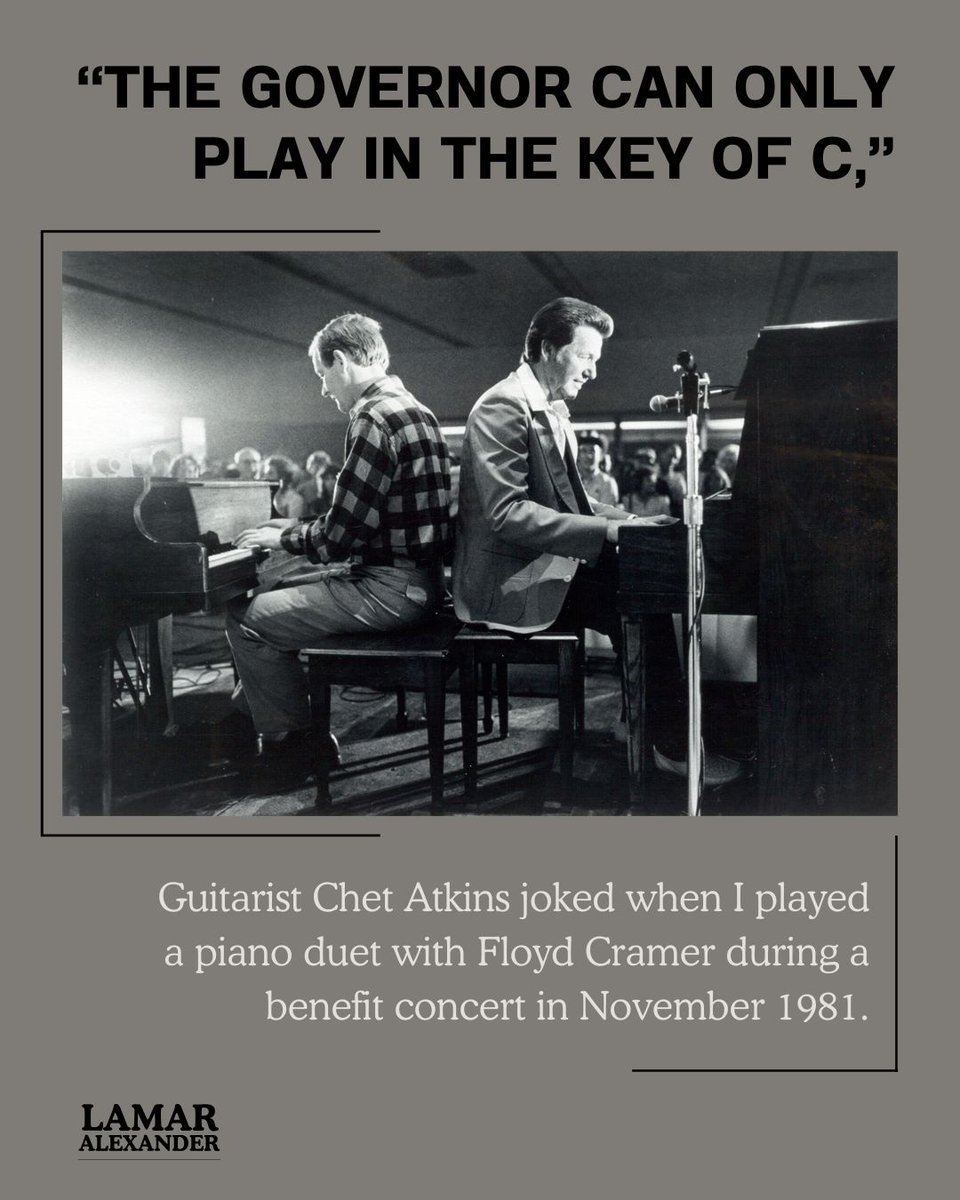
“The governor can only play in the key of C,” guitarist Chet Atkins joked when I played a piano duet with Floyd Cramer during a benefit concert in November 1981, at East Tennessee State University which also included saxophonist Boots Randolph. I asked the legislature to appropriate funds to support Tennessee’s symphonies and community orchestras and then I performed with them in twenty-seven concerts to raise more money. I played the piano at the Grand Ole Opry, too, usually accompanying Roy Acuff, who sometimes introduced me as “Larry.”
This is an excerpt from my new memoir, THE EDUCATION OF A SENATOR: FROM JFK TO TRUMP, where I paint portraits of the presidents I worked with, tell stories about what I saw behind the scenes, and recount the lessons I learned about American politics and our country’s future.
THE EDUCATION OF A SENATOR: FROM JFK TO TRUMP is available now from @PostHillPress.
You can use this link to order: https://t.co/2zBcn6BcQQ
I describe wallowing after losing the 1974 governor’s race in Chapter 16 of my new memoir, THE EDUCATION OF A SENATOR: FROM JFK TO TRUMP. Campaigns end, win or lose. Either way, it’s sudden death. The difference is that when you win, a new life is sitting up there, like a polished apple waiting for you to take a bite. When you lose, you don’t know where to go from where you are, and the hardest thing is that there seems to be nothing but the end. The loser must discover a new life, and that usually involves wallowing. Wallowing is precisely the word for the process, which becomes uncomfortably long for the wallower and uncomfortably messy for those watching.
Losing was hard on Honey, too. “I took the loss very personally. I couldn’t understand why Lamar wasn’t elected. I was depressed and very unhappy with myself. Kathryn was born in June and was my appendage for four years. After Lamar lost that first race, I cocooned for a while,” she said.
In THE EDUCATION OF A SENATOR: FROM JFK TO TRUMP, I paint portraits of the presidents I worked with, tell stories about what I saw behind the scenes, and recount the lessons I learned about American politics and our country’s future.
THE EDUCATION OF A SENATOR: FROM JFK TO TRUMP is available now from @PostHillPress.
You can use this link to order: https://t.co/2zBcn6BcQQ
“I first met Ronald Reagan in April 1980, during his presidential campaign when the Reagans spent the night at the Tennessee governor’s residence. Before that I thought that he was too old, too western, and too conservative to be president. Reagan was sixty-nine. I was thirty-nine, the youngest governor. My opinion changed the next day. At an 8 a.m. breakfast—6 a.m. on the West Coast—the California governor was sparkling and engaging. I was impressed by his executive demeanor and good humor.”
This is an excerpt from my new memoir, THE EDUCATION OF A SENATOR: FROM JFK TO TRUMP, where I paint portraits of the presidents I worked with, tell stories about what I saw behind the scenes, and recount the lessons I learned about American politics and our country’s future.
THE EDUCATION OF A SENATOR: FROM JFK TO TRUMP is available now from @PostHillPress.
You can use this link to order: https://t.co/2zBcn6BKGo
According to Bill Clinton, Tennessee Democratic House Speaker Ned McWherter introduced him to Al Gore. I describe that meeting and my relationship—and competition—with Clinton in Chapter 31 of my new memoir, THE EDUCATION OF A SENATOR: FROM JFK TO TRUMP.
“You two should get together. Al here knows everything about everything. Bill can explain it so people can understand it,” McWherter told Clinton and Gore at the Tennessee Governor’s residence. McWherter also relied on Clinton for advice. “Ned asked me, 'How do you get a woman interested in you when you’re 80?’ Tell her you’re ninety,” Clinton replied.
In THE EDUCATION OF A SENATOR: FROM JFK TO TRUMP, I paint portraits of the presidents I worked with, tell stories about what I saw behind the scenes, and recount the lessons I learned about American politics and our country’s future.
THE EDUCATION OF A SENATOR: FROM JFK TO TRUMP is available now from @PostHillPress.
You can use this link to order: https://t.co/2zBcn6BcQQ
One county commissioner proposed naming the road to the new plant “Pearl Harbor Boulevard” because feelings still ran high about World War II when Nissan announced in 1980 that it was coming to Tennessee. In Chapters 21 and 22 of my new memoir, THE EDUCATION OF A SENATOR: FROM JFK TO TRUMP, I recount that my 1979 Tokyo dinner with Nissan executives came only thirty-four years after American atomic bombs devastated Nagasaki and Hiroshima. Mitsuya Goto, who attended that dinner as an interpreter, later gave me two miniature airplanes he had carved. They were replicas of General Jimmy Doolittle’s carrier-based fighter planes that had flown over Nagoya, strafing railroad yards when Goto was a boy. “The planes flew so low that I could see the faces of the pilots from the rooftop of my grandfather’s house,” Goto told me. Some Tennessee war veterans still had nightmares of death marches from Japanese prison camps in China.
Overcoming those feelings, Nissan built the highest-volume assembly plant in North America south of Nashville. Forty-one miles away, GM built its largest plant. Volkswagen chose Chattanooga for its North American manufacturing plant and, near Memphis, Ford built its “most advanced, most efficient auto production complex in [the company’s] 118-year history.” The 1,000 auto suppliers that followed these manufacturers were the major reason why Tennesseans’ family incomes grew more rapidly in the 1980’s and 1990’s than those of any other southern state.
In THE EDUCATION OF A SENATOR: FROM JFK TO TRUMP, I paint portraits of the presidents I worked with, tell stories about what I saw behind the scenes, and recount the lessons I learned about American politics and our country’s future.
THE EDUCATION OF A SENATOR: FROM JFK TO TRUMP is available now from @PostHillPress.
You can use this link to order: https://t.co/2zBcn6BcQQ
“Make every day count,” was my advice to freshman senators at their orientation. “It’s hard to get here, hard to stay here and while you’re here, you might as well try to accomplish something good for the country.” In Chapter 36, “Freshman Orientation”, of my new memoir, THE EDUCATION OF A SENATOR: FROM JFK TO TRUMP, I write about how, in June 2014, speaking at the senators’ prayer breakfast, retired South Dakota Senator Tom Daschle offered the same advice.
“My major regret about my time as majority leader was not reminding myself every day of what a consequential position I held, and how much opportunity I had to make a difference,” Daschle said.
He urged senators to remember a poem, “The Young Dead Soldiers Do Not Speak,” that Archibald MacLeish, the Librarian of Congress, wrote in the 1940s after witnessing the burial of a soldier at Arlington National Cemetery. Its words are emblazoned on the World War I Memorial in Washington, DC.
“Our responsibility is to give meaning to those who gave their lives for our country,” Daschle said.
In Chapter 37, I write about how Daschle, the Democratic leader, and Republican leader Trent Lott worked together. At an earlier Senators-only prayer breakfast on Wednesday, August 1, 2012, Lott described his relationship with Daschle and how the two had worked together as leaders during the impeachment trial of President Clinton.
“Sometimes, we would slip into the back door of each other’s office and say, ‘I’m sorry.’ We became friends, and now we and our wives see each other often… When I heard on Sunday afternoon that the House had voted to impeach the president, I called Tom and said, ‘Well, I guess it’s in our lap now. How are we going to do this?’” Lott said. “We formed a committee of senators who made recommendations, and that fell flat. Then, we were in a scrum down on the floor one afternoon, and Senator Nickles suggested we ought to try meeting in the Old Senate Chamber. That turned out to be a good idea.”
Lott went on.
“I asked Danny Akaka to give a prayer. And then I asked Byrd to give some history, hoping he wouldn’t talk too long. And then I had Connie Mack say a few words. That put us in the right mood. After a few people spoke, Phil Gramm made a proposal, and Ted Kennedy made a proposal. I walked over to Tom and said, ‘It sounds to me like they said the same thing, although to tell the truth, I couldn’t tell exactly what it was.’ So, we asked some senators to write down whatever the Kennedy-Gramm proposal was, and that’s the way we proceeded,” Lott said.
In THE EDUCATION OF A SENATOR: FROM JFK TO TRUMP, I paint portraits of the presidents I worked with, tell stories about what I saw behind the scenes, and recount the lessons I learned about American politics and our country’s future.
THE EDUCATION OF A SENATOR: FROM JFK TO TRUMP is available now from @PostHillPress.
You can use this link to order: https://t.co/2zBcn6BcQQ
“You’re the worst trombone player in our organization, but you're just right for our kind of music,” Joel Schiavone, the owner of Your Father’s Mustache, told me one night.
In Chapter 7 of my new memoir, THE EDUCATION OF A SENATOR: FROM JFK TO TRUMP, I tell the story of Joel sitting right in front of me playing the banjo during one of his visits to New Orleans to see how his beer joint business was doing. After playing in the banjo band at night on Bourbon Street, I was a little sleepy the next day, but I learned a lot from Judge Wisdom.
To encourage his law clerks to use plain English, he compiled “Wisdom’s Idiosyncrasies,” seventy-five "suggestions, some of which you never learned in elementary school from Miss Thistlebottom before you ever heard of Strunk.”
These included:
* There should be one idea to a sentence.
* Use one word instead of two; two instead of three, five, and so on.
* The adjective is the enemy of the noun; the adverb is the enemy of the verb. Think of the right word.
* Avoid vogue words.
* Beware of metaphors.
* Simple is better.
In THE EDUCATION OF A SENATOR: FROM JFK TO TRUMP, I paint portraits of the presidents I worked with, tell stories about what I saw behind the scenes, and recount the lessons I learned about American politics and our country’s future.
THE EDUCATION OF A SENATOR: FROM JFK TO TRUMP is available now from @PostHillPress.
You can use this link to order: https://t.co/2zBcn6BcQQ
“Any jackass can kick down a barn, but it takes a good carpenter to build one,” House of Representatives Speaker Sam Rayburn once said. In my conversation with @KenDBerryMD about my new memoir, THE EDUCATION OF A SENATOR: FROM JFK TO TRUMP, I told him about taking American history teachers on the floor of the Senate when it was not in session. In the epilogue to my memoir, I write that I told the teachers, “It takes builders. Our republic is more likely to survive if your students also become builders. And I hope you will help them understand that the best way to change the direction of our country is to be a builder in public office. When former Tennessee Gov. Bill Haslam teaches Baker School students, he tells them that he has been surprised at how much more he accomplished in public office than he can in private life.
“Inspire your students to become a part of a project to save and improve our Republic. They don’t have to become a Senator at one of these desks. They can be a school board member or a legislator or work for someone elected to a local office. They can be a citizen politician in their hometowns for a few years. After all, our country works from the bottom up.”
Often, as our visit was about to end, a teacher would ask, “What would you like for us to tell our students about being a United States Senator?” “Please tell them," I would say, “that after seeing public life from almost every angle for a long time, I have learned that the best way to help the largest number of people—and to keep our Republic from falling apart—is to be elected to public office or go to work for someone who has been.” “Tell that I have been able to wake up every day thinking I might be able to do something good for my state or country and go to bed most nights thinking that I had.”
You can watch the full conversation here: https://t.co/iW2zpzNYzO
In THE EDUCATION OF A SENATOR: FROM JFK TO TRUMP, I paint portraits of the presidents I worked with, tell stories about what I saw behind the scenes, and recount the lessons I learned about American politics and our country’s future.
THE EDUCATION OF A SENATOR: FROM JFK TO TRUMP is available now from @PostHillPress.
You can use this link to order: https://t.co/2zBcn6BcQQ
I had a wonderful conversation with @SenBoWatson on his Tennessee Today podcast about my new memoir, THE EDUCATION OF A SENATOR, my first run for governor of Tennessee, my leadership style, and what my hopes are for Tennessee.
You can listen to the full episode here: https://t.co/rcWM8GgTx3
On this week's episode of Tennessee Today, I had the incredible honor of sitting down with Lamar Alexander, a former U.S. Senator, former Governor of Tennessee, and one of the most influential leaders our state has ever known.
Listen wherever you get your podcasts or online at https://t.co/dckYz5HIC1.