Senaro shows you what your money will actually do, before you commit. A second opinion on every money decision. No bank linking, every answer cites its source.
@theficouple Ran their leftover through the buffer math. Thing is, once essentials come out, even the standard three month cushion takes 38 months to save up. Assuming they can put anything aside at all.
@charliebilello That participation drop lands on household balance sheets. We ran the drawdown. A 2.7% saving rate on the $83,730 median income is about $2,261 a year. Average household spend is $6,545 a month. With no benefits or partner income, that year of saving doesn't cover a full month.
@unusual_whales Worth separating the lender from the loan. On a median-priced house with 10% down, the 30-year at 6.66% carries $313,516 more interest than the 15-year at 6.04%. I'd still run the break-even though. Invest the payment gap above 7.69% and the 30-year wins.
There's a difference between income dropping and income stopping. $20,000 against $4,146 a month in essentials empties in month 5. Keep $2,200 coming from a partner or side work and the fund reaches month 11. Net burn falls to $1,946.
@KobeissiLetter I keep putting the saving rate next to prints like this. It was 2.7% in June. For a household carrying an average card balance, the market has to clear 21.52% before investing wins, so outside a matched 401k the owning side isn't really a market call for them.
@elerianm Claims are a flow measure. They count who just lost a job, not how long a household absorbs it. So I sized the buffer. Saving 2.7% of income, the BEA's June rate, gets a median earner from zero to three months of essentials, $12,438, in 67 months. Productivity doesn't move that.
@BrianFeroldi I ran it at the rate his math needs, and he's right nominally. $983,585. Deflate that at the long run CPI average and it's $414,454 in today's money. So the inflation replies aren't wrong, just too harsh. Closer to 42% of it than a quarter.
On $83,730 at a 50% match on the first 6%, contributing 3% captures $1,256 and forfeits $1,256 every year. Going to 6% costs $2,512 more of your own money. And if there's no true-up, front-loading forfeits $1,739 instead.
@FluentInFinance Rent gets the blame, but for borrowers there's a line sitting above it. The average federal student balance on the standard plan runs $449 a month for ten years before anyone's looked at a lease. And the interest share is the part that gets me, $14,387.
@dollarsanddata Checked your number at 4% real and it lands at $494, so the 5x is right there. The timing is the part I find people miss. That last decade alone adds more than triple what the first one does, and you only get it if the money's already sitting there.
@NickTimiraos If the bar to hike is that low, revolving debt feels it first. Card APRs track prime, so it's in the next statement. I ran the average card balance a quarter point higher and it still clears in 249 months. The minimum rises to absorb it. You just pay $118 more.
@KobeissiLetter A hold isn't relief. It just freezes the average APR on accounts assessed interest at 21.52%. On a $6,715 balance, $168 a month still runs 69 months and $4,952 in interest before it clears.
@FluentInFinance I'd ask what the skipped rent is actually doing. Banking the $1,579 median asking rent gets a solo renter to an $8,400 cushion in about six months. Without that, the first bad month just sends you home again.
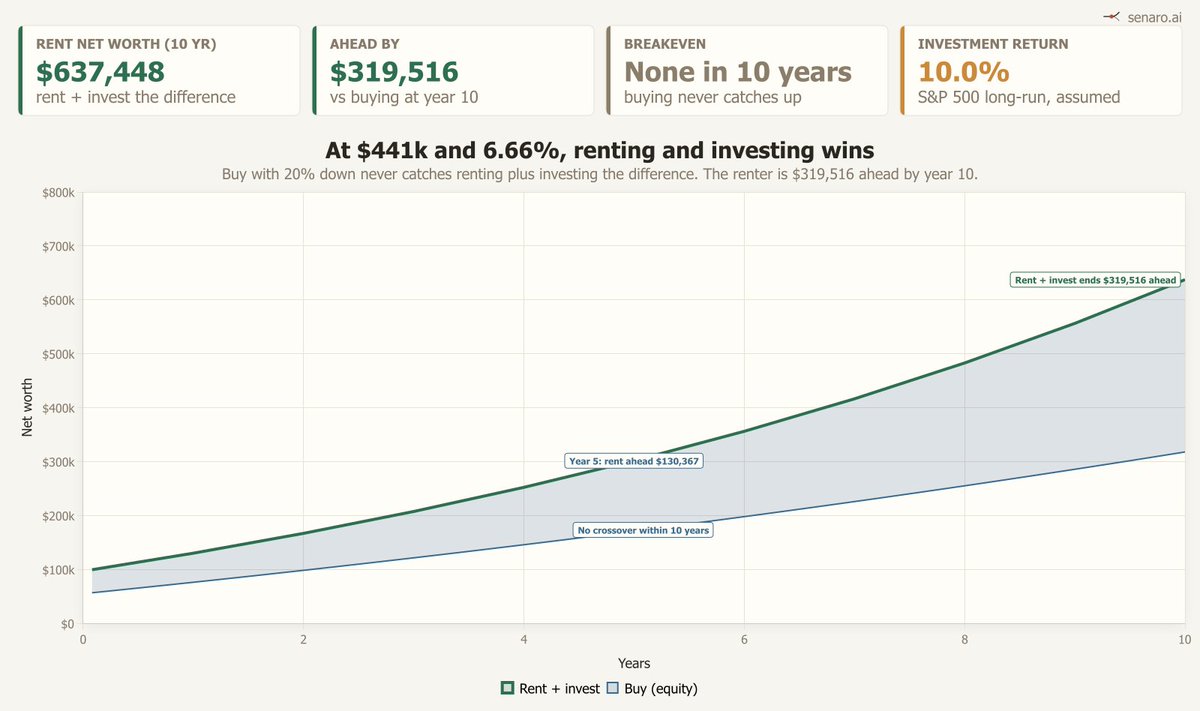
The median existing home sold for $440,600 in June. At this week's 6.66% with 20% down, against $1,579 rent with the gap invested at 10%, buying doesn't reach parity inside 10 years. The renter's ahead $319,516. Push the horizon out and that changes.
@charliebilello Expansions ending isn't a risk households can time. What they can measure is how much of gross income is already spoken for, so I ran the median household. Rent, a car note, a card minimum and a student loan come to 39% of gross. Fannie's manual underwriting baseline is 36%.
@DaveRamsey Starting this late doesn't make it pointless, it just changes what's doing the work. So I checked the split. A decade of $800 a month from zero at 6% leaves almost three quarters of the ending balance sitting in plain deposits. Compounding mostly shows up in the back half.
@BrianFeroldi Where this gets expensive is the raise nobody notices. Let spending drift up $500 a month and hold it for a 25-year career. At market returns that's about $277,000 of foregone growth in today's dollars, and none of it ever shows up as a decision.
@theficouple Good breakdown. The line I'd add is the buffer, since a layoff only has to cover the essentials, not the fun money. Three months of their rent, food, transport and utilities comes to $6,630. I'd fill that before the investing starts.
June's personal saving rate came in at 2.7%, down from 3.0%. On a household budget that's about $157 a month. With $4,146 in essential costs, $9,000 saved is 2.2 months of cover. The 5-month target is $11,730 away. At that pace it's 75 months.
@unusual_whales Worth putting a clock on that. Housing, food and transport run $4,146 a month on BLS numbers. So $2,000 of cushion with nothing coming in doesn't reach month two. I don't think most people have priced that.