Mum, daughter, sister, auntie, friend, someone's (better!) other half, teacher 4-25, SLT, SENDCo and jump-rope obsessed! All views are mine. Or my chimp...😬
JK Rowling slams Paris Olympics calling it a ‘Disgrace’ after a biological male beat a female in women’s boxing.
“A young female boxer has just had everything she’s worked and trained for snatched away because you allowed a male to get in the ring with her. You’re a disgrace, your ‘safeguarding’ is a joke and #Paris24 will be forever tarnished by the brutal injustice done to Carini.”
The Harry Potter authors comments came after Algerian boxer Imane Khelif, who is biologically male, beat Italian female boxer Angela Carini in 46 seconds.
Another account hits the news of a school implementing extremely controlling behavioural policies, in the name of turning the school around.
All these pieces report similar approaches - immediate detentions escalating quickly to isolation for minor infractions, including uniform and equipment issues. Staff encouraged to be rigidly consistent, and penalised if they aren't.
The results are predictable. Kids start to dislike school, parents start to protest, and undercover teachers say it's a toxic environment, but they don't dare say so in public. And then people in power say that the parents and kids are making it up and it's only one side of the story.
If they are making it up, it's odd that so many of them say the same thing.
Why are we hearing about so many schools punishing kids for missing green pens, or the wrong colour socks? It's down to the Broken Window theory.
Sweat the small stuff and you won’t have to worry about the big stuff.
This is based on broken window policing. The idea is that if you leave the broken window in a neighbourhood people will think that it’s uncared for and not monitored, and more disorder will follow. The neighbourhood will go downhill. Mend the windows, and you can stop that from happening.
It wasn’t meant to be about people. It was about the environment (and even then, the research isn’t strong). Because it turns out that when you apply it to people it has some quite troubling consequences. Lots of ‘stop and search’. Racial profiling, and deteriorating relationships between people and the police. It turns out people don’t like being jumped on for every little thing. It doesn’t make them feel more positive or pro-social.
Windows and people are, after all, quite different.
In some British schools, however, the idea that the way to turn a school around is to 'sweat the small stuff’ has turned into an obsession with uniform details, missing equipment and everyone doing things the same. Line ups in the morning and inspections at tutor group. Refusing to allow girls to wear socks over their tights, as Longsands school did last winter. Everyone using rulers to track reading, and having to keep books flat in the desk, as is reported happening in Astrea Academy schools. Sending girls home en masse for skirt length, as a Welsh school did last week.
Petty control, in the name of ‘sweating the small stuff’. It makes it hard for parents to complain, because schools will say it’s part of their overall strategy to turn behaviour around. Yes, no socks over tights might seem trivial, but they are the ‘broken windows’. Let them wear non-regulation socks and next thing you know they'll be dealing drugs at the school gate.
The result? Schools are seeing broken windows where before there was just a pane of glass. They’re finding windows which weren’t actually broken, but are just designed differently to other windows, or perhaps were left slightly open. Behaviours which were not an issue before have become worthy of sanction.
They’re looking so hard for broken windows that they are seeing them everywhere.
The result is to turn (almost) all the kids into perpetrators. Even the ‘well behaved’ kids get multiple behaviour marks and instant detentions. Those who push back end up in isolation very quickly. I spoke to one girl who said that in her large comprehensive school, only eight children made it through the whole year with no behaviour marks. Less than 1%. She knows because there was a special assembly about it.
Young people and their parents say it creates a negative environment, where kids feel that they are only noticed when they do something wrong - and it’s easy to get things wrong. Some teachers say the same. Staff are leaving and some of them are speaking out. They are scared too, just like the kids.
Some kids get into a spiral of being constantly pulled up for minor infractions and pushing back. Because that is what some kids do. They push back. They want to be able to make some choices in their lives, and they resist petty control. They say No.
For them, sweating the small stuff has exactly the opposite effect that is intended. The small stuff gets bigger and bigger. Cracked windows appear in places where there weren’t even windows before. Broken glass is everywhere you look. The kids fall apart - and the same strategy continues.
https://t.co/88f7DMbXgW
When my son was four, we were sent a gift subscription to an educational software package called something like Education City. It has questions which children were meant to answer. I opened it up and showed it to him. He enjoyed numbers and patterns so I opened the maths sections.
The questions were not hard and he could easily do them. We did Level 1 and to his surprise a screen with three gold stars came up. He’d done them perfectly.
Onto Level 2 and it got slightly harder. He got a couple wrong. When we got to the end, there were only two gold stars on the screen. He jumped up and came over to me. “Mummy” he said, “You do it. I need to get all the stars”.
Up to this point, there had been no linking of rewards or stars with achievement. I had never given him stars or certificates for doing things.
At the moment I remembered everything I had read about how rewards change a child’s relationship with what they do. When an adult comes along and gives stars, or stickers, or a certificate, suddenly the purpose of the activity shifts. Before, they were doing it for its own sake. Now they are doing it for the reward.
My son had accurately picked up on this shift. The point of doing the maths, in this educational programme, was to get the stars. Not to learn. Three stars was the best and that’s what he wanted.
He’d worked out the most efficient way to get those stars. Get me to do the maths.
I reflected on my own experience of learning and how often I had made choices based on maximising my rewards. I’d chosen to do the subjects I knew I would do best at for my exams, not the subjects I would learn most from. I’d chosen not to learn a new language, thinking I’d do better in the one I knew already. I’d chosen the options I thought I’d do best at for my English coursework, because I already knew a lot about the topic. Even though I was more interested in something else.
I’d restricted my own learning all the way along, because the rewards were too important. It worked, I did well.
I know I’m not the only one who does this. The research shows that this happens throughout our education system. When we make learning about outcome rather than process, young people learn less. It becomes about how to game the system, not about learning.
What happened to my son? We cancelled the subscription when I said I wasn’t going to do the maths and he said he wouldn’t do it either. We found other ways to learn maths without the need for stars. I don’t know what he learnt from that experience, but I know what I learnt.
Adding a reward changes the learner’s relationship with the activity and not necessarily in a good way. Do so with care.
I think this thread from @naomicfisher is written as succinctly as one can write about the impact on children and young people of the central ideological position that we have endured since 2010, which has intensified profoundly in the last few years.
🧵 pls RT:
I’m writing an article about problems parents of children with SEND are faced with when trying to get support (problems with EHCPs, lengthy waits for external agencies- SALT, EPs, CAHMS- subsequent waits for assessments/diagnosis, lack of special school places etc)
I’ve been reading school behaviour policies and it seems there is a lot of confusion about what a behavioural intervention really is and how it should work.
Here’s the thing about consequences for behaviour. If your aim is to change the behaviour, then that should actually happen. That is how behavioural interventions are meant to work. You alter the consequences, and the behaviour changes. This should happen relatively quickly, within a few weeks.
If a child is received repeated detentions, or being sent to isolation regularly, or clocking up enormous numbers of behaviour points - then those interventions aren’t working. They aren’t changing the behaviour. At this point, it is just punishment. It makes the child feel bad, but it doesn’t change anything in a positive way.
If behavioural interventions are working as they are meant to, then a school should have to use fewer and fewer of them after the first few weeks of each school year. Everyone should have got the message.
If that isn’t happening, then there is probably something else going on. Lagging skills perhaps, distress, additional needs or inappropriate expectations. The problem isn’t ’just behavioural’. This means that if consequences haven’t worked to change behaviour before, they are unlikely to suddenly start to work on the twentieth time.
If a school is suspending or isolating significant numbers of pupils repeatedly, then it’s likely that that behaviour intervention is not working. Behavioural interventions should lead to behavioural change. That is the point of an intervention.
9 Harsh Truths I wish I understood in my 20's:
1. Everyone is responsible for their choices and behavior. At the end of the day, it's always on us.
2. Quick fixes are popular because healing take time, new habits, and consistent commitment.
3. There might not be the one. Focusing on finding the perfect person takes away the time you could be learning how to self regulate and communicate.
4. We all self sabotage. We all have narcissistic traits. We all have self doubt. Welcome to being human.
5. People's opinions are mostly projections. You can learn from all feedback, but also know it's extremely bias. Nothing is personal.
6. Not everything needs to be fixed. The wisest people know how to sit with the pain and suffering people experience without saying or doing much of anything.
7. People pleasing is an attempt to control people's perception of us. Once you face that, you can finally start to let it go.
8. No one has a perfect life. Stop romanticizing the life of other people. We all carry things we don't talk about.
9. Your body doesn't just age because of genetics. It ages because of how it's cared for. Care for your body, it's your vessel for navigating life.
Which do you think is most important to learn in this life?
Retweet if you felt this to be true.
Dear @Ofstednews I don't really have any followers so don't suppose this will make a difference but- I have been a bloody good and dedicated teacher for 22 years working and making a difference in an area of true deprivation. I have been a head teacher for the last 3 years
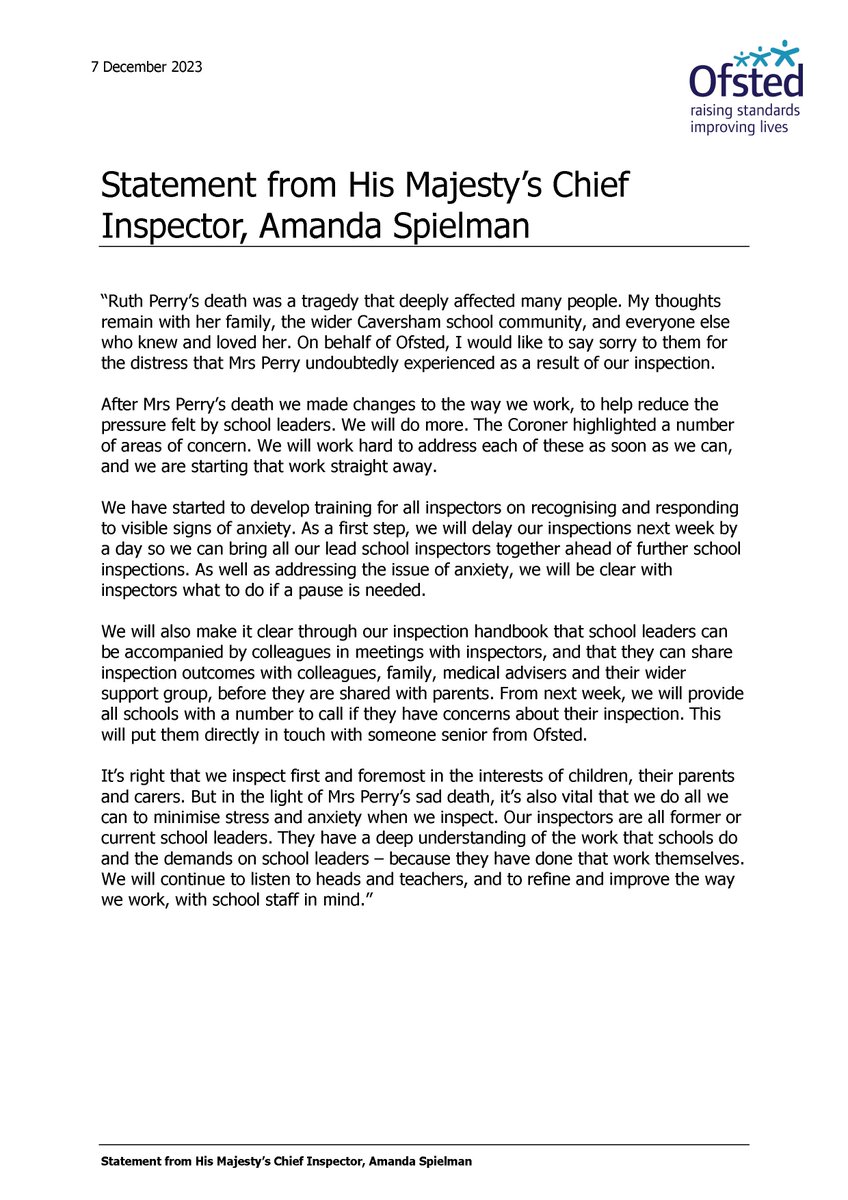
A statement from His Majesty's Chief Inspector, Amanda Spielman, on the conclusion of the Coroner's inquest into the death of headteacher Ruth Perry: https://t.co/QWIB1nUuJ8