Our paper with @KermanToygar is now published in Theory and Decision! If you think ignoring connections between phenomena is always a bad thing — think again! Using info design, we show that this can make persuasion harder, and thus help elicit more information from the expert.
On my way to the Netherlands 🇳🇱 and will be super happy to see you all at #EEAESEM24 Congress https://t.co/ebGCXTdgFf
and then at @earie_news conference https://t.co/byDLO0tOKV
There I was revising an old project on information design with @RastislavRehak and had a chance to present a new project on confirmatory learning. That's great to have a coauthor and friend with a double affiliation :)
A week ago, I was delighted to visit the Center for Social and Economic Behaviour (C-SEB) at the University of Cologne and the Max Planck Institute for Research on Collective Goods in Bonn.
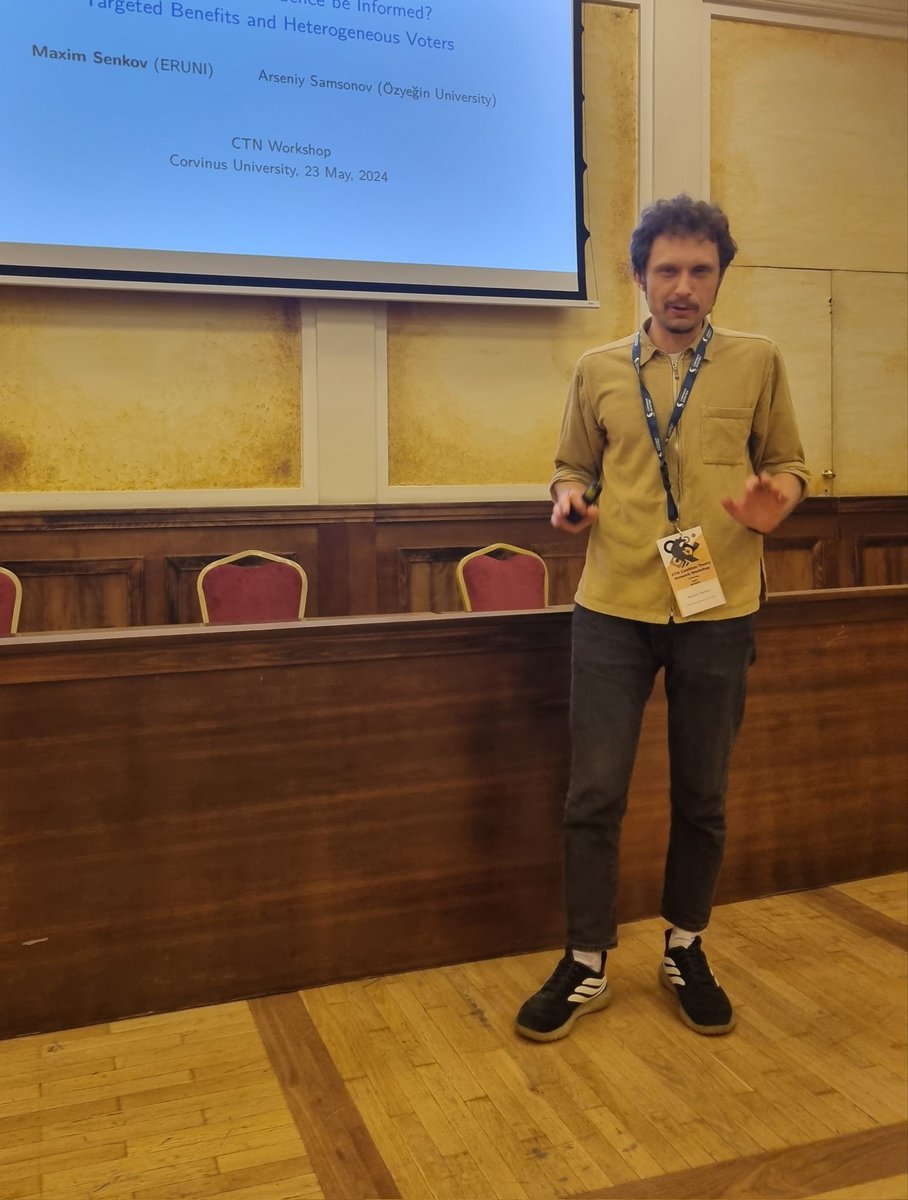
CTN Annual Workshop at @uni_corvinus in Budapest last week was great: just two days, but so many interesting talks and meetings! Special thanks goes to @KermanToygar, Slava, and Anastas for the smooth organisation
@bnjmnblmnthl Yes, indeed, thanks for writing, Benjamin! A quick look suggests that you study the effects of giving info to voters, and thus address a question somewhat complementary to the one we ask (info to politicians). I'll have a look at your paper too!
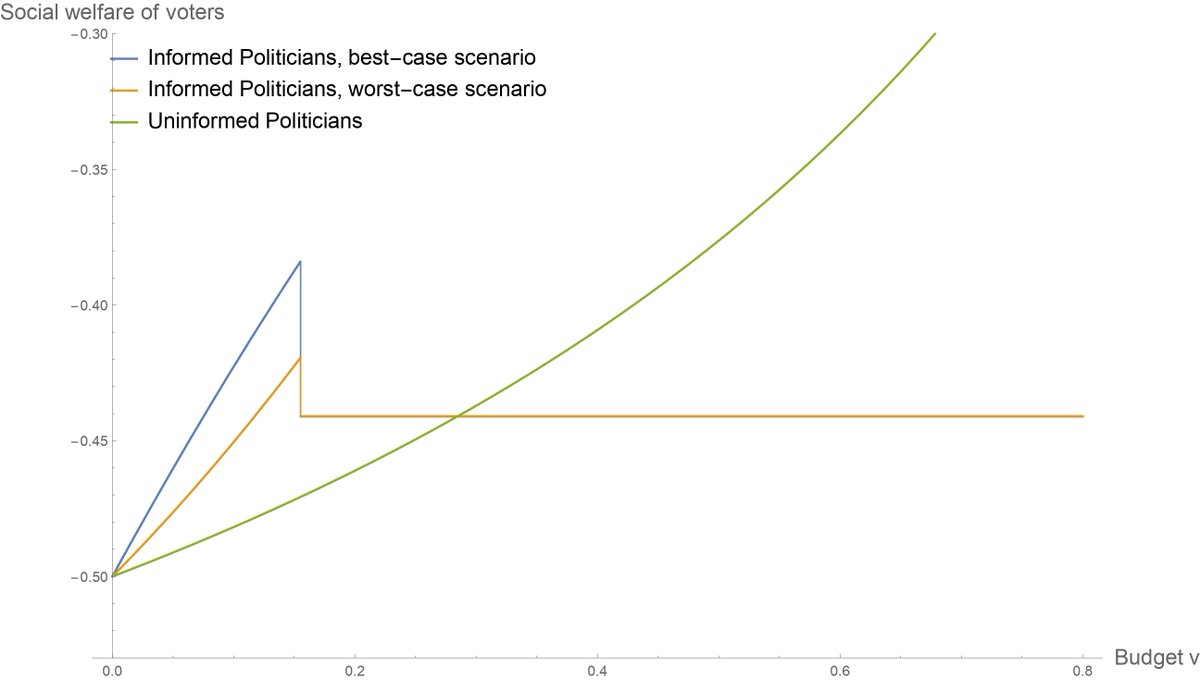
Do voters benefit if competing politicians learn their needs? Me and Arseniy Samsonov show that when politicians have a small budget or the public good has a high value, access to voter information enhances voter welfare (converse holds for large budget) https://t.co/s0DmPbVctv
More specifically, with a small budget, access to voter information leads the winning politician to focus on poorer voters, enhancing
voter welfare. With a larger budget, informed politicians target a narrow group of swing voters, which harms the voter welfare.
@MatteoTriossi in some sense yes, in the comparative statics exercise that we consider, it is beneficial for the expert to persuade, i.e.,disclose at least some information to the decision-maker (both in sophisticated DM and naive DM benchmark), but optimal signal differs between the benchmarks
Is naively ignoring the connection between phenomena a good or bad thing for the decision-maker facing an expert? In our paper, @KermanToygar and I show that naivety can benefit the decision-maker https://t.co/1ca4NjXunQ
@MartaCota14@UvA_Amsterdam Very nice indeed (what I wouldn't say regarding the weather :)). I had little time for exploring, yet had a chance to enjoy a bike ride.
I spent the last week at @UvA_Amsterdam School of Economics. This was a very exciting and stimulating time, thanks to my amazing coauthor Daniel Barreto and the friendly team of the Microeconomics section of the Department. Looking forward to future visits!