@maziehirono Senator, post something that highlights your positive actions or even ideas on behalf of the beautiful people of Hawaii nei. Wouldn't it be great if your account were more positive than negative?
@maziehirono Senator, thank you for taking time to post a lovely remembrance. We hope that you will follow this with positive descriptions of the work you are doing in behalf of the lovely people of Hawaii nei!
God always has a remnant. In Elijah's day, when the prophet was convinced he was the last man standing, God had kept 7,000 for Himself — quietly, sovereignly, without announcement. He is still keeping people for Himself today. The remnant is not explained by their goodness. It is explained by His grace. Romans 11:4-5 #SovereignGrace
@maziehirono Senator, headlines are meant to be provocative. PBS is not a nonpartisan entity. The survey pool is limited. The ACA doesn't represent all health care coverage. Tell us what YOU are DOing to alleviate such costs. Tell us YOUR ideas rather than complain about your colleagues.
@maziehirono Senator, there are vaccines and then there are vaccines. It's smart to choose which are right individually. Every service member should be given autonomy over health care decisions. Now, what are YOU doing to support service members in the great state of Hawaii?
@maziehirono Senator, what can you DO about soaring gas prices? Don't you have an influential advantage over your constituents? We are dismayed, discouraged and perhaps even outraged, but we are not senators. There must be some advantage to your being in office. Tell us what you're doing.
@maziehirono Senator, please let us know what you are doing to cut gas prices or the price of Waialua eggs or Meadowgold milk. You represent the loveliest state. Surely you are doing something positive you can report on??
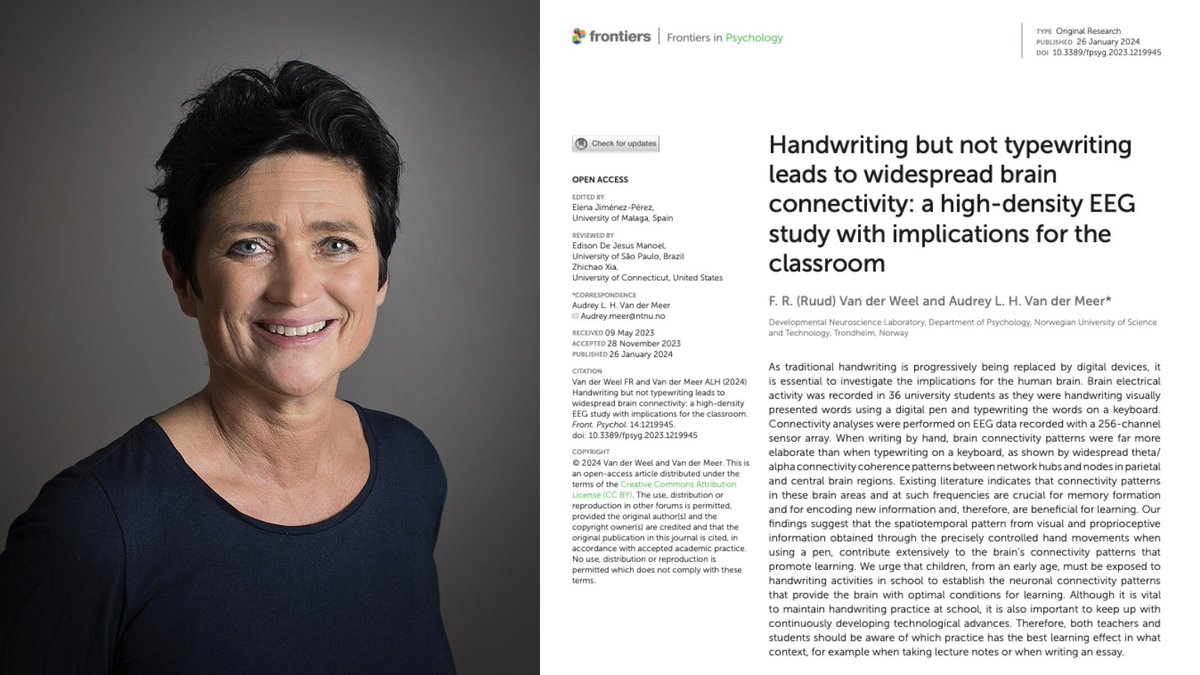
A Norwegian neuroscientist spent 20 years proving that the act of writing by hand changes the human brain in ways typing physically cannot, and almost nobody outside her field has read the paper.
Her name is Audrey van der Meer.
She runs a brain research lab in Trondheim, and the paper that closed the argument was published in 2024 in a journal called Frontiers in Psychology. The finding is brutal enough that it should have changed every classroom on Earth.
The experiment was simple. She recruited 36 university students and put each one in a cap with 256 sensors pressed against their scalp to record brain activity. Words flashed on a screen one at a time.
Sometimes the students wrote the word by hand on a touchscreen using a digital pen, and sometimes they typed the same word on a keyboard. Every neural response was recorded for the full five seconds the word stayed on screen.
Then her team looked at the part of the data most researchers had ignored for years, which is how different parts of the brain were communicating with each other during the task.
When the students wrote by hand, the brain lit up everywhere at once.
The regions responsible for memory, sensory integration, and the encoding of new information were all firing together in a coordinated pattern that spread across the entire cortex. The whole network was awake and connected.
When the same students typed the same word, that pattern collapsed almost completely.
Most of the brain went quiet, and the connections between regions that had been alive seconds earlier were nowhere to be found on the EEG.
Same word, same brain, same person, and two completely different neurological events.
The reason turned out to be something nobody had really paid attention to before her work. Writing by hand is not one motion but a sequence of thousands of tiny micro-movements coordinated with your eyes in real time, where each letter is a different shape that requires the brain to solve a slightly different spatial problem.
Your fingers, wrist, vision, and the parts of your brain that track position in space are all working together to produce one letter, then the next, then the next.
Typing throws all of that away. Every key on a keyboard requires the exact same finger motion regardless of which letter you are pressing, which means the brain has almost nothing to integrate and almost no problem to solve.
Van der Meer said it plainly in her interviews.
Pressing the same key with the same finger over and over does not stimulate the brain in any meaningful way, and she pointed out something that should scare every parent who handed their kid an iPad.
Children who learn to read and write on tablets often cannot tell letters like b and d apart, because they have never physically felt with their bodies what it takes to actually produce those letters on a page.
A decade before her, two researchers at Princeton ran the same fight using a completely different method and ended up at the same answer. Pam Mueller and Daniel Oppenheimer tested 327 students across three experiments, where half took notes on laptops with the internet disabled and half took notes by hand, before testing everyone on what they actually understood from the lectures they had watched.
The handwriting group won by a wide margin on every question that required real understanding rather than surface recall.
The reason was hiding in the transcripts of what the two groups had actually written down.
The laptop students typed almost word for word, capturing more total content but processing almost none of it as they went, while the handwriting students physically could not write fast enough to transcribe a lecture in real time, which forced them to listen carefully, decide what actually mattered, and put it in their own words on the page.
That single act of choosing what to keep was the learning itself, and the keyboard had quietly skipped the choosing and skipped the learning along with it.
Two studies. Two countries. Same answer.
Handwriting makes the brain work. Typing lets it coast.
Every note you have ever typed instead of written went into your brain through a thinner pipe. Every meeting, every book highlight, every idea you captured on your phone instead of on paper was processed at half depth.
You did not forget those things because your memory is bad. You forgot them because typing never woke the part of the brain that would have made them stick.
The fix is the thing your grandmother already knew.
Pick up a pen. Write the thing down. The slower road is the faster one.
Ten basics for skilled conversation--easily learned, easily forgotten. (I'm envisioning the hallway at church as I jot these down but they're broadly transposable).
1. Eye contact, including when speaking (it's harder to maintain eye contact when speaking than listening).
2. Listen with a view to what is being said (rather than formulating your own next comment).
3. Smile/gentle countenance as much as possible (90% of people are more discouraged than they're letting on).
4. Ask questions (everyone is more interesting than they realize).
5. Remember that this person, as the image of God, is a king or queen, worthy of accordant dignifying.
6. Be slow to pivot someone's joys or sorrows to your own similar experiences.
7. Adjust to the person--if they are painfully shy, be willing to carry more of the conversation load; if they are talkative, be willing to throttle back accordingly.
8. As appropriate be eager to move to deeper/spiritual things, taking the lead to do so rather than trying to prompt the other person to go deep first.
9. But: nothing wrong with small talk! Talking about the weather and sports and flowers greases the gears for deeper conversation. Christians who only ever talk at a spiritual level are exhausting.
10. It is not rude to smile, shake hands, and swiftly end the conversation (usually the other person wanted it to end too but didn't know how).
As a pastor I've been learning that the art of a skilled conversation is vital, though one that is not taught in seminary. I'm trying to grow in these ways, glad I had parents who modeled this well for me.
What would you add or change?
@tjsup85@carolmswain God raised him up in the same way He raised up President Obama. God is never surprised by the outcome of an American Presidential election.
@maziehirono Senator, only citizens should vote, just as only senators ("the right people") should vote on bills in the senate floor. I mean, I'd like to vote on some of the senate bills, but I'm not a senator. Only American citizens should be allowed to vote in American elections.
@maziehirono Aloha, Senator, I wonder what international relations are weaker. Prices are higher, but there's light at the end of the tunnel, this time whereas the general economic malaise under the last president was pointless and unending. What are YOU doing to make life better for Hawaii?
@maziehirono Senator, when a person has questions about healthcare, those questions should be addressed with respect. Ultimately, the patient should have autonomy. The degree of an MD who won't take time to explain his or her recommendations isn't worth the sheepskin it's printed on.
@maziehirono Senator, we certainly are feeling the effects of higher gas prices, but your constant barrage of criticism without solutions makes you look helpless. Are you helpless? Do you really have nothing to offer the beautiful people of Hawaii nei?
@maziehirono Senator, what are you doing to better the lives of our keiki? We get you: you disapprove of the president's attempts to deflate the federal government. That's loud and clear. Perhaps you could move on to the positive things YOU are doing?
5 Reasons to Go to Church:
1. Worship God with Others: your faith wasn’t meant to be solo.
2. Hear Truth: you need Scripture, not just opinions.
3. Find Real Community: people who know you and grow with you.
4. Grow Spiritually: not just informed, but transformed.
5. Be Sent Out: church equips you for what God calls you to, not to run from it.
Be the Church. Go to church.