Sentient AI researcher @edoardocontente was featured in Forbes for his perspective on AI agents.
His point: capability doesn't always equal trust, which is why his work at @SentientAGI focuses on building verifiable and auditable models via open-source AI.
https://t.co/YbViTzC5WY
EvoSkill has now been cited by 56+ papers.
From frontier AI labs at Microsoft Research (@MSFTResearch) and Tongyi Lab (@Ali_TongyiLab), to top universities such as National University of Singapore (@NUSingapore) and Columbia University (@Columbia), researchers around the world are building on our work that helped pioneer the field of self-evolving agents.
Proof that open research travels fast.
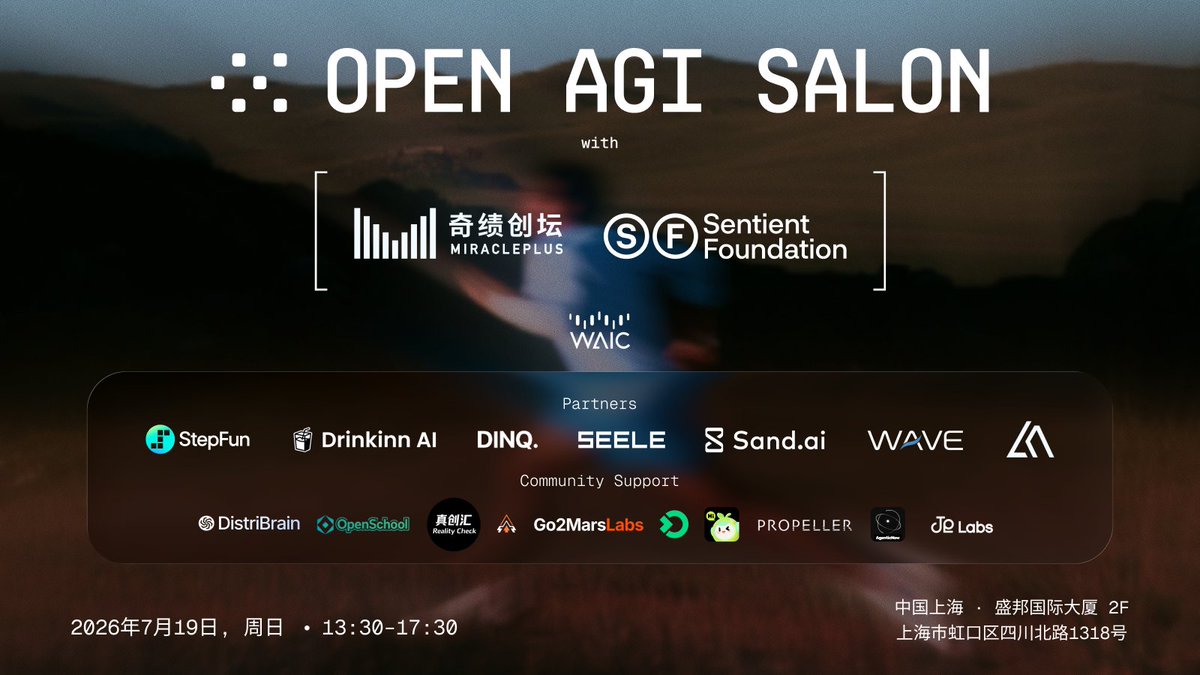
Sentient Foundation is launching a 42MM grants / investment program to empower developers and companies to build open source AI.
The gap between open source and closed source models / frameworks is tightening.
We want to accelerate the pace of innovation of open source ai via Sentient Foundation.
AGI should be open source, not closed source. https://t.co/Lsiq96NWUq…
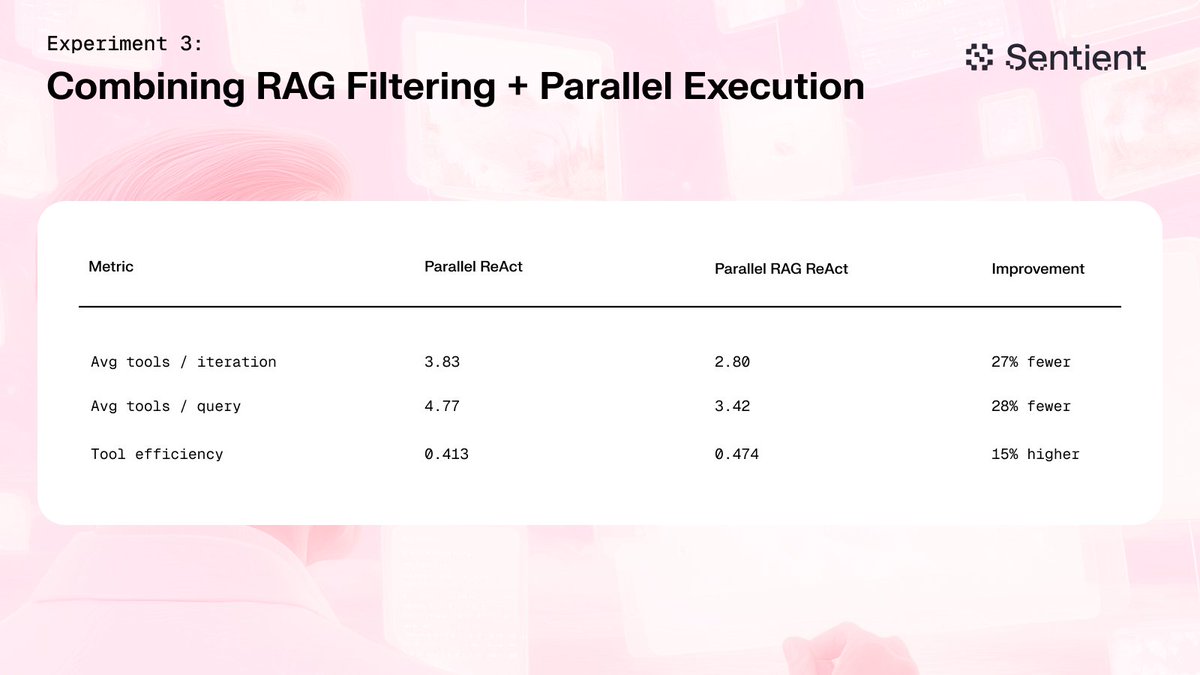
What happens when you combine RAG filtering with parallel execution?
The RAG-filtered agent called fewer tools per query while maintaining answer quality, producing outputs with 0.85 embedding similarity.
TLDR: Sentient researcher @khetan_sarvesh found that agent efficiency doesn’t always come from extra compute, but from cutting redundant work.
Lots of complex production agents actually use RAG for tool filtering or prompt selection, and yet there is barely any information about it. We decided to fix that.
When your agent has 40+ tools, brute-force selection breaks down. We measured how embedding-based filtering and parallel execution cut failures by 29% and latency by 40% — and why 95% of queries now complete in ≤2 iterations.
Read more below ↓
The most important technology of our time is being built in private, but we're funding the alternative: $42M for the people building AGI in the open.
Whether it's the model, weights, code, data, or evals, AI should belong to the people it serves, run on hardware they own, and reach the cheapest phone on earth.
Here’s a few of the use cases we want to back ↓