We’re excited to share our new X name, Slingshot Seradata Intelligence. Although we’ve updated our look & feel to align with the @sling_shot_aero brand, we'll still be providing the same space market analysis & event reporting that you depend on.
📢 Incoming! Slingshot’s technical papers from the 25th Advanced Maui Optical and Space Surveillance Technologies (AMOS) Conference are here!
We're excited to share the groundbreaking work Slingshot presented at AMOS last month. Our team showcased three innovative AI/ML technologies set to transform space situational awareness:
🪪 ML-Based Photometric Fingerprinting: Identifying and characterizing LEO satellites using unique brightness measurements to create digital ‘fingerprints’
💥 Early Identification of High-Covariance Conjunctions: Predicting potential collision risks days in advance to support improved space traffic coordination
🕵️ Action-Free Inverse Reinforcement Learning for Satellite Similarity and Anomaly Detection: Spotting unusual satellites hidden within mega-constellations
These advancements are looking to revolutionize threat detection, space traffic coordination, and constellation monitoring. We're proud of the work our team is doing to stay at the forefront of space safety, sustainability, and security.
Read our full AMOS recap and access the technical papers here: https://t.co/Zyy0C1CzVl
and a technical paper: IAC-24-D6.3.10 Analysis of the causes and consequences of launch failures over the past 20 years at circa 1200 in the Yellow Hall 1 on Thursday 17 Oct.
Slingshot’s David Todd will also present an Interactive Poster: IAC-24-D5.IP.16 Factors affecting in-orbit anomalies causing insurance losses at the IP area’s screen 82 at 1310 on Monday 14 Oct;
@PushFourLeft @rickspinradnoaa @BigJoeBastardi@NOAA The rotation rate of a wheel-like hurricane will be similar across the radius (just like a wheel having the same rotational speed at its centre and rim), but its tangential linear velocity will be faster at the outer rim than at the hub (the eye in this case).
Storm Kirk expected to cause flooding in parts of France, but that is small beer vs Cat 5 Hurricane Milton that will strike Florida. A reported 5 million residents are trying to evacuate. Good luck to all. We hope that the damage is minimal to all homes and to space facilities.
Unprecedented to have three Atlantic hurricanes in Oct: Cat 5 Hurricane Milton with 180 mph winds delays 10 Sept launch of Europa Clipper to Jupiter from Cape Canaveral, Florida. Meanwhile, Hurricane Kirk threatens France, S. Eng & even Germany. Hurricane Leslie is off W Africa.
@spacefanh Each launch vehicle will have an ground & upper level wind speed limitation...usually around 30-40 mph. Weather/wind delays are common. What is not so common is seeing so many hurricanes which may be being caused by ocean energising effect of global warming.
7 October 2024 - 1452 GMT Launch - Falcon 9v1.2FT Block 5, from Canaveral, FL, USA. Carrying ESA's Hera asteroid probe and given special dispensation from FAA's suspension of launch licence of Falcon 9 due to upper stage issues. B1061 stage on 23 flight was flown expendably.
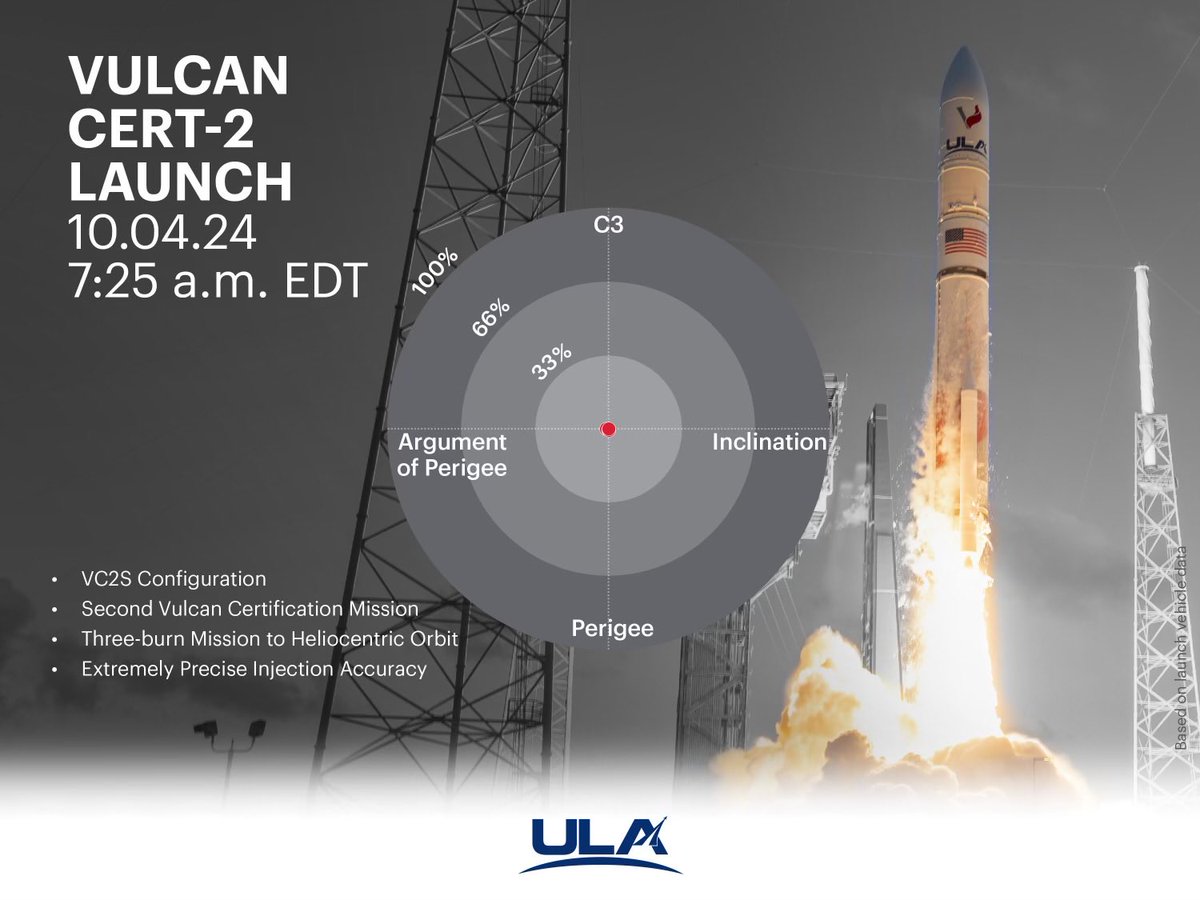
Tory Bruno/ULA are vague about Bullseye chart being for final orbit or parking orbit. C3 (characteristic energy above escape) on it appears to make it a final orbit. Thus, we assume that target was achieved despite SRB nozzle failure. Vulcan's robustness saved its launch. Success
ULA CEO @torybruno is claiming an "orbital bullseye" insertion. We assume this to mean the parking orbit. In other words, Centaur stage burn 1 probably made up for underperformance of the SRB 1 after its nozzle failure. But does this detract from its later Burn 2 performance?
A quick look at an abnormal part of today's Vulcan Cert-2 mission. Awaiting more information from ULA.
📸 - @NASASpaceflight
📺 - https://t.co/uzKGo20deK