If you're on the right path and you're taking little steps everyday, one thing is sure.
You'll get to the finish line.
THE POWER OF COMPOUNDING EFFECTS
A man has only 5 ways out of depression;
1. Making money.
2. Hitting the gym.
3. Believing in God.
4. Chasing his purpose.
5. Building a loving family.
If you feel down, go all in on one.
You'll feel better within a week.
Guaranteed.
Major cheat code for life: Build a boring baseline. Go to bed early. Wake up early. Move your body. Eat simple foods. Save money. Read good books. Avoid drama. Be present. Listen intently. Change your mind. The inputs may not look impressive, but the results certainly do.
If you want to do better in business as a man
You literally just need more testosterone
High T males are shown to persevere longer, keep up work focus bettee under pressure & distractions, and are most likely to be belligerently confident in their continued success regardless of current circumstances (good or bad)
If you are any type for entrepreneur
You need to be Testmaxxing
Premium SEO and content workflows can now be automated using mostly free tools. Full breakdown 👇
1) Content Planning
Step 1: Define your niche and target audience in one clear line. You’ll use this directly inside your prompt.
Step 2: Generate a plan in ChatGPT or Claude.
Prompt:
“Act as a professional SEO content strategist. Generate a 30-day content calendar for the [niche] industry, targeting [audience]. For each day include: topic title, primary keyword, search intent (informational/transactional/navigational), and estimated search volume tier (high/medium/low). Format as a table so I can paste it directly into Google Sheets.”
Step 3: Paste the output into Google Sheets and add a Status column (Draft / Published / Needs Update). This makes the whole process much easier to track.
Advanced tip: Don’t stop at a 30-day calendar. Build topic clusters. Under one pillar topic, create 8–10 related subtopics. This helps build topical authority, which improves visibility in both Google Search and AI search experiences.
2) Free Keyword Research
Step 1: Add and verify your site in Google Search Console at https://t.co/Ev4j4LSNhy.
Step 2: Go to the Performance report and open the Queries tab.
Step 3: Identify keywords with high impressions but low clicks. These are your biggest opportunities: people are seeing your pages, but not clicking.
Step 4: Paste those keywords into ChatGPT or Claude and ask why CTR might be low. Is the title weak? Is the search intent mismatched? Is the page not compelling enough?
Advanced tip: Once a month, export your Search Console data and let AI analyze trends. It can quickly show which topic clusters are growing and which ones are losing momentum.
3) Outlines, FAQs, and Headlines
Step 1: Run a separate prompt for each topic. Don’t batch everything together.
Prompt:
“Act as an SEO content editor. For the topic [Topic], generate: an SEO-optimized H1-H4 outline, 5 FAQ questions with short answers based on real search intent, and 3 catchy title options under 60 characters. Keep the structure ready to paste into a CMS.”
Step 2: Review the outline before sending it to a writer. Remove any sections that feel irrelevant or bloated.
Advanced tip: Add an “AI Overview Target” section to the outline — a 40–60 word paragraph that directly answers the core question. This is the kind of concise answer AI Overviews, ChatGPT, and similar tools are more likely to surface.
4) Research Verification
Step 1: Before publishing any fact or stat, ask the question in Perplexity.
Step 2: Open the sources it cites and verify the original report or dataset yourself. Never rely on Perplexity alone.
Step 3: Store verified facts in a separate Sources sheet so you can reuse them later.
5) Internal Linking
Step 1: Connect your site to a tool like Outranking or Link Whisper.
Step 2: These tools will map entities and topics, then suggest which pages should link to which.
Step 3: Review the suggestions manually. Not every recommendation will be relevant.
Advanced tip: Tools like Link Whisper have an annual cost (around $97/year, depending on site count), so if you’re running a smaller site, you can absolutely manage internal linking manually with a spreadsheet and a simple entity map.
6) Schema + Meta Descriptions
Step 1: Once the article is complete, copy the full blog post.
Prompt:
“Act as a technical SEO specialist. Generate valid JSON-LD FAQ schema and an SEO meta description (under 155 characters) for this blog post: [Paste blog content here]. Keep the tone matching the article and make sure the schema is Google Rich Results eligible.”
Step 2: Paste the generated schema into Google’s Rich Results Test tool to validate it and catch any errors.
Step 3: Add the meta description to your CMS.
7) Visuals
Step 1: Paste a section of your blog into Napkin AI — for example, a comparison table or process explanation.
Step 2: Generate an infographic, then add descriptive alt text. This can help you capture additional image search traffic as well.
8) Workflow Automation
Step 1: Sign up for AirOps’ free solo plan.
Step 2: Start with a simple pipeline, such as generating meta descriptions in bulk from a spreadsheet of URLs.
Step 3: Once that works, expand into more advanced workflows like keyword clustering or content gap analysis.
Step 4: Use Zapier or Make to connect the process end-to-end:
New idea → Auto content brief → Writer assignment → Auto upload
That said, I’d still keep the final publishing step manual.
The Most Advanced Layer: GEO + AI Visibility
In 2026, SEO is no longer just about ranking in Google. It’s also about whether your brand appears inside answers from ChatGPT, Perplexity, Claude, and Gemini. That’s where Generative Engine Optimization (GEO) comes in.
Step 1: Use tools like Indexly or Sight AI to track whether your brand is showing up in AI-generated answers across ChatGPT, Claude, Perplexity, and Gemini.
Step 2: As soon as a new page goes live, submit it through the IndexNow protocol so search engines are notified immediately. That helps pages get discovered and indexed faster instead of waiting for the next crawl cycle.
Step 3: Add at least one direct, quotable answer line in every article. AI models tend to favor clear, concise, citation-friendly answers.
I’m out of breath just writing this list 😅 but once you set up the system properly, the hard part is done. After that, it becomes a repeatable machine.
One important note: most of the advanced tools mentioned here like Indexly, Sight AI, or higher-tier AirOps plans do come with monthly costs (usually somewhere between $99–$299/month). Their free tiers are enough for learning and basic workflows, but not for serious scale.
So if you’re running a small site or just getting started, begin with the free stack, learn the workflow, and only move to paid tools when scaling actually makes sense.
Save this post and share it , then follow the system step by step.
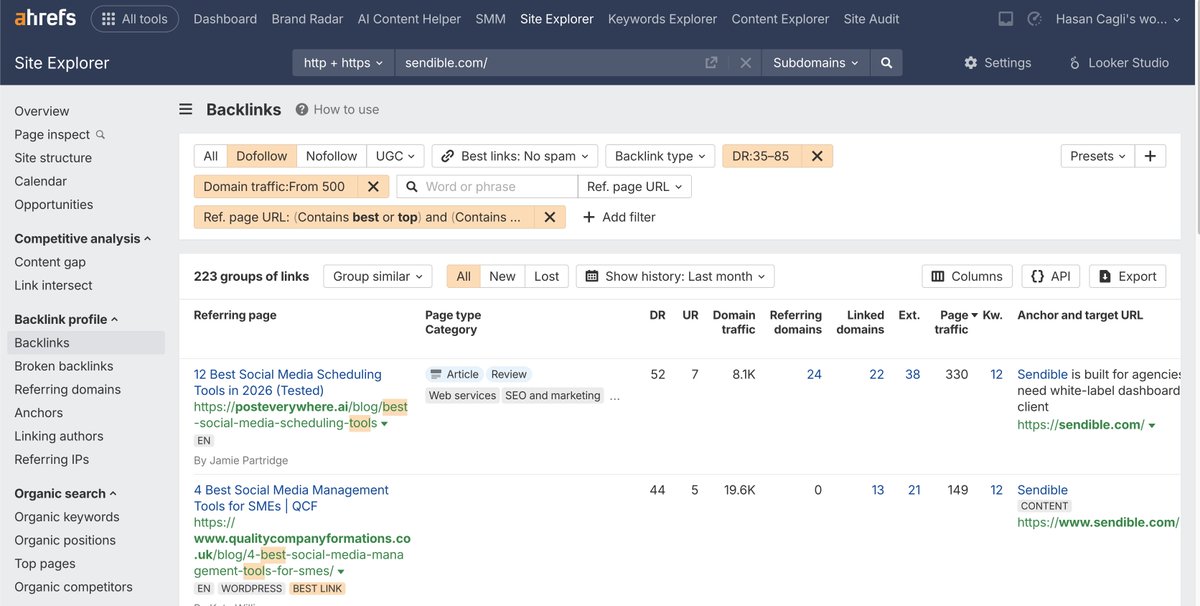
this is how i do "backlink outreach" for my SEO 👇
1. buy ahrefs lite plan ($129/mo)
2. open "site explorer" -> competitor domain -> "backlinks"
3. filters (35-85 DR, do-follow, no-spam, min traffic 500, page URLs contains "best" OR "top" and "software" OR "tool")
4. reach out to every website manually (open link -> contact form -> send message/email)
important:
🟢 volume matters a lot (30-50 outreach/day is good)
🟢 most want money, that's okay, just send more emails
🟢 having a wide range of pages help, so write more content on your blog
it's simple, not easy.
so keep going!! 💪
(feel free to ask any questions in the comments)


![Awesome_O_AI's tweet photo. Premium SEO and content workflows can now be automated using mostly free tools. Full breakdown 👇
1) Content Planning
Step 1: Define your niche and target audience in one clear line. You’ll use this directly inside your prompt.
Step 2: Generate a plan in ChatGPT or Claude.
Prompt:
“Act as a professional SEO content strategist. Generate a 30-day content calendar for the [niche] industry, targeting [audience]. For each day include: topic title, primary keyword, search intent (informational/transactional/navigational), and estimated search volume tier (high/medium/low). Format as a table so I can paste it directly into Google Sheets.”
Step 3: Paste the output into Google Sheets and add a Status column (Draft / Published / Needs Update). This makes the whole process much easier to track.
Advanced tip: Don’t stop at a 30-day calendar. Build topic clusters. Under one pillar topic, create 8–10 related subtopics. This helps build topical authority, which improves visibility in both Google Search and AI search experiences.
2) Free Keyword Research
Step 1: Add and verify your site in Google Search Console at https://t.co/Ev4j4LSNhy.
Step 2: Go to the Performance report and open the Queries tab.
Step 3: Identify keywords with high impressions but low clicks. These are your biggest opportunities: people are seeing your pages, but not clicking.
Step 4: Paste those keywords into ChatGPT or Claude and ask why CTR might be low. Is the title weak? Is the search intent mismatched? Is the page not compelling enough?
Advanced tip: Once a month, export your Search Console data and let AI analyze trends. It can quickly show which topic clusters are growing and which ones are losing momentum.
3) Outlines, FAQs, and Headlines
Step 1: Run a separate prompt for each topic. Don’t batch everything together.
Prompt:
“Act as an SEO content editor. For the topic [Topic], generate: an SEO-optimized H1-H4 outline, 5 FAQ questions with short answers based on real search intent, and 3 catchy title options under 60 characters. Keep the structure ready to paste into a CMS.”
Step 2: Review the outline before sending it to a writer. Remove any sections that feel irrelevant or bloated.
Advanced tip: Add an “AI Overview Target” section to the outline — a 40–60 word paragraph that directly answers the core question. This is the kind of concise answer AI Overviews, ChatGPT, and similar tools are more likely to surface.
4) Research Verification
Step 1: Before publishing any fact or stat, ask the question in Perplexity.
Step 2: Open the sources it cites and verify the original report or dataset yourself. Never rely on Perplexity alone.
Step 3: Store verified facts in a separate Sources sheet so you can reuse them later.
5) Internal Linking
Step 1: Connect your site to a tool like Outranking or Link Whisper.
Step 2: These tools will map entities and topics, then suggest which pages should link to which.
Step 3: Review the suggestions manually. Not every recommendation will be relevant.
Advanced tip: Tools like Link Whisper have an annual cost (around $97/year, depending on site count), so if you’re running a smaller site, you can absolutely manage internal linking manually with a spreadsheet and a simple entity map.
6) Schema + Meta Descriptions
Step 1: Once the article is complete, copy the full blog post.
Prompt:
“Act as a technical SEO specialist. Generate valid JSON-LD FAQ schema and an SEO meta description (under 155 characters) for this blog post: [Paste blog content here]. Keep the tone matching the article and make sure the schema is Google Rich Results eligible.”
Step 2: Paste the generated schema into Google’s Rich Results Test tool to validate it and catch any errors.
Step 3: Add the meta description to your CMS.
7) Visuals
Step 1: Paste a section of your blog into Napkin AI — for example, a comparison table or process explanation.
Step 2: Generate an infographic, then add descriptive alt text. This can help you capture additional image search traffic as well.
8) Workflow Automation
Step 1: Sign up for AirOps’ free solo plan.
Step 2: Start with a simple pipeline, such as generating meta descriptions in bulk from a spreadsheet of URLs.
Step 3: Once that works, expand into more advanced workflows like keyword clustering or content gap analysis.
Step 4: Use Zapier or Make to connect the process end-to-end:
New idea → Auto content brief → Writer assignment → Auto upload
That said, I’d still keep the final publishing step manual.
The Most Advanced Layer: GEO + AI Visibility
In 2026, SEO is no longer just about ranking in Google. It’s also about whether your brand appears inside answers from ChatGPT, Perplexity, Claude, and Gemini. That’s where Generative Engine Optimization (GEO) comes in.
Step 1: Use tools like Indexly or Sight AI to track whether your brand is showing up in AI-generated answers across ChatGPT, Claude, Perplexity, and Gemini.
Step 2: As soon as a new page goes live, submit it through the IndexNow protocol so search engines are notified immediately. That helps pages get discovered and indexed faster instead of waiting for the next crawl cycle.
Step 3: Add at least one direct, quotable answer line in every article. AI models tend to favor clear, concise, citation-friendly answers.
I’m out of breath just writing this list 😅 but once you set up the system properly, the hard part is done. After that, it becomes a repeatable machine.
One important note: most of the advanced tools mentioned here like Indexly, Sight AI, or higher-tier AirOps plans do come with monthly costs (usually somewhere between $99–$299/month). Their free tiers are enough for learning and basic workflows, but not for serious scale.
So if you’re running a small site or just getting started, begin with the free stack, learn the workflow, and only move to paid tools when scaling actually makes sense.
Save this post and share it , then follow the system step by step.](https://pbs.twimg.com/media/HM4eynKbQAA3qJ7.jpg)