Sterke en terechte redevoering van Jean-Marie Dedecker. Het moeten niet altijd Vlaams Belangers zijn die de rotte appels zoals Vandenbroucke op hun plaats zetten.
@IveMarx Alle Belgen samen slikken al decennia door idiote beslissingen van Vooruit! Nu klagen dat olie& gasbedrijven woekerwinsten maken nadat je je eigen energievoorziening kapotgemaakt, faut le faire! Oorzaak-gevolg is precies niet de sterke kant daar a linkerzijde, economie nog minder
@bronwynmarits waarom zeggen die fake zieken niet: "Goh, eigenlijk is dat tegen het goed fatsoen dat ik hier zit te profiteren omdat ik pijn aan mijn goesting heb en in het buitenland zit. Laat ik eens solidair zijn."? Net zoals die 37% "werklozen" die spoorloos zijn verdwenen uit de statistiek
@PeterDeKeyzer De frustratie na verloren verkiezingen, zijn gefnuikte droom om premier te worden + de haat en afgunst tov Vlaanderen zijn bij @PaulMagnette groter dan zijn wil om vooruitgang te boeken voor zijn regio! Gevaarlijke drijfveren…
I don't know how many of you realize that history is repeating itself.
But what's happening to Jensen Huang looks a lot like what happened to Steve Jobs. A founder who built the most important company of his era. A board meeting to decide whether he should go. And an entire system that thinks this is a great idea.
What's pretty funny is that today, in my opinion, if Steve Jobs were still alive, he'd be fighting everything Bill Gates stands for.
Let me explain.
To understand, you have to go back to the late 70s and early 80s. Back then, computing belonged to IBM. Big Blue. The gray giant, the dark suits, the processes, the hierarchy. In corporate America, everyone repeated the same line: nobody ever got fired for buying IBM.
And on the other side, there was a kid from Cupertino who had started his company in a garage.
In late 1983, Jobs went on stage and asked his people the question: will Big Blue dominate the entire computer industry? The entire information age? Was George Orwell right?
A few weeks later, during the Super Bowl, Apple aired "1984," directed by Ridley Scott.
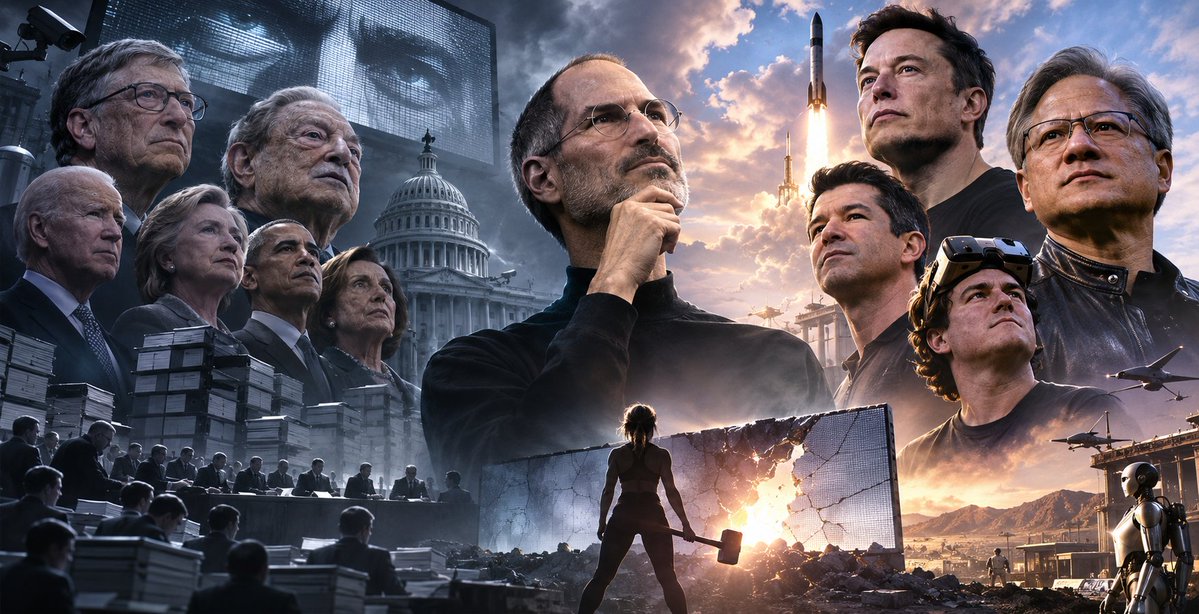
A gray hall. Rows of shaven-headed men in uniforms, marching in lockstep. On a giant screen, Big Brother recites a speech about uniformity. Suddenly, an athlete bursts in, chased by the thought police. She spins a hammer. She throws it. The screen explodes.
Then a line on a black screen: Macintosh is coming, and you'll see why 1984 won't be like "1984."
It wasn't an ad for a computer. It was a manifesto. The individual against the system. The creator against the bureaucratic machine.
And Jobs fought that fight his whole life. Against a lifelong rival: Bill Gates.
Jobs didn't just accuse Microsoft of copying. He accused it of a worldview. One line summed it up: the problem with Microsoft is they just have no taste. No taste, no vision, no soul. Products designed by committees, for committees.
Because that's what Jobs hated more than anything: bureaucracy.
In 2010, on stage with Walt Mossberg, he asked the audience a question. Do you know how many committees we have at Apple? Zero. Apple is organized like a startup. The biggest startup on the planet.
Zero committees. One person accountable per product. Ideas, not hierarchy.
Now look at what Bill Gates has become.
A foundation shaping health, agriculture and energy policy in dozens of countries. One of the largest funders of the WHO. Global conferences, task forces, expert committees, public-private partnerships. A world where nobody builds anymore, they coordinate. Where nobody launches products anymore, only programs. Where nobody voted for the people making the decisions.
Bill Gates has become the perfect embodiment of everything Steve Jobs hated.
That's why I'm convinced Jobs would be on the other side today. Not in the committees. Not in the agencies. On stage, throwing the hammer.
Because the battle of 1984 never ended. It just changed cast.
On one side, the bureaucrats. A Democratic Party that wants licenses, pauses and federal agencies to decide who gets to build. Bill Gates and his global committees. Soros and his billion a year poured into NGOs, campaigns and institutions.
On the other, the builders.
Elon Musk. Jensen Huang. Palmer Luckey. Travis Kalanick.
And they all have one thing in common with Jobs: the system tried to throw them out.
Jobs was fired from his own company by a board, in favor of a manager brought in from Pepsi. Kalanick was pushed out of Uber by his investors. Luckey was fired from Facebook over a political donation. Musk has been fighting regulators for twenty years. And Jensen is living through the exact same thing, in real time, right in front of us.
None of them stopped. Jobs founded NeXT and Pixar, then came back to save Apple. Luckey founded Anduril. Musk built rockets the entire establishment said were impossible.
And the day Apple fired Jobs, nobody imagined he'd come back twelve years later and turn it into the most valuable company in the world.
Keep that in mind as you watch what's happening to Jensen.
Today, the giant screen isn't called IBM anymore. It's called licenses, committees, federal agencies, moratoriums. And the question Jobs asked on stage is back, more urgent than ever.
Was Orwell right?
The answer depends on one thing.
Whether anyone will still be allowed to throw the hammer.
Best zot om te zien. De CEO van het Belgische EnergyVision dreigt met een exit van de beurs van Brussel als de effectentaks ingevoerd zal worden op aandelen op naam. En hij heeft in mijn ogen trouwens volledig gelijk.
Voor wie geïnteresseerd is, heb ik hieronder de oproep gezet die de CEO van EnergyVision zonet op zijn persoonlijk account heeft gepost (hij is hier niet actief) samen met zijn correspondentie met @conner_rousseau. EnergyVision was vorig jaar de meest succesvolle beursgang van de Brusselse beurs in jaren. Dat men na 1 jaar al van de Brusselse beurs zou verdwijnen zou ongezien zijn.
Hieronder de tekst:
Ja, volgens De Rijkste Belgen hoor ik bij de honderd rijkste landgenoten.
En ja, ik vind absoluut dat de sterkste schouders moeten bijdragen.
Maar neen, ik heb geen miljoenen op mijn bankrekening.
En ja, ik ben failliet als doorgaat wat de regering-Bart De Wever volgens de kranten gaat doen. En onze medewerkers van het eerste uur ook.
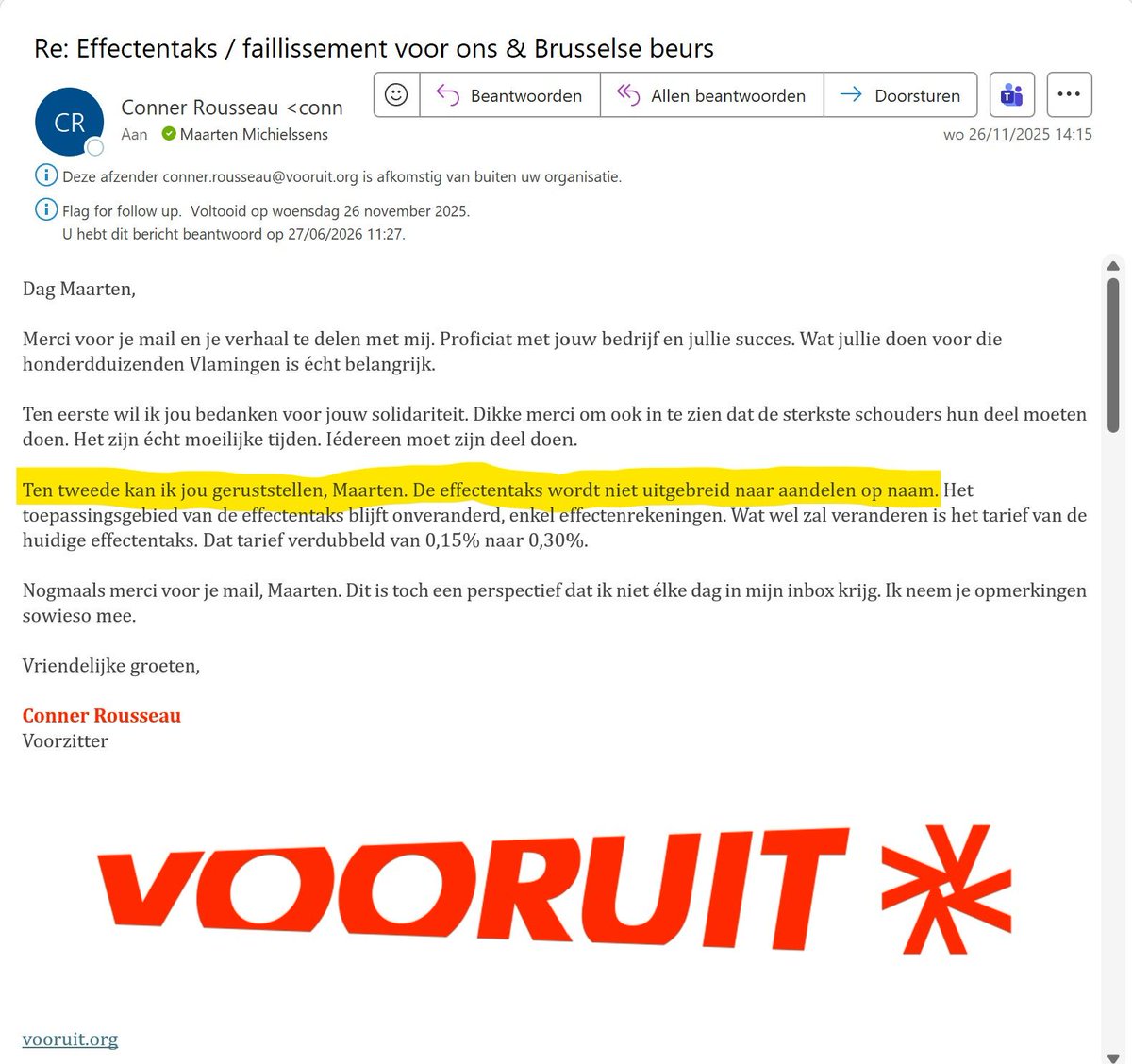
De regering zou een effectentaks willen heffen op aandelen op naam voor beursgenoteerde bedrijven. Exact een jaar geleden heb ik daar nachten van wakker gelegen, maar Conner Rousseau Officieel himself bevestigde dat die er niet zou komen (je ziet de mail hier). En nu ligt dat toch weer op tafel?
Ik heb nul problemen met een meerwaardebelasting als je aandelen verkoopt – wat mij betreft mag die gerust omhoog. Maar papieren vermogen belasten, dat is een waanzinnig slecht idee.
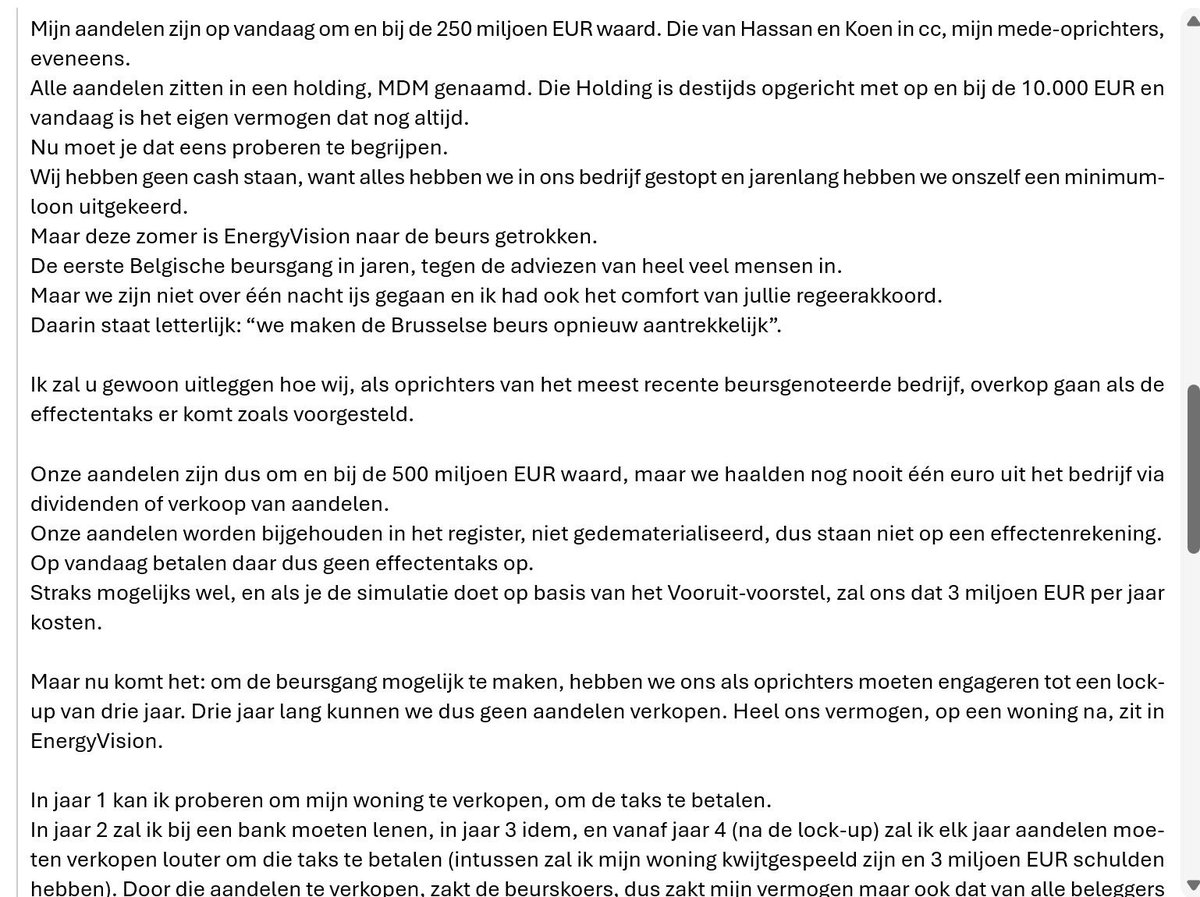
De oprichters (Koen, Hassan en ik) hebben voor intussen 700 miljoen EUR aandelen in EnergyVision. Die aandelen kunnen we jarenlang niet verkopen (lock-up getekend bij beursgang). Maar we zouden er wel miljoenen EUR per jaar voor moeten betalen. Geld dat we niet hebben: ik heb één gezinswoning, één wagen en 70.000 EUR op mijn spaarrekening. Mijn hele vermogen zit in de uitbouw van EnergyVision.
Of neem onze eerste medewerkers: die kregen tien jaar terug opties, die intussen miljoenenpakketten in aandelen betekenen. Ook zij kunnen die niet verkopen wegens lock-up, maar gaan straks wel een effectentaks betalen?
En los van ons: kijk naar andere Belgische small- of midcap bedrijven. Strategische aandeelhouders in bedrijven, die zich inkopen om een bedrijf te redden en er daarna volop in werken – met heel hun vermogen en al hun aandacht – moeten straks effectentaks betalen en dus aandelen verkopen om die te kunnen betalen?
Beste regering. Verhoog gerust de meerwaardebelasting. Ik denk dat ondernemers van mijn generatie of jonger daar NUL problemen mee hebben. Maar belast geen papieren vermogen. Dan heb je wellicht geen volgende TechWolf meer. Dan komt Aikido Security wellicht niet naar de beurs. Dan gaat EnergyVision noodgedwongen weg van de beurs (of ben ik persoonlijk failliet).
We gaan Euronext Brussel aantrekkelijk maken, stond in het regeerakkoord. Wat kregen we sindsdien: een meerwaardebelasting, een verdubbeling van de effectentaks, en nu ligt een uitbreiding naar aandelen op naam op tafel. Ik zou het op onze volgende Raad van Bestuur willen hebben over onze groeiplannen, hoe we de uitverkoop van onze energiemarkt stoppen en terugbuigen, over hoe we dé Belgische speler in energie kunnen worden. Maar zoals het nu voorligt, gaat onze volgende Raad van Bestuur over onze beursexit.
Bron: Maarten Michielssens, founder en CEO bij EnergyVision
@MasterMaliq They are part of a plan even if they’re not aware of it or intend to help execute the plan. Cause the extremist minority will do that through infiltration in political and legal systems on the one hand and the black economy and street violence and intimidation on the other hand