🚨Is America under ATTACK?
New reports show MAJOR outages across Walmart, Target, Chipotle, Skechers and other major companies, leaving employees locked out of critical HR systems.
Millions of workers are unable to access pay information, timekeeping, leave and benefits systems as Workday, the infrastructure powering these systems, reports severe outages.
Workday says the disruption began after an issue surfaced while testing its backup systems, leaving some data in an "inconsistent state."
The disruption spans a platform used by more than 11,500 organizations, including major corporations and public institutions.
Email. Flights. And now payroll and HR.
The chain of events over the past few days is just unbelievable.
First came Microsoft's BIGGEST outage in recent times.
Then came the FAA grounding, with more than 7,000 flights delayed or cancelled in what was only the second nationwide ground stop since September 11.
All these events are beginning to look suspiciously like a coordinated cyberattack.
However, the companies involved have ruled out cyberattacks, while the US government maintains that the incidents are not connected.
The scale of these disruptions in such a short span has the nation questioning just how prepared its critical infrastructure really is, especially after months of government warnings about the need for "emergency preparedness."
🧵 THAILAND IS BRINGING CRYPTO INTO EVERYDAY PAYMENTS.
The new WORPT app lets tourists convert USDT and USDC into Thai Baht and pay merchants through PromptPay.
But there’s a bigger story behind this Everyday Payments app.
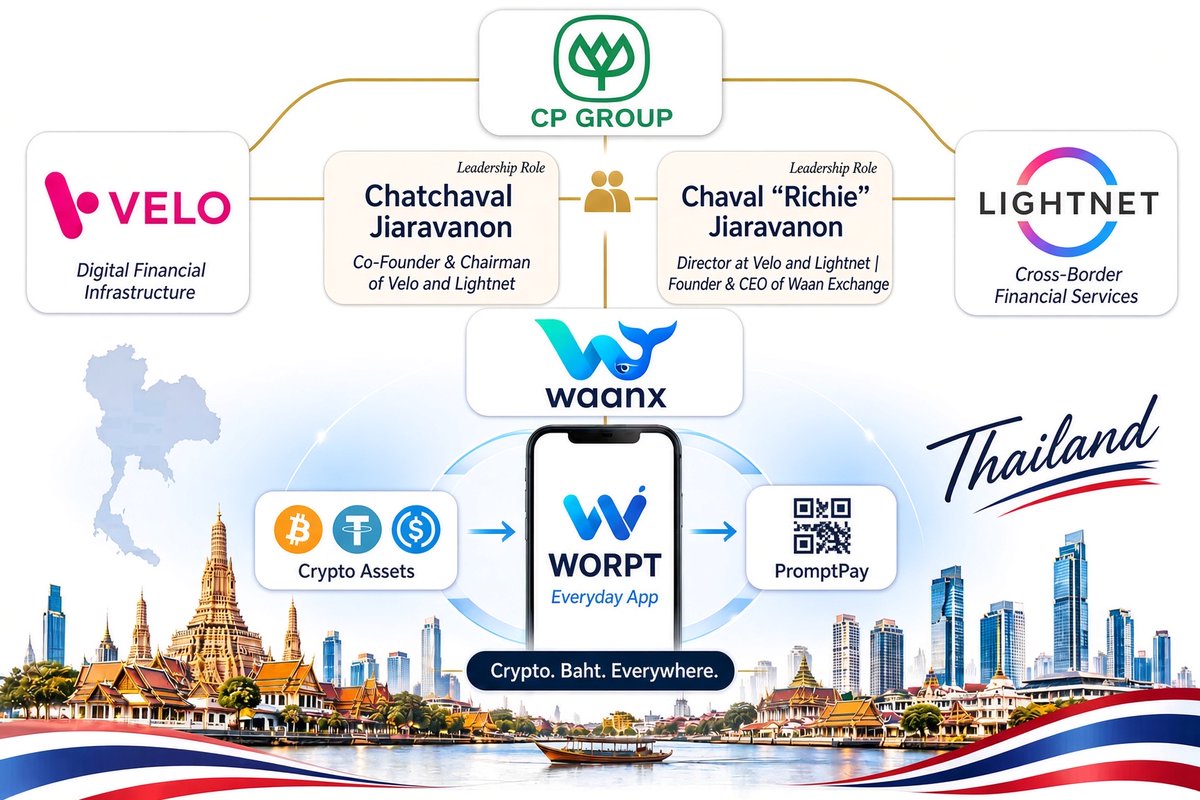
It connects to the Jiaravanon family through Chaval Jiaravanon, whose business background also links him to @veloprotocol and @lightnetgroup.
And there is another important connection: WaanX previously appointed Rakkar as its digital asset custodian. Rakkar was later acquired by Astra Enterprise.
Here’s how the pieces fit together. 👇
Thailand is taking another step towards connecting digital assets with everyday payments.
WORPT, launched under the country’s Tourist DigiPay Regulatory Sandbox, allows foreign visitors to convert supported crypto assets into Thai Baht and pay participating merchants using Thailand’s PromptPay QR system.
No Thai bank account required.
The process is straightforward:
Tourists deposit supported USDT or USDC into the app.
The crypto is converted into Thai Baht, which is then used to pay merchants through PromptPay.
Merchants receive Baht, not cryptocurrency.
This is a regulated payment use case, not simply another crypto wallet.
Two companies are at the centre of the app:
@WaanExchange (WaanX), a Thai SEC-licensed digital asset exchange and broker, and WiPay, which provides the e-money and payment infrastructure.
The platform was developed with HashPay.
Now comes the interesting connection.
Waan Exchange was founded by Chaval Jiaravanon, who is also listed as the company’s CEO.
And Chaval is the son of Chatchaval Jiaravanon, a Thai businessman from the Chearavanont family, the family behind @CPGroup_Live.
This is a documented family connection, not just a name coincidence.
Chaval’s professional background also reaches into the digital asset infrastructure ecosystem.
His profile at Infinity Ventures Crypto lists previous roles including:
• Chief Digital Officer at @lightnetgroup
• Director at @Velo
• CEO of Snapask Thailand
These are relevant connections when looking at the wider network around digital payments and financial infrastructure.
There is also a direct business connection between WaanX and Rakkar.
In August 2024, Waan Exchange appointed Rakkar as its digital asset custodian.
The announcement included a statement from Chaval Jiaravanon himself.
This means the WaanX–Rakkar connection goes beyond overlapping people or family relationships. It was an actual documented business arrangement.
And here is where Astra enters the picture.
In 2026, Astra Enterprise acquired Rakkar Digital, a Thai-licensed digital asset custodian.
Chatchaval Jiaravanon is Co-Founder & Chairman at @lightnetgroup and @veloprotocol and Chairman at @Astratreasury.
So a company that previously served as custodian for Chaval’s WaanX is now part of Astra’s digital asset infrastructure portfolio.
The timeline is worth noting: the WaanX appointment dates back to 2024, before Astra’s acquisition.
Look at the broader picture:
WORPT connects crypto conversion with Thailand’s existing PromptPay payment network.
WaanX provides the regulated digital asset exchange component.
WiPay provides the payment and e-money layer.
Chaval connects WaanX to the wider Lightnet and Velo ecosystem through his professional background.
And the historical WaanX–Rakkar relationship creates another documented link to Astra and Chatchaval.
This does not mean Velo, Lightnet or Astra operate WORPT.
Nor does the historical custody appointment establish that the same arrangement remains in place today.
But the connections are worth following.
Thailand is moving digital assets closer to everyday payments, while people and companies connected to an established Southeast Asian financial infrastructure network are building across several parts of the ecosystem.
The interesting part may be how these separate pieces evolve from here.
@Pure8Nature@CristianIonita6@ChartNerdTA
🇩🇪 Mercedes-Benz is stopping all new investments in Germany and considering closing factories.
The problem? Building cars in Germany has become too expensive, and the company can't agree with unions on how to cut labor costs.
Management has been pushing for months to bring those costs down, even warning in September that two factories could shut if nothing changed.
Now that possibility is getting more serious.
Mercedes says it wants to avoid closing factories, but without a deal on costs, it's running out of options.
Source: Reuters / Writer: Daniyal
🚨BLOODBATH IN CRYPTO: Bitcoin nukes below $68,000 and Ethereum falls below $1,900 for the first time in 3 months.
Bitcoin crashes nearly -10% in less than 48 hours wiping out nearly $200,000,000,000 from the Total Crypto Market cap.
Could the news be much more dramatic? History teaches that an AI crash is likely. But clues from manias past suggest it would not be a financial cataclysm https://t.co/3x8rt21WS0
We are advancing our multi-chain strategy with plans to connect the DTCC Tokenization Service with @solana, expanding network choice for market participants.
DTC-tokenized assets are expected to be available on Solana in the second half of 2027. ➡️ https://t.co/OdWc9KDeQS
Mientras todos miran el precio y se tiran de los pelos, esto ha pasado hoy y casi nadie lo ha visto.
Mastercard acaba de lanzar su Global Money Platform: pagos financiados en stablecoins que se liquidan directamente en cuentas bancarias locales de 11 divisas. Pesos mexicanos, reales brasileños, pesos argentinos, pesos chilenos, pesos colombianos... Una sola integración y el dinero digital se convierte en dinero de tu banco.
¿Y por qué me importa esto a mí como inversor?
Porque la plataforma la mueve BVNK, la empresa que Mastercard compró este año por 1.800 millones de dólares. Y BVNK no es una desconocida:
1- Soporta XRP de forma NATIVA en su infraestructura (depósitos y pagos salientes, está en su documentación técnica)
2- Colabora con Ripple desde 2024 llevando la liquidez de RLUSD a usuarios finales
3- Las dos participan en el Multi-Token Network de Mastercard, el programa donde se construyen los raíles de pago blockchain
Y el dato que lo corona: Mastercard ya abrió su liquidación a seis stablecoins reguladas. Entre ellas, RLUSD.
Traducción: el mayor procesador de pagos del planeta se ha comprado la fontanería, la ha enchufado a Latinoamérica, y la stablecoin de Ripple ya corre por esos raíles.
Esto es lo que me fascina de los mercados. Cuando el precio sube, todo el mundo celebra noticias que no valen nada. Cuando el precio cae, nadie mira las noticias que lo valen todo.
Hoy da miedo comprar. Lo sé. A mí también me cuesta darle al botón cada día.
Pero la utilidad no espera a que tengas ganas. La adopción no mira tu cartera en rojo. Mastercard no construye plataformas de 1.800 millones para el precio de esta semana: las construye para los volúmenes de la próxima década.
Y justo ahí, por detrás, cuando nadie mira... es cuando todo empieza.
🚨 NEW: The Bank for International Settlements (BIS) just released a global liquidity stress-testing tool covering nearly 13,000 banks in 100+ economies, about $170 trillion in assets.
The paper warns digital bank runs can unfold in hours, challenging Basel III liquidity rules.
🚨BREAKING: MSCI officially removes Michael Saylor’s Strategy from its global indexes.
The removal takes effect at the close on November 30, per MSCI.
Funds tracking MSCI indexes hold about 13 MILLION Strategy shares, roughly 3.1% of the company, per Strategy.
At today’s $122.35 close, that’s about $1.6 BILLION, close to 60% of a normal day’s trading in the stock.
🇯🇵 SoftBank’s CEO, of Japan, says the latest OpenAI model found 35,000 security vulnerabilities in the company’s systems, overwhelming its team 😨
An earlier scan found 10,500 issues across 700 systems, taking 3 months to fix.
In October, hackers also breached SoftBank’s cloud division through unscanned open-source code.
The company now faces up to 700M cyberattack attempts per month, twice last year’s volume!
The numbers show how AI is exposing security flaws faster than companies can fix them.
Writer: Lucas
Traducción:
El motivo de que tu dinero no esté en el banco, no es culpa de ellos…
…es culpa de los ciberataques, del calentamiento global.
De cualquier cosa menos de su gestión.
Chinese Machine Plants Seedlings Automatically, Reducing Labor Across Vast Fields
In vast farmlands, planting no longer relies solely on manual labor.
CHINA has developed a machine that automatically plants seedlings, completing in a short time what once required significant effort and long hours, while enabling large areas to be cultivated quickly and efficiently.
A practical innovation that directly benefits farmers, proving that the most useful technology is the one that reduces workload and boosts productivity.