A robotics researcher can have a promising idea and still be unable to test it.
Not because the model architecture is wrong.
Not because the hypothesis is weak.
But because generating the physical experience needed to evaluate that idea requires hardware, operators, environments, and time.
This is one of the less visible bottlenecks in Physical AI research.
In software-based machine learning, a researcher can often download a dataset, reproduce a benchmark, and begin experimenting.
Robotics introduces another layer of complexity.
Real-world demonstrations require physical robots, reliable control systems, carefully designed tasks, and consistent data collection procedures.
And not every research lab has the resources to build that infrastructure from scratch.
This is why @PrismaXai's newly announced University Research Program is interesting.
The program offers selected university research projects free access to existing robotics datasets or customized data collection tailored to their research objectives.
Instead of forcing every team to establish its own collection operation, PrismaX can provide recorded experience across different tasks, environments, and robot embodiments.
The distinction between existing data and custom collection is important.
A researcher studying general robot manipulation might benefit from a broad collection of demonstrations.
But a team investigating a specific failure mode, embodiment, or control strategy may need something much more targeted.
PrismaX's program is designed to support both approaches.
The company has also announced its involvement with UPenn's GRASP Lab capstone program, where real-world YAM robotics data supports research exploring reinforcement learning for adaptive robot policies.
That collaboration is still research in progress, not evidence of a completed breakthrough.
But it illustrates a useful division of work.
Data infrastructure providers can specialize in capturing and organizing physical experience.
Research teams can concentrate on developing algorithms, evaluating hypotheses, and understanding why particular policies succeed or fail.
There is another important detail in the program's terms.
For selected projects, PrismaX says it takes no equity, requires no exclusivity, and makes no claim on the models researchers train.
Researchers can also publish papers, release checkpoints, and share episodes as benchmarks, with attribution.
That opens the possibility of a broader research feedback loop.
A dataset supports an experiment.
The experiment produces findings.
Those findings can reveal new weaknesses, new benchmarks, or new requirements for future data collection.
And the resulting knowledge can become useful beyond the original research team.
Of course, providing data does not automatically solve robotics research.
Hardware differences, simulator limitations, evaluation quality, and model generalization remain difficult problems.
But removing part of the data-access burden can allow more researchers to focus on those questions directly.
The deeper lesson is that progress in Physical AI depends on more than better models.
It also depends on who has access to the physical experience needed to develop and evaluate them.
The next robotics breakthrough may not be waiting for a larger model.
It may be waiting for a researcher to get the right data.
A lower validation loss does not guarantee a robot can complete the task.
In machine learning, we often judge training progress through a familiar set of signals.
The loss decreases.
The checkpoint improves on held-out data.
The training curves look healthy.
But a robot does not operate inside a loss function.
It operates in a physical environment where small errors can accumulate into failed actions.
A model might predict actions that closely resemble recorded demonstrations and still struggle when those predictions are executed in a continuous control loop.
The gripper might approach correctly but close too early.
The robot might lift an object successfully but miss the target container.
Or a small change in lighting might cause an otherwise promising policy to fail.
This creates a difficult question for Physical AI researchers.
How do you know whether a checkpoint is actually getting better at the task?
@PrismaXai explored this problem while developing the π0.5 models behind its IROS 2026 demonstration.
Rather than relying exclusively on offline evaluation metrics, the team built a custom simulation environment called yamulator.
It combines MuJoCo-based contact physics, a robot control implementation derived from the deployment scripts, and a pathtraced renderer with physically based materials and lighting.
The result is an environment where trained policies can be evaluated through simulated task execution.
Instead of asking only how closely a model's predictions match recorded actions, researchers can examine whether those actions achieve the intended outcome.
Did the robot grasp the object?
Did it place the object into the container?
How long did the grasp take?
And what happens when the environment changes?
According to PrismaX, this setup allows thousands of simulation tests per day, including experiments involving lighting, camera placement, clutter, and hardware configuration.
That changes the economics of evaluating robotics models.
A research team can investigate potential weaknesses across many controlled conditions without requiring a physical robot to execute every experiment.
It also creates a tighter relationship between training and evaluation.
When a checkpoint fails under a particular condition, researchers can use that information to reconsider training settings, select a different checkpoint, or investigate gaps in the dataset.
PrismaX argues that simulated rollout performance is a more useful proxy for real-world performance than evaluation loss alone, helping researchers make better training decisions and avoid unnecessary GPU hours.
But simulation has its own limitations.
The team acknowledges that its simulated deployments generally perform better than real ones.
Physical robots introduce effects that a simplified simulator may not fully capture: joint friction, mechanical backlash, camera misalignment, and communication latency.
So simulation should not be confused with proof of real-world reliability.
Its value lies in making experimentation faster, more repeatable, and more informative before deployment.
The deeper point is that robotics evaluation should not end at predicting the right action.
It needs to examine what happens when the robot actually tries to execute that action.
A loss curve tells you how training is progressing.
A rollout tells you what the robot can actually do in the tested environment.
tokenizing a financial asset doesn't automatically create a functioning onchain financial system.
a tokenized money market fund might bring an investment product onto blockchain infrastructure, but institutions still need a reliable way to move capital into and out of that product. subscriptions, settlement, redemptions, and liquidity management all depend on how the investment side connects with the money side.
that's what makes the recent agreement between BlackRock, SBI Holdings, and @StartaleGroup worth examining.
the three companies have signed an MOU to explore connecting tokenized money market funds with JPYSC, a yen-denominated trust-type stablecoin developed by Startale and SBI.
the distinction between these two instruments matters.
a tokenized MMF represents an investment position, while a stablecoin can serve as the digital money used to transfer value and settle transactions. both can exist onchain independently, but simply tokenizing them doesn't solve the infrastructure needed to make them work together.
the collaboration is focused on exactly those missing connections: technical infrastructure, business and distribution models, and the regulatory conditions required to support integration.
if developed successfully, this could create a more seamless relationship between investment assets and digital cash. institutions could potentially move between the two within more connected financial workflows, rather than relying on completely separate systems for asset management and settlement.
but there's an important boundary between the announcement and the outcome.
this is still an exploratory agreement, not a launched financial product. no specific BlackRock fund, blockchain deployment, or implementation timeline has been announced.
and that distinction makes the broader strategy more interesting.
Startale isn't only working on bringing regulated yen onto blockchain infrastructure through JPYSC. it's also exploring where that digital money could connect with existing financial markets.
the next challenge in onchain finance isn't simply creating more tokenized assets or more stablecoins.
it's building the infrastructure that allows assets and money to interact as parts of the same financial system.
Teaching a robot how to move is not the same as teaching it how to understand what it sees.
When fine-tuning a Vision Language Action model, an attractive shortcut is to train only the component responsible for generating actions.
It's faster, cheaper, and requires considerably less GPU memory than updating the entire network.
But what happens when the robot also needs to adapt how it interprets its environment?
This is an important question explored in @PrismaXai's recent π0.5 fine-tuning research.
The team trained models using 668 episodes, approximately 10 hours of YAM robot pick-and-place demonstrations, and evaluated the resulting checkpoints in a custom simulator.
They compared three approaches:
Expert only fine-tuning: Update the action expert while keeping the larger backbone frozen.
Full parameter fine-tuning: Update the entire model.
LoRA fine-tuning: Adapt selected parameters efficiently, without updating every original weight.
The results revealed a substantial difference.
In the reported simulation benchmark, expert-only training achieved a 51% pickup success rate but only 12% successful dropoffs into a container.
Full fine-tuning reached 89% pickup success and 53% dropoff success.
The LoRA checkpoint achieved 84% pickup success and 59% dropoff success.
The important observation is not that LoRA universally outperforms full fine-tuning. These are results from one experimental setup.
The more interesting finding is how much performance was left on the table when adaptation was restricted to the action expert.
The distinction became even more apparent under challenging lighting conditions.
When the team introduced harder shadows, the expert-only checkpoint deteriorated significantly, while the full fine-tuning and LoRA approaches maintained much stronger performance.
This suggests that adapting a robotics policy is not simply about improving the mapping from existing representations to motor commands.
The representations used by the policy can matter just as much.
A robot must understand relevant objects, spatial relationships, and visual conditions before its action-generating components can execute the right movements.
And those capabilities cannot always be adapted effectively by training the action expert alone.
But full fine-tuning comes with a cost.
PrismaX reports that training the backbone was roughly four times slower than expert-only training and placed substantially greater demands on GPU memory.
LoRA offered an interesting middle ground in these experiments: competitive task performance with substantially lower memory requirements.
That creates a more useful question for Physical AI researchers.
Not simply:
How many parameters can we afford to train?
But:
Which parts of the model actually need to adapt for the task?
The answer depends on the model, dataset, and deployment conditions.
For PrismaX's tested π0.5 setup, restricting learning to the action expert was not enough.
A robot needs more than a policy that knows how to move.
It needs representations that support the right movement in the first place.
A robotics model can be blocked by hardware limits that have little to do with its actual intelligence.
When a model requires more GPU memory than a machine can provide, the usual options are familiar.
Buy a larger GPU.
Reduce numerical precision.
Compress the model.
Or accept slower execution by moving parts of the workload elsewhere.
But there is another possibility.
What if the software is holding memory it no longer needs?
This is the problem @PrismaXai recently addressed while optimizing its π0.5 robotics inference stack.
After previously reducing inference latency, the team turned its attention to GPU memory consumption.
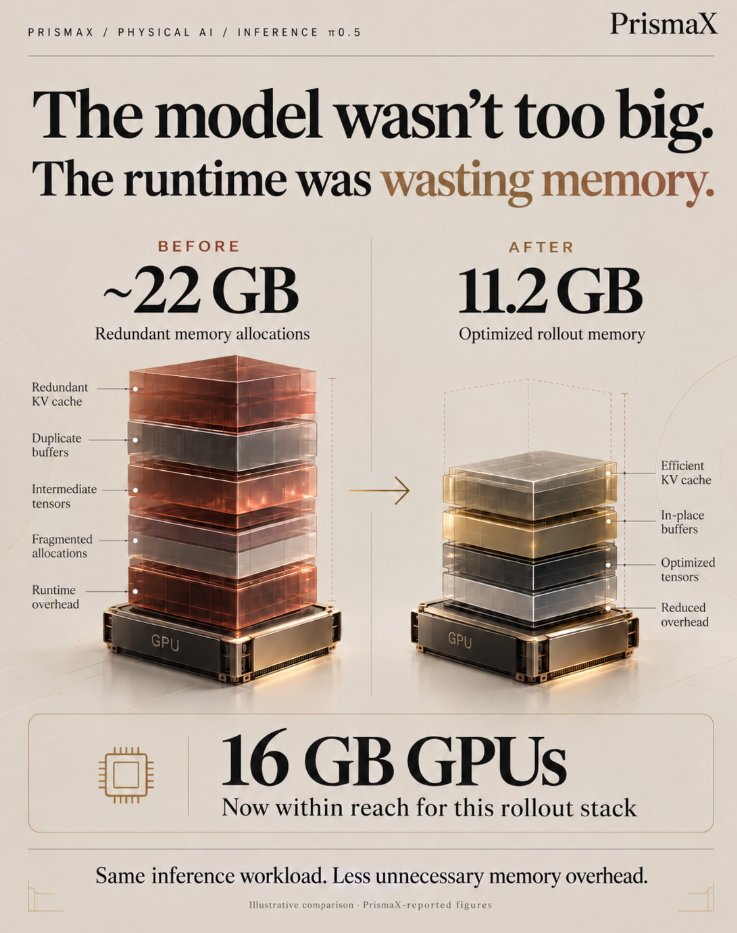
The initial rollout stack occupied approximately 22 GB of VRAM.
That requirement limited deployment to GPUs with enough memory to accommodate the entire runtime.
But a significant portion of the footprint came from implementation decisions rather than an unavoidable requirement of the model itself.
PrismaX identified two opportunities to eliminate unnecessary allocations.
First, the model-loading process was creating a temporary full-precision backbone that increased peak memory consumption.
Second, PyTorch model copies could remain allocated alongside TensorRT inference engines, keeping redundant representations in GPU memory.
Removing these unnecessary allocations reduced the reported footprint from approximately 22 GB to 11.2 GB.
That is nearly half the original VRAM requirement.
More importantly, it changed the hardware requirements of the deployment.
A rollout that previously needed roughly 22 GB of GPU memory could now fit within the memory budget of certain 16 GB consumer GPUs.
That matters for Physical AI.
Robotics development is not limited by model quality alone. Teams also need affordable hardware capable of running policies close to the machines they control.
Every unnecessary GPU allocation increases the cost and complexity of experimentation.
Reducing memory overhead can make the same inference workload accessible to more developers without requiring an entirely new model architecture.
But there is an important distinction.
Reducing runtime memory is not the same as shrinking the model.
The optimization targets how the software loads and maintains the model during execution, rather than claiming the model has become fundamentally smaller or more intelligent.
And fitting within a GPU's memory budget does not automatically guarantee acceptable latency or real-world control performance.
Those are separate engineering constraints.
Still, the broader lesson is valuable.
Before assuming a robotics model requires more expensive hardware, it is worth understanding how much of the available memory is actually serving the computation.
For Physical AI, deployment efficiency is not only about how powerful a GPU is.
It is also about how intelligently the software uses it.
Sometimes the model is not too large for the hardware.
The runtime is simply carrying too much unnecessary weight.
A robot can have a capable AI model and still behave poorly because the software around it is too slow.
When a robot hesitates, overshoots a target, or struggles to correct its movements, it is tempting to blame the model.
Maybe it needs better demonstrations, more training, or a larger architecture.
But sometimes the problem is not what the model has learned.
It is how quickly the system allows that intelligence to act.
This is an interesting finding from @PrismaXai's recent work on π0.5 rollout performance.
While optimizing the inference pipeline behind its IROS demonstration, the team discovered that a Python pipe buffer was holding camera frames until approximately 64 KB of data accumulated.
That seemingly ordinary software behavior introduced hundreds of milliseconds of additional delay into the robot's control loop.
The robot was not necessarily responding to the world as it existed in that moment. It could be acting on observations that had already become stale.
And in Physical AI, stale information matters.
A robot approaching an object needs to observe its position, generate an action, execute it, and use new observations to correct its trajectory.
Delay that feedback loop, and even a capable policy can struggle to execute precise movements.
PrismaX addressed latency across several parts of its rollout stack, including camera buffering, inference execution, GPU optimization, and numerical precision.
The team reports reducing π0.5 inference time from 230 ms to 87 ms on a laptop GPU, without model pruning or distillation.
But the most interesting result was not simply the faster benchmark.
According to PrismaX, the robot's behavior became more deliberate.
Instead of relying on slower, less responsive movements, the policy began exhibiting action patterns resembling skilled human demonstrations: approaching quickly, pausing to inspect the gripper, making small corrections, and completing the grasp.
That reveals an important distinction.
A robotics model does not operate in isolation. Its real-world performance depends on the entire perception-to-action pipeline.
Camera capture, buffering, inference, communication, and control execution all influence how effectively learned intelligence becomes physical behavior.
Improving those systems does not automatically make every model more capable.
But it can remove bottlenecks that prevent an existing model from expressing capabilities it has already learned.
For Physical AI, model intelligence and execution responsiveness cannot be treated as separate problems.
Sometimes the robot doesn't need to learn more.
It needs the system to stop making it wait.