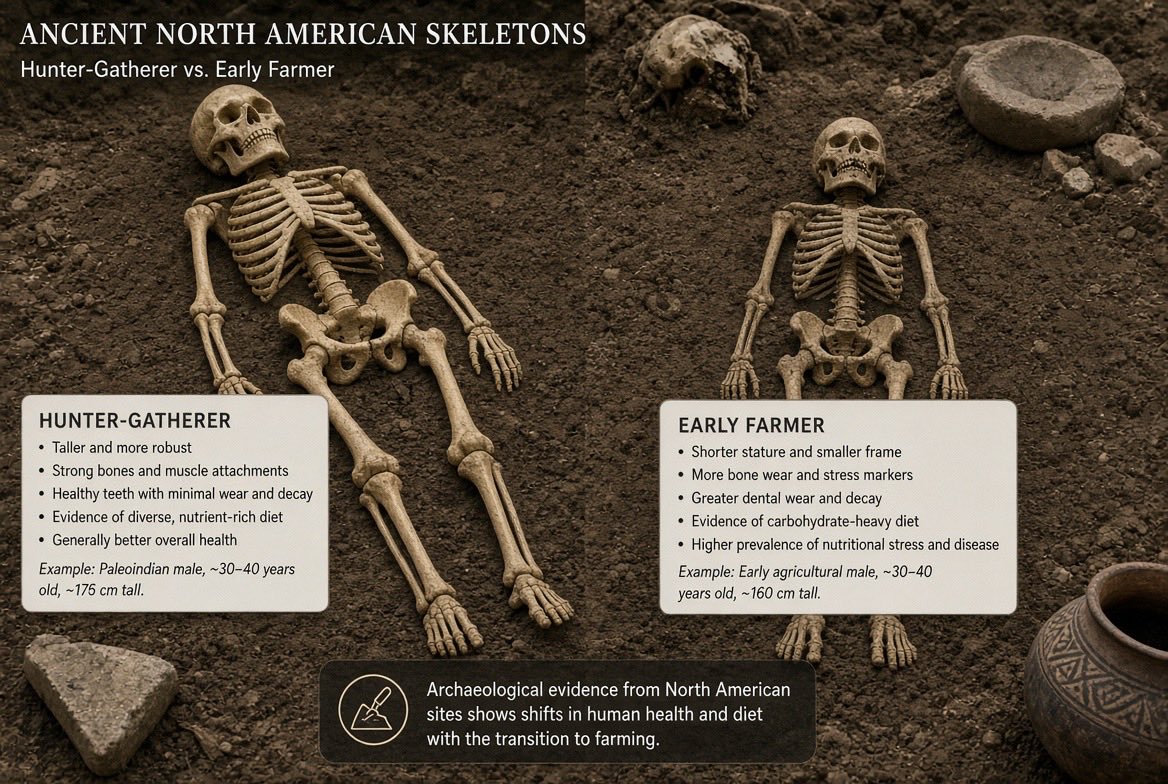
When humans left hunting and gathering for grain agriculture, the skeletons tell the story. Average height dropped several inches. Dental disease, anemia, and infectious disease rates rose sharply. The new “have-nots”—the early farmers—were shorter, weaker, and sicker than the meat-eating populations they replaced. The ones who kept access to animal foods stayed taller and more robust.
The pattern held for thousands of years. Pastoralists and warriors who ate meat and animal fat consistently outperformed the grain-dependent peasantry in strength and health. Grain was what you ate when meat was scarce or deliberately withheld.
Today the labels have flipped, but the biology has not. Modern elites fund and promote observational studies that downplay meat while elevating grains, seed oils, and ultra-processed carbohydrates as the virtuous choice for everyone else. The same playbook that once kept peasants on bread now uses manipulated science to convince the public that the foods of scarcity are actually optimal.
Meat was never the luxury. Grain was the compromise.
The US presidency is the most dangerous office in the world.
Here are the top 3 best and worst presidents ever:
Let's start with the best:
1. Grover Cleveland vetoed 414 bills in his first term alone, including congressional handouts to drought-stricken Texas farmers in 1887, on the grounds that the Constitution authorized no such charity. He was right.
2. Warren Harding inherited the sharp 1920-21 depression and did almost nothing, cutting federal spending from $6.4 billion to $3.3 billion and slashing tax rates. The economy recovered within eighteen months, precisely because Washington stepped aside.
3. John Tyler, largely forgotten today, vetoed a national bank bill twice, endured expulsion from the Whig Party, and refused to let Henry Clay transform the Treasury into a political instrument.
These three men share a rare quality: they treated the federal government as a cage, not a tool.
Now the worst.
3. Abraham Lincoln suspended habeas corpus, imprisoned 14,000 political opponents without trial, shut down opposition newspapers, and conscripted men at gunpoint. The war's financing required the Legal Tender Acts of 1862, which forced irredeemable paper greenbacks on US citizens regardless of what contracts previously specified. Centralization of federal power over the states never fully reversed after 1865. The constitutional republic that emerged was a different animal from the one that entered.
2. Woodrow Wilson delivered the Federal Reserve in 1913, the income tax through the Sixteenth Amendment, the military draft, and the Espionage Act, which could imprison anyone for criticizing the war. He segregated the federal civil service. He took the country into a European slaughter with a propaganda apparatus, the Committee on Public Information, designed to manufacture consent. Every major expansion of state power in the twentieth century traces a direct line back to Wilson's two terms.
1. Franklin Roosevelt gets the top prize for catastrophe. He criminalized gold ownership via Executive Order 6102 in 1933, forcing Americans to surrender their gold at $20.67 per ounce, then immediately revalued it to $35, confiscating roughly 41 percent of savings held in the hardest monetary form available. He extended a cyclical recession into a decade-long depression through the National Industrial Recovery Act, agricultural price controls, and relentless uncertainty about property rights. Businesses do not invest when the rules change by executive whim every quarter. Real unemployment never fell below 14 percent throughout the 1930s. He packed the Supreme Court when it resisted. The regulatory state you live inside today, with its 188,000 pages of federal rules, grew from seeds Roosevelt planted between 1933 and 1945.
Power corrupts budgets, currencies, and constitutions with equal efficiency. The best presidents understood their job was to leave you alone.
Murray Rothbard took Mises's price theory and drove it to a destination Mises never reached.
Mises built the case that central planning fails because socialist planners cannot perform rational economic calculation without real market prices. Prices carry information that no committee can replicate. Rothbard accepted every word of this and asked the obvious follow-up: if state intervention distorts prices and destroys coordination, why stop your critique at the water's edge? Why exempt the state itself from the logic?
The answer required property rights. Rothbard grounded everything in self-ownership. You own your body. By extension, you own what you mix your labor with, provided you homestead it from a prior unowned state. Every other right flows from this. Taxation is the seizure of your property under threat of imprisonment.
From that foundation, Rothbard constructed anarcho-capitalism systematically, not as a utopian dream but as the logical terminus of taking rights seriously. Defense, arbitration, contract enforcement: private firms supply all of it in a competitive market. His 1973 book "For a New Liberty" laid this out with unflinching precision. His 1982 "The Ethics of Liberty" supplied the philosophical scaffolding.
What Rothbard accomplished was a fusion, not a compromise. Mises gave him the economic engine. Locke and Lysander Spooner supplied the moral chassis. The result was a system where aggression has no legitimate institutional home, including Congress, including the Federal Reserve, including every bureaucrat drawing a salary your paycheck funded involuntarily.
Capitalism has a win condition. Socialism does not.
Here's why, explained so simply a 10-year-old could get it. It starts with a book written in 1944 by an Austrian economist named Friedrich Hayek: The Road to Serfdom.
Imagine a classroom of 30 kids. One day the teacher says: "From now on, I decide what everyone eats for lunch, which games you play at recess, and who sits next to whom. It's fairer that way."
First problem: the teacher doesn't know what you like. You hate carrots. Your friend is allergic to peanuts. Lucas wants to play football, Emma wants to draw. 30 kids, 30 different wishes. Nobody can know all of that, not even the smartest teacher on Earth. Hayek called this the knowledge problem. The information needed to run an economy is scattered across millions of heads, and it can't be gathered in one office.
Second problem: the kids start fighting. "Why does he get the window seat?" "Why football again?" Before, everyone just chose for themselves. Now every choice is a fight, because every choice is made for everyone.
Third problem: the class can't agree on a plan, so someone says "we need one person in charge who just decides." This is Hayek's key insight. Planning doesn't fail because planners are evil. A plan needs everyone to agree on the same goals, and free people never agree on everything. So the plan needs force to work.
Fourth problem, and it's the scariest one: who wants that job? The kind kid doesn't want it, because the kind kid doesn't want to force 29 people to eat carrots. The job attracts the one who likes giving orders and doesn't mind punishing those who disobey. Hayek wrote a whole chapter on this, called "Why the Worst Get on Top." It doesn't happen by accident. It happens by selection.
Here's the trap. When the person who controls your lunch also controls your job, your home, your shop and your newspaper, they control your whole life. You can't say no, because there's nowhere else to go. Controlling the economy doesn't mean controlling one part of life. It means controlling the means to every goal you have.
That's the road to serfdom. Nobody votes for a dictator. People vote for "someone should fix this," then for "give them more power to fix it," and one day they wake up with no one left to say no to.
The USSR, Maoist China, Cambodia, North Korea, Cuba, Venezuela. These are different countries with different cultures and languages, and the story has the same ending every time. When a script produces the same ending every time, it isn't bad luck. It's the script.
Now capitalism. Back to the classroom. Instead of one teacher deciding everything, every kid can trade. You give me your carrots, I give you my apple, and we both walk away happier. Nobody needs to know what everyone wants, because prices do that job. A price is a message telling millions of strangers what's scarce and what's wanted, with no one in charge.
That's the win condition. In capitalism, you get rich by making something other people freely choose to buy, so your success depends on serving others. In a planned system, you get ahead by pleasing whoever holds power. One rewards usefulness. The other rewards obedience.
And this isn't theory. Two centuries ago, almost every human being was extremely poor. In 1990, about 38% of humanity still lived in extreme poverty. Today it's under 10%. More than a billion people escaped it in a single generation. It happened when China, India, Vietnam and South Korea opened up to markets, trade and private enterprise. The largest reduction in poverty in human history came from letting people trade.
So why do so many people hate capitalism?
Because what they hate usually isn't capitalism.
They hate the bank that got bailed out with their taxes while they lost their house. They hate the giant company that writes the regulations so no startup can compete with it. They hate rent they can't afford because building new homes has been made nearly impossible. They hate the lobbyist who gets a subsidy while the small business owner drowns in paperwork.
Look closely at each one, and you'll find a state handing out privileges. A bailout is not the market. The market would have let the bank fail. A regulation written by incumbents is not competition. It's protection from competition. None of this is capitalism. It's cronyism, which is what happens when businesses stop competing for customers and start competing for politicians.
People see the symptom and blame the wrong cause. They say "capitalism failed" and ask for more state. That gives more power to the same people who created the problem, and it puts us right back on Hayek's road.
The answer to bad capitalism isn't less freedom. It's less privilege. That means fewer bailouts, fewer protected incumbents, fewer permits, and more people allowed to build, compete and trade.
Capitalism has a win condition: make things people want. Socialism has an end condition: someone has to be in charge. And history keeps showing us who ends up in that chair.
Senator George McGovern didn’t wait for the science. He pushed the low-fat guidelines anyway.
In 1977 his Senate Select Committee on Nutrition and Human Needs released Dietary Goals for the United States. It told Americans to cut fat from ~40% to 30% of calories, slash saturated fat, and load up on carbohydrates. The stated reason was heart disease.
The problem was the evidence. Randomized trials at the time did not show that cutting fat reduced heart attacks or death. Scientists testified that the data were incomplete and more research was needed before telling the public what to eat. McGovern’s response was blunt: “Senators don’t have the luxury that the research scientist does of waiting until every last shred of evidence is in.”
Industry pushed back and the report was softened, but the core message stuck. It became the foundation for the 1980 Dietary Guidelines and the decades of low-fat advice that followed. Obesity and metabolic disease climbed while the guidelines stayed in place.
A politician set national diet policy on incomplete evidence because he decided the public couldn’t wait. The results are still with us.
Bones dug up across North America tell a surprising story about the first farmers. Long before Europeans arrived, people who hunted and gathered wild foods left behind skeletons that were often taller and healthier than those of the early farmers who followed them.
Scientists have compared thousands of ancient skeletons from sites in the eastern United States, the Southwest, and other regions. Hunter-gatherers usually had longer bones, meaning they grew taller. Their teeth showed far fewer cavities. Signs of childhood stress and poor nutrition, such as porous bones in the skull that point to anemia, were also less common. When groups switched to growing corn and other crops, many of those health markers got worse. People became shorter on average. Tooth decay jumped because the new diet was heavy in starchy foods that stuck to teeth. More skeletons showed evidence of infection and nutritional shortfalls.
The change did not happen overnight, and not every group suffered equally. Some communities adapted better than others, and later farming societies sometimes recovered some of the lost height once they added more variety to their meals. Still, the overall pattern from the bones is clear. Relying more on crops and living in denser villages brought new problems that the older hunting-and-gathering way of life had largely avoided. Population numbers rose with farming, but individual health often declined for a time.
These findings come from careful study of real skeletal remains, not just theories. They show that the move to agriculture was a trade-off: more food in good years, but greater risk of disease and weaker bodies for many people.
The Inuit didn’t get old by eating plants.
Traditional Inuit diet was almost pure animal: seal, whale, fish, caribou, and the fat that came with them. Plant food was seasonal and minimal. Explorers who lived with them in the early 1900s (Stefansson and others) repeatedly noted the absence of the degenerative diseases common in the West at the time—no scurvy, little heart disease, strong teeth into later life, and people remaining active well into their 60s and 70s.
In an era when average life expectancy in Europe and North America was often in the 40s–50s (dragged down by infant mortality, infection, and hard labor), reaching 70+ on a near-zero-carbohydrate, high-fat animal diet was noteworthy. They didn’t have hospitals or modern medicine. They had meat, fat, and a climate that killed the weak early. The ones who made it to old age did so on the same foods their ancestors had eaten for centuries.
Modern contact changed the diet and the health outcomes. The traditional pattern is the one the early observers actually documented.
Why so many carnivores notice better joints
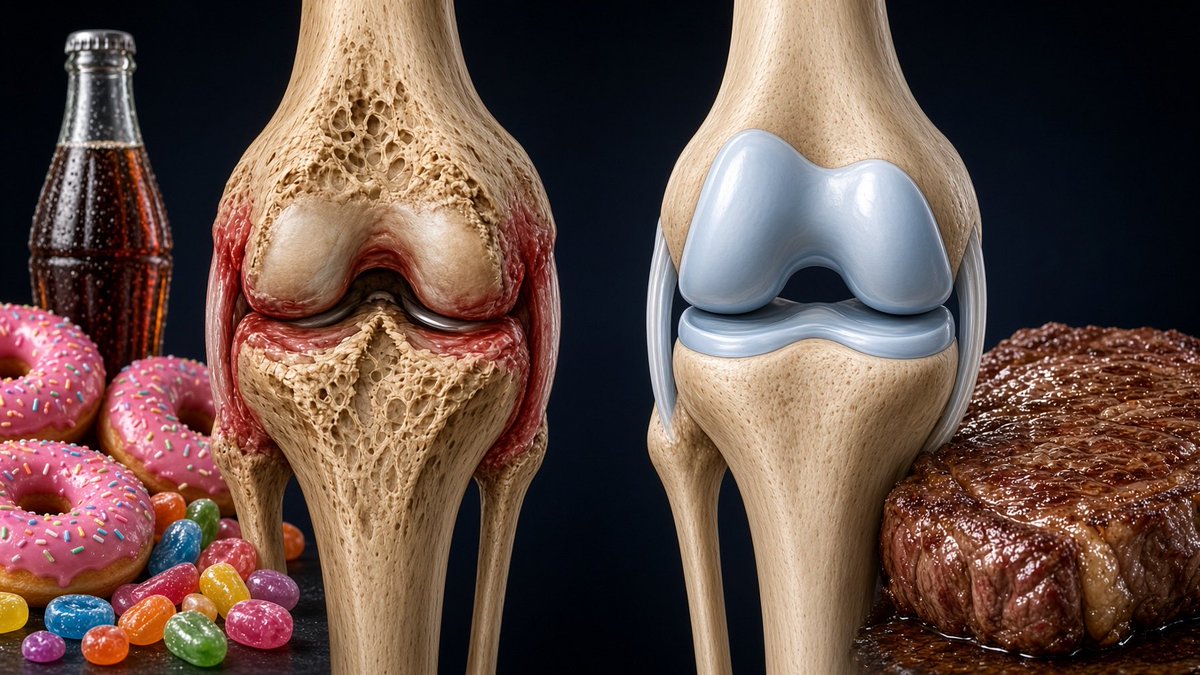
Cartilage ages mainly through glycation. Collagen in joint cartilage has a half-life measured in decades (estimates up to ~100 years in some tissues). Once formed, the cross-links from advanced glycation end-products (AGEs) stick around. The result is stiffer, less resilient cartilage that doesn’t glide or absorb load the way it used to. Most of those AGEs form endogenously from circulating glucose and reactive dicarbonyls, not from the meat on your plate.
Beef supplies a direct countermeasure: carnosine. This dipeptide is concentrated in muscle and acts as a sacrificial scavenger. It reacts with methylglyoxal and other carbonyls that would otherwise bind lysine and arginine residues on collagen, reducing new AGE cross-links and protein carbonylation. Human data show carnosine supplementation lowers circulating AGE markers and improves glucose handling in people with diabetes.
Eating the actual muscle delivers the compound in its natural matrix along with the protein and fat that support stable blood sugar.
On a carnivore diet two things happen at once. Endogenous glycation pressure drops because glucose stays lower and more stable, and you continuously supply carnosine that mops up the reactive intermediates that do form.
That combination plausibly slows the progressive stiffening of cartilage that most people accept as normal aging. It is not magic or a cure for advanced structural damage, but it is a coherent explanation for the repeated reports of less pain, better mobility, and fewer “old joints” once people stop eating the foods that keep glucose elevated all day.
L'homme qui a imposé la misère et le rationnement à tout un peuple au nom de l'égalité communiste vivait secrètement comme un milliardaire.
Dans les médias du monde entier, Fidel Castro s'est toujours présenté comme le commandant austère de la révolution. Il affirmait publiquement ne gagner qu'un salaire d'environ quarante dollars par mois et ne posséder aucune richesse personnelle.
Mais derrière la propagande officielle et le modeste treillis militaire se cachait un train de vie digne d'un monarque absolu.
Cette double vie a été révélée et documentée par une source intime : Juan Reinaldo Sánchez, qui a été le garde du corps personnel de Castro pendant dix-sept ans.
Dans son livre témoignage de 2014, La Vie cachée de Fidel Castro, l'ancien lieutenant-colonel détruit le mythe. Il révèle que le dictateur possédait une île privée et secrète, Cayo Piedra, située au large de la baie des Cochons.
Loin du peuple cubain qui subissait les pénuries, Castro s'y rendait à bord de l'Aquarama II, son luxueux yacht personnel.
Pour décrire cette propriété exclusive, Sánchez emploie les mots exacts de : « un paradis pour millionnaires ».
Dans son ouvrage, il détaille ce quotidien surréaliste en ces termes précis, évoquant un environnement fait de : « yacht, de parties de chasse sous-marine, piscine d'eau douce et une armée de gardes et de serviteurs ».
Cette accumulation de richesses occultes n'a pas échappé aux observateurs internationaux. En 2006, le prestigieux magazine financier américain Forbes a mené l'enquête sur la fortune des chefs d'État.
Leur conclusion a fait l'effet d'une bombe : Forbes a estimé la fortune personnelle de Fidel Castro à 900 millions de dollars.
D'où venait cet argent colossal ? Le magazine précise que le dirigeant s'appropriait directement les profits d'un vaste réseau d'entreprises d'État. Il contrôlait personnellement un immense conglomérat commercial (Cimex), un palais des congrès (El Palacio de Convenciones) et une entreprise d'exportation médicale (Medicuba), confondant purement et simplement le trésor national avec son portefeuille privé.
L'idole absolue de l'extrême-gauche mondiale exigeait de son peuple des sacrifices quotidiens pour détruire le capitalisme, tout en profitant secrètement de l'un des trains de vie les plus exclusifs et luxueux de la planète.
"You reduce crime by eliminating poverty."
This is one of the greatest intellectual confusions of our century. It sounds compassionate. It feels obvious. And the moment you actually test it, it falls apart.
Let's look at the data.
First, the correlation is real. Nobody serious denies that poorer areas have more crime. In Sweden, kids from the poorest 20% of families are about 7 times more likely to be convicted of a violent crime than kids from the richest 20%.
But correlation is not causation. So Swedish researchers did something brilliant: they compared siblings. Same parents, same home, same upbringing, but different family income at different points in their childhood, because parents' income moves over time.
Result, on more than 500,000 children (Sariaslan et al., British Journal of Psychiatry, 2014): once you account for what's shared inside the family, the effect of income on violent crime goes from 7x to nothing. The hazard ratio drops to 0.95. No effect.
Finland ran the same test on 650,000 people. Same result: the income-crime link disappears when you compare siblings.
What predicts crime isn't the bank balance. It's what travels inside families.
Second test: what happens when poverty spikes for everyone at once? 2008. US unemployment doubled from 5% to nearly 10%. 15% of Americans officially poor. If poverty creates crime, crime should have exploded. Instead it fell. Year after year. Robbery, the most "economic" crime of all, dropped 10% in 2010 alone. Criminologists literally said they were stumped. Same story in the Great Depression: 25% unemployment, and crime went down in many cities.
Third test: take families out of poverty and see. The US government ran a randomized lottery called Moving to Opportunity. Thousands of families in public housing got vouchers to move to low-poverty neighborhoods. For boys, violent arrests dropped at first, property crime arrests went up, and over time the effects faded. New zip code. Same behavior.
Fourth: the claim that police don't matter. This one is just false. Chalfin et al. (American Economic Review: Insights, 2022): each additional police officer prevents about 0.1 homicides. And per capita, the lives saved are twice as many among Black victims as among white victims. The people who suffer most from "police don't matter" are the poorest neighborhoods.
So what does predict crime? The Dunedin study followed 1,000 children from birth to age 32. Self-control measured between ages 3 and 11 predicted adult criminal convictions, even after controlling for social class and IQ (Moffitt et al., PNAS, 2011). Cognitive ability matters too: across 700,000 Swedish men, lower cognitive scores at 18 track with violent convictions, and the link barely moves when you control for childhood socioeconomic status (Frisell et al., 2012).
And here's the part nobody quotes: in Dunedin, kids whose self-control improved over time did better than predicted. Behavior can change. Which means responsibility is real.
Why does this matter? Because "poverty creates crime" isn't just wrong. It's toxic.
It turns criminals into victims. The man who robbed you becomes a symptom of "the system," and you, the real victim, become a footnote in someone else's narrative.
It merges two completely different things. "You're poor, we'll help you" is one policy. "You're poor and you committed a crime, so we'll excuse you" is another. Fusing them insults the millions of poor people who work, raise their kids, and never hurt anyone. The vast majority of poor people are not criminals. That alone kills the theory.
It removes responsibility. Build a political system on "your circumstances made you do it" and you destroy the one thing that actually changes behavior: the certainty that you own your choices. Every excuse the state manufactures is an incentive.
And it feeds the state forever. If every crime is a social failure, every crime justifies a new program, a new budget, a new agency. Crime becomes the business model of bureaucracy.
The alternative is simple and old.
A lighter state that protects instead of explains. The same rules for everyone, from the projects or from a gated community. Certain, swift punishment for anyone who commits a crime. And never, ever telling someone their crime was written in their social condition.
Treating someone as responsible is respecting them. Excusing someone because they're poor is the most condescending thing you can do to them.
The Yorkshire pudding was invented to catch fat. Its original name, in the first recipe ever printed, was the dripping pudding.
That recipe appeared in 1737. A joint of mutton turned on a spit in front of the kitchen fire. As it roasted, the fat ran out of it and fell, hissing, into the hearth. It was the most valuable thing in the meal, and it was going up the chimney.
So some northern cook slid a pan of pancake batter underneath. The fat dripped into it for the whole of the roasting. The batter fried from below and soaked from above, and rose into something crisp, hollow and rich. The recipe tells you to shake the pan now and then, so that it is "light and savoury".
Ten years later a cookery writer called Hannah Glasse printed it again and gave it the name of the county it came from.
It was served first, on its own, with gravy. That was the point. A family filled up on pudding, which was cheap, and the joint went further. The old rule at the table was that those who ate the most pudding got the most meat.
So the nation's favourite side dish began as a device for making sure not one drop of animal fat was lost.
It still only works properly one way. The tin has to be smoking with beef dripping before the batter goes in. Made with oil it comes out pale and tastes of cardboard.
In 2008 the Royal Society of Chemistry solemnly ruled that a true Yorkshire pudding must stand at least four inches tall.
Britain kept the pudding, built a standard for it, and threw away the dripping it was designed to save.
People ask me why I'm so obsessed with ruminants. I've given it some thought, and my conclusion is that I'm not obsessed enough.
A cow walks onto a wet hillside that grows nothing a human can eat, puts her head down, and comes back with steak, butter, cream and a pair of boots.
She does it with a 150 litre fermentation tank she carries inside her, stocked with more bacteria than there have ever been people, which she feeds, waters and keeps at blood heat herself. Grass goes in. The bacteria take apart the one thing no animal can digest, and she lives on what they make. Then she digests the bacteria as well. Nothing is wasted. Even the fat comes out the far side rebuilt into something stable enough to fry in.
Fuel: rain and sunlight. Emissions: next year's grass. She repairs herself, builds her own replacement every spring, and improves the ground she is standing on while she works. The finest engineers alive have spent billions trying to copy one chamber of her stomach in a steel shed, and so far they have made a paste.
We have leaned on that machine for everything. The word capital comes from cattle, because a herd was the first bank. Domesday Book is written on sheep, and so was every deed in England for 500 years. Ruminants clothed our armies, lit our houses and carried our laws. Civilisation is a thing that happened to people who kept them.
And they are such good company about it.
A sheep remembers fifty faces for two years, which is forty-six more than I manage. A cow has a best friend, and her heart rate drops when that friend is beside her. A goat that cannot solve a problem will turn and look to you for help, as a dog does, and then ignore your advice. Let a herd out onto spring grass after a winter indoors and half a tonne of animal will skip.
They ask for grass, rain, and to be left to get on with it.
After ten thousand years of feeding, dressing and housing us, they will still walk over to the gate to see who you are.
So no, I will not be calming down.
This week a council approved a solar farm on two hundred and thirty-five acres of grazing, and the family who had run cattle on it for generations said it would probably finish them. The panels will be there for forty years. The cattle were there for four hundred.
The land is not the developer's. It belongs to an estate or a pension fund, and the developer offers a rent per acre no cow has ever earned. The farmer gets a letter. The council, told to triple solar by a minister who has never kept a beast, finds that the loss of a herd is not a planning consideration.
So the field goes under glass. In Britain a solar array produces for about one hour in nine. It makes most in June at noon, when the country needs it least, and nothing on a January evening, when it needs it most, so a gas station is kept idling behind every one. The panels are made in China from polysilicon out of a province the government will not name. They lose output every year they stand there, and at the end there is no plan and no bond for taking them away. A quarter of a million square metres of glass, aluminium and copper cable, in a field, with a thirty-year lease and a company that will not exist when it ends.
Under the panels the grass dies for want of light, the soil compacts under the plant, and the hedges go because the fence has to be electric and the fence has to be straight. The sheep in the brochure are for the photograph.
The cattle were a solar panel already. Grass takes the light, the cow converts it, and the output is beef, every day of the year, on no cable, no subsidy and no inverter, for as long as there is rain.
They have replaced a power station that makes dinner with one that works on a sunny afternoon and sits dead the rest of the time, and the family who ran the first one are being evicted to make room for the second.
Meat doesn’t destroy the microbiome. It rewires it—and the long-term data show the rewiring leaves diversity intact.
The “meat kills your gut bacteria” claim rests on short-term feeding trials that captured rapid shifts toward bile-tolerant species after a few days of all-animal food. Those snapshots were treated as proof of permanent damage. Newer work on people who have lived on carnivore diets for years tells a different story.
In a 2024 case study of a healthy man on a strict carnivore diet for four years, researchers found a microbiome dominated by Faecalibacterium, Blautia, Lachnospiraceae, Bacteroides, and Roseburia—genera classically labeled as fiber degraders. Alpha- and beta-diversity matched omnivore controls. Predicted functional capacity was comparable. The carnivore’s profile was actually least similar to people who ate meat daily on an otherwise standard diet.
A 2026 cross-sectional study expanded this to ten healthy long-term carnivores (average adherence ~36 months) compared against 874 matched omnivore controls. Alpha-diversity was not reduced; the carnivores showed higher Chao1 richness, meaning more low-abundance taxa. There were no significant losses of Akkermansia muciniphila, the Lactobacillus group, or butyrate-related pathways. Taxonomic shifts occurred—enrichment of Synergistetes and Desulfobacterota, reductions in some Bifidobacterium and specific Faecalibacterium and Roseburia species—but the diet itself, not age, BMI, or lifestyle, drove the differences. Functional modules moved toward amino-acid degradation, vitamin B synthesis, energy metabolism, and protein fermentation. The authors noted the results challenge the assumption that dietary fiber is required to maintain microbiota diversity.
Clinical observations line up. A 2024 case series of ten patients with confirmed ulcerative colitis or Crohn’s disease reported large gains on the Inflammatory Bowel Disease Questionnaire after switching to mostly carnivore or carnivore-ketogenic diets. Several had failed multiple other diets and stayed in remission for years off medication. Low-residue eating has long been used in IBD; these cases simply extend that pattern to a zero-plant extreme.
The microbiome is adaptive, not fragile. Meat-heavy diets change which microbes thrive and which metabolic pathways dominate, but the available long-term human data show preserved richness and retention of key taxa and functions. The destruction narrative was an extrapolation from short-term shifts. The longer view does not support it.
"Drinking milk is unnatural" is an argument made by people holding an oat latte, and it deserves a proper look.
The objection is that milk was made to feed a baby cow. Correct. Now apply it to the rest of the trolley.
A grain of wheat is the food supply packed for a baby wheat plant. You grind it up and call it toast.
A nut is the same arrangement for a baby tree. A bean is the same for a baby bean.
An egg was made for a baby chicken. Honey was made for baby bees.
Almost everything you eat was put there for somebody else's offspring. Milk is simply the one that admits it.
The second objection is that no other animal drinks the milk of another species.
Cats do. Hedgehogs do. Dogs would, given a minute alone with the jug.
Blue tits learned to open British milk bottles for the cream and taught each other the trick across the whole country.
Seagulls in California have been filmed stealing milk directly from nursing elephant seals.
No animal turns it down on principle. They only lack a bucket and a stool.
No other animal ferments a soybean, sets it with gypsum and presses it into a block either. Nobody calls tofu a crime against nature.
No other animal soaks oats in enzymes, adds rapeseed oil and a phosphate to stop it splitting, and sells it in a carton with a joke on the side.
Milk comes out of a cow, who made it from grass, in a field. It is ready when it arrives.
One of these drinks needed a factory, a chemist and a marketing department.
The other one is being accused of being unnatural.
The most feared soldiers in medieval Europe were dairy farmers. Their enemies had a name for them, and it was meant as an insult. They called them the cow-Swiss.
The cantons of the high Alps had almost no land that would grow grain. What they had was summer pasture. From the 1300s the people there turned over almost entirely to cattle. They lived on milk, butter, cheese and meat, drove their surplus animals over the passes to sell in Italy, and bought in what little bread they wanted.
Their overlords were the Habsburgs. In 1315 a duke rode in with an army of armoured knights to bring them to heel. About 1,500 herdsmen caught the column in a narrow pass beside a lake and destroyed it. At Sempach in 1386 they did it again, on open ground, and killed the duke. In the 1470s they wiped out three armies of the richest prince in Europe, one after another, and left him dead in a frozen ditch.
Contemporaries could not get over the size and stamina of these men. Every king in Europe wanted to hire them. In 1506 the Pope chose them as his bodyguard, and they are still at the gates of the Vatican in the same uniform.
The Germans to the north mocked them as cowherds and milkers, and made cruder jokes than that. The Swiss went to war over the insult in 1499 and won that as well.
Machiavelli, who had seen them fight, put it in a single phrase. The Swiss, he wrote, are the most armed and the most free.
They had no king, no nobles and no wheat. Europe laughed at them for living on cows, and for 200 years could not beat them.
When the editor of the world’s most prestigious medical journal concluded that much of the clinical research it published could no longer be trusted, the problem was no longer abstract.
Marcia Angell, a pathologist who joined the New England Journal of Medicine staff in 1979, rose to executive editor and then served as interim editor-in-chief from 1999 to June 2000. She stepped down after more than two decades at the journal, formally to write a book. The deeper context was her growing conviction, formed from years of editing manuscripts, that pharmaceutical industry influence had compromised the independence of clinical research. She and previous editors had enforced strict conflict-of-interest rules, yet industry-sponsored studies continued to arrive with designs, analyses, and selective reporting that favored the sponsor’s product. Negative results were often suppressed, side effects minimized, and “academic” authors frequently carried undisclosed financial ties.
In a widely cited 2009 New York Review of Books essay, Angell wrote the line that crystallized her position: “It is simply no longer possible to believe much of the clinical research that is published, or to rely on the judgment of trusted physicians or authoritative medical guidelines. I take no pleasure in this conclusion, which I reached slowly and reluctantly over my two decades as an editor of The New England Journal of Medicine.” She described an industry that had shifted from discovering useful drugs toward marketing, co-opting academic medical centers, researchers, and even the journals that were supposed to serve as independent arbiters. Her 2000 editorial “Is Academic Medicine for Sale?” and later book The Truth About the Drug Companies expanded the critique, arguing that commercial priorities systematically distorted what research was done, how it was conducted, and what reached publication.
Angell’s departure marked the end of an era of tighter editorial resistance to industry influence at the NEJM. Her public statements afterward made clear that she viewed the problem as systemic rather than isolated: once the bulk of clinical research depended on commercial funding, journals could no longer function as reliable filters of medical evidence.