Taking vitamins at the right time can significantly improve how well your body absorbs and uses them.
Vitamin D and Omega-3 are best taken in the morning with meals that contain fat, while Vitamin B12 can also be taken in the morning with or without food. Magnesium is typically taken in the evening to promote relaxation and better sleep. Iron should be taken on an empty stomach with vitamin C, avoiding coffee, tea, and calcium for better absorption.
Calcium, zinc, selenium, and vitamin C can be taken at flexible times, but consistency and avoiding certain combinations are key for optimal benefits.
La realidad es que la sobrealimentación de los seres humanos en los últimos 50 años aumentó muchas enfermedades.
La obesidad es simplemente la manifestación inevitable de eso.
Cualquier intervención que disminuya el ingreso de materia prima a las vías metabólicas sobrecargadas mejora resultados
YOUR "HEALING" FIBER IS SLOWLY POISONING YOUR THYROID
Mainstream health gurus push fiber as the universal gut healer. They never mention what it does inside a sluggish digestive tract. Soluble fiber stagnates when motility crashes, feeding gram-negative bacteria instead of passing through.
These bacteria release lipopolysaccharide (LPS) into the intestine with every die-off. The lipid A core of LPS triggers a fierce immune response once it crosses a compromised gut barrier. Your liver bears the brunt of this endotoxin assault.
Hepatocytes don't just detoxify toxins. They house the Type 1 deiodinase enzyme that converts T4 into active T3. This process demands hepatocyte nuclear factor 4-alpha and thyroid hormone receptors, plus coactivators like SRC-1 and CBP/p300.
Kupffer cells in the liver recognize LPS through TLR4 and ignite inflammation. TNF-alpha, IL-1beta, and IL-6 flood hepatic tissue while NF-kB scrambles for those same coactivators. The transcriptional machinery needed for DIO1 gets hijacked, shutting down T4-to-T3 conversion.
The damage doesn't stop there. Inflammation-induced nitric oxide combines with superoxide to form peroxynitrite. This oxidizes the selenocysteine active site of existing deiodinase enzymes and depletes glutathione, marking the enzymes for destruction.
With D1 crippled, the liver shunts T4 toward reverse T3. Inflammatory cytokines upregulate Type 3 deiodinase, which performs inner ring deiodination to produce metabolically dead rT3. Reverse T3 then blocks nuclear thyroid receptors, silencing whatever active T3 remains.
This collapse in active thyroid signaling cripples mitochondrial respiration. Excess nitric oxide competes with oxygen at cytochrome c oxidase, halting electron transport. ATP production nosedives, and cells slide into anaerobic glycolysis.
Low carbon dioxide production, a consequence of anaerobic metabolism, worsens tissue oxygenation via the Bohr effect. Hemoglobin clings to oxygen instead of releasing it. Tissues suffocate even when blood oxygen levels look normal.
The gut itself deteriorates further under this low metabolic state. Cortisol rises and suppresses the migrating motor complex, the cleaning wave that sweeps bacteria from the small intestine. Stagnant fiber ferments, spawning more endotoxin in a vicious cycle.
Joint pain and stiffness often accompany this metabolic collapse because chondrocytes need T3 to synthesize high-molecular-weight hyaluronic acid. Without it, synovial fluid thins out, and hyaluronidases chop existing hyaluronic acid into useless fragments. Joint surfaces grind, producing the mysterious arthritis doctors blame on aging.
Chronic steady-state cardio amplifies every step of this catastrophe. Long runs shunt blood away from the gut, causing splanchnic hypoperfusion and ischemic injury. Reperfusion generates reactive oxygen species that rip apart tight junction proteins, widening the gaps endotoxin exploits.
What works instead is mechanically harsh, explosive movement that compresses the abdomen. Ballistic actions drive intra-abdominal pressure, pumping lymphatic clearance and triggering the enteric nervous system to restart motility.
The right kind of exercise restores the movement that makes fiber tolerable, and a full action plan plus a cheat sheet are laid out in Parts 2 and 3.
Vitamin C is more than "immune support"
Neurons accumulate vitamin C to approximately 10 mM intracellularly, roughly 200 times the concentration found in plasma. This gradient is maintained by SVCT2, a sodium-dependent transporter expressed almost exclusively in neurons in vivo. The brain is also the last organ to be depleted during deficiency. In guinea pigs (which, like humans, cannot synthesize vitamin C), the brain retained 24% of its vitamin C stores after 14 days of zero intake, while the adrenal glands dropped to 4% and the spleen to 3%. The body prioritizes the brain above everything else.
The adrenal glands are the other major site of accumulation. Vitamin C is a required cofactor for two enzymes central to the stress response: 11β-hydroxylase, which catalyzes the final step of cortisol synthesis in the adrenal cortex, and dopamine β-hydroxylase, which converts dopamine to norepinephrine in the adrenal medulla.
Padayatty et al. (2007) measured this directly in 26 human patients. After ACTH administration, adrenal vein vitamin C concentration surged from 39 to 162 μmol/L within 2 minutes, while cortisol did not peak until 15 minutes. The adrenals released vitamin C before they released cortisol.
This sequence suggests ascorbate must be mobilized for steroidogenesis to proceed.
This doesn't mean mega-dosing vitamin C will improve your stress response. Most of this work describes what happens during deficiency or acute demand, not supplementation above adequate intake. But it does reframe what vitamin C actually does in your body: it's not primarily an antioxidant or immune molecule. It's a required manufacturing input for cortisol and catecholamines, concentrated exactly where those hormones are made.
Harrison & May, Free Radic Biol Med, 2009. Padayatty et al., Am J Clin Nutr, 2007.
Bornstein et al., Endocrine Research, 2004.
Psyllium lowers LDL by about 13 mg/dL across 28 randomized trials. The mechanism gets misrepresented constantly. It does not absorb cholesterol.
It does not scrub the gut. The mechanism is purely mechanical, and understanding it explains why most other "soluble fibers" do not produce the same effect.
Psyllium is the seed husk of Plantago ovata. When it hits the small intestine and hydrates, it forms a viscous gel. That gel physically traps bile acids, the cholesterol-derived molecules your liver releases through the bile duct to emulsify dietary fat. Normally about 95% of bile acids are reabsorbed in the ileum and recycled back to the liver. The pool cycles 4 to 12 times per day, losing about 5% per pass. The recycling is efficient because synthesizing new bile acids is expensive. The substrate is cholesterol.
When psyllium disrupts that recycling, the liver loses inventory. Loss of FXR-mediated feedback upregulates CYP7A1, the rate-limiting enzyme in bile acid synthesis, which depletes the hepatic cholesterol pool. SREBP-2 activates, LDL receptors get upregulated, and hepatocytes pull LDL from circulation to refill it. Serum LDL drops. This is the same mechanism used by prescription bile acid sequestrants like cholestyramine.
Jovanovski et al. (2018, American Journal of Clinical Nutrition) pooled 28 randomized controlled trials covering 1,924 participants. The median dose was about 10.2 grams of psyllium per day. LDL fell by approximately 13 mg/dL. Non-HDL fell by approximately 15 mg/dL. ApoB, a more direct measure of atherogenic particles, fell by 0.05 g/L. The apoB evidence was graded as high quality.
Two things matter. First, the mechanism is purely mechanical. Psyllium is not metabolized, does not enter circulation, does not act on a receptor. That is why it has a clean side-effect profile and does not interact with the cytochrome P450 system the way most lipid-lowering drugs do.
Second, viscosity is the active property. Inulin is also classified as a soluble fiber under FDA rules, but inulin does not form a viscous gel. It is highly fermentable instead. The label calls them both soluble fiber, but their functional profiles share almost nothing.
The honest framing on magnitude. A 13 mg/dL drop is meaningful but modest compared to even the lowest-dose statin, which typically delivers 25 to 50 mg/dL. If your numbers are borderline and you want to avoid medication, psyllium is one of the few interventions with this level of evidence. If a statin is indicated, psyllium is not a replacement.
Practical: target around 10 grams of psyllium husk daily, taken with or just before a meal with a full glass of water. That matches the Jovanovski median. Many trials dose 7 grams two or three times per day for a larger effect. Start at 5 grams and titrate up to manage GI side effects.
Jovanovski et al., Am J Clin Nutr, 2018
McRorie & McKeown, J Acad Nutr Diet, 2017
Gonzalez, Compr Physiol, 2012
Magnesium and blood sugar are often viewed as unrelated, but inside the cell they're linked.
Insulin is called a key that lets sugar into cells. But insulin doesn't open the door itself. It signals from outside, and the cell has to do the work of opening up, which runs on energy.
That energy (ATP) only works when paired with magnesium. Low magnesium, and the cell gets insulin's message but can't fully act on it. Sugar stays in the blood. That weak response is part of what insulin resistance is.
This doesn't mean "magnesium fixes blood sugar." It's clearest in type 2 diabetes, and a blood test can miss it since a very small amount of magnesium is in your blood.
Insulin sends the message. Magnesium powers the cell's ability to answer it. Without enough, the message lands but the cell cannot fully respond.
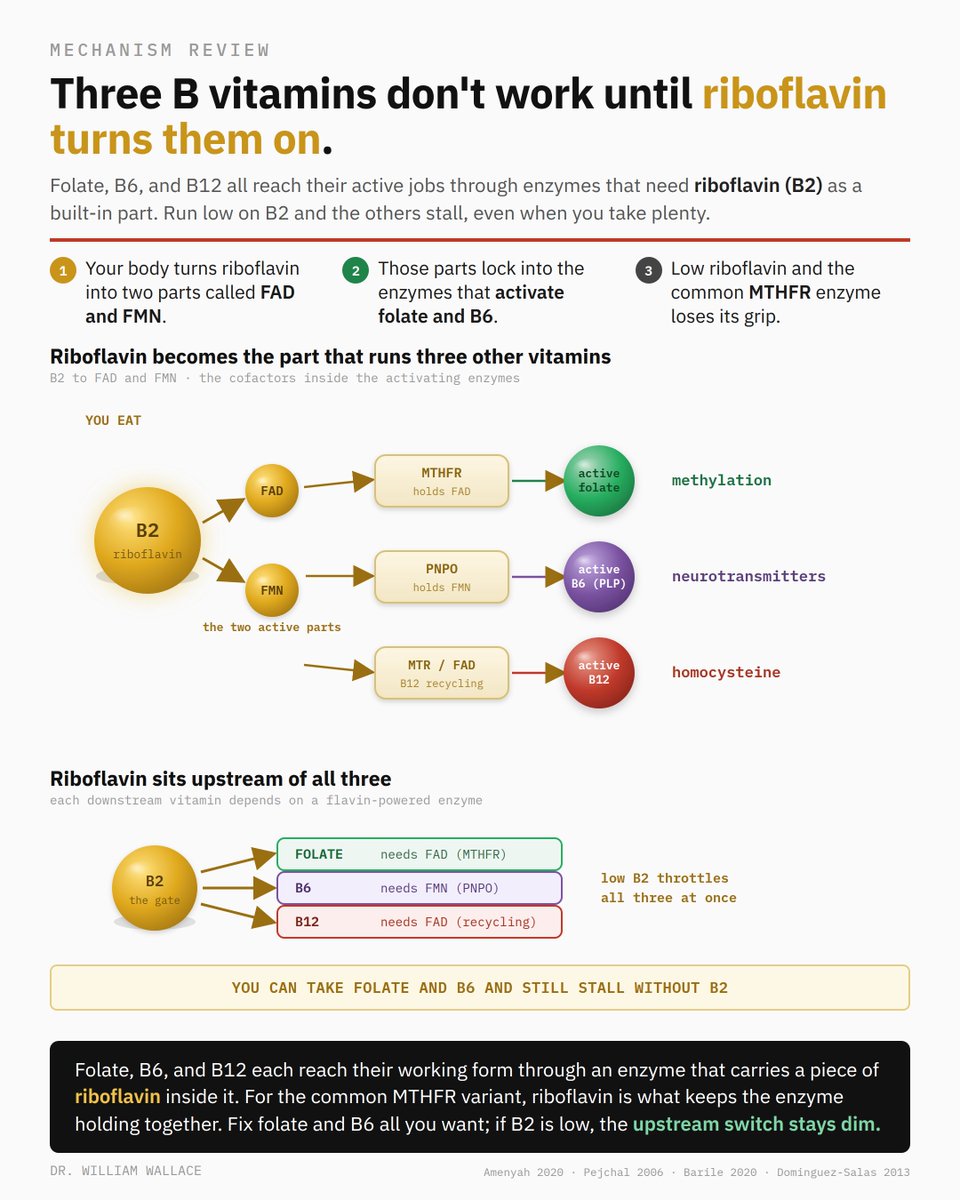
The MTHFR and folate conversation skips the vitamin one step above it.
Your body turns riboflavin (B2) into two parts, FAD and FMN. Those parts are built into the enzymes that activate folate, convert B6 to its active form, and let B12 work in the same cycle. B2 sits upstream of all three.
It matters most for the common MTHFR variant: that enzyme doesn't just run slow, it loses its grip on its riboflavin part. Giving riboflavin to people with that genotype lowers homocysteine, because it helps the wobbly enzyme hold the piece it keeps dropping.
The nuance: most people aren't B2 deficient, and the clear effect is specific to the MTHFR TT genotype, not a general fix. It's about removing a bottleneck in the deficient, not taking more for everyone.
Squats = brainpower! 🏋️♂️🧠
Sitting for 20 minutes straight is a silent drain on your executive function. But here's the good news:
A 2023 study in the Journal of Applied Physiology found that one minute of half-squats every 20 minutes rescues cerebral blood flow from the "sedentary slump." It re-oxygenates the prefrontal cortex, the seat of your focus and decision-making.
The Result of a 60-second "Interrupt":
🧠 Preserved blood flow to the brain.
⚡️ Sharpened executive function.
📈 Spiked concentration levels.
📉 Reduced mid-day mental fatigue.
Action plan:
The 20/1 Protocol: Set a timer for 20 minutes of focused work. When it pings, drop into 10-12 controlled half-squats. It’s the cheapest 'nootropic you'll find.
Source:
Horiuchi, Masahiro, Alice Pomeroy, Yoko Horiuchi, Keeron Stone, and Lee Stoner. “Effects of Intermittent Exercise during Prolonged Sitting on Executive Function, Cerebrovascular, and Psychological Response: A Randomized Crossover Trial.” Journal of Applied Physiology 135, no. 6 (December 1, 2023): 1421–1430
#BrainHealth
#MovementSnacks
collagen and vitamin C have a unique relationship
Collagen's three strands only lock into a stable triple helix after an enzyme adds OH groups to proline. That enzyme needs vitamin C as a cofactor. No vitamin C, no stable helix.
Under-hydroxylated collagen melts around 32 to 34C. Properly built collagen holds to ~40C. Your body runs at 37. This is why scurvy is a vitamin C disease, not a protein problem.
METABOLIC DECLINE AND HOW TO AVOID IT
Mitochondria are the microscopic engines inside your cells. They take the food you eat and the oxygen you breathe and convert both into usable energy. That energy comes in the form of a molecule called ATP, the universal fuel for everything your body does.
As the years pass, these engines naturally lose some of their horsepower. The number of active mitochondria drops. The ones that remain start to sputter, becoming less efficient at converting fuel into clean energy.
Instead of a clean burn, you get something closer to a smoky exhaust. This cellular exhaust comes in the form of free radicals, which leak back into the cell and cause real damage. They attack the sensitive receptor sites on the muscle cell wall that respond to insulin.
Think of insulin as a key and the receptor as a lock. When the lock is undamaged, the key fits, the door opens, and glucose flows in to power the cell. Free radicals warp the lock. The key no longer fits, the door stays shut, and the cell starves in the midst of plenty.
This is the slow, grinding onset of insulin resistance. The machinery that repairs and maintains your muscles gets starved of fuel. Protein synthesis slows down, muscle tissue breaks down faster, and the creeping loss of strength we call sarcopenia begins to compound.
Metabolic decline is not just a side effect of getting older. It is a primary driver of the aging process itself. But the encouraging part, and it is genuinely encouraging, is that this system responds powerfully to the demands you place on it.
When you push hard during a workout and ask more of your body than it can comfortably give, your muscle cells face a demand they cannot fully meet. That energy gap acts as a trigger. It sends a signal directly to your DNA to build more mitochondria.
This is the chain reaction you want. More mitochondria generate more clean energy. More clean energy means less cellular exhaust. Less exhaust means insulin receptors stay intact and responsive, which keeps inflammation low across your entire system.
Now, consider a strange biological riddle that perfectly illustrates this principle. It is called the Athlete’s Paradox. In sedentary individuals, a buildup of toxic fat fragments inside muscle cells physically blocks the insulin signal, creating profound insulin resistance.
This can happen even in people who do not look overweight. Yet, when researchers examine the muscle tissue of highly trained endurance athletes, they also find elevated amounts of intramuscular fat. Significantly elevated.
The question is simple. If high intramuscular fat causes insulin resistance, why are these athletes the most insulin-sensitive humans on the planet? The answer circles back entirely to the mitochondrial network.
In a sedentary body, fat drifts into the muscle cell and just sits there. Without enough active mitochondria to burn it, it breaks down into those toxic fragments that jam the insulin receptor. The cell becomes a toxic waste site.
Inside a well-trained athlete, the story is different. Their mitochondrial network is dense, active, and perpetually hungry for fuel. Fat enters the muscle cell and is immediately packaged into stable, inert triglycerides, stored right next to the muscle fibers by design.
It becomes a primary, quickly-accessed fuel source for endurance performance. The same fat that poisons a sedentary cell becomes clean-burning rocket fuel in an active one.
Research from institutions like the Human Performance Laboratory at Ball State University has shown that lifelong athletes in their 80s maintain mitochondrial signaling that rivals individuals decades younger.
Studies from the Mayo Clinic compared older active adults against young sedentary adults. The older athletes displayed mitochondrial function and insulin sensitivity that looked nearly identical to the young group. The decline tracked with physical inactivity levels, not simply with the number of candles on the birthday cake.
Your muscle can be a clean furnace or a toxic dump. The amount and health of your mitochondria decide which one it is. And that health is built through hard, consistent training.
But training without the right nutritional support, especially as you age, is like planting a field and forgetting to water it. The post-exercise window is where you lock in the cellular gains from your effort. And two common factors in daily life can either open that window wider or slam it completely shut.
The first factor is protein timing, which becomes more critical every year you get older. Your muscles need a higher dose of quality protein after exercise to trigger the same repair and building response. The second factor is alcohol, which some research suggests can suppress muscle protein synthesis by over a third when consumed in the hours after a hard workout.
There is a way to structure your day so that training, nutrition, and even a modest evening ritual can coexist without sabotaging your progress. The detailed, step-by-step protocol for exactly this is laid out in the attached Part 2, with a quick-reference cheat sheet waiting in Part 3.
There's a magnesium ion plugging one of the most important channels in your brain. That block isn't a flaw. It's how your brain decides what to learn.
The NMDA receptor only opens when glutamate binds AND the neuron is already firing, both at once. That double-check pops the magnesium out, calcium floods in, and the synapse strengthens. That strengthening is learning.
The block keeps the synapse quiet until a signal is real. Low magnesium loosens that brake.
THE SPRINT IMPERATIVE: RECLAIM THE PRIMAL SIGNAL BEFORE YOUR JOINTS FORGET HOW TO MOVE
Sprinting is the diagnostic standard for a functional human body. A healthy organism can accelerate its mass to maximal velocity without pain, fear, or distraction.
The modern adult's inability to sprint reveals a deep failure in tissue capacity, neural inhibition, and metabolic signaling. It is the canary in the coal mine for systemic decline.
Most adults have lost the capacity to sprint because they have unlearned the foundational movement patterns that build elastic resilience. They sit in chairs, wear cushioned footwear, and move within a narrow range that avoids the high-force, high-velocity stimuli necessary for structural adaptation.
Their joints ache because the fascia and tendons have grown brittle from disuse. Their nervous system is locked in a sympathetic overdrive that prevents the coordinated relaxation and rapid co-contraction needed for explosive movement. This is a metabolic and hormonal problem, not a lack of athletic talent.
The human frame evolved to handle sudden, intense loading. When the foot strikes the ground at full speed, the bones momentarily deform under loads exceeding several times body weight. This deformation generates a piezoelectric charge that triggers osteocalcin release from osteoblasts.
Osteocalcin is a hormone that travels to the pancreas and brain, improving insulin sensitivity and protecting against neurodegeneration. Without this signal, the brain loses an organizing cue. Alzheimer's and Parkinson's pathologies are consistently preceded by a long history of reduced bone loading. Sprinting is the quickest way to send this survival signal.
Gravity is the organizing force. When you sprint barefoot or in minimal shoes, the ground transmits a blunt truth to every joint and myofascial chain. If the foot is coddled in air-inflated foam, the feedback is muted, and the body learns to accept inefficient, joint-destroying patterns.
The shoe industry has created a population that cannot sprint because it has disconnected feet from the ground, leading to overstriding, heel striking, and a loss of the elastic recoil stored in the Achilles tendon and plantar fascia. Return to the ground, and the body will remember.
The physiological remodeling from sprinting is rapid and profound. The crimp pattern in collagen fibrils requires sufficient strain to mechanically unfold and then reform in a more organized, resilient arrangement. This improves elastic energy return; every subsequent step becomes less costly.
Visceral fat and excess, non-functional muscle mass are shed because they directly impede forward propulsion. The body is brutally honest: if tissues do not contribute to the task, they are signaled as metabolic dead weight. Sprinting forces a return to efficiency.
A sedentary life, even one filled with long, slow running, fails to provide the necessary strain rates. Endurance runners often become the worst sprinters because they have taught their bodies a rigid, low-amplitude gait that builds chronic tension without the speed or force to trigger structural adaptation.
They live at the edge of their tissue failure threshold, accumulating microtrauma with each mile. Sprinting sets the upper limit, thereby establishing the safe range for all other movements. Without that limit, all training is guesswork.
The mental effect is equally important. A true sprint requires a narrowed, focused attention that shuts out the chattering mind. This state of flow, of being completely in the body, is impossible to replicate in a gym or on a treadmill.
It is a direct antidote to the chronic hyper-vigilance and psychological rigidity that characterize the modern condition. As physical capacity expands, so does psychological flexibility. The individual who can sprint is less dogmatic, less reactive, and more resilient.
The pathway back to sprinting begins with a return to infantile movement, progressively building from the ground up.
The detailed practical application of these remedies, along with the step-by-step protocol and bullet action points, are provided in Parts 2 and 3 for those ready to reclaim their birthright.