Je veux présenter mes excuses, au nom des Français, pour avoir enfanté la French Theory (qui a enfanté la pire des merdes idéologiques : le wokisme).
Nous avons donné au monde Descartes, Pascal, Tocqueville. Et puis, dans les ruines intellectuelles de l'après-68, nous avons donné Foucault, Derrida, Deleuze. Trois hommes brillants qui ont fabriqué, dans l'élégance de notre langue, l'arme idéologique qui paralyse aujourd'hui l'Occident.
Il faut comprendre ce qu'ils ont fait. Foucault a enseigné que la vérité n'existe pas, qu'il n'y a que des rapports de pouvoir déguisés en savoir. Que la science, la raison, la justice, l'institution médicale, l'école, la prison, la sexualité, tout n'est qu'une mise en scène de la domination. Derrida a enseigné que les textes n'ont pas de sens stable, que tout signifiant glisse, que toute lecture est une trahison, que l'auteur est mort et que le lecteur règne. Deleuze a enseigné qu'il fallait préférer le rhizome à l'arbre, le nomade au sédentaire, le désir à la loi, le devenir à l'être, la différence à l'identité.
Pris isolément, ce sont des thèses discutables. Combinées, exportées, vulgarisées, elles forment un système. Et ce système est un poison.
Car voici ce qui s'est passé. Ces textes, illisibles en France, ont traversé l'Atlantique. Les départements de Yale, de Berkeley, de Columbia les ont absorbés dans les années 80. Ils y ont trouvé un terreau qui n'existait pas chez nous : le puritanisme américain, sa culpabilité raciale, son obsession identitaire. La French Theory s'est mariée à ce substrat, et l'enfant de ce mariage s'appelle le wokisme.
Judith Butler lit Foucault et invente le genre performatif. Edward Said lit Foucault et invente le post-colonialisme académique. Kimberlé Crenshaw hérite du cadre et invente l'intersectionnalité. À chaque étape, la matrice est française : il n'y a pas de vérité, il n'y a que du pouvoir, donc toute hiérarchie est suspecte, toute institution est oppressive, toute norme est violence, toute identité est construite donc négociable, toute majorité est coupable.
Voilà comment trois philosophes parisiens, qui n'ont probablement jamais imaginé leurs conséquences pratiques, ont fourni le logiciel d'exploitation à une génération entière d'activistes, de bureaucrates universitaires, de DRH, de journalistes, de législateurs. Voilà comment on a obtenu une civilisation qui ne sait plus dire si une femme est une femme, si sa propre histoire mérite d'être défendue, si le mérite existe, si la vérité se distingue de l'opinion.
C'est de la merde pour une raison simple, et il faut la dire calmement. Une civilisation se tient debout sur trois piliers : la croyance qu'il existe une vérité accessible à la raison, la croyance qu'il existe un bien distinct du mal, la croyance qu'il existe un héritage à transmettre. La French Theory a entrepris de dynamiter les trois. Pas par méchanceté. Par jeu intellectuel, par fascination du soupçon, par haine de la bourgeoisie qui les avait nourris. Mais le résultat est là. Une génération entière a appris à déconstruire et n'a jamais appris à construire. Une génération entière sait soupçonner et ne sait plus admirer. Une génération entière voit le pouvoir partout et la beauté nulle part.
Je m'excuse parce que nous, Français, avons une responsabilité particulière. C'est notre langue, nos universités, nos éditeurs, notre prestige qui ont donné à ce nihilisme son emballage chic. Sans la légitimité de la Sorbonne et de Vincennes, ces idées n'auraient jamais traversé l'océan. Nous avons exporté le doute comme d'autres exportent des armes.
Ce qui se construit maintenant, en silicon valley, dans les labos d'IA, dans les startups, dans les ateliers, dans tous les lieux où des gens fabriquent encore des choses au lieu de les déconstruire, c'est la réponse. Une civilisation se reconstruit par les bâtisseurs, pas par les commentateurs. Par ceux qui croient que la vérité existe et qu'elle vaut qu'on s'y consacre. Par ceux qui assument une hiérarchie du beau, du vrai, du bon, et qui n'ont pas honte de la transmettre.
Alors pardon. Et au travail.
People often say that the developing world is poor because the Western world colonized them and stole their resources.
The truth, however, is that over the past century, the developing world has, for the most part, shown that they are completely incapable of harnessing their own resources. They are not poor because we stole from them. They are poor because they do not know how to run and administer their own countries, resources be damned.
Take Venezuela. The world's largest oil reserves mean nothing if you have a corrupt communist as your leader. People will actually be starving and trying to eat zoo animals while you sit on trillions of dollars in resources!
Africa is another example. Europeans left behind farmland, trains, roads, and mines in Africa. What happened to it all?
It's not that all of a sudden, the Africans started running things like anti-colonialist activists had envisioned at the time. No, no.
All the infrastructure fell into disrepair and/or was stripped down and looted. They were literally handed fully functioning, completed supply chains for resource extraction, and basically unlimited wealth, but they couldn't manage the simple upkeep.
Now, the defense for Africa might be that "The Europeans didn't teach the Africans how to manage any of this! It's not the Africans' fault they couldn't run it independently! They were never trained!"
But my brother in Christ, the Europeans DID try to train locals for management! Obviously it would have been easier to have at least some locals in administration, rather than having to import an ENTIRE workforce, but efforts to find African talent were largely unsuccessful.
Don't believe me? Just look at the different outcomes in Hong Kong and Singapore when compared to Africa. In East Asia, Europeans often did work with locals in administrative and management capacities. When colonialism ended, Hong Kong and Singapore were able to manage themselves. Not the case with Africa.
Now, none of this is to say that colonialism is good. People have the right to self-rule and seld-determination. However, the idea that colonialism and resources extraction are responsible for the developing world's ongoing poverty? That is quite simply a crock of shit.
2. Stop auto-downloading every photo and video.
This is the main reason WhatsApp explodes in size.
- Go to Settings → Storage and Data → Media Auto-Download
- Set all to:
- When using mobile data: No media
- When connected on Wi-Fi: Choose only what you really need
- When roaming: No media
From now on, tap to download only what matters. Your storage stops growing on autopilot.
If someone ever edits your photo with Al or Photoshop to create a nude pic, go to https://t.co/IljuKrXyoi and submit the original photo & the edited photo, they’ll take it down. If you’re a minor go to https://t.co/0Mz9VJO1Q6 or https://t.co/v2g7eFYSUz
Pls share to help someone.
How the U.S. Deleted China From South America.
China is furious.
Maduro is gone.
And the media completely missed what actually happened.
This wasn’t about “international law” or “sovereignty.”
It was real power, applied in real time.
In this video, I break down how the U.S. dismantled China’s strategic foothold in Venezuela, voided Beijing’s oil and loan contracts overnight, and reminded the world what the Monroe Doctrine looks like when it’s enforced.
From China’s reflexive defense of dictators, to America’s cold realpolitik, to why Chinese weapons collapse under real pressure—this was a strategic defeat for Beijing, not a talking-point.
Beijing issues statements.
Washington moves carriers.
That’s the difference.
🚨BREAKING: Australia, France, and Germany have now all CANCELLED their New Year's Celebrations.
"It has ALL been cancelled beacuse the French government can NO LONGER keep its citizens safe from Radical Islamic Terrorism."
"We are watching one of the most beautiful countries and cultures commit suicide."
Benin coup attempt fails.
President Talon is safe; loyal forces have full control.
Presidency: “A small group briefly took the TV signal. The country remains fully secure.”
#Benin#BeninCoup
BREAKING: A group of soldiers appeared on Benin’s state TV, announcing they had dissolved the government in what appears to be a coup in the West African nation.
Make una dey play Zuby Michael took my prayer seriously.
If you like allow ashawo to use, "A real man doesn't care about a woman's body count" enter you.
You go visit anonymous link or my DM by fire by force
Ordinarily, I would let such ahistorical claims pass, but given their capacity to mislead, a correction is unavoidable. The tweet below is not just inaccurate; it is a deliberate inversion of historical cause and effect. What transpired at the Universities of Ibadan and Lagos was not an unprovoked Yoruba assault on Igbo academics, but a corrective response to entrenched Igbo nepotism and institutional capture. Unfortunately, much of Nigerian historiography has relentlessly painted the Yoruba as the primary aggressors in ethnic struggles, a narrative even echoed by some Yoruba intellectuals who neglect these critical antecedent events.
So let’s set the record straight.
First, a factual correction: Richard Akinjide became the Federal Minister of Education in 1965. The claim that he was "pushing against Igbo academia" at the Universities of Ibadan and Ife in 1962 is chronologically impossible and factually incorrect. The central events revolve around Ibadan and Lagos; the inclusion of the University of Ife here is a red herring.
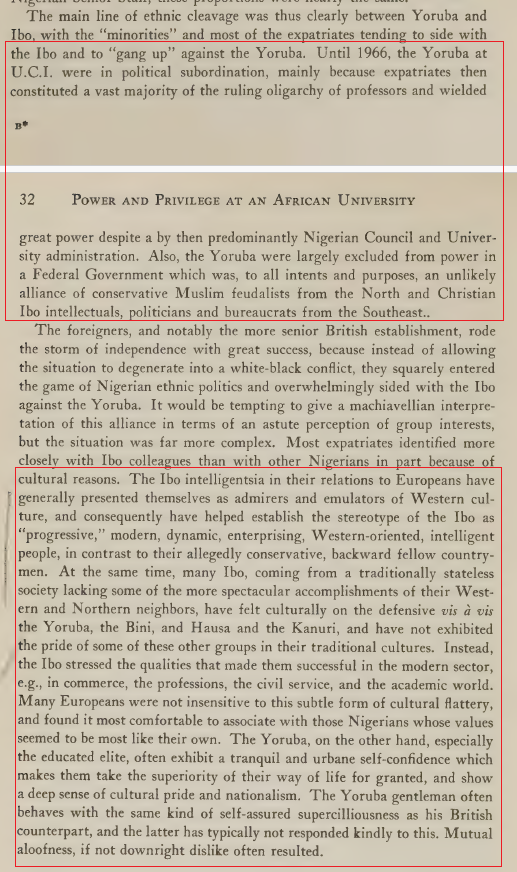
To understand the events at Ibadan, one must turn to the eyewitness account of Pierre van den Berghe (Power and Privilege at an African University), a visiting professor during this turbulent period. He identified the central dynamic: “The main line of ethnic cleavage was clearly between Yoruba and Ibo, with the ‘minorities’ and most of the expatriates siding with the Ibo and ‘ganging up’ against the Yoruba” (pg. 31).
This alliance was rooted in a cultural clash. Van den Berghe observed that the Yoruba, with their centuries-deep intellectual tradition, carried a natural cultural confidence that "makes them take the superiority of their way of life for granted, and show a deep sense of cultural pride and nationalism". The educated Yoruba often displayed a self-assurance that the expatriates found off-putting, seeing themselves as equals with no need to ape European manners (pg. 31).
The Igbo intelligentsia, by contrast, presented themselves as eager emulators of Western culture, measuring progress by proximity to European norms. Van den Berghe notes that this posture ingratiated them deeply with expatriates and helped entrench the stereotype of the Igbo as “progressive, modern, dynamic, enterprising, Western-oriented, intelligent people”, in contrast to their allegedly “conservative, backward” compatriots. This cultural flattery forged a comfortable British–Igbo partnership that became the backbone of campus politics (pg. 31).
This dynamic took on institutional consequence in 1962 when the University College, Ibadan, became an independent university. The Vice-Chancellorship went to Professor Kenneth Dike, an Igbo historian favored by expatriates and the NCNC-led federal government, rather than to an equally qualified Yoruba candidate, Professor Ajose. This appointment was made by Aja Nwachukwu, the Igbo Minister of Education. At the same time, another Igbo academic, Professor Eni Njoku, was appointed Vice-Chancellor of the University of Lagos. In a country with only two federal universities, both were now headed by Igbo men.
Furthermore, the University of Ibadan Act, crafted by Minister Nwachukwu, appointed Dike as VC without specifying any time limit. Thus, barring removal for misconduct, Dike became, in effect, Vice-Chancellor for life.
Yet despite this glaring imbalance, there was not a single Yoruba riot, not a single newspaper meltdown, not a single declaration of persecution. The Yoruba intelligentsia accepted the situation as part of the politics of the time.
But Dike’s tenure quickly revealed a systematic pattern of ethnic preference. Van den Berghe reports that he “systematically favored fellow Ibo,” placing them in strategic positions: the Deanships of Agriculture and Medicine (both held by his relatives), the Headship of the History Department, and other key administrative offices (pg. 37 - 38). Dike’s stated goal was “ethnic balance,” but in practice, it meant prioritizing Igbo candidates even when better-qualified Yoruba candidates were available. Under him, UI increasingly resembled an Igbo fiefdom.
Dike’s methods were subtle but effective. He would promote Yoruba and Igbo candidates to the professorial level to create an appearance of fairness but reserve the real levers of power — the chairmanships, deanships, and strategic administrative roles — for Igbos (pg. 38). When obstructed, he undermined the officeholder. His campaign against the Registrar, Nathaniel Adamolekun, was the most egregious example. Dike saw Adamolekun as the final obstacle to his full consolidation of the university into an ethnic patronage system (pg. 39). His solution was to remove academic affairs from the Registry's jurisdiction by creating an “Academic Office” under an Igbo loyalist and to bypass Adamolekun in major decisions (pg. 40).
The result was a spiraling administrative crisis. By 1966, the feud had descended into a grotesque spectacle - countermanding memos, press leaks, court injunctions, threats, office lockouts, and even police involvement.
The crisis came to a head in June 1966, when a trivial disciplinary action against an Intermediate Staff clerk, most liklely a non-Yoruba, accused of fornication in a university office escalated into a violent strike and demonstration by the non-Yoruba faction of the University Workers’ Union against Adamolekun, demanding his resignation. The University Council, effectively captured by Dike’s faction, obliged by suspending Adamolekun. The injustice was so transparent that Bola Ige, a personal friend of Dike's, represented Adamolekun against him. When Ige later recounted the story, he described Dike’s shock that he would defend a man subjected to such plainly unfair treatment.
The crisis only ended when Dike resigned in late 1966 and returned to the East in the aftermath of the coup. The Gowon administration reinstated Adamolekun, restoring administrative order. Yet in Chinua Achebe’s telling, Dike becomes the victim of Yoruba small-mindedness. It is therefore laughable to read Chinua Achebe’s portrayal of Dike as a victim of "tribal small-mindedness." To Achebe, this blatant nepotism was acceptable, the resistance to it was the sin. (Achebe, There was a Country, pg. 77)
The crisis at the University of Lagos was a direct parallel. The law establishing UNILAG set a four-year term for the Vice-Chancellor. Professor Eni Njoku, appointed by fellow Igbo, Aja Nwachukwu, completed his full term on May 31, 1965. By then, Chief Richard Akinjide had become Minister of Education. Exercising his lawful discretion, he chose not to renew Njoku’s contract and appointed Dr. Saburi Biobaku. Njoku was not fired; he was offered a professorship and allowed to retain his VC salary. But the reaction from Igbo students and certain expatriate staff was immediate, violent, and politically choreographed. Riots broke out. Picketing intensified. Expatriate deans (mostly British) staged a rebellion against the Federal Government. Zik’s West African Pilot flooded the public space with inflammatory editorials about “tribalism” and “Igbo victimization,” weaponizing the press to manufacture outrage.
The Federal Government’s response was unequivocal: accusations of tribalism were baseless. Both federal universities had previously been under Igbo leadership; if anything, the Igbo had been favored. The government described the behavior of the foreign agitators as “a naked form of neo-imperialism" (Vickers & Post, Structure and Conflict in Nigeria 1960-1966, pg. 210). Chief Akinjide, not one to tolerate such interference, terminated the appointments of the expatriates who had fomented the crisis. Despite riots and an attempted murder, Prof. Biobaku eventually assumed his position.
The fundamental flaw in lies such as the one in this tweet is the neglect of antecedents. The story did not begin with Akinjide’s decision; it began with the lopsided appointments engineered by Nwachukwu, the systemic ethnic favoritism of Kenneth Dike, the patronage network built between British academics and Igbo elites, and the entrenched administrative capture at Ibadan and Lagos. But the revisionists skip all this. They begin the story at the point of correction, erase the provocations, cast Akinjide as the villain, and sanctify the architects of the imbalance.
It is therefore a profound historical misrepresentation to claim that “Akinjide’s actions remain central to the Yoruba–Igbo academic struggle.” The truth is the reverse: the ethnic tensions were set in motion long before Akinjide entered the story. The actions of men like Dike and Nwachukwu, who first entangled these institutions in ethnic competition, are the true origins of the conflict. Akinjide’s role, in contrast, was an attempt to recalibrate a balance that had already been severely compromised and to reassert rightful federal oversight over institutions that had drifted into ethnic capture.
Anyone insisting otherwise is not recounting history — they are manufacturing myth.
@ibidunniOodua@patrickanum@naija1babe
My name is Haruna Daniels.
I'm an Architect, from Zuru, Kebbi State (North West Nigeria).
I was born on the 7th of December, 1968: I'll be 57 next month.
I've lived most of my life here in Nigeria, all my Education (from Nursery School to MSc Degree) I got here in Nigeria...
Now, how would YOU feel if you're given the same tag YOU give others?
How would YOU feel if you're given a sub-human treatment, like Pastor Mrs gave me in Lagos (I was there to HELP them fix their house, not to ask for help!"?
We all KNOW what we're doing, as @Mr_JAGs says...
😑
The way some of you talk as if the sound hasn't been existing before Kòtò Ayé dey muzz me. 🤣🤣🤣 You were probably born in the late 90s or even 2000s. That's why you think "EVERYONE who hears it will think it's from Kòtò Ayé"
Here's a little history lesson for you. The three songs I attached here were released before Alhaji Yekini Ajileye, the producer and director of Kòtò Ayé, made his first film (Kòtò Ọ̀run).
If you hear someone sing Amapiano, you won't think it's an adaptation of the Amapiano song you heard earlier, would you?