Imagine a public official with N4.6 billion worth of Jewelleries in a third World country listed in the top poverty index with challenges in Health,Education and infrastructure.A Country receiving aid and regularly seeking for foreign loans.Some countries are poor and some are pillaged to be poor.
Abuja City Walk is a great investment for the future of the city.Its something that ought to have been done decades https://t.co/0XVBjr4u0H will elevate the status of the City to that of other great cities in the World.Its an investment in tourism,job opportunities and commerce.Long after we are gone,this will be part of the legacy the future generations will appreciate.The money invested is much,but it’s money that can be stolen by one person.
That Orire rescue operation was led by the General Officer Commanding (GOC) 2 Division, Maj Gen Chinedu Nnebeife, thank your sir for completing assigned task by the NSA and HMOD.
If you have 53m you are not urgently using, go to GTBank or any other bank that does it and ask for Money Market Fund.
The rate fluctuates daily but it’s around 17%.
You’re not locking the money. They will create an investment account and you can send the money from your account to it. It is 100% insured.
Everyday, you get paid interest and you can withdraw your money anytime you like.
For that 53m, this is how you calculate your daily interest.
53,000,000 x 0.17 = 9,010,000
9,010,000/365 = 24,684.932
So everyday, you make N24,600 on your 53m.
In one year, you make N9m.
If you do 24,684 x 30 = 740,520 this means you make N740k every month on your money. You can withdraw your dividends every quarter or choose to reinvest them.
Your capital stays untouched and it is on your phone app that you can withdraw anytime.
This is why billionaires stay billionaires. They live on the interest from their money.
The best thing about this is that you don’t need to give anyone this money to do it for you, your bank mobile app already has it. All you need to do is set it up.
It is way better than doing Ponzi schemes that won’t give you peace of mind.
This is 2026, there are many ways to stay rich.
*Copied
With INEC's Self-Service Registration Portal, you can begin your voter registration on your phone from 8 July. (https://t.co/GEmh7UMAyB)
Need assistance? Our State and LGA Offices remain open daily from 9:00am–3:00pm.
📅 Don't miss the deadline: 26 July 2026
🌐 https://t.co/XEbjxciTLU
#CVR2026
CASH AND PROPERTIES LEFT FOR THE WORLD BY ALHAJI AMINU DANTATA.
He left behind ₦61 trillion in cash in both Nigerian and foreign banks. He also left behind 800 petrol stations within and outside Nigeria that do not bear his name, but belong to him.
In Kano alone, he left 500 houses, plus 1,200 plots with only fencing or partial structures, no buildings on them just empty plots.
He also left 320 houses in other towns across Nigeria and abroad.
He left 280 vehicles in use, and another 120 vehicles that are not in use, just parked.
He left shares worth over ₦30 trillion in companies within and outside Nigeria.
In an interview he granted in 2022, he said he started buying private jets in 1967 at the cost of $120,000 USD. He had 10 private jets, each not worth less than ₦1 billion.
He lived with four wives, had over 45 children and more than 150 grandchildren.
He was buried in Medina, Saudi Arabia according to his wish.
Copied
BREAKING: “Nigeria’s 2027 elections are under close watch. Violence, voter intimidation, and electoral malpractice will NOT be tolerated.”
— United States Congressman Riley Moore says
PRESS RELEASE
FEDERAL MINISTRY OF FINANCE
5 July 2026
𝐑𝐄𝐒𝐏𝐎𝐍𝐒𝐄 𝐓𝐎 𝐑𝐄𝐂𝐄𝐍𝐓 𝐌𝐈𝐒𝐑𝐄𝐏𝐑𝐄𝐒𝐄𝐍𝐓𝐀𝐓𝐈𝐎𝐍𝐒 𝐎𝐍 𝐏𝐔𝐁𝐋𝐈𝐂 𝐄𝐗𝐏𝐄𝐍𝐃𝐈𝐓𝐔𝐑𝐄
The Federal Government has noted recent public commentary alleging that approximately two percent of GDP amounting to over ₦8 trillion was spent outside the approved budget based on references to the IMF Representative in Nigeria and the Fund's 2026 Article IV Consultation Report. These claims are incorrect and risk misleading the public regarding the government's financial management.
For the avoidance of doubt, the Federal Government does not operate a "shadow budget" or expend public funds outside the constitutional and statutory framework established for public finance.
Under Sections 80 - 83 and 162 of the Constitution of the Federal Republic of Nigeria, 1999 (as amended), public funds may only be withdrawn and expended in accordance with the Constitution and laws enacted by the National Assembly. Accordingly, Federal Government expenditure is incurred pursuant to duly enacted Appropriation Acts, Supplementary Appropriation Acts, and other statutory authorities enacted by the National Assembly. In addition, multi-year capital projects which necessarily span multiple budgets are implemented in accordance with extant laws and approved provisions for capital rollovers where applicable. These are recognised features of public financial management and should not be misconstrued as expenditures outside the budget.
It is inaccurate to suggest that trillions of naira have been secretly spent outside legislative approval. Such allegations should have identified the specific projects purportedly executed without appropriation or legal authority and present credible evidence in support of the claim. To be meaningful, assertions of this magnitude must be supported by verifiable facts rather than conjecture.
For the purpose of public education, it is important to distinguish between appropriation, expenditure authorisation, financing, and fiscal reporting.
Nigeria's public finance framework contains several statutory transfers, first-line charges and intervention mechanisms established by Acts of the National Assembly. These include, among others:
- Statutory allocations and contributions to development commissions and other agencies created by law.
- Cost of collection and cost of administration retained by designated revenue-collecting agencies as expressly provided under relevant legislation.
- Capital expenditure approved in separate budgets for some agencies and the Federal Capital Territory by the National Assembly.
- Special interventions approved by law to address national priorities such as security, infrastructure, disaster response, and other strategic national programmes or emergencies.
- Debt service obligations and other statutory transfers that are authorised under applicable legislation.
These expenditures are neither secret nor illegal. They are established by law, disclosed in various fiscal reports, and subject to applicable oversight, audit and accountability mechanisms. Their treatment for reporting purposes may differ from their presentation in the annual Appropriation Act, particularly under international statistical and reporting standards adopted by the Federal Government. Such classification differences should not be misrepresented as evidence of unlawful expenditure.
It is equally incorrect to suggest that the reported amount represents an increase in budget deficit. A fiscal deficit is determined by the relationship between total government revenues and total government expenditures. Whether a capital project is financed through annual appropriations, supplementary appropriations, statutory transfers, approved intervention mechanisms, or other lawful financing arrangements does not, by itself, increase the fiscal deficit.
Indeed, the IMF's observation relates primarily to the comprehensiveness, timing and presentation of fiscal reporting rather than the legality of expenditure. Like many countries, Nigeria continues to strengthen the alignment between budget presentation and international fiscal reporting standards as part of ongoing public financial management reforms. As a matter of fact, His Excellency, President Bola Ahmed Tinubu, GCFR had himself formally requested the National Assembly to end the practice of running multiple and overlapping budgets, and rather harmonise into a single, cohesive framework during his presentation of the 2026 Appropriation Bill to a joint session of the National Assembly on December 19, 2025.
The Federal Government remains firmly committed to prudent fiscal management, transparency and accountability. Recent reforms have significantly strengthened public financial management with ongoing improvements in budget assumptions and credibility, transparent revenue administration, digitalisation of government financial processes, and stronger treasury management. These reforms have been acknowledged by the IMF itself and other multilateral institutions, as well as international credit rating agencies, major media organisations and investors.
Public debate is both welcome and essential in a democratic society. However, it should be based on facts and an accurate understanding of Nigeria's constitutional and fiscal framework. Mischaracterising technical observations as evidence of unlawful expenditure neither advances informed public discourse nor strengthens democratic accountability.
The Federal Government will continue to uphold the rule of law, maintain transparency in the management of public resources, and work with the National Assembly, oversight institutions, development partners and the Nigerian people to further strengthen fiscal governance in line with international best practices.
Signed:
Taiwo Oyedele
Honourable Minister of Finance and Coordinating Minister of the Economy
Federal Republic of Nigeria
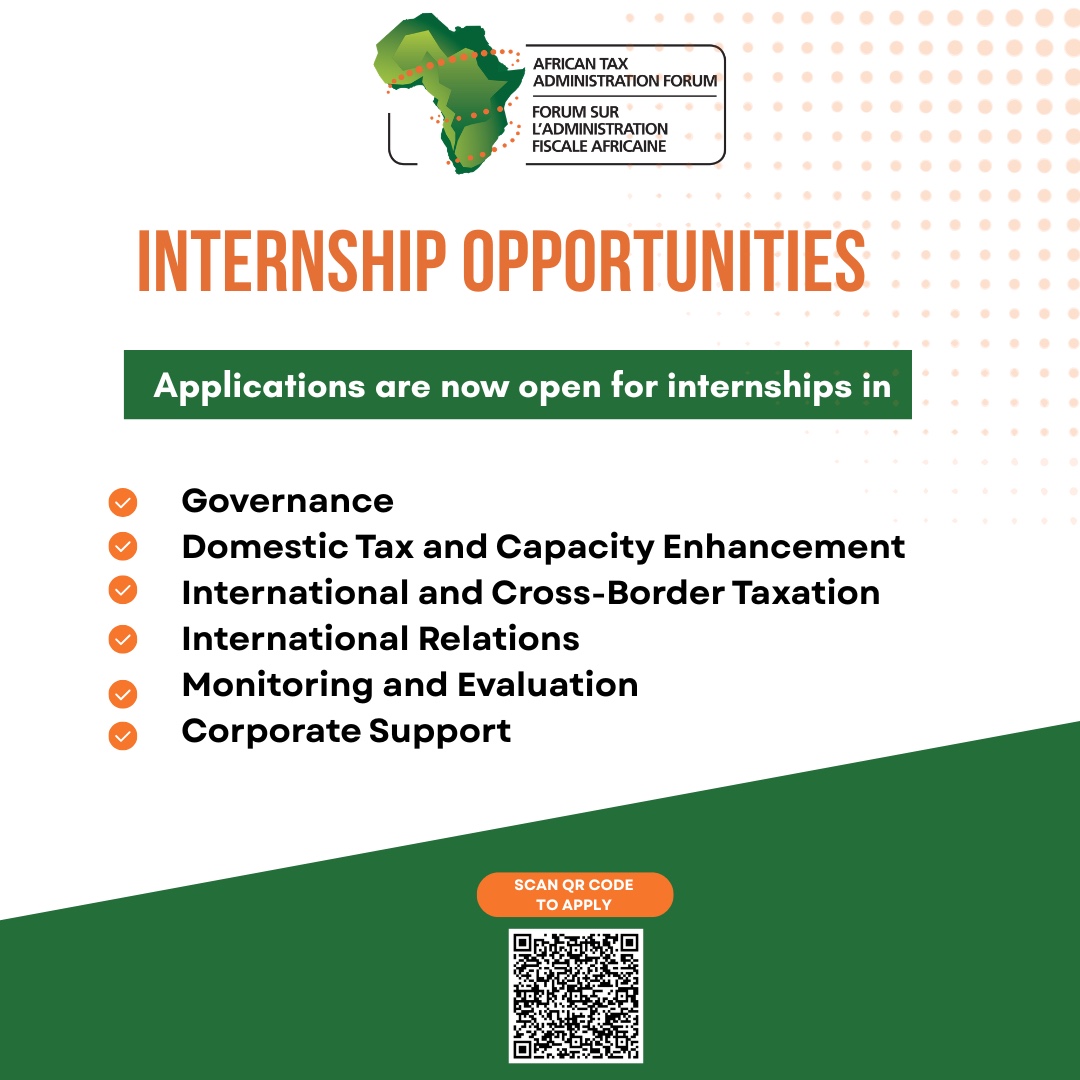
𝐈𝐧𝐭𝐞𝐫𝐧𝐬𝐡𝐢𝐩 𝐎𝐩𝐩𝐨𝐫𝐭𝐮𝐧𝐢𝐭𝐢𝐞𝐬
We are inviting applications for our Internship Programme from current students, recent graduates, and young professionals looking to gain hands-on experience in an international organisation that strengthens domestic resource mobilisation on the continent.
As an ATAF intern, you will work alongside leading tax specialists, policy experts, researchers, governance professionals, and corporate support teams, gaining practical experience in a dynamic and multicultural environment.
Internship opportunities are available in Governance, Domestic Tax and Capacity Enhancement, International and Cross-Border Taxation, International Relations, Monitoring and Evaluation, and Corporate Support.
Whether your background is in Risk Management, Internal Audit, Accounting, Financial Management, Governance, Public Finance, Taxation, Economics, Public Administration, International Relations, Public Policy, Development Studies, Human Resources, or Office Administration, this is an opportunity to apply your knowledge, develop practical skills, and gain valuable professional experience alongside experts in your field.
Master's and PhD students specialising in tax-related disciplines are especially encouraged to apply for placements within ATAF's technical tax programmes.
Follow the link to view the full advert, eligibility requirements, and application process:
https://t.co/oV9bi0QAc2
#Internship #GraduateProgramme #TaxPolicy #PublicPolicy #InternationalRelations #Research #Africa #ATAF
Call For Expressions of Interest
The Office of the Special Assistant to the President is inviting qualified Nigerian youths with a background in Agricultural Extension to submit their details for consideration.
Eligibility Requirements
Applicants must meet the following criteria:
1. Have a minimum of two (2) years of field experience in the agricultural extension sector, either as: * An Agricultural Extension Agent, or * An Input Dealer working directly with farmers.
2. Possess a valid and functional email address and phone number.
3. Have a functional bank account with a name that exactly matches the name on their National Identification Number (NIN).
4. Be able to read and write.
Qualified candidates who meet the above requirements are encouraged to submit their details as directed in the application process.
We encourage all eligible young professionals to take advantage of this opportunity.
https://t.co/VsWEDonA4T