What you’re seeing is a non custodial wallet designed for real world asset management. Manage crypto and tokenized assets from a single interface. Send and receive assets with ease. Track balances and portfolio activity. Move smoothly into the Setary Dashboard experience.
The wallet is built to operate inside the full Setary ecosystem. The dashboard and upcoming RWA marketplace connect directly to it. AI agents are designed to handle compliance, valuation, and structuring in the background. Asset workflows are engineered to move faster while complexity stays hidden.
This is an early look at what is being built.
The product is still in development. Screens and flows are evolving. More details, features, and progress will be shared as development continues.
The biggest challenge in RWA tokenization isn't technology.
It's trust.
Who verifies ownership?
Who verifies authenticity?
Who verifies value?
Without verifiable data, tokenization is just a database entry.
Setary is building the infrastructure RWAs need.
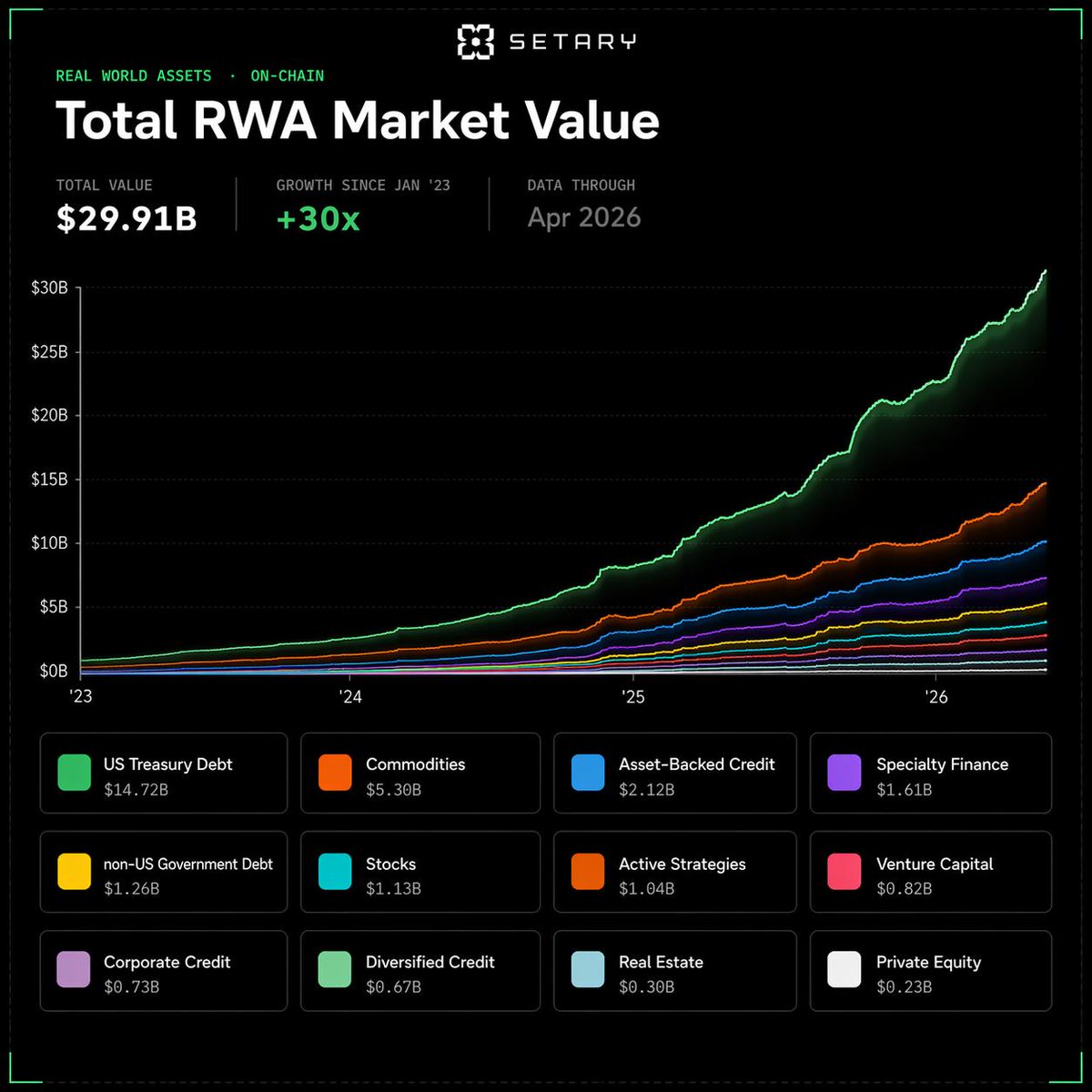
One of the craziest adoption charts in the entire crypto space.
This is a real liquidity signal of what institutions are preparing for: a tokenized future. Setary is part of this broader RWA adoption trend, building for less adopted and more complex asset classes such as private equity, commodities, invoices and receivables, intellectual property, art, and real estate, while supporting tokenization across the broader RWA market.
Though, the real novelty is not just tokenization itself, but doing it with compliance-first infrastructure and 6 in-house AI agents. By automating document verification, valuation, legal structuring, smart contract preparation, investor onboarding, and jurisdiction-aware compliance, Setary is designed to reduce tokenization from weeks to hours after successful document submission and verification. That is the critical bottleneck RWA infrastructure needs to solve to unlock real mid-size and broader institutional adoption.
Yeah sure, capital efficiency is the headline, but compliance and structuring speed are still the bottleneck. That’s the gap Setary is building for, with RWAs going on-chain in hours, not weeks.
This is the signal.
Tokenization is no longer a fringe narrative if the largest financial institutions are framing it as competitive infrastructure.
Setary is front-running this transition by turning complex real-world asset classes into compliant, on-chain markets at scale.
JPMorgan’s 2026 shareholder letter - 1st part about threats to the business:
‘A whole new set of competitors is emerging based on blockchain, which includes stablecoins, smart contracts and other forms of tokenization’
The largest bank in the US now sees crypto-native infrastructure as a direct competitive threat
@OndoFinance Institutions are validating RWAs and Setary is built to capture it with tokenization in hours, compliance-first infrastructure, and a full Wallet Marketplace Dashboard ecosystem powered by AI agents.
@WatcherGuru $13T RWA market by 2030 just confirms the trajectory... and Setary is built to capture it with AI-driven tokenization in hours (not weeks), a compliance-first stack, and a unified Wallet + Marketplace + Dashboard powered by 6 in-house agents.
Impressive growth. But once RWAs scale into the billions, the real test is whether the backend infrastructure can support them —> compliant onboarding, legal wrappers, and dynamic valuation at institutional standard. Momentum is important, but durable growth needs automation that can compress tokenization from weeks to hours.
Strong step. Tokenizing shares on BTC rails is a clear signal that the TradFi-to-blockchain bridge is getting more practical. The bigger unlock now is making post-launch operations scalable —> valuation, governance, and compliance need infrastructure that can keep up without adding weeks of manual overhead.
Great overview. As tokenized funds mature, the real bottleneck becomes execution at scale, not awareness —> valuation updates, legal structuring, and compliance workflows still slow too many launches down. The next phase is reducing that friction from weeks to hours through AI-powered infrastructure.