Dedicated to helping kids w/blood & cancer diseases My views are data/science-driven. RT doesn't = endorse. Science IS open debate & critical analysis.
On Sunday, my friend Gordon Wood was struck and killed in a car accident. Gordon taught history at Brown Univ. and was among the most accomplished historians America has produced. He won the 1993 Pulitzer Prize for The Radicalism of the American Revolution, and his earlier book The Creation of the American Republic, 1776–1787 took the 1970 Bancroft Prize. He also received the National Humanities Medal.
He was, in my view, the finest historian of America's founding—which makes it all the sadder that he did not live to see the nation's 250th birthday. His reputation reached popular culture, too. Matt Damon's character in Good Will Hunting invokes him by name in the famous bar scene, accusing a Harvard student of simply "regurgitating Gordon Wood, talking about [...] the pre-Revolutionary utopia and the capital-forming effects of military mobilization."
I feel fortunate to have collaborated with Gordon on several projects. In a 2019 anthology I compiled, he wrote an essay on the possibility of a shared American narrative. He centered his argument on equal rights as "the most radical and most powerful ideological force" the Revolution unleashed. "This powerful sense of equality is still alive and well in America," he wrote, "and despite all of its disturbing and unsettling consequences, it is what makes us one people."
When I needed jacket blurbs for my new book Lincoln's Compass, coming out this November, I turned to Gordon. The fit was natural: the book argues that Abraham Lincoln took the Declaration's claim that "all men are created equal" as his guiding moral compass—and that he refocused the nation on that claim. Gordon, ever the gentleman, offered generous praise.
He was, in many respects, the dean of American historians. He will be very hard to replace.
Wonderful seminar yesterday by Professor John Dick on “Backtracking leukemias to their cellular origins” in Hallmarks of Cancer Seminar Series organized by Professor @SenduraiMani.
Dr. Mani introduced Dr. Dick as an influential pioneer in stem cell biology having discovered and studied stem cells in leukemia, clonal evolution, resistance with implications for precision medicine.
I have admired his work for decades.
Dr. Dick has been interested in tracing back the origins of relapse and resistance in leukemia.
He made a powerful statement that is worth listening to and thinking about:
“The seeds of relapse are there before chemotherapy.”
He used T cells as “normal controls” in leukemia samples and showed results from his paper by Shlush et al in Nature, 2014.
He described DNMT3A as a common ancestor as revealed by age-related clonal hematopoiesis (CH).
CH associates with higher risk of AML in the next decade.
Dr. John Dick captivated me as a listener by suggesting that the insights from his findings could serve as a prevention strategy for leukemia.
Listening to him I couldn’t help but think about a parallel of APC mutations in Familial Polyposis where the mutations foreshadow the development of colorectal cancer with the most penetrant mutants of 100% risk. Cancer prevention there has typically involved surgical intervention as well as a number of chemoprevention strategies with agents like sulindac, celecoxib, among others.
I later asked him about the situation in AML as far as being able to predict progression and or resistance.
He showed evidence for KTM2A gene associations with different leukemia phenotypic outcomes.
Interestingly and I asked him later about this, higher PERK in leukemia stem cells leads to their death. He mentioned when I asked that PERK inhibitors promote survival of leukemia stem cells.
Dr. Dick mentioned that stem cells “don’t like to be taken out of dormancy.”
He showed data with stem cell subpopulations including a role for TNF and inflammatory NFkB signatures. He said “cells remember inflammatory stress.”
He showed data with a post-COVID signature that is enriched for HSC
-iM and an HSC -II population
He spoke about inflammatory memory signature of aging and mentioned that during CH, TET2 causes an inflammatory milieu. He showed data from Paresh Vyas Cell Stem Cell 2024 paper.
“TET2 pushes pseudotime” in the inflammatory memory setting.
He discussed genetic and non-genetic determinants of aberrant differentiation in AML, the impact of genomic driver alterations on leukemic differentiation, recurrent patterns of disordered differentiation in human acute myeloid leukemia, cross ontogeny mapping, multipoint vs committed states along with genetic determinants in B-ALL.
He provided some additional references at the end including one that maybe of interest:
Classify 10,000 cells in 10 minutes on your laptop: BoneMarrowMap R package:
https://t.co/KdFMnM0w3b
Signal transduction inhibitors have revolutionized cancer care for almost every type of liquid and solid cancer improving the lives of millions! No other class of anti cancer therapy has been as effective or nontoxic!
#Gleevec25
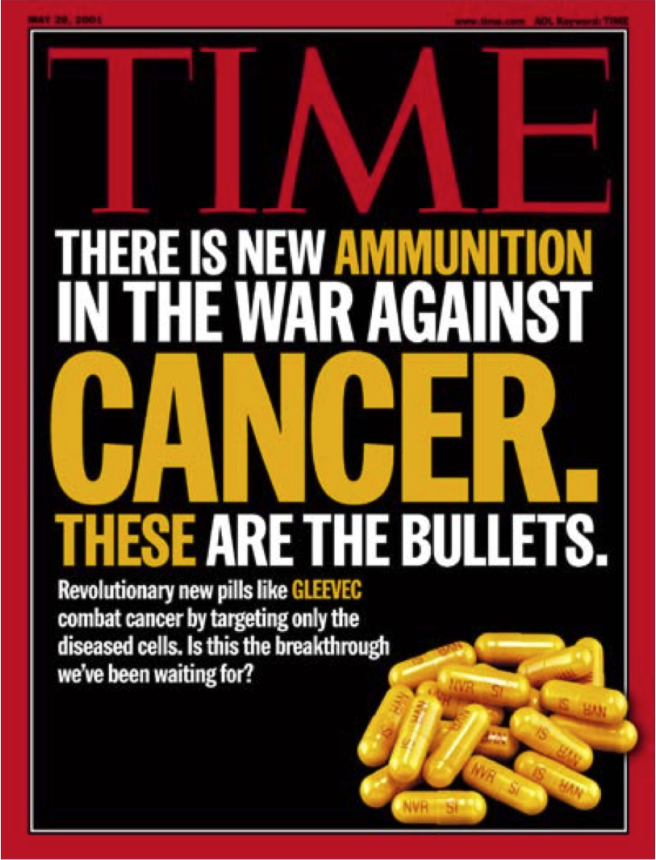
25 years ago TIME magazine put Gleevec (imatinib) on its cover.
As a fledgling transplanter at the NIH, I vividly recall valid concern about the durability of response and potential loss of the window for curative therapy. A thread on Imatinib development. 🧵
My husband Abraham was diagnosed with a very rare sacral chordoma. The surgery to remove bone and surrounding tissue lasted almost seven hours and was successful. He had a rough night and is in a lot of pain but is finally home resting. Now recovery begins. We’re so grateful for the outpouring of prayers and kind messages from all of you. Our hearts are full. ❤️
Check out our new work in Cell Systems!
Much of cellular biochemistry is organized by biomolecular condensates, but what mechanisms control their distribution throughout the cell? And is this mesoscale organization important for function?
link: https://t.co/lm4bXyTNYp
One of the most important lessons emerging from large-scale CRISPR perturbation studies is that the effect of a perturbation is often highly conditional on cellular state.
The same genetic perturbation can produce markedly different molecular phenotypes even within the same cell type; T cells in the figure.
◻️ Depending on factors such as signaling activity, cell-cycle stage, metabolic state, differentiation status, and environmental context. A perturbation does not act on a static system, it acts on a dynamic cell.
This has important implications for how we interpret perturbation data. A CRISPR screen performed under one condition should not be viewed as revealing a context-independent function of a gene product. Instead, it reveals how that perturbation manifests within a particular cellular state.
This is beautiful.
A previously undruggable target was finally properly drugged, doubling the survival time for a very deadly form of pancreatic cancer.
The profession gave it the standing ovation it deserved.
A new cellular atlas of atherosclerosis based on scRNAseq, snATACseq, and spatial transcriptomics across 216 human samples.
A useful resource, including associations with histological levels of atheroprogression.
10 years ago, this type of lung cancer was a death sentence for >95% of patients in less than 2 years. Since 2020, more than half the patients are still alive after 6 years! This is how we are curing cancer. In the next 5 years, these cure rates will greatly accelerate with AI.
Cancer deaths in the U.S. have declined by 33% since 1991. @theNCI-funded research has been central to that progress — alongside advances driven by the broader scientific community. It shows what sustained investment in science can achieve. https://t.co/HdWl8VKnHj
This July, @theNCI is convening the Precision in Practice workshop on functional precision medicine — an approach with real potential to improve how we guide cancer treatment decisions and patient care. I hope you’ll join me for this hybrid event July 1–2. https://t.co/aMgGTBIpO4


![JoshuaClaybourn's tweet photo. On Sunday, my friend Gordon Wood was struck and killed in a car accident. Gordon taught history at Brown Univ. and was among the most accomplished historians America has produced. He won the 1993 Pulitzer Prize for The Radicalism of the American Revolution, and his earlier book The Creation of the American Republic, 1776–1787 took the 1970 Bancroft Prize. He also received the National Humanities Medal.
He was, in my view, the finest historian of America's founding—which makes it all the sadder that he did not live to see the nation's 250th birthday. His reputation reached popular culture, too. Matt Damon's character in Good Will Hunting invokes him by name in the famous bar scene, accusing a Harvard student of simply "regurgitating Gordon Wood, talking about [...] the pre-Revolutionary utopia and the capital-forming effects of military mobilization."
I feel fortunate to have collaborated with Gordon on several projects. In a 2019 anthology I compiled, he wrote an essay on the possibility of a shared American narrative. He centered his argument on equal rights as "the most radical and most powerful ideological force" the Revolution unleashed. "This powerful sense of equality is still alive and well in America," he wrote, "and despite all of its disturbing and unsettling consequences, it is what makes us one people."
When I needed jacket blurbs for my new book Lincoln's Compass, coming out this November, I turned to Gordon. The fit was natural: the book argues that Abraham Lincoln took the Declaration's claim that "all men are created equal" as his guiding moral compass—and that he refocused the nation on that claim. Gordon, ever the gentleman, offered generous praise.
He was, in many respects, the dean of American historians. He will be very hard to replace.](https://pbs.twimg.com/media/HKTRZYnXkAAoZO7.jpg)