@UPS have you ever tried calling India customer care numbers- try it some day? Wait time is the longest best I have ever come across any other brand of any other service or product! Good work 👊
*STATEMENT*
As per reports, the Hon’ble Delhi High Court today has issued notice to me in a plea seeking initiation of criminal contempt proceedings over one of my reports concerning the appearance of conflict of interest and reasonable apprehension of bias in Justice Swarana Kanta Sharma hearing the CBI appeal in the Delhi Excise Policy case. The petitioner alleges that my report contains “serious, unfounded and scandalous allegations” against Justice Sharma.
I stand firmly by my reporting.
The report was based entirely on documentary material: RTI data furnished by the Ministry of Law & Justice, the judge’s own judicial orders in Criminal Revision Petitions, publicly available records, and statements made by a sitting Hon’ble Judge of the Supreme Court himself.
Not a single fact reported by me has been rebutted either by the judge concerned or by the CBI in any of the proceedings, including the suo-motu contempt proceedings. In that backdrop, an unattached third party has now come into the picture.
That said, since the matter now directly concerns me and is sub-judice, it will not be appropriate to comment further on the merits at this stage. I shall place my response before the Court after consulting distinguished members of the Bar, eminent legal luminaries, and respected members of the fraternity.
The constitutional guarantee of free speech includes the right, not just of journalists, but of every citizen, to fairly scrutinise and critique judicial functioning and administrative decisions that have a bearing on public confidence in the institution. The faith in the institution can never be strengthened through opacity or the chilling of public scrutiny.
Journalism that seeks to uncover these uncomfortable facts in the largest of public interests is part of the constitutional duty of the fourth pillar. Questions cannot be contempt.✊🏻
#JournalismIsNotACrime
Shekhar Gupta sent me word last night that my contract with The Print—where I was a columnist—will not be renewed because I called Narendra Modi a “coward” and a “curse on India”.
Gupta was perfectly fine with my calling the Gandhi family “a plague on India”, but Modi apparently is too sacred a cow.
It is not clear to me whether Gupta took this call or was instructed to take it. The former would be worse because it would mean that he censors those with whom he disagrees.
I obviously do not want anyone else to get into trouble for my posts—which is why my Twitter page carries the disclaimer that “I speak solely for myself here”—and I don’t wish Gupta ill.
The Print gives opportunities in journalism to people who wouldn’t otherwise have any. Does sustaining such an enterprise require compromise? I don’t know.
What I do know is that I value Gupta’s work as a chronicler of India’s republican vicissitudes. Which is what makes his pitiful conduct rather painful.
I’m sufficiently blessed not to be affected by this in any material way. I’m vaguely worried that I’ll be hassled by the authorities, but as far as work is concerned I’ve other avenues in which to publish.
I’m just sorry to see a man I mildly respected reduced to cutting ties out of fear.
I don’t want anybody to become a martyr—but I’d be dishonest if I didn’t admit that I’m troubled by the knowledge that Gupta is a far smaller man than I had supposed.
He didn’t have the courage—or even the decency—to speak directly to me.
He delegated that duty to someone else.
Sad.
BSNL director Vivek Bazal's "royal trip" to Prayagraj now stands cancelled. After reading the official order, at least 50 senior BSNL officials deployed in the duty to arrange everything from luxury to undergarments, breathe a sigh of relief.
ये दिल्ली है !
23 साल के युवक को एक रीलबाज, रईसजादे ने Scorpio-N से उड़ा दिया। ना उसके पास लाइसेंस था, ना कार चलाने आती थी।
लेकिन 19 साल के लड़के के पास SUV थी, क्योंकि बाप का बड़ा बिजनेस है।
पहले Sahil Dhaneshr की बाइक में टक्कर मारी, फिर Dzire में भी भिड़ा दिया।
साहिल की on the spot डेथ हो गई।
अब मां, न्याय मांग रही है।
BREAKING ⚠️
40 MORE days of parole for rape-murder convict Dera chief Gurmeet Singh, 3 months after his last parole in Aug 2025.
It’s his 11th parole/furlough since 2020.
That’s 4️⃣0️⃣6️⃣ days out of jail total since his conviction.
Shame on the Govt, shame on the Judiciary.
देश के सबसे साफ शहर में गंदा पानी पीने से 10 से ज्यादा लोगों की मौत हो चुकी है जिस शख्स पर लोगों को साफ पानी पिलाने का जिम्मा है वो सवालों को फोकट बता रहे हैं हमारे सवालों को "घंटे" में उड़ा रहे हैं @manishdekoder@GargiRawat@Abhinav_Pan@sanket
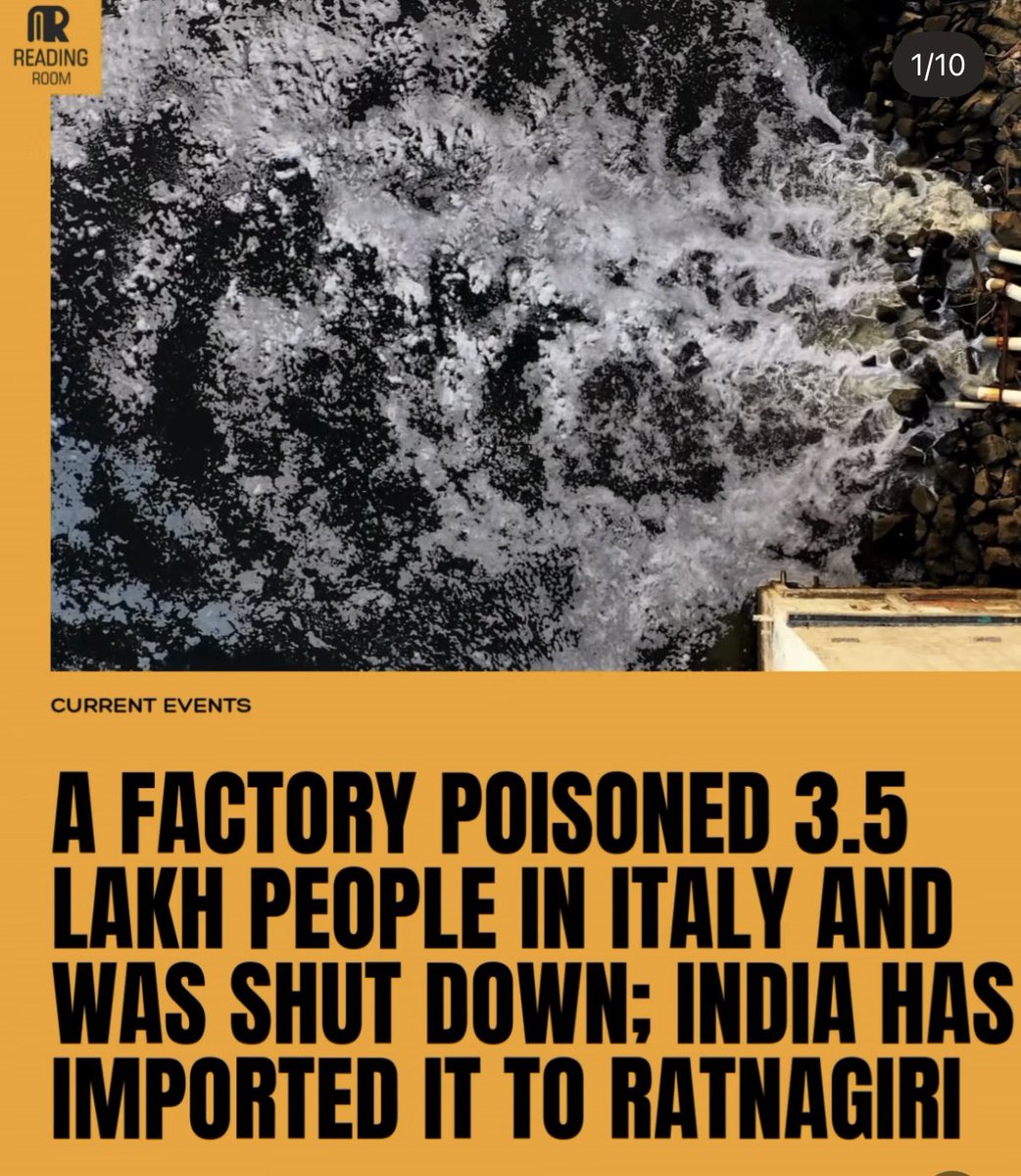
I am struggling to wrap my head around this. How did a factory that poisoned 350,000 people in Italy and sent its executives to prison for 141 years get a second life in India?
This is the story of a “toxic hand-me-down" thats unfolding right now in Ratnagiri, Maharashtra.
In 2018, the Miteni plant in Italy was shut down. It had leaked "Forever Chemicals" (PFAS) into the groundwater for decades. The result? Kidney cancer, heart disease, and thousands of excess deaths. It was an environmental crime so bad that the Italian courts actually held the bosses accountable.
But instead of being scrapped, the plant was bought, dismantled, and shipped in containers to Mumbai.
By early 2025, it became fully operational in the Lote Parshuram industrial area.
Here’s why this is terrifying:
1. No Rules: India doesn't even have PFAS regulations yet. We are basically a "wild west" for chemicals that stay in your blood and soil forever.
2. Infrastructure Gaps: In rural Maharashtra, power cuts are frequent. When the power goes out, the treatment plants stop, and toxic waste gets dumped directly into the streams that feed the Vashishti and Jagbudi rivers.
3. The Western Ghats: We are doing this in the heart of one of the world's most sensitive ecosystems.
It feels like we’re being used as a dumping ground for a business model that was literally ruled a crime in Europe.
Why are we importing equipment that was deemed too poisonous for Italians? Who is looking out for the 25,000 workers and the families living in Ratnagiri?
We need to talk about this before "Forever Chemicals" become a forever problem for our children.
#Ratnagiri #Maharashtra #Environment #PublicHealth #PFAS #India #WesternGhats #CleanWater
https://t.co/98JZaIypZX
@ananya_sharma_@IndiaSpend@CSIR_IITR@IVLSecurities@aerf_india@toxicslink
More bad news for mobile phone users in India (after SIM binding): Our government is mandating a government app (sanchar saathi) on every new phone, permanently, Reuters reports.
Will be pushed to your phone via OTA. New smartphones need to have it. Users cannot delete it. This is a first. India has never before required an unremovable state app on every device. Russia does btw, with its MAX Messenger (started September 2025).
A few comments regarding this:
1. Sanchar Saathi is a lost phone tracker, but if it gets embedded with no possibility of removal, it becomes a government tracker on your device.
IF the government is allowed to get away with this, what’s next? A mandatory digital ID app? Digiyatra forcefully installed on each device? An app that disables VPNs or tracks your app and browser history? An app that sends copies of your messages to the government once a month?
Once the OS layer is opened to the state, it doesn’t close.
2. Legally, one can argue that your mobile phone is your personal space, and this is an invasion of your personal space.
It’s where we have our most private conversations. Exchange sensitive information with people we trust.
How do we know this app isn’t used to access files and messaging on our device, which is unencrypted on device? Or a future update won’t do that? This is clearly an invasion of our privacy.
3. Remember how the government exempt itself from much of the Data Protection Law. This explains why.
The Data Protection Law will make private companies more accountable and the Indian government less accountable.
4. Bloatware is already an issue with some phones (It’s why I don’t use Samsung). Now there’s more, and this time the government is forcing bloatware. I guess we’ll all have to root our phones now. When you buy a phone with bloatware, you're choosing to buy it with bloatware. This is different.
5. The way things work with India’s Department of Telecom, there was no public consultation, the order wasn’t disclosed. Just forced. This is dictatorial in nature. If they get away with this, more will follow.
In July, just three months before the IPO, Piyush Bansal took a ₹200 crore loan to buy Lenskart shares at an ₹8,500 crore valuation.
Now, in November, he is selling those same shares to the public at a whopping ₹70,000 crore valuation and is expected to cash out ₹850 crore himself.
What exactly changed in three months? How did the valuation jump 8X
Maybe it’s time we put on a different lens to see the real picture
(Long read) Meesho: A logistics giant masquerading as an e-commerce platform 🛒🚚
A lot of effort went into writing this - please RT if it adds value, will help my business grow! ♻️
One of India’s largest e-commerce businesses, Meesho is getting ready for listing later in the year. It has published a 667 page DRHP outlining its business - and we went through it to bring you cutting edge insights about the business.
Part A: Bottom of pyramid consumption play?
For ages the investing community has lamented about a lack of opportunities to play the bottom of pyramid growth. Options were limited to rural staples businesses or gold backed financiers with reach. But India’s BoP is consuming more than just staples - they are buying apparel, footwear, home & kitchen appliances and beauty products. And there now seems to be a business to play it!
Meesho now reaches 21cr+ users in India, and each of them make 8+ orders a year on the app! That is a non-trivial portion of India’s population (15%+) using the app on an almost monthly frequency
This market however is not without its challenges. Being a largely cash on delivery market (75%+ orders are CoD) cancellations and return to origins are high. Out of every 100 orders placed, less than 70 are actually successfully delivered.
This combined with the low average order value for this segment, makes this an extremely challenging market to cater to! The average apparel sold on the platform sells for 300, the average beauty product just 160! [To highlight the contrast - Nykaa, a platform focussed on Tier1 India, has a beauty AoV of 2000+, and a fashion AoV of 4500+.]
Part B: Peeling the onion- the order vs AoV trade off!
Most players in the ecommerce race are hyper-focussed on increasing average order value. And it makes sense - a higher order allows your larger contribution margin to cover your fixed cost base, and take you to coveted profitability.
But Meesho seems to be taking a different path. Over the last two years, the business mix has moved away from the (relatively) higher priced apparel segment towards lower priced home and kitchen appliances and beauty segments.
This has driven a whopping 38% CAGR in successful order growth, even as NMV per successful order dropped from 281 to 230
And this tradeoff is telling! What the business appears to be doing is optimizing for order growth - that will bring economies of scale to its logistics business - as it attempts to deliver deeper into India’s hinterlands.
Part C: The logistics play
Unlike most e-commerce platforms that charge their sellers a commission - Meesho runs a commission free business model - instead charging its sellers a delivery charge. Meesho today has 58 lakh+ sellers on its platform - each making ~40,000 a year after delivery fees.
Given that it’s sellers sell low value items - getting their delivery costs down is critical to make business lucrative for sellers. Meesho to it’s credit has been doing that quite well. The cost per order shipped has moved from ₹66 in FY23 to ₹52 today.
For context - Delhivery, one of the largest purely logistics players in the country - and Meesho today has a close to 30% advantage over it on average cost per delivery. While part of this could be attributable to difference is shipment size etc. - the improvement in the Meesho cost of delivery is undeniable.
More impressive is that this advantage has been built without compromising on margins. Logistics cost, while the largest cost head for the business, have remained steady as % of marketplace revenue (delivery fee) - indicating strong operating level changes that the business has executed starting FY23.
Part D: Ye Valmo Valmo kya hai?
In 2021, Meesho conceptualized an asset light way to play logistics in India. They would own no warehouses or trucking assets - instead letting logistics partners compete amongst themselves to bid to service the orders (increasing their utilization, but crushing margins).
In FY23 it covered just 2% of Meesho’s total order volume. That number has now scaled to 62% and the benefits that the business generates via this fierce competition between India’s fragmented logistics players is passed on directly to their sellers.
The average Valmo order goes through 4 different handovers across firstmile, middle-mile, last mile and warehousing - with each participant in the logistics chain bidding for the business. The business today has 85,000+ delivery agents and 13,500+ active logistics providers.
Interestingly, this lower cost of delivery has allowed the sellers to sell a lot more faster on the platform. It took the FY22 cohort 3 years to triple their NMV. It takes the latest cohorts just 1.
Part E- Putting it all together!
Which brings us to the most critical question - how do you think of Meesho as a business and how would you value it? Because both those questions have a profound impact on the TAM for the business, and the multiples that business gets.
The Indian e-commerce shipment market is booming - growing north of 30% for the last 5 years, and poised to growth 25%+ till FY30. Of the 700cr+ orders that are delivered in India every year - Meesho controls ~180cr (or roughly 25%).
As more and more of it’s orders go to Valmo instead of other third party logistics players, the smaller players with a heavier dependence on Meesho like EcomExpress will fall away, or be subsumed by one of the larger players in the industry like Shadowfax or Delhivery.
In the long run, once Valmo has started catering to the bulk of Meesho business - it will likely venture outward to take external clients, making it a strong player (~25-30% captive revenue) in a oligopolistic end-market.
Back of envelope, in five years (FY30) this is a 1 lakh crore opportunity, in which this business could have a third of market share, and a thin low single digit margin (industry is still reasonably competitive) on that sales. Given that most logistics plays in India trade at ~2-4x sales, entry valuations doing the rounds in the media do look punchy.
That being said - a phenomenally well build business and definitely one to keep in your radar.
Disc: This is a purely educational post and is NOT intended as an investment recommendation. Please consult a SEBI Registered professional or do your own diligence before taking any investment decision.
About me: If you’ve landed on this blog for the first time, do subscribe. We do a lot such business deep-dives. You can also read up more about my research here :
https://t.co/ezmwanqQGg (SEBI Registered RA)
Scooter or EV? Why choose when you can have the best of both!
Gear up for the EVOOTER - a ride that has it all 💯
Launching on 1st July. Stay tuned!
#StayTuned#ComingSoon#NewLaunch#EVOOTER#ElectricScooter#VIDAEV
.
.
.
.
.
[Electric scooter, Vida electric scooter, Best electric scooter, Removable batteries, charging simple hai, Next-gen mobility]







![bharatbetpf's tweet photo. (Long read) Meesho: A logistics giant masquerading as an e-commerce platform 🛒🚚
A lot of effort went into writing this - please RT if it adds value, will help my business grow! ♻️
One of India’s largest e-commerce businesses, Meesho is getting ready for listing later in the year. It has published a 667 page DRHP outlining its business - and we went through it to bring you cutting edge insights about the business.
Part A: Bottom of pyramid consumption play?
For ages the investing community has lamented about a lack of opportunities to play the bottom of pyramid growth. Options were limited to rural staples businesses or gold backed financiers with reach. But India’s BoP is consuming more than just staples - they are buying apparel, footwear, home & kitchen appliances and beauty products. And there now seems to be a business to play it!
Meesho now reaches 21cr+ users in India, and each of them make 8+ orders a year on the app! That is a non-trivial portion of India’s population (15%+) using the app on an almost monthly frequency
This market however is not without its challenges. Being a largely cash on delivery market (75%+ orders are CoD) cancellations and return to origins are high. Out of every 100 orders placed, less than 70 are actually successfully delivered.
This combined with the low average order value for this segment, makes this an extremely challenging market to cater to! The average apparel sold on the platform sells for 300, the average beauty product just 160! [To highlight the contrast - Nykaa, a platform focussed on Tier1 India, has a beauty AoV of 2000+, and a fashion AoV of 4500+.]
Part B: Peeling the onion- the order vs AoV trade off!
Most players in the ecommerce race are hyper-focussed on increasing average order value. And it makes sense - a higher order allows your larger contribution margin to cover your fixed cost base, and take you to coveted profitability.
But Meesho seems to be taking a different path. Over the last two years, the business mix has moved away from the (relatively) higher priced apparel segment towards lower priced home and kitchen appliances and beauty segments.
This has driven a whopping 38% CAGR in successful order growth, even as NMV per successful order dropped from 281 to 230
And this tradeoff is telling! What the business appears to be doing is optimizing for order growth - that will bring economies of scale to its logistics business - as it attempts to deliver deeper into India’s hinterlands.
Part C: The logistics play
Unlike most e-commerce platforms that charge their sellers a commission - Meesho runs a commission free business model - instead charging its sellers a delivery charge. Meesho today has 58 lakh+ sellers on its platform - each making ~40,000 a year after delivery fees.
Given that it’s sellers sell low value items - getting their delivery costs down is critical to make business lucrative for sellers. Meesho to it’s credit has been doing that quite well. The cost per order shipped has moved from ₹66 in FY23 to ₹52 today.
For context - Delhivery, one of the largest purely logistics players in the country - and Meesho today has a close to 30% advantage over it on average cost per delivery. While part of this could be attributable to difference is shipment size etc. - the improvement in the Meesho cost of delivery is undeniable.
More impressive is that this advantage has been built without compromising on margins. Logistics cost, while the largest cost head for the business, have remained steady as % of marketplace revenue (delivery fee) - indicating strong operating level changes that the business has executed starting FY23.
Part D: Ye Valmo Valmo kya hai?
In 2021, Meesho conceptualized an asset light way to play logistics in India. They would own no warehouses or trucking assets - instead letting logistics partners compete amongst themselves to bid to service the orders (increasing their utilization, but crushing margins).
In FY23 it covered just 2% of Meesho’s total order volume. That number has now scaled to 62% and the benefits that the business generates via this fierce competition between India’s fragmented logistics players is passed on directly to their sellers.
The average Valmo order goes through 4 different handovers across firstmile, middle-mile, last mile and warehousing - with each participant in the logistics chain bidding for the business. The business today has 85,000+ delivery agents and 13,500+ active logistics providers.
Interestingly, this lower cost of delivery has allowed the sellers to sell a lot more faster on the platform. It took the FY22 cohort 3 years to triple their NMV. It takes the latest cohorts just 1.
Part E- Putting it all together!
Which brings us to the most critical question - how do you think of Meesho as a business and how would you value it? Because both those questions have a profound impact on the TAM for the business, and the multiples that business gets.
The Indian e-commerce shipment market is booming - growing north of 30% for the last 5 years, and poised to growth 25%+ till FY30. Of the 700cr+ orders that are delivered in India every year - Meesho controls ~180cr (or roughly 25%).
As more and more of it’s orders go to Valmo instead of other third party logistics players, the smaller players with a heavier dependence on Meesho like EcomExpress will fall away, or be subsumed by one of the larger players in the industry like Shadowfax or Delhivery.
In the long run, once Valmo has started catering to the bulk of Meesho business - it will likely venture outward to take external clients, making it a strong player (~25-30% captive revenue) in a oligopolistic end-market.
Back of envelope, in five years (FY30) this is a 1 lakh crore opportunity, in which this business could have a third of market share, and a thin low single digit margin (industry is still reasonably competitive) on that sales. Given that most logistics plays in India trade at ~2-4x sales, entry valuations doing the rounds in the media do look punchy.
That being said - a phenomenally well build business and definitely one to keep in your radar.
Disc: This is a purely educational post and is NOT intended as an investment recommendation. Please consult a SEBI Registered professional or do your own diligence before taking any investment decision.
About me: If you’ve landed on this blog for the first time, do subscribe. We do a lot such business deep-dives. You can also read up more about my research here :
https://t.co/ezmwanqQGg (SEBI Registered RA)](https://pbs.twimg.com/media/G31m0odWAAAl-uN.png)
![VidaDotWorld's tweet photo. Scooter or EV? Why choose when you can have the best of both!
Gear up for the EVOOTER - a ride that has it all 💯
Launching on 1st July. Stay tuned!
#StayTuned #ComingSoon #NewLaunch #EVOOTER #ElectricScooter #VIDAEV
.
.
.
.
.
[Electric scooter, Vida electric scooter, Best electric scooter, Removable batteries, charging simple hai, Next-gen mobility]](https://pbs.twimg.com/media/Gs7FomPWkAA-ezp.jpg)


