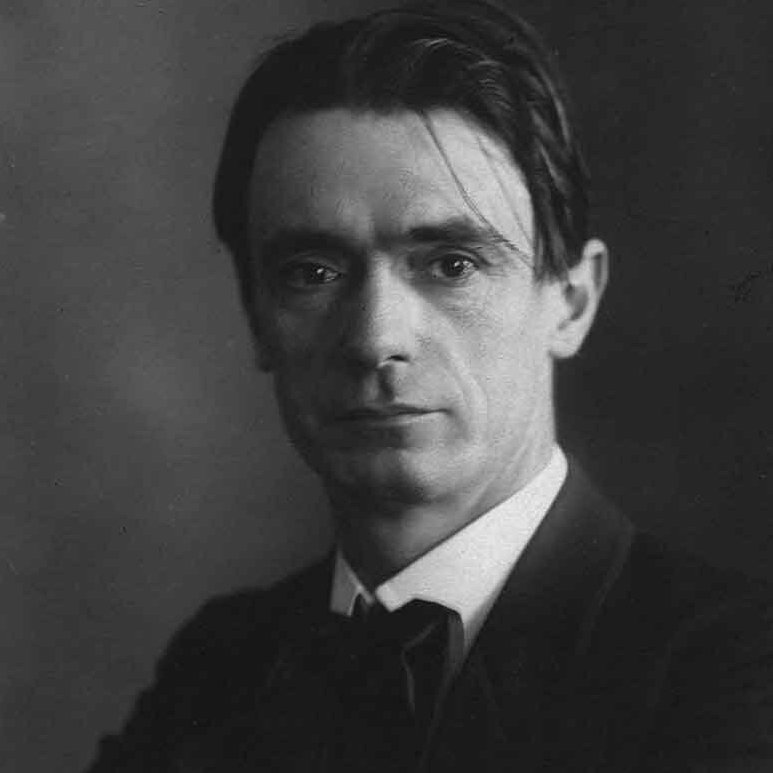
“Homer’s Greeks had no inner life” is what happens when you judge every age of humanity by the standards of our own.
They did lack something, but what they lacked was our kind of inner life: the private, reasoning self that sits behind its own eyes and looks out on a world it no longer feels part of.
Rudolf Steiner described this a century ago. Before the age of Greek philosophy, he wrote, “the human soul lived in imaginative (symbolic) thought pictures,” and “as long as the human soul conceives world phenomena through pictures, it feels itself intimately bound up with them.” The soul felt itself “a member of the world organism,” rather than a spectator of it.
Even the early Greek thinkers, he says, experienced a thought much as we experience a colour or a tone, as something met with in the things themselves rather than produced inside the head.
So when Homer opens with “Sing, O Muse,” he was describing something real. In Steiner’s words, “it was an inner experience of the soul. The poet knew that his inner being was seized by an objective spiritual force.”
Julian Jaynes looked at the same evidence and called it hallucination. Steiner looked at it and called it perception.
A soul still open to the gods and to the world around it, moved by forces it had not yet learned to call its own, can hardly be said to have had no inner life. If anything, it had a fuller one. What it was missing was the intellect, the cool and self-contained thinking that was only just beginning to wake in Greece itself.
Consciousness is no younger than the pyramids; it has simply changed its form, and ours is only the latest. The more interesting question is what we gave up to gain it.
Kundalini practice begins at the base of the spine, whereas the Rosicrucian path begins at the opposite end. This is not a matter of preference; the reason lies in the way human consciousness itself has changed.
In the yogic teaching of ancient India, the forces that lie coiled at the root of the spine are called kundalini, or the “serpent power.” Through breath-work and posture the practitioner would seek to awaken these forces, and draw them upward, centre by centre, until they reach the crown of the head.
For its own age, the age of the etheric body, this was the method for working with these forces. Dr. Rudolf Steiner taught that the spiritual organs of the soul, which he called the “lotus flowers,” were already partly active in humanity’s remote past, at a time when consciousness was still “in a dull, dreamy condition”; and he points out that their old manner of working “was only compatible with that dull state of consciousness.”
To force them open today is to pull a modern soul back into an earlier state. Such methods, Steiner warned, bring “illusions and fantastic conceptions.” With regard to the lower centres he is quite explicit, advising against the development of even the six-petalled lotus “unless the student has made great progress.”
Dr. Robert Gilbert adds that in the old traditions this work was carried out in ashrams, under strict discipline. Where that discipline was lacking, as it so often was in the West, many people fell into what has since come to be known as 'kundalini sickness.'
The Rosicrucian path, on the other hand, works in the opposite direction, beginning with wakeful thinking, the faculty proper to our present age of the consciousness soul.
Steiner describes how a centre is first formed in the head, and is then “moved lower down, to the region of the larynx,” before it is finally established in the region of the heart.
It is from the heart that “the most important of these currents flow to the lotus flowers,” and from there on through the whole body.
According to Gilbert, every chakra, and indeed every meridian and acupuncture point, holds a power of its own; yet when these are activated without a centre to coordinate them, they remain only scattered fragments.
It is the heart which is meant to become this centre, and Steiner’s six basic exercises are the means by which it does so; for as Gilbert explains, with each exercise a petal of the twelve-petalled lotus is unfolded, until the heart is able to order and harmonize the whole being.
Steiner is quite specific about what the heart centre perceives once it has developed. In How to Know Higher Worlds he tells us that it ��permits of clairvoyant knowledge of the sentiments and disposition of other souls,” and that it also makes it possible to observe “certain deeper forces in animals and plants.”
It should be said that these centres were not simply invented by one of the ancient religions. Steiner described them out of his own spiritual research, and the number of petals he gives for each of them agrees with what was recorded in India many centuries earlier.
Moreover, the places where he locates them, near the larynx, the heart and the pit of the stomach, are the same places where anatomy has found the great clusters of nerves in the body. Science, of course, only finds the physical location; what Steiner describes as being perceived there are “the sense-organs of the soul.”
Gilbert draws attention to the image that shows the Christian character of this path, namely the Baptism in the Jordan, where the Spirit descends upon Christ “like a dove.” Here the awakening comes from above, whereas in the old teaching of the serpent power it was made to rise from below.
It would be a mistake, however, to see in the Rosicrucian path merely an Eastern technique that has been given a Christian name. It is esoteric Christianity in the form that is appropriate for our time; the path that Steiner associated with the mission of Christian Rosenkreutz, and thereby a path of initiation for humanity in the age after Christ.
The old path awakens what the soul once was, while the Rosicrucian path awakens what the soul is in the process of becoming.
Every time you let a screen think for you, Rudolf Steiner had a name for what takes over.
During a lecture in 1913, he told his students to be present: to think along, to do the work themselves.
“At a slide lecture, Ahriman is called upon to think for people.”
But this didn't come from a personal dislike of projectors. He was pointing at a gesture of the soul: the moment images arrive by themselves, thinking stops arriving from within.
Ahriman, in Steiner’s cosmology, is the spirit of cold intelligence: exact, mechanical and without warmth or freedom. He does not need to defeat human thinking. He only needs it handed over.
In 1917 he went further. The human being, he said, would learn to lead “his intentions, his thoughts, into the forces of machines.” And “the welding together of human nature with machine nature” would be one of the great problems for the rest of earthly evolution.
Then, in March 1925, in the last weeks of his life, he wrote that technology had become “sub-nature”: a world beneath nature, a shadow of the etheric realm. And so:
“Man must find the strength, the inner power of knowledge, not to be overwhelmed by Ahriman in this technical culture.”
Notice how he does not call for us to destroy the machine, but that we must rise in spirit as far above nature as technology has sunk below it.
The danger is never the machine by itself. It is the soul that submits to its domination.
Gurdjieff said it more brutally: “Man is a machine. All his deeds, actions, words, thoughts, feelings, convictions, opinions, and habits are the results of external influences, external impressions.”
Dr. Steiner believed being mechanical is precisely what gives way to Ahrimanic infiltration.
He said:
"The masses of humanity go through life as if asleep, without thought." And so "the human intellect is to be taken over more and more by such powers."
Humans fear the day where machines think like us, the more terrifying truth is that we have long thought like them; and in our sleep, we have handed over our thinking to them without noticing the handover.
Thinking is the activity in which we become ourselves. Whatever we stop doing, we slowly lose the power to do.
The machine thinks without knowing that it thinks.
The human being must do the reverse: to know that he thinks, and to do it himself.
No machine will take your thinking from you.
You can only give it away.
Few people know how much these two actually overlap.
It’s not just their teachings. Both deeply admired the master Goethe, and both confronted what drives man without his knowing.
As someone once put it:
Jung - Soul Science
Steiner - Spirit Science
@EsotericWisdom_@ZherkaOfficial In anthroposophy, Rudolf Steiner is considered to be the reincarnation of Thomas Aquinas and Aristotle.
Interestingly, all 3 have a similar work ethic. Steiner, 6000+ lectures. Aquinas, Summa Theologiae +more. Aristotle, read every book in Plato’s academy. Not many like that…