Nothing says “net zero” quite like 93 private jets full of billionaires, technocrats and politicians arriving at the COP31 summit to tell the rest of us to turn the heating down and use paper straws.
One of those flights emits roughly as much as an average person does in an entire year. The people setting the rules are the ones who refuse to follow them.
@cbcsports@CanadianTire I hardly see anyone there who looks like me. My kind are underrepresented here, and I've been told that when I don't see my people represented I shouldn't bother watching.
This is how you manipulate a population.
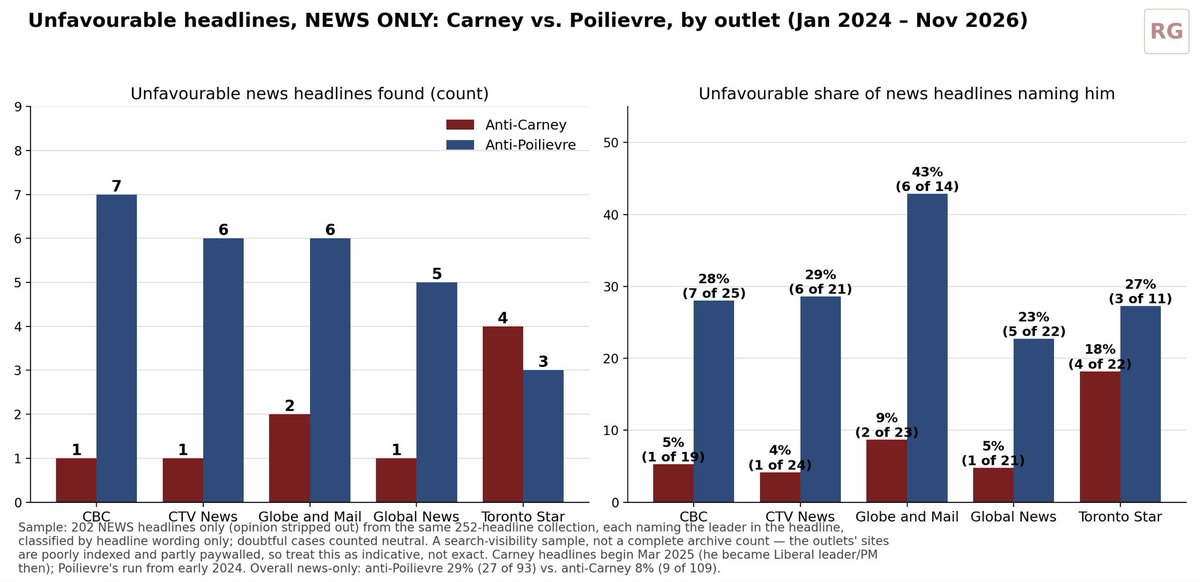
I did a search on headlines from Canadian mainstream media.
When any are about Carney, only 9 out of 109 headlines were unfavorable
When it’s about Pierre 27 out of 93 headlines were unfavorable.
That’s 8% for Carney and almost 30% for Pierre.
Poilievre's share of unfavourable headlines is 3.5 times greater than Carney's and he isn’t even in charge of the Country.
I would say that’s pretty clear evidence of media bias.
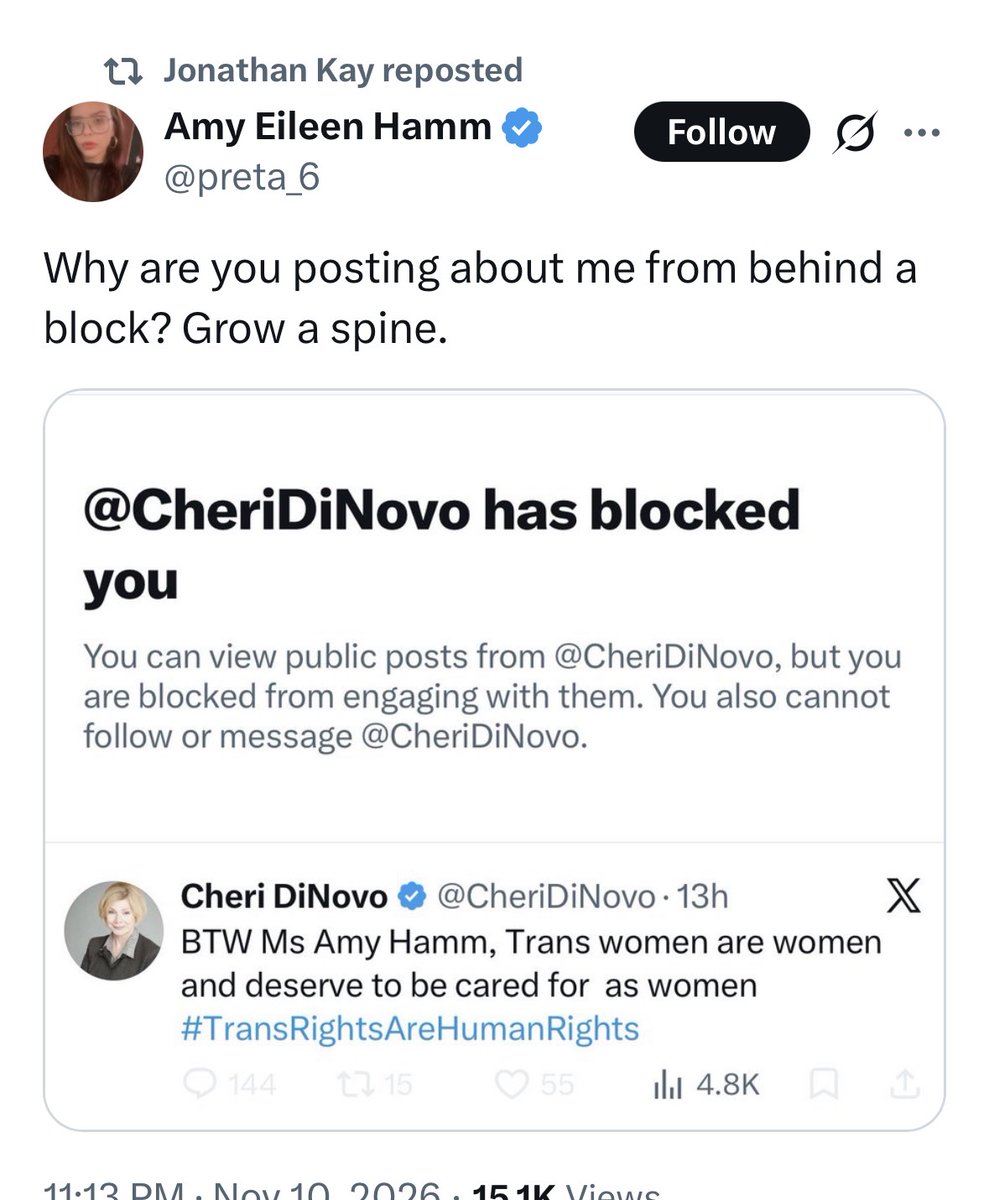
So, when a man who claims to be a woman turns up to hospital claiming to have prostate problems, should a nurse “care for” him like a woman & tell him that’s impossible, potentially putting him in serious danger, or care for him like the man he is and look into it? There is only one right answer here, Cheri.
One place where biological sex seriously matters is in a hospital and it is your stupid rhetoric that is putting people in danger, not a nurse like @preta_6 who is simply acknowledging reality, which the job requires.
You have fallen into such a black hole of misogynistic and homophobic ideology that you won’t even spell out “same sex marriage” in your bio in a futile attempt to ignore the reality of sex you yourself blatantly used to know matters.
You’re going after a woman for telling the truth so that men can keep lying. It’s absolutely absurd.
This is Manitoba’s fermented dumpster juice of a premier Wab Kinew @WabKinew in a mullet, in a trash lot, yelling “stank bitch” and “your pussy ain’t shit” for 3 minutes. That is the video. Real deal loser shit.
Standing next to dumped furniture, rating women like garbage, then later tossing on a suit with a man bun acting like the province should salute him. That man bun is doing more work than he is holding anything together whatsoever. He’s really committed to that.
this post has so much wisdom in it i thought naval wrote it
and i don't think the author even realizes why
if you understand this properly, you can explain almost all political issues we see in the world today
you can't take care of your loved ones if you can't even take care of yourself. you can't build a functioning country if your loved ones aren't taken care of. and you certainly can't save the world if your own country is falling apart. responsibility has to expand outwards.
the problem with so much left-wing thinking is that it's backwards. it starts with the most noble sounding objective imaginable, "saving the world" or "climate change" or "poor migrants", and thinks about the most nice-sounding solution, without considering if the conditions required to achieve it even exist, and that's why so many apparently well-intentioned policies end up doing the exact opposite of what they were supposed to achieve.
they sound compassionate, but completely ignore incentives, tradeoffs, or second-order consequences
clean your own damn bedroom and put your house in order before trying to change the world
you will never be able to fix the world if you can't even get the order of your own responsibilities right
Name one? How about a few?
Rockefeller lowered the cost of kerosene through efficient refining and distribution.
Ford made automobiles affordable through mass production.
Carnegie reduced steel production costs through industrial innovation.
Walton lowered retail prices through bulk purchasing and efficient logistics.
Dell made computers cheaper by eliminating retail intermediaries.
Kamprad made furniture affordable through flat-pack manufacturing and distribution.
Bezos intensified retail competition through Amazon.
Koum made international messaging practically free through WhatsApp.
Page and Brin made search, navigation, email, and translation available without direct charges.
And that's barely scratching the surface.
In fact, it would be considerably more challenging to find a billionaire who earned their fortune through voluntary trade without lowering costs, improving quality, increasing productivity, or making something more accessible.
That's how fortunes are generally made in competitive markets. You create value for others, and the more people you serve, the greater your potential reward.
You don't even have to buy from these businesses to benefit. Their competitors must improve their offerings or risk losing customers.
These clout chasers destroy their credibility daily without so much as flinching.
They enjoy the accumulated benefits of capitalist innovation while confidently demanding evidence that any of it ever happened.
The economic illiteracy would be impressive if it weren't so commonplace.
Je parle souvent de La Route de la servitude de Friedrich Hayek. Je vais être direct : pour moi, quiconque lit ce livre en étant sain d'esprit et n'en ressort pas libéral et profondément anti-étatiste est soit fou, soit stupide, soit corrompu. Soit les trois à la fois.
Voici pourquoi. Masterclass.
D'abord, l'homme.
Friedrich Hayek naît à Vienne en 1899, dans un empire qui se croit éternel. À 18 ans, il est sur le front italien. Quand il rentre, l'empire n'existe plus. Il voit l'Autriche sombrer dans l'hyperinflation, les économies d'une vie effacées en quelques mois.
Il devient l'élève de Ludwig von Mises, celui qui avait démontré qu'un planificateur sans prix libres navigue à l'aveugle. En 1931, il part enseigner à Londres et devient le grand rival intellectuel de Keynes. En 1938, il voit son pays natal avalé par Hitler sous les acclamations de la foule. Il prend la nationalité britannique.
C'est là, en pleine guerre, entre 1940 et 1943, qu'il écrit son livre. Pas contre les nazis : tout le monde l'était déjà. Contre quelque chose de bien plus dérangeant. Il voit les élites anglaises, les meilleurs esprits, les gens les mieux intentionnés, reprendre exactement les idées qui avaient mené l'Allemagne au désastre. Planification, direction de l'économie, organisation « scientifique » de la société.
Il dédie le livre « aux socialistes de tous les partis ». Tout est dit.
Trois éditeurs américains le refusent. Il sort en 1944, s'épuise en quelques semaines, puis le Reader's Digest le condense pour des millions de lecteurs. Keynes lui-même, son grand adversaire, lui écrit qu'il en approuve moralement et philosophiquement presque chaque ligne. Trente ans plus tard, Hayek reçoit le prix Nobel. Thatcher relit le livre en 1974 et change la trajectoire de l'Angleterre.
Le titre, d'ailleurs, est un hommage à un Français : Tocqueville, qui avait vu venir le despotisme doux.
Maintenant, ce que dit le livre. En clair.
Première idée : personne ne sait assez pour planifier.
La connaissance qui fait tourner une économie n'est dans aucun bureau. Elle est éparpillée dans des millions de têtes : l'agriculteur qui sait quand sa terre est prête, le commerçant qui sent son quartier changer, l'artisan qui connaît son fournisseur. Le prix libre est le seul système capable de rassembler tout ça en un signal. Remplacez les prix par un plan, et vous remplacez le savoir de millions de gens par l'ignorance de quelques-uns.
Deuxième idée : contrôler l'économie, c'est contrôler la vie.
On croit que l'économie est un domaine à part, matériel, secondaire. Faux. Celui qui contrôle les moyens contrôle les fins. S'il décide de ce que vous pouvez produire, acheter, chauffer, cultiver, il décide de la façon dont vous vivez. Il n'y a pas de liberté politique sans liberté économique.
Troisième idée : une démocratie ne peut pas se mettre d'accord sur un plan.
Tout le monde veut « un plan ». Personne ne veut le même. Le Parlement débat, tergiverse, se divise. L'impatience monte, et on finit par dire : laissons faire les experts. On délègue à des agences, des commissions, des autorités « indépendantes ». La démocratie ne meurt pas d'un coup d'État. Elle se dessaisit elle-même, par lassitude.
Quatrième idée : l'État de droit contre l'arbitraire.
Dans un pays libre, l'État fixe des règles générales, connues à l'avance, les mêmes pour tous, comme le code de la route. Vous savez à quoi vous attendre et vous construisez votre vie autour. Dans un pays planifié, l'État décide au cas par cas : qui a droit à quoi, quel secteur survit, quelle région est sacrifiée. Ce n'est plus la loi qui gouverne, c'est la volonté de quelqu'un.
Cinquième idée, la plus terrible : pourquoi les pires arrivent au sommet.
C'est le chapitre que tout le monde devrait lire. Quand le plan échoue, et il échoue toujours, il faut contraindre. Il faut des gens prêts à faire ce que les gens honnêtes refusent de faire. Le système ne promeut pas les meilleurs, il sélectionne ceux qui n'ont pas de scrupules. Et pour souder une majorité autour du plan, rien ne marche mieux qu'un ennemi commun : le riche, l'étranger, le récalcitrant.
Sixième idée : la fin de la vérité.
Un plan a besoin que tout le monde y croie. Alors l'information devient un instrument. Ce qui sert le plan est vrai, ce qui le gêne devient de la « désinformation ». La propagande n'est pas un accident du dirigisme. C'est une nécessité.
Et la leçon centrale, celle qui glace le sang : ceux qui ouvrent la route ne sont pas des monstres. Ce sont des gens sincères, cultivés, bien intentionnés. Ils veulent la justice, la sécurité, le progrès. Ils ne voient pas où mène le chemin. Les monstres arrivent après, quand le terrain est prêt.
Ce livre est une bouteille à la mer. Hayek nous a laissé le mode d'emploi pour reconnaître la pente avant qu'elle devienne un précipice.
Et que fait l'Europe ? Elle rejoue le livre, chapitre par chapitre.
Les règles générales remplacées par des milliers de normes au cas par cas. Des décisions qui pèsent sur nos vies prises par une Commission que personne n'a élue et que personne ne peut renvoyer. Des plans à vingt-cinq ans pour l'énergie, l'agriculture, l'industrie, l'automobile, comme si quelqu'un à Bruxelles savait mieux que 450 millions d'Européens ce qu'il faudra produire en 2050. Et quand ça échoue, on ne remet jamais le plan en cause. On ajoute une couche : une taxe, une interdiction, un régulateur.
Le plus cruel, c'est l'ironie. En 1939, Hayek défendait l'idée d'une fédération européenne. Mais une fédération où ni le centre ni les États ne pourraient diriger l'économie. Une union pour libérer les échanges, pas pour piloter les vies. Nos européistes ont gardé le mot « fédération » et jeté tout le reste. Ils ont construit exactement ce contre quoi il nous mettait en garde.
Ils avaient le livre à portée de main. Ils refont les mêmes erreurs, avec les mêmes bonnes intentions et le même mépris pour ceux qui doutent.
Je ne crois pas que l'histoire se répète à l'identique. Je crois qu'elle rime. Au XXe siècle, la route de la servitude a mené au pire : des tyrans fous, des peuples broyés, des dizaines de millions de morts. Ceux qui avaient ouvert la route n'avaient jamais voulu ça.
J'espère que, pour une fois dans l'histoire, nous saurons nous arrêter avant. Que nous n'attendrons pas le tyran pour comprendre où menait le chemin.
Hayek nous a tout dit il y a quatre-vingts ans. La seule question est de savoir si nous saurons le lire à temps.
Lisez La Route de la servitude. Puis offrez-le à quelqu'un que vous aimez.
THE GREAT FEMINIZATION: ONE YEAR ON
One year ago, Helen Andrews published one of the most provocative and important essays of recent times: The Great Feminization, in Compact Magazine.
https://t.co/20KJUmihHi
Her central thesis? The rise of wokeness, cancel culture, institutional conformity and declining meritocracy is partly explained by the unprecedented feminization of Western institutions.
Andrews deserves enormous credit for challenging conventional wisdom and asking questions that few have dared to raise...
The evidence supporting her argument deserves serious attention:
🔹 Demographic transformation: Women became the majority of American law students in 2016, medical students in 2019 and the college-educated workforce in 2019. Women also dominate psychology and increasingly occupy influential positions across education, media and government.
🔹 Established psychological differences: Research identifies average sex differences in risk-taking, competitiveness, agreeableness and conflict management. These differences can influence institutional culture.
🔹 Free speech versus social cohesion: Survey evidence indicates women are, on average, more inclined than men to prioritise social cohesion over unrestricted expression.
🔹 Institutional mechanisms: HR bureaucracies, DEI initiatives, speech codes and complaint procedures can elevate emotional safety and consensus above open debate and procedural fairness.
🔹 Historical examples: The Larry Summers controversy, Bari Weiss's departure from The New York Times, and campus cancellation campaigns illustrate the institutional dynamics Andrews questions, although they do not establish causation.
Her essay generated enormous discussion, sympathetic commentary and vigorous debate across major publications and podcasts.
Andrews's great achievement is recognising that female-dominated institutional cultures deserve the same critical scrutiny routinely applied to male-dominated ones.
Her overarching causal thesis remains contested, but her contribution is intellectually courageous, timely and worthy of much deeper investigation...
Equal standards. Genuine meritocracy. Intellectual freedom. For everyone.
The Problem With Feminising Society, from Triggernometry (1.4 million views):
https://t.co/jXK97j048O
Spare us the sermon, @WabKinew . You're an intellectual and political lightweight with a record of misogyny and a seriously questionable, immoral history. Shame on Manitoba for electing you. And as the interloper you are, let me remind you that you have no business posing as anyone's moral compass.
We fired an unethical government whose negligence and nefarious "management" has caused irreparable damage– sold out our rights and freedoms, fuelled division, racism and hate, and devastated British Columbia. Full stop.
Be happy for now that we don't have the legislation to grab your buddy Eby to hold him responsible for what he's done to this province.
The scandal is what the NDP did with power and always has.