A resident living under half a mile from a Google data center near Evansville says nearly 10 years in, there's no noise or light pollution — "only positive." A quiet counterpoint to national data center fears. https://t.co/fCe00uIMyx
A Claude Code project folder is not just a pile of config files. Each piece decides when it loads, and knowing that is what keeps your context clean. Here is the structure sorted by when each part kicks in.
Some things load every session. CLAUDE.md loads from the root down to your current folder, all merged, and a subfolder CLAUDE.md loads once Claude works there. Put private notes in CLAUDE.local.md, import files with @path up to four hops, and know that Claude Code now reads AGENTS.md if there is no CLAUDE.md. Settings.json holds permissions, env, model, and hooks, with settings.local.json as your own overrides kept out of git. When settings conflict, the order is managed, then CLI, then local, then project, then user.
Some things load only when needed. Rules are one topic per .md file, and a rule with path globs loads only when matching files open, while one without frontmatter loads at launch. Skills keep just their name and description in context at startup, and the full body loads when you run the skill or the task matches.
Some things run in isolation. A subagent is one .md file with a required description. Its body is its own system prompt, it runs in its own context window, and it can set tools, model, memory, and a worktree for isolation. If it sets memory to project, it gets its own agent-memory folder with a MEMORY.md, and the first 500 lines or 25KB load into that agent.
Some things enforce behavior. Hooks are scripts that fire on lifecycle events like PreToolUse, PostToolUse, and Stop, across 33 events in all. An exit code of 2 blocks the action, and /hooks lets you browse them.
Two things connect and scale. A .mcp.json shares MCP servers with your team and expands variables, and you add one with claude mcp add and the project scope. The new workflows folder holds JavaScript that orchestrates many subagents at once, up to 16 at a time, using agent, parallel, and pipeline calls.
Bookmark this before you restructure your next repo and decide which parts should always load.
🚨BREAKING: American fighters are reportedly operating over Qeshm as explosions and fires erupt across the Islamic Republic’s strategic military corridor from the Strait of Hormuz to Bandar Jask.
Iranian state media have confirmed explosions or explosion-like sounds on Qeshm Island and around Sirik, Jask and Bandar Abbas. Images attributed to Jask show flames and a large column of smoke rising over the area.
Opposition and OSINT channels are reporting American strikes. Iranian outlets have offered incomplete or conflicting explanations, including possible Iranian military activity around the strait. The precise targets and damage remain unclear.
President Trump has confirmed limited American action in the area. He said American forces conducted “minor strikes” and destroyed a recently constructed Iranian air-defence system on Qeshm Island within approximately 15 minutes.
The action reportedly followed Iranian forces threatening or firing at American aircraft operating around the Strait of Hormuz.
Tonight’s activity appears to form part of the same continuing campaign against the regime’s air-defence, surveillance, missile and naval infrastructure along Iran’s southern coast.
Qeshm is Iran’s largest island and occupies a commanding position along the northern side of the Strait of Hormuz. The IRGC can use the island for radar coverage, air-defence batteries, anti-ship missiles and surveillance of commercial shipping and American military movements.
Bandar Jask serves a different but complementary function.
Located on the Gulf of Oman east of the strait, it hosts Iranian naval facilities supporting surface vessels, patrol craft and submarine operations. Its position allows the regime to project power into the Arabian Sea without remaining confined inside the Persian Gulf.
Jask is also the terminus of the approximately 1,000-kilometre Goreh–Jask oil pipeline. The Islamic Republic built it to create an alternative export route capable of bypassing the Strait of Hormuz.
The pipeline has a stated capacity of approximately one million barrels per day, although actual exports through Jask have remained extremely limited. It is not currently a viable replacement for Kharg Island, but its strategic purpose is clear: provide the regime with an external oil outlet if its facilities inside the Persian Gulf become unusable.
Together, Qeshm and Jask form critical points in the regime’s strategy for controlling the strait while protecting its naval and energy infrastructure from confinement within it.
The Islamic Republic has repeatedly claimed that it controls the Strait of Hormuz and can determine who passes through it. American aircraft operating over Qeshm and strikes against air-defence systems directly challenge that claim.
This remains limited kinetic activity rather than a confirmed return to full-scale war. But the geographic pattern is significant. Pressure is being applied simultaneously to the regime’s eyes over the strait, its weapons around the shipping lanes and its naval infrastructure beyond them.
The Islamic Republic built Qeshm to watch the strait and Jask to bypass it. Both are now inside the American target envelope.
[@Rppress0]
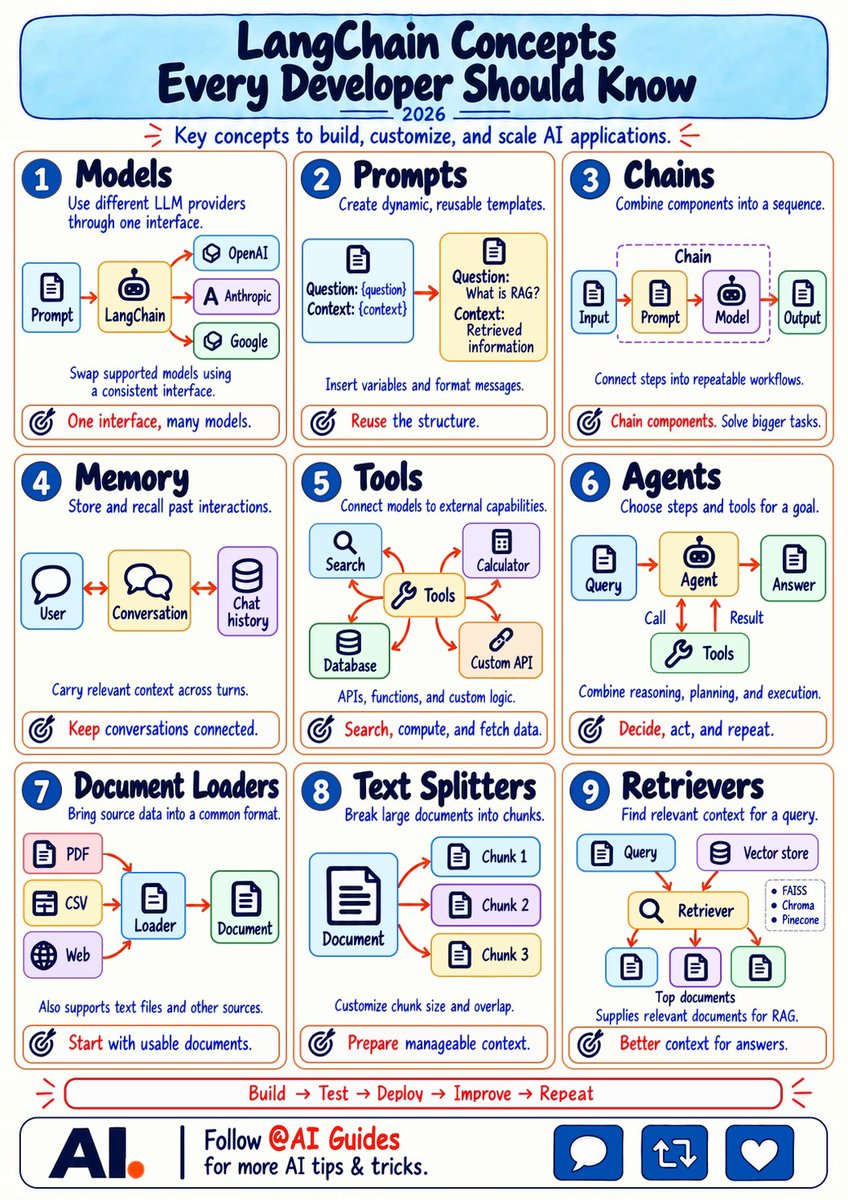
Most LangChain confusion comes from seeing nine separate names instead of three layers that stack. These are the nine concepts that build, customize, and scale an AI application.
Start with the core. Models give you one interface to many providers, like OpenAI, Anthropic, and Google, so you can swap supported models without rewriting your app. Prompts are dynamic, reusable templates where you insert variables like the question and context and format the messages. Chains connect input, prompt, model, and output into a repeatable sequence, which is how you solve bigger tasks from small components.
Next, give it abilities. Memory stores and recalls past interactions through chat history, so relevant context carries across turns. Tools connect models to external capabilities like search, a calculator, a database, or a custom API. Agents combine reasoning, planning, and execution, choosing steps and tools for a goal, then deciding, acting, and repeating.
Finally, feed it your own data. Document loaders bring PDFs, CSVs, web pages, text files, and other sources into one common document format. Text splitters break large documents into chunks, and you control the chunk size and overlap. Retrievers take a query, search a vector store like FAISS, Chroma, or Pinecone, and return the top documents that supply context for RAG.
Put together, the cycle is build, test, deploy, improve, and repeat.
Bookmark this before you start your next LangChain project and check that you can place every piece in one of the three layers.
Researcher pushes a $10,000 Apple Pay charge through a locked iPhone — no passcode, no Face ID, no approval. Owner never unlocked the device. Live demo raises hard questions about NFC payment authentication. https://t.co/eHpjjvadOh #ApplePay#Cybersecurity
Bot has this bias for action that makes it feel like the most fearless coworker you’ve ever worked with.
So much work is needless friction, bot finds the path of least resistance and grinds through tasks until they’re complete.
Feels like a new era of productivity.
BREAKING: Claude can read every threat in your business like the CIA reads enemy intelligence.
Give it your emails, contracts, and numbers, and these 7 prompts tell you what to act on and what to ignore.
Fuck you if you hate on Elon Musk.
Just imagine this was your son…
ALS took away Jake’s ability to use his wheelchair joystick and now, Neuralink lets him control his chair with his mind.
Hate on Elon all you want, he’s out here giving people their lives back.
The future of software is stateful, multiplayer, and collaborative.
The team environment is the ultimate harness, the dining room table where we eat and talk and laugh together.
Every Sunday I do the same thing.
Hit claim. Take the solana:7GdpaeSzvkx1a78rRkU11KstM1x8naMmMmmpWQnQSEAS. Leave it where it is.
No chart decides that. No mood does either.
@SeasonsDEFI pays Builders weekly at 0.8x the network rate. Claim #9 is two days out, and it joins the other eight.
How a Builder node works, start to finish:
1️⃣ Hold 1,000 to 9,999 solana:7GdpaeSzvkx1a78rRkU11KstM1x8naMmMmmpWQnQSEAS, with 100+ contributed through TTT, the 10% transfer tax.
2️⃣ Earn at 0.8x the network rate, paid weekly in solana:7GdpaeSzvkx1a78rRkU11KstM1x8naMmMmmpWQnQSEAS.
3️⃣ Claim it every Sunday and keep it. At 10k the node becomes a Director.
Fine print I don't skip: round size follows volume, and the Inclusion Set is a team pick until the DAO goes live.
What will it take to boost global investor confidence in Africa?
In 60 Seconds With at #FTAfrica, Hendrik du Toit, CEO of @ninetyone_uk, shares his perspective on attracting greater investment to the continent.
Anthropic's CEO said AI would write most of our code, run cyberattacks and start taking entry-level jobs. All 3 are happening.
Here's what Dario Amodei called, and what he says comes next.
Already happened:
✅ AI writing 90% of code: Anthropic now says Claude writes about 90% of Claude Code's own code.
✅ AI-run cyberattacks: Anthropic caught a Chinese state-backed group using Claude Code to run 80 to 90% of a hacking campaign against about 30 targets.
✅ Entry-level jobs going first: Anthropic's own junior technical hires just fell from 27% to 9%.
✅ AI "like a generally well educated human" within 2 to 3 years: He said it in 2023.
Still pending:
⏳ AI-led cyberattacks becoming "a serious and unprecedented threat to the integrity of computer systems" worldwide.
⏳ A swarm of AI agents able to take over the entire internet, within 6 to 12 months of September 2026.
⏳ AI "smarter than a Nobel Prize winner across most relevant fields" as early as 2026. 10 weeks left.
⏳ AI doing most or all of a software engineer's job, end to end, by January 2027.
⏳ The first one-person company worth $1B.
⏳ Half of all entry-level white-collar jobs gone, and US unemployment at 10 to 20%, by 2030.
Which of the pending ones lands first?
Grok Bot team shipped in the last few days:
• Reports, memos, dashboards in the chat
• iPhone action button to talk to Bot
• 3x faster computer tasks
• Aliases for your Bot email
• Connectors for Robinhood, Coinbase, Runway
• Notifications only on the device you're using
You can now run the Perplexity Decision Model fully locally on your Mac, without any data leaving your machine. The power of open-weight and compact models!
Researchers found ChatGPT is building a psychological profile of its users without being asked.
They published a paper showing what it saves about you, and how little of it you chose.
And the results are unsettling.
80 users donated their ChatGPT histories to the team through GDPR data requests. The team found 2,050 saved memories inside them.
Only 84 of those memories came from a user asking ChatGPT to remember something. ChatGPT created the other 96% on its own.
28% of the memories held personal data under GDPR, like names, money details, and social identity.
Among the 65 users who had memories, 91% had personal data stored and 54% had special-category data. That's the GDPR class covering health, sexual orientation, religion, and political views. 35% had health information saved.
In January 2026, OpenAI's memory FAQ said ChatGPT was trained not to proactively remember sensitive details like health information. The FAQ now says sensitive information can appear in memory if you tell ChatGPT about it.
52% of the memories described how the person thinks. ChatGPT recorded their goals, their plans, and their fears.
One saved memory in the paper reads "has a fear of failure, particularly related to making major career decisions."
Ad platforms build your profile from what you click. ChatGPT builds it from what you tell it you want.
The researchers also checked accuracy. 84% of the memories traced back to what users wrote in their chats, so the record is mostly faithful. You didn't choose what went into it.
They built a tool called Attribution Shield to help. It suggests a rewrite of your question that drops personal details and keeps the meaning. In a test of 36 questions, the rewrites exposed less about the user in over 94% of cases, and the answers stayed useful in roughly 9 out of 10.
The sample is small, 80 users mostly from the US and Europe. The study also covers ChatGPT's older saved-memory system, and OpenAI has since moved to a more automatic one.
You can see a summary of what ChatGPT keeps about you in Settings, under Personalization and Memory. OpenAI says that summary leaves some details out. Have you checked yours?
Day 2 of the FT Africa Summit is underway in London!
Today, leaders from business, finance and government continue discussions on the opportunities and challenges shaping Africa’s economic future.
Follow along for key insights and highlights.
#FTAfrica