The second GPT-powered result is a resolution of the unclonable encryption problem, concurrently and independently found by Prabhanjan Ananth and Amit Sahai as Henry mentions below. Their version is already available online and mine will be online within a couple of days. (1/3)
Ananth-Sahai bounds it using a conditional overlap lemma and the Paulis' pairwise orthogonality. My version bounds it using the Paulis' commutation-anticommutation structure. (3/3)
The second GPT-powered result is a resolution of the unclonable encryption problem, concurrently and independently found by Prabhanjan Ananth and Amit Sahai as Henry mentions below. Their version is already available online and mine will be online within a couple of days. (1/3)
I'm happy to see the unclonable encryption problem solved; Prabhanjan Ananth and Amit Sahai report their findings, with the help of the UCLA harness (link below). This was a challenge for the quantum crypto community for the last 6 years.
Our (LLMs') constructions are identical and the proofs are extremely close as well. The main difference is that the approaches bound the spectral norm of E_BE_C differently. (2/3)
Our construction builds on the "matching vectors + decoding polynomials" framework pioneered by Efremenko (2009) and recently refined by GKS25. In short: we find and plug in decoding polynomials exponentially sparser than previously known.
Link: https://t.co/jCkeEFX3yf (3/3)
I'm excited to share two GPT-fuelled results from this month! The first, with Aparna Gupte, shows under a plausible number-theoretic conjecture that there exists s-server private information retrieval for database size n with communication exp(\tilde{O}((log n)^{1/s})). (1/3)
The s = 2, 3 cases were resolved by Dvir-Gopi (2016) and Ghasemi-Kopparty-Sudan (2025), but as s grows, previous constructions needed 2^{O(s)} many servers (rather than our s) to get the same communication. (2/3)
AI has now solved a major open problem -- one of the best known Erdos problems called the unit distance problem, one of Erdos's favourite questions and one that many mathematicians had tried.
https://t.co/SD1vVPkrHR
Alexandra Henzinger, Ted Pyne and I recently resolved the below question (picture by Gemini), building on landmark results by James Cook, @ian_mertz and @rrwilliams. The starting point was a new connection to private information retrieval (PIR), a problem from cryptography. (1/5)
Alexandra Henzinger, Ted Pyne and I recently resolved the below question (picture by Gemini), building on landmark results by James Cook, @ian_mertz and @rrwilliams. The starting point was a new connection to private information retrieval (PIR), a problem from cryptography. (1/5)
Why MVCs and why the bizarre specifications for Computer C?
High-level answer: compared with RM codes, MVCs require fewer servers (enabling our memory reduction) but are otherwise less efficient (hence the need for the large catalytic hard drive). (4/5)
Chevignard et al show residues also reduce the qubit cost of quantum attacks on elliptic curves: https://t.co/TJDqTu7n4L
The space savings is less dramatic than for factoring (1.6x instead of 6x), and they again pay a big gate count penalty (256x), but very interesting.
Can you encrypt a program to hide its inner workings while still enabling others to use it? This problem of "program obfuscation" is central to cryptography.
To learn more, see this article! It also touches on a paper by myself, @NeekonV, and @Vinod_MIT from TCC 2024.
In my latest blog I discuss the challenges of building a powerful cryptographic technique that aims to “obfuscate” the internal implementation details of programs-https://t.co/H4ZAvOAJfu
Thanks @seyoonragavan & Rahul Ilango for the nice chat about their works @SimonsInstitute!
Chevignard's QIP2025 talk on reducing the space cost of quantum factoring:
https://t.co/yfOlChtRzr
And her co-author Schrottenloher's talk at the Simons Summer Cluster on Quantum Computing:
https://t.co/KA1tBta110
@demishassabis@lmthang Consulting a couple of individual coordinators/graders for verification is very different from having submissions graded through channels endorsed by all official personnel including those who led the IMO problem setting and coordination.
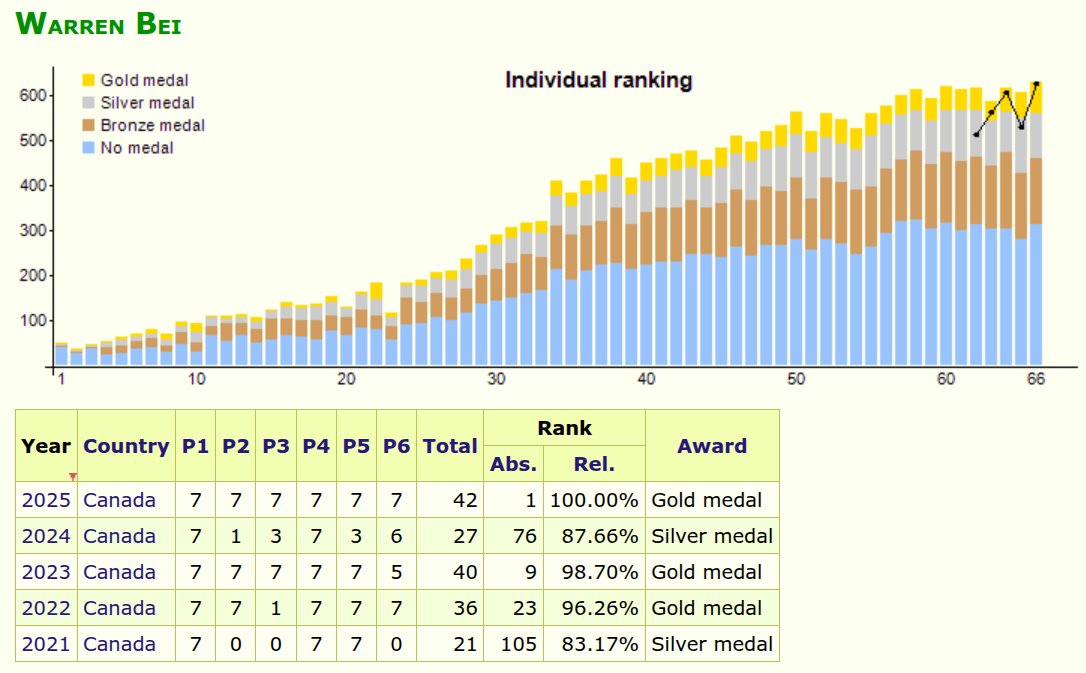
Everyone's talking about AI performance on the IMO. Let me highlight 🇨🇦Canadian 11th grader Warren Bei🇨🇦, one of five participants with a *perfect* 42/42.
This is his *fifth* (and final) IMO representing Canada, with three golds and two silvers. (➡️ MIT undergrad in the fall)