I built yolonot, an open-source permission firewall for Claude Code, Codex, Cursor, OpenCode & 20 other CLI agents.
Why? Because existing options are broken:
- Manual prompts: 100% ask (~93% blind click-through)
- --yolo mode: misses 100% of risks
- Native Auto Mode (measured on Claude Code): misses 17.0% of risky commands and blocks 0.4% of safe ones.
Across 456 benchmark cases, yolonot cuts missed risks to:
- 4.9% in balanced mode (0.0% safe blocked)
- 1.6% in strict mode (0.0% safe blocked)
- 0.0% in paranoid mode
It parses bash AST locally in ~1.6us (clearing 54.2% of commands with 0 API calls) and reads local scripts before running ./script.sh.
brew install sezaakgun/tap/yolonot && yolonot setup
I built yolonot, an open-source permission firewall for Claude Code, Codex, Cursor, OpenCode & 20 other CLI agents.
Why? Because existing options are broken:
- Manual prompts: 100% ask (~93% blind click-through)
- --yolo mode: misses 100% of risks
- Native Auto Mode (measured on Claude Code): misses 17.0% of risky commands and blocks 0.4% of safe ones.
Across 456 benchmark cases, yolonot cuts missed risks to:
- 4.9% in balanced mode (0.0% safe blocked)
- 1.6% in strict mode (0.0% safe blocked)
- 0.0% in paranoid mode
It parses bash AST locally in ~1.6us (clearing 54.2% of commands with 0 API calls) and reads local scripts before running ./script.sh.
brew install sezaakgun/tap/yolonot && yolonot setup
@dxiaolong It can do both but keep in mind that you have to sail it to the waters you want. If you keep it as is, it will only suggest surface level patterns or fixes.
We are live on Product Hunt today.
I also published the full benchmark write-up comparing manual prompts, native auto mode, and yolonot.
Links in reply:
I built yolonot, an open-source permission firewall for Claude Code, Codex, Cursor, OpenCode & 20 other CLI agents.
Why? Because existing options are broken:
- Manual prompts: 100% ask (~93% blind click-through)
- --yolo mode: misses 100% of risks
- Native Auto Mode (measured on Claude Code): misses 17.0% of risky commands and blocks 0.4% of safe ones.
Across 456 benchmark cases, yolonot cuts missed risks to:
- 4.9% in balanced mode (0.0% safe blocked)
- 1.6% in strict mode (0.0% safe blocked)
- 0.0% in paranoid mode
It parses bash AST locally in ~1.6us (clearing 54.2% of commands with 0 API calls) and reads local scripts before running ./script.sh.
brew install sezaakgun/tap/yolonot && yolonot setup
@dxiaolong yolonot comes with a skill that can learn from code and usage data to suggest some settings to you. We also support setting walk-up and just like how AGENTS.md works, with that you can set ‘deny npm test*’ to repo’s .yolonot file if you want to.
@CarolRehor 5th is generous tbh, if I get asked twice in 5 minutes I already lose my mind. Making prompts rare enough that you actually stop and read them was the whole goal.
@ArgusPlatformAI Such a great question. For balanced mode with haiku5.5 as judge model, we measured 0.0% deny and 1.4% ask. This is intentional design of yolonot, asks are remembered through session so one approve is enough.
You can check further details in -> https://t.co/mLtlxNOkGa
Been there. One of the first things I ever allowlisted was Bash(git *) until I realized how fast git status privileges turn into git reset --hard :D What was the command that bit you?
Fair call, definitely two different exams. Reason is Anthropic didn't open-source their 52 internal cases, and Auto Mode doesn't expose a standalone classifier endpoint to run headless against a benchmark suite. Our cases come from real session logs across 4 engineers plus adversarial cases (all open in the repo). This is real usage + open datasets + some synthetic cases so this is closer we can get to Anthropic's dataset.
@artistxeature It's totally up to you! yolonot collects no telemetry and configurable to be able to run both hosted and local models. It has build in benchmark tool so you can experiment on different options. I can suggest gemma4:e4b, its a good starting point for local models.
Repo & full benchmark breakdown across rogue-security, RedCode-Exec, Dippy CLI, and Trojan script suites:
Website & Benchmarks: https://t.co/k7ZFzhAKhy
GitHub (Apache-2.0): https://t.co/WPMhnW3u4l
If you already have permissions scattered across .claude/settings.json, Cursor, or Codex, you can import them into a single git-tracked .yolonot file in one command:
yolonot rules discover
While learning Claude Code mods I built two examples, one fun one and one that I actually use everyday:
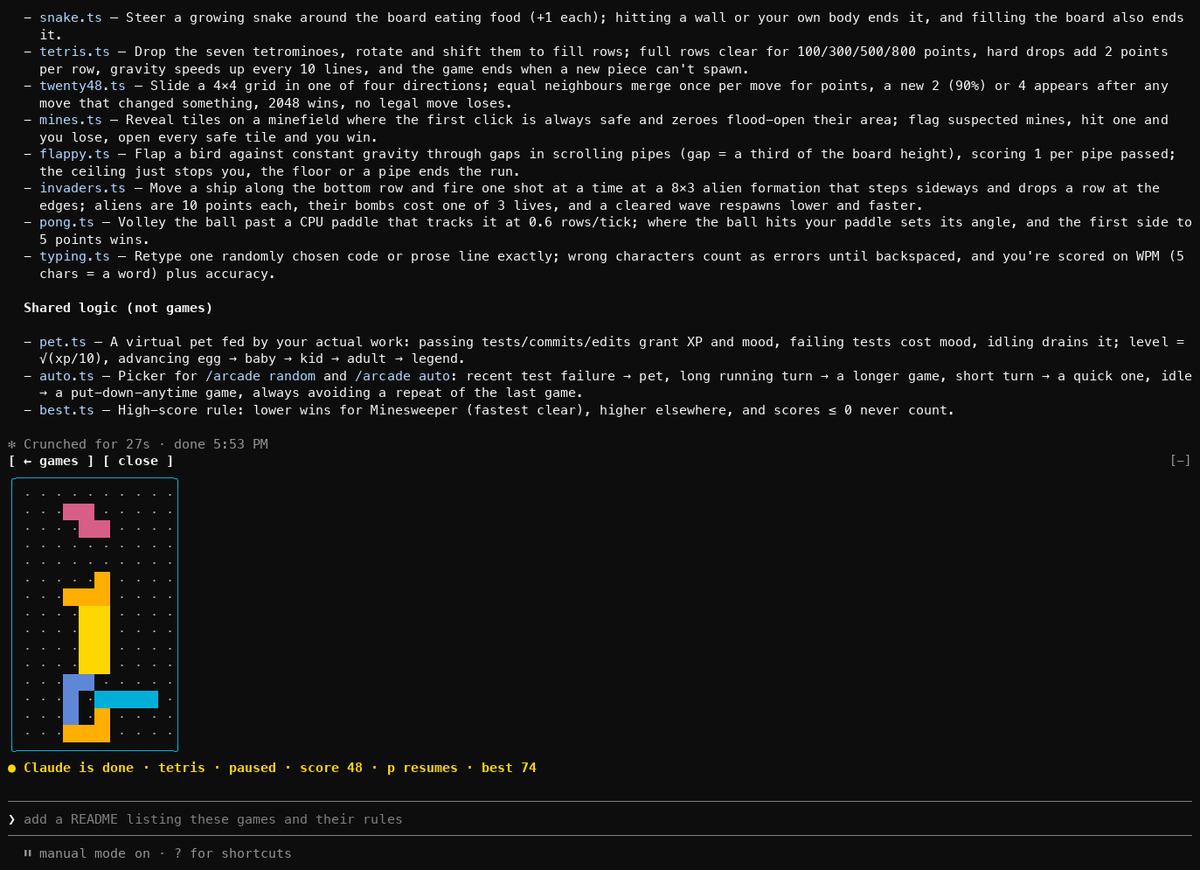
cc-arcade => games (Snake, Tetris, Doom, Flappy…) + a pet that levels up from Claude’s tests/commits/edits, drawn above the prompt:
https://t.co/s7sPttF2jW
cc-pr-tracker => live GitHub PR status line (merge state, reviews, checks) with alerts when things change:
https://t.co/QMHamE2eGU
Pasting Claude Code table output into Slack and teammates get a mess of lines and pipes…. 🫠
Made a tiny site that turns them into something readable on chat apps 🧹
https://t.co/1Kdmp3Cm7I
@bcherny When I made tetris, I also added games like snake, sudoku, minesweeper and many more! Feel free to fork and add yours!
Check out my repo to try it out -> https://t.co/txon8S7VxK
First one to port doom to run on claude-code wins I guess
@bcherny@adocomplete
@bcherny When I made tetris, I also added games like snake, sudoku, minesweeper and many more! Feel free to fork and add yours!
Check out my repo to try it out -> https://t.co/txon8S7VxK
First one to port doom to run on claude-code wins I guess
@bcherny@adocomplete
Wow, did not get out of the bed expecting to got picked up by Boris. Anyways here is an actual plugin that benefits massively from Function Hooks -> https://t.co/c2Ds62H5ks
Claude Mods are landing now. Someone already built a Tetris-in-Claude mod 🤯
See issue for the latest community update, technical details, and more cool demos
https://t.co/A15qGUZ6nx
We're exploring a new way to let you extend and customize Claude Code: Function Hooks.
Here's a couple videos showing what you'd be able to do. It hasn't shipped yet, we'd love feedback on this on our GitHub issue.