Our chapter, Ethics and Publishing in Forensic Linguistics: Policing Credibility (with Bernardo Turnbull), is out in The Routledge Handbook of Ethics in Forensic Linguistics (2026). We analyse linguistic bias and English dominance.
https://t.co/Wg7QfucnV9
#ForensicLinguistics
"Make autism uncool again"
I haven't been in middle school for 30 years but I still have a traumatic stress reaction to the sound of girls laughing.
So actually can we not.
I cannot stand AI but I am especially upset at folks shilling AI as an accessibility tool. An AI notetaker is NOT the same quality as a human notetaker. An AI bot is NOT a stand in for a therapist. An AI bot is NOT equivalent of a teaching assistant. 1/3
Como editora de Psicología Iberoamericana, me da gusto compartir que participamos en la creación de la Red Nacional de Revistas Científicas de Psicología en México, en el 75 aniversario del Depto. de Psicología de la Universidad Iberoamericana #Psicología#RevistasCientíficas
Our chapter, “From the Editor’s Desk of a Bilingual Journal in Mexico,” appears in "Plurilingual Perspectives on Scholarly Writing for Publication". We reflect on the challenges of equitable publishing across languages.
https://t.co/qisqaywui3
#Plurilingualism#AcademicWriting
Lots of folks out here who drool over AI are just showing their (already) problematic ways of thinking about production. Claiming you dont do data cleaning, lit review, etc and just shove these off on collaborators is not something you should brag about. 1/5
I disagree with the premise of this argument. AI CANNOT do social science research better than most professors. However, AI can easily plagiarize the research that has already been done by social science professors.
"Why do you want to be autistic?"
It's not about wanting, but that was how I was born and it's a permanent lifelong disability. So I'm choosing to accept that
This is not true. PhD students who write with AI are unable to defend their thesis in Viva presentations as they haven't worked through the processes of reading, learning, internalisation & argument formation.
Academics need to throw LLMs out, not 'wake up' & accept them.
¡Estamos en LinkedIn! 👩💻📚
Sigue a Psicología Iberoamericana y mantente al día con nuestra investigación y actualizaciones.
https://t.co/ZatFGeAj4t
¡Te esperamos!
They disregard peer review. They disregard ethics.
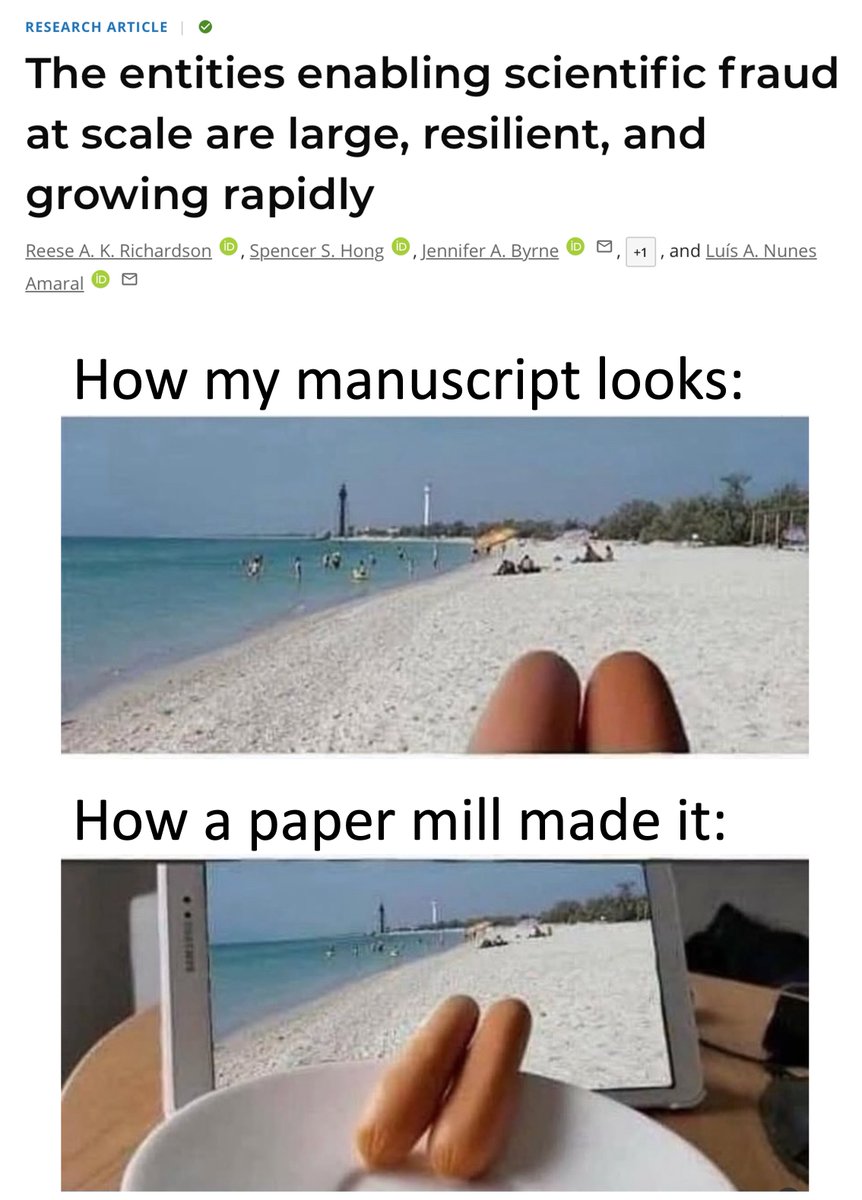
New study in PNAS show that some editors likely cooperate with authors to publish their trashy papers:
1. Some editors handle suspicious articles far more often than chance would explain.
2. Certain authors prefer these same flagged editors.
3. Image duplication forms “networks” that can be thousands of articles wide. Papers sharing the same images often appear in the same journal at the same time.
4. Paper mills work in BULK. They produce articles in coordinated batches.
5. Brokers can place papers in journals on demand. They adapt to de-indexing of journals.
6. Paper mills thrive in fields where plausible manuscripts can be MASS-produced from templates.
7. Retractions now come in batches. Ten or more from the same journal, same day. Large-scale integrity breaches are becoming routine.
8. The dataset of suspected paper-mill papers doubles every 1.5 years. This is FAR faster than overall scientific output. De-indexing is no better: fewer than 100 journals drop each year out of 22,000+. So, more than 90% of paper-mill products end up in indexed journals.
📍 Why is this nightmare happening?
1. Metrics-based evaluation. Scientists are “measured” by their “output”. If you’ve ever sat on a hiring or promotion committee, talking about output is standard. Somehow, scientists combine the logic of “we love science” with “how many papers does this person have?”
2. Overcompetition. Only 5-20% of funding proposals are normally accepted. Scientists fight for funding. Any “extra output” is seen positively.
Yes. Publishing is largely about money. Not science.
Yes. Paper mills are thriving.
But these are by-products of metrics-based evaluation and overcompetition.
📍 In my view, the following can help:
1. Funding should NOT be allowed to be spent on “publishing services” such as paper mills.
2. Fraud papers should result in 3-year suspension from funding applications. PIs must be warned!
3. Proposals should be assessed based on the IDEA and proposed execution. Not based on the CV of the applicant. Even if a Nobel laureate with 100 papers/year applies, the proposal should be rejected if the idea is not worth it.
4. But DO include the “assessment of scientific quality” for the last few papers of the PI.
5. We need fewer large-money grants. Instead of $ 2,000,000 given to one PI, give $500,000 to four PIs. This reduces completion.
6. When reviewing grants, require recommendation letters from former PhD students. This will shift the focus from quantity of papers to quality of supervision.
Encantada de participar en #ALPSP2025 en Mánchester (10–12 sept). Formaré parte del panel Global Challenges and Local Solutions to Equitable Participation, donde hablaré sobre los retos de las revistas en América Latina y las desigualdades sistémicas en la publicación académica.
Excited to speak at the #ALPSP2025 conference in Manchester (10–12 Sept)! I’ll join the panel, Global Challenges and Local Solutions to Equitable Participation, to discuss challenges for journals in Latin America & systemic disparities in scholarly publishing. #OpenAccess#Equity