As another summer of extreme temperatures approaches, adaptation to heatwaves remains a pressing global issue
📖 Sharing a new preprint co-authored w/ @TimSchwanen on people's adaptations to daily activities in response to heatwaves
A thread 🧵(1/15)
🔗https://t.co/vrt0nSzwHl
F4: Urban characteristics and social inequalities influence activity changes during heatwaves. Ex. counties with lower average incomes exhibit more positive changes in park usage during HWs -- highlights importance of green spaces as heat refuges for those most vulnerable (14/15)
If you’d like to read more check out the pre-print! Special thanks to @TSUOxford, @oxfordgeography, @SSHRC_CRSH. I also recommend @jeffgoodell “The Heat Will Kill You First” to learn more about extreme heat.
Here is the link again: https://t.co/vrt0nSA4wT
This research contextualizes heatwaves within people’s everyday lives, highlighting how daily activities and obligations shape behavioural adaptations. It sheds light on the diverse, dynamic, yet constrained processes by which people adapt to these deadly disasters. (15/15)
F3: Heatwave adaptation evolves over time, both between and within heatwaves. During longer heatwaves (>= 5 days), workplace, park, and transit activity drop. As days pass within a heatwave (Stage %), more time is spent indoors, substituting workplace and park activity (13/15)
F2: Relative intensities (temperature increase between heatwave and closely matched 'control day') have distinct yet similarly large effects on adaptive responses as absolute temperatures (12/15)
Now some key findings...
F1 (p1): A region's typical climate influences the rigidity of workplace obligations during heatwaves and how non-work activities are adapted (9/15)
F1 (p3) In typically temperate regions (often with less AC), home and work are substituted for activities outside the home during heatwaves -- highlighting the importance of cool public spaces to escape heatwaves in regions unaccustomed to extreme heat (11/15)
F1 (p2) In typically hotter regions, people continue to work at greater rates during HWs, while substituting non-work activities for more time at home. Greater AC ownership in hotter regions may influence these substitutions towards the home during HWs (10/15)
Using a simultaneous modelling approach, the various activity changes are explored across the climatic, temporal and contextual features of heatwaves. By modelling all 6 activity types together, the analysis also explores their interdependencies (8/15)
Across the region, heatwaves are flexibly defined as 2 or more days of extreme temperatures surpassing regional norms, and we develop an algorithm which iteratively searches for the closest ‘control’ day to calculate activity changes (7/15)
Grounded in concepts from time-geography, the paper implements an 'activity scheduling' framework for adaptation, considering the varying flexibility of daily activities and their competing nature given the limited time in a day (6/15)
As another summer of extreme temperatures approaches, adaptation to heatwaves remains a pressing global issue
📖 Sharing a new preprint co-authored w/ @TimSchwanen on people's adaptations to daily activities in response to heatwaves
A thread 🧵(1/15)
🔗https://t.co/vrt0nSzwHl
Addressing this gap, our paper use cell phone mobility, climate, and census data to simultaneously model how people's everyday activities (home, work, transit, grocery/pharm, retail/rec, park) change together during HWs across the Pacific Northwest of NA (5/15)
Despite the urgency to support adaptation, the processes which shape and constrain opportunities to seek cooling remain poorly understood. It has yet to be examined how people alter the various activities and obligations of everyday life during HWs (4/15)
As heat exposure and adaptive responses are tightly linked to mobility behaviours, a growing body of literature has been analyzing mobility data during HWs. Many adaptive responses and intersections between exposure and social inequalities have been identified (3/15)
Heatwaves (HWs) are the 'silent killers' of climate disasters, increasing in intensity, frequency, and duration due to climate change. Despite staggering death tolls of extreme heat (480,000+ globally per year), many are preventable if people can visit cool environments (2/15)
“We have never seen anything like this before.”
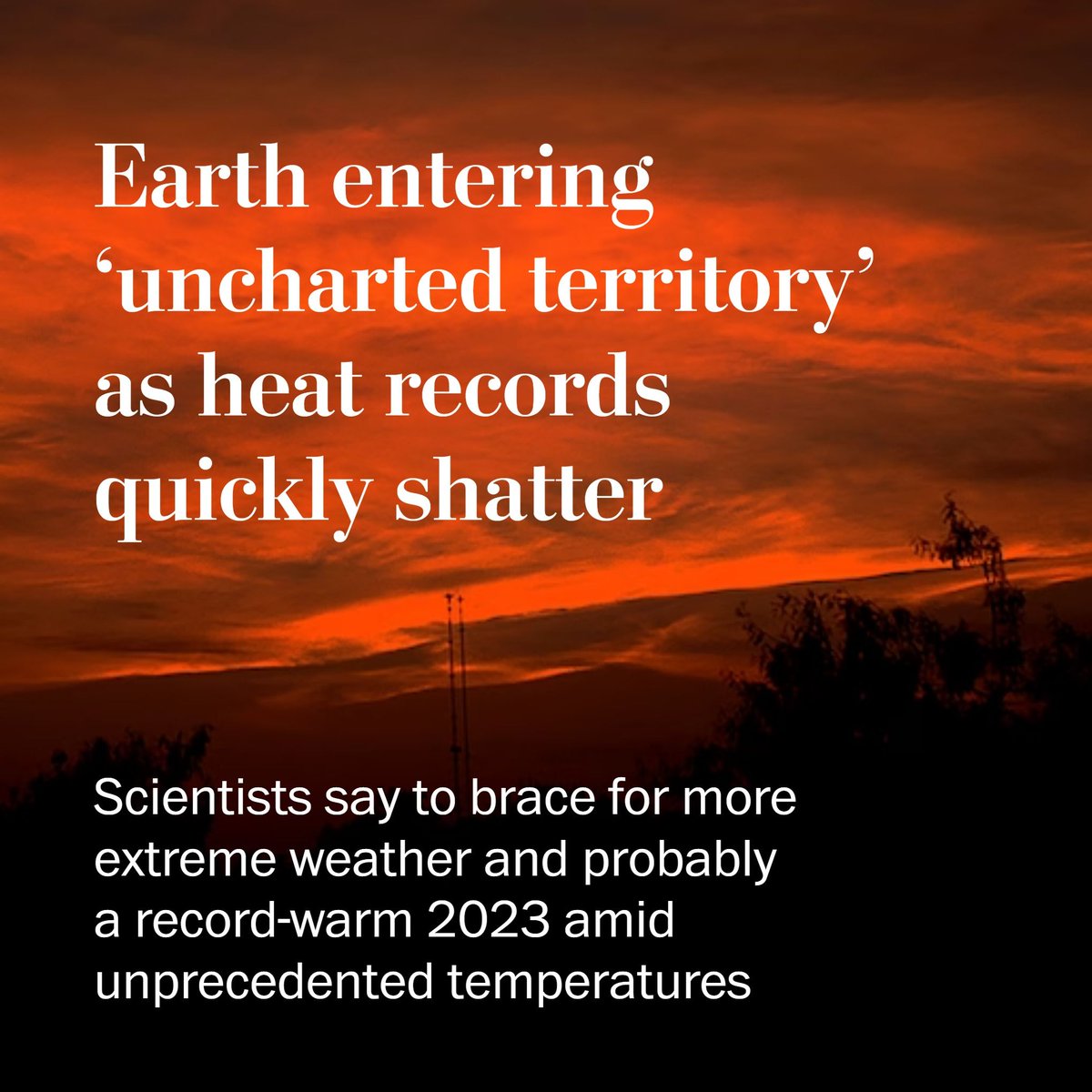
On Monday came Earth’s hottest day in at least 125,000 years. Tuesday was hotter.
A remarkable spate of historic heat is hitting the planet, raising alarm over looming extreme weather dangers — and an increasing likelihood this year will be Earth’s warmest on record. https://t.co/WUo39sNveR
Chuffed to see our paper online. Here we intoduce the new time interval cumulative accessibility measure, which mitigates the impact of arbitrary choices of trip duration on cmltv accessibility analyses
📑Paper https://t.co/uQXDvW2YiU
🔓PDF +Code
https://t.co/T19SNAHcP6
🧵below👇