This is an unbelievable piece of work by Sarthak and something that requires amplification.
Let me explain what he found, in simple terms.
Sarthak is a Class 12 student from the 2025-26 batch, one of the 17 lakh students whose answer sheets went through CBSE's new On-Screen Marking system.
He spent days reading through CBSE's evaluation tenders, scraped all 576 tenders CBSE has issued, and tracked how the rules changed across three versions of the same tender.
The core finding is that the company that won the contract to scan and grade 17 lakh students' answer sheets is Coempt Eduteck.
Coempt used to be called Globarena Technologies. Globarena was the company behind the 2019 Telangana intermediate exam disaster, where software failures led to 3.8 lakh students getting wrong or missing marks, and 23 students died by suicide.
A government committee found systemic failure and negligence. Six months later, Globarena rebranded to Coempt Eduteck.
So a company with that track record won a contract to handle 17 lakh CBSE students. Sarthak's investigation is about how the rules were rewritten to let that happen.
The tender was issued three times.
> First tender, February 2025. It existed, then disappeared from the public GeM portal. Sarthak scraped all 576 CBSE tenders and this one was missing from the archive entirely.
> Second tender, May 2025. Four companies applied including TCS and Coempt. All four failed the technical evaluation. Cancelled.
> Third tender, August 2025. Coempt won. Between the second and third tender, a series of rule changes happened, and every single one made it easier for Coempt to qualify.
Here is what changed, one by one.
01. The old rules disqualified any company with a history of abandoning work, failing to complete contracts, or financial weakness. The new rules deleted this clause entirely. Coempt's Telangana history stopped being a barrier.
02. The old rules disqualified any company that was "blacklisted earlier." The new rules changed this to "currently blacklisted." Because Globarena rebranded after Telangana, removing the word "earlier" effectively erased their past.
03. The rules required Rs 50 crore average turnover over three years. Coempt's exact average came to Rs 50.86 crore. They cleared the bar by less than 1%. Earlier, a smaller company had asked CBSE to lower the bar to Rs 30 crore for fairer competition. CBSE refused. So the bar was kept high enough to block small players, but sat exactly low enough for Coempt to scrape through.
04. Software maturity is measured on the CMMI scale, 1 to 5. The old rules required Level 5. The new rules dropped it to Level 3. Coempt is a Level 3 company.
05. The cooling-off period for engaging retired CBSE officials was cut from two years to one. This makes it easier to use recently retired insiders to influence the process.
06. The old rules required experience with large projects of at least 5 lakh students each. The new rules removed the student count and counted cumulative answer-book volume across small projects instead. Coempt has many small fragmented university contracts. This helped Coempt and hurt TCS.
07. The old rules required bidders to own their own data centre and disaster recovery centre on Indian soil. The new rules allowed third-party MeitY-empanelled cloud hosting. Coempt runs on AWS and Azure. This helped Coempt and hurt TCS, which owns its own data centres. It also means student data is no longer on sovereign, Indian infrastructure.
08. The old rules required the bidder to own or control the complete source code of its software. The new rules deleted this. Coempt's platform runs on Microsoft's proprietary IIS, which they don't own.
09. A last-minute corrigendum, issued right before bid submission, removed CBSE's own power to blacklist the firm if its software failed catastrophically. So even a Telangana-scale failure couldn't get Coempt banned from future government tenders.
10. The penalty structure shifted from punishing mistakes to punishing delays. The old rules fined the vendor for wrong scanning, merged pages, and unscanned books. The new rules dropped those and instead levied Rs 50,000 per day for delays. This incentivises rushed scanning over accurate scanning.
11. The old rules had a hard accuracy threshold, error rate not to exceed 0.5%. The new rules removed this number entirely.
12. The old rules specified proper book and robotics scanners. The new rules just say "sufficient scanners." The definition was vague enough that, as Sarthak notes, the scanning could be done with a phone on a stand.
13. On the security side, the contract required a VAPT (vulnerability and penetration test) certified by CERT-In before go-live, and a restricted beta phase before launch. The system clearly wasn't restricted, because the other researcher, Nisarga, was able to access it and find vulnerabilities four days before go-live. So the mandatory security audit appears to have been bypassed.
These are more than a dozen rule changes, all between the failed tender and the winning tender, all pushing in the same direction, all benefiting the one company with the worst track record in the field.
The security holes Nisarga found last week now have an explanation. The system was built by a vendor that was specifically allowed to skip the security certification, the source code ownership, the data sovereignty, and the quality thresholds the original rules demanded.
Following things need to happen immediately;
1. An immediate CAG audit of the tender process.
2. A parliamentary debate on the topic.
3. An independent investigation into
> Why the first tender vanished?
> Why the disqualification clauses were deleted?
> Why the turnover bar was held exactly where it was?
> Why the security level was dropped?
> Why the blacklisting power was removed at the last moment?
Sarthak, this is genuinely exceptional investigative work. Far better than most journalists with full resources ever manage. Take a bow. :)
If anything good about this country I see today it is India's GenZ like Sarthak Sidhant. They are better. They are smarter. And most importantly they know damn well these pile of scum Ministers, gutless Godi traitors, and those wanky Unkols and Buddhas doing morning yoga and charcha on Pakistan in parks are all equally the most disgusting creatures on this planet earth, not to be trusted. So GenZ is doing what they have to do their own, and wish very soon they'll kick out these incompetent, corrupt, bunch of thugs in power.
In 2:30 hr webinar @sushilkedia analysed #Nifty going to 27000+ & exactly which of its 50 stocks are where on the cycle.
As #CSR effort, what is priced INR 2500, can be availed free:
To get registration link:
-Follow us [So we can DM]
- Retweet
-Nice Replies Help
Modi gov't has 'temporarily suspended' the forced feeding of Fortified Rice to 80 cr poor Indians.
Context:
In May 2023 my @reporters_co colleague @shreegireesh unearthed the scam called Modi govt's Fortified Rice Scheme.
Based on spurious science and failed pilot projects, against warnings by its own experts, Modi gov't had pressed ahead to force feed fortified rice to all of 80 crore poor in India. The orders to do so had come from the top.
There were foreign business interests backing the scheme. They stood to earn thousands of crores annually from this move. Modi gov't, which otherwise makes such a hue and cry over 'foreign interests', had played into their hands to force the poor in India to consume something untested.
Across the country, Shreegireesh found, the poor were complaining of this 'plastic rice' making it to their plates.
He brought out a complete set of internal gov't documents to demolish the governments propaganda around the scheme. And showed who the real beneficiaries of the scheme were - Corporates backed by dubious NGOs working for the corporate interests.
Now, the government has 'temporarily suspended' the scheme claiming its now learnt that fortified rice is not doing any good.
We still don't know the real reasons why it has done so. We will dig those out too.
Shreegireesh's reports and evidence was used in the courts.
It was picked up, plagiarised, copy pasted and replicated by others in media, sometimes with and sometimes without due credit.
Our reports were shortlisted for the world's biggest award for investigative journalism, the Fetisov award.
We were grateful for the straight and the backhanded compliments. But, most of all, we were happy that our work had put the truth out bluntly and with hard evidence.
I write this to explain, why investigative journalism is central to keeping those in power accountable. It is the essential form of journalism. It is effective, even if the wheels take time to turn.
We don't know why yet the government has finally stopped the distribution of the spurious artificial rice grain. We are glad it has.
Such journalism requires immense courage and resources. When you support it, you empower yourselves as citizens, to defend your rights and that of the poorest who have the least ability t hold the powerful to account.
Democracies need public-funded journalism to be better democracies.
Read Shreegireesh's work, if you had missed it then.
https://t.co/hLSoEgxj1W
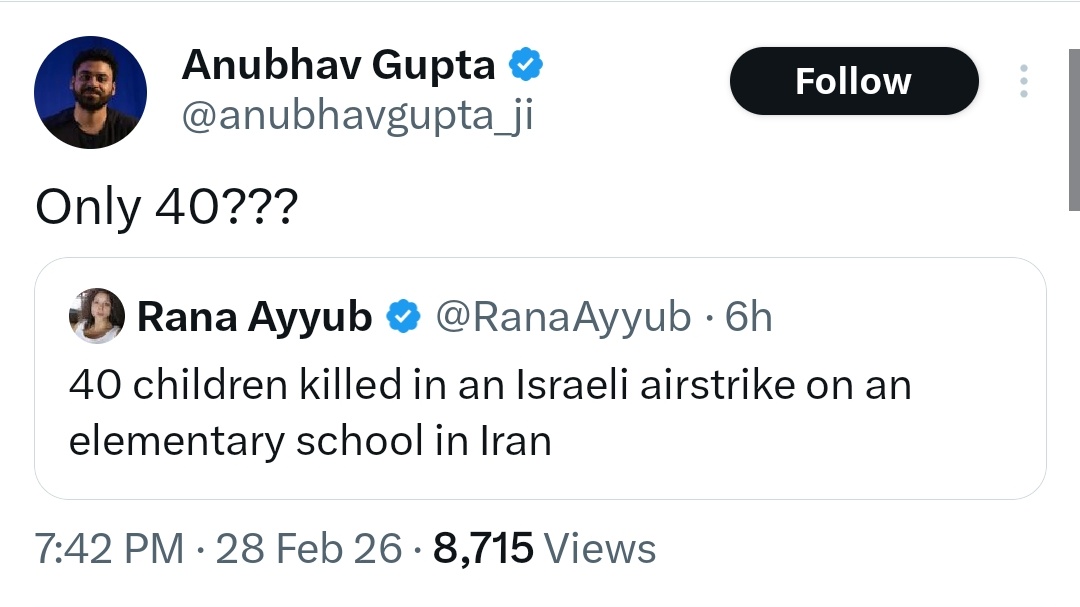
Meet Anubhav Gupta, BJP supporter & Proud Modi Bhakt
He hates Congress. No problem.
He hates Muslims. Okay 👍
But he is mocking & cheering the death of innocent children in Iran 💔
No political ideology can justify that
Anubhav is parasite to the society. Don’t be like him.
Many people are telling me in the comments that SIM binding doesn’t affect anything and I’m overreacting. Let me walk you through why this matters.
First, let me be clear. SIM binding by itself is not surveillance. I’m not saying the government is reading your chats. The concern is structural.
Under the new TIUE framework, the government now has the power to direct platforms to stop providing services to any specific phone number. No court order needed. No judicial oversight. No requirement to even notify the user. The Internet Freedom Foundation flagged this directly in their letter to DoT.
Think about what that means for independent journalism in a country ranked 161 out of 180 on the Press Freedom Index.
India has no source protection law for journalists. The Whistleblower Protection Act 2014 only covers disclosures to “competent authorities,” not to the press. Now every messaging account is tied to a KYC-verified SIM, which is tied to your Aadhaar. Every anonymous source, every whistleblower, every activist becomes easier to trace. The Editors Guild of India already warned that new data rules “create a chilling environment for reporters and weaken the public’s right to know.”
Now the practical impact on you and me.
You use WhatsApp on a tablet without a SIM slot? Might stop working or log you out every 6 hours. Travel abroad and swap to a local SIM? You lose WhatsApp access. Run a small business on WhatsApp Web? QR code login every 6 hours now. The Broadband India Forum, representing the actual tech industry, said this will “impose material inconvenience on ordinary users” while offering “limited incremental benefit against sophisticated fraud networks.”
Now here’s what other countries do to fight cyber fraud instead.
The EU built the European Digital Identity Wallet. User-controlled, open source, privacy preserving. Verifies identity without tying every app to a SIM card. The UK built a Digital Identity Trust Framework with private sector participation. Europe introduced double authentication for payments which actually reduced fraud without touching messaging apps. Singapore uses SingPass for secure digital identity.
None of them said “tie your WhatsApp to your SIM or we shut it down.”
India chose the one approach no other democracy has tried. Not because it’s more effective. But because it’s easier to implement top-down without public consultation or parliamentary debate.
The question isn’t whether you have something to hide. The question is whether a government should be able to disconnect your communication without a court order in a country that has no law protecting the people who speak up.
That’s not about today. That’s about what becomes possible tomorrow.
Meet Chief Minister of Madhya Pradesh
> People died drinking sewage water
> Fake cough syrup killed children
> Increasing Reservations to 73%
> Building Ambedkar Dham
> Strengthening BHIM army
> Keep announcing more ladli behna schemes
And the man is just getting started !
A convicted child sex offender is also a power broker - it is perfectly ok to meet him for networking. How many more of these ghastly interviews is this arrogant bully going to do before he resigns? @narendramodi
Tomorrow I will post nifty analysis, which will also include Gann cosmogram analysis. And the cosmogram chart to learn .
If you want to know the reason after 3 pm Tomorrow, like and retweet maximum.
What do you think bullish or bearish? 🤔
#Nifty#Stockmarket
I've started posting threads on Gann stock market learning and a 50-day learning challenge. However not getting a good response.
Should I continue this series or not?
Comment with a "yes" or "no," along with your suggestions.
If you are interested , like and retweet maximum.
Tomorrow I will post nifty analysis, which will also include Gann cosmogram analysis. And the cosmogram chart to learn .
If you want to know the reason after 3 pm Tomorrow, like and retweet maximum.
#Nifty#Stockmarket


![kedianomics's tweet photo. In 2:30 hr webinar @sushilkedia analysed #Nifty going to 27000+ & exactly which of its 50 stocks are where on the cycle.
As #CSR effort, what is priced INR 2500, can be availed free:
To get registration link:
-Follow us [So we can DM]
- Retweet
-Nice Replies Help https://t.co/mx08XSMBlR](https://pbs.twimg.com/media/HDiu2OkW0AICJ8G.jpg)