IBW2026 × 0xSpace - Community Giveaway! 🎟️
Want to experience India Blockchain Week 2026 in Mumbai? 🇮🇳
We’re giving a FREE IBW2026 General Pass to a selected 0xSpace community member. 👀
How to participate:
1️⃣ Follow @ZeroXSpace_ & @IBWofficial
2️⃣ Repost this post 🔁
3️⃣ Comment why you want to attend IBW2026 + what you hope to get from the experience.
We’ll select community members based on their responses. 👀
See you in Mumbai! ⚡️
@ZeroXSpace_@IBWofficial I'm really looking forward to meeting new people from this space who can give me feedback on my startup: https://t.co/iDzHyQh1Ol. I'm hoping to learn from experts and share my knowledge of cryptography!
One optimistic and still very-non-consensus belief I have about the far future of cryptography:
I think that there is a 33% chance that, for average real-world computation, there exist ways to implement all three of what I call the Egyptian God Protocols (SNARK, FHE, iO) with 1+ε factor overhead (meaning, for large enough instances, the added overhead of cryptographizing a computation becomes arbitrarily small compared to the base cost of doing the computation itself)
And a 60% chance that all three can be done with single-digit overhead (ie. <10x, measured in total cost of energy plus amortized compute)
I think there's a good chance we'll get one of these (probably SNARKs with single-digit overhead) by the end of this decade. After all, we're already there for specialized hash functions and for some LLM inference.
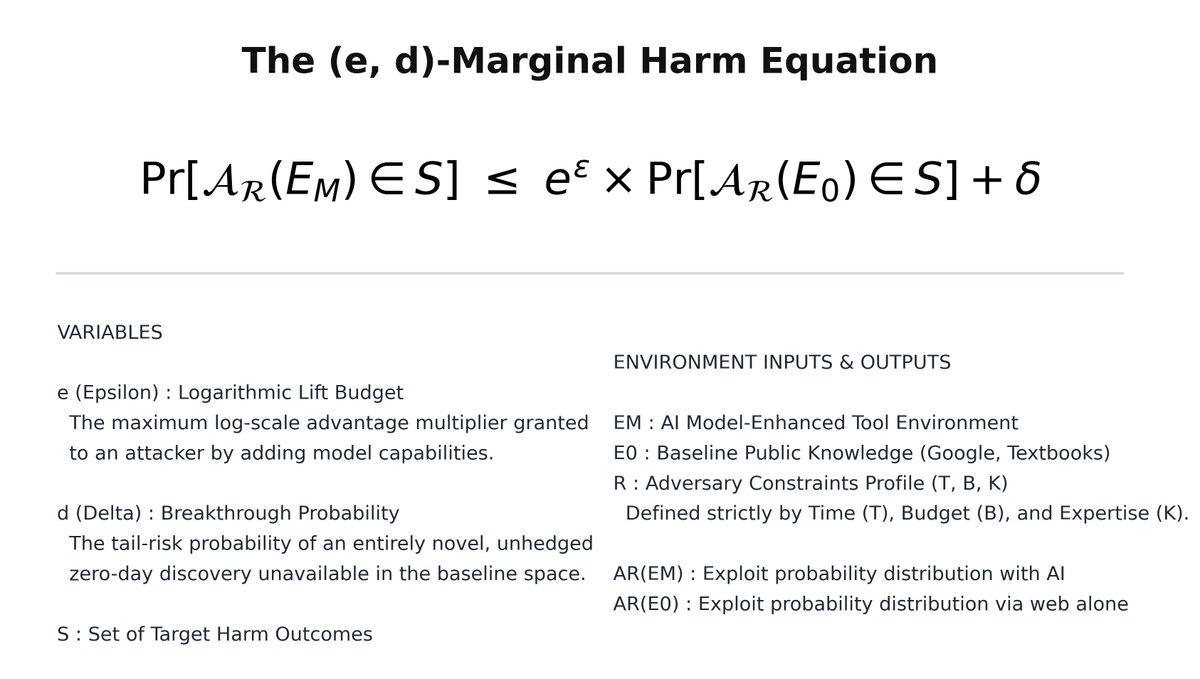
My bet is that safety lies in building external, deterministic architectures that strictly bound an adversary's lift (ε) and suppress structural breakthrough risks (δ), rendering the probability of systemic failure negligibly small.
TL;DR on safety: treat safety like computational cryptography. Measure the exact logarithmic lift (ε) the AI gives a resource-bound attacker beyond public knowledge, and use strict structural boundaries to keep the probability of a catastrophic breakthrough negligibly small (δ).
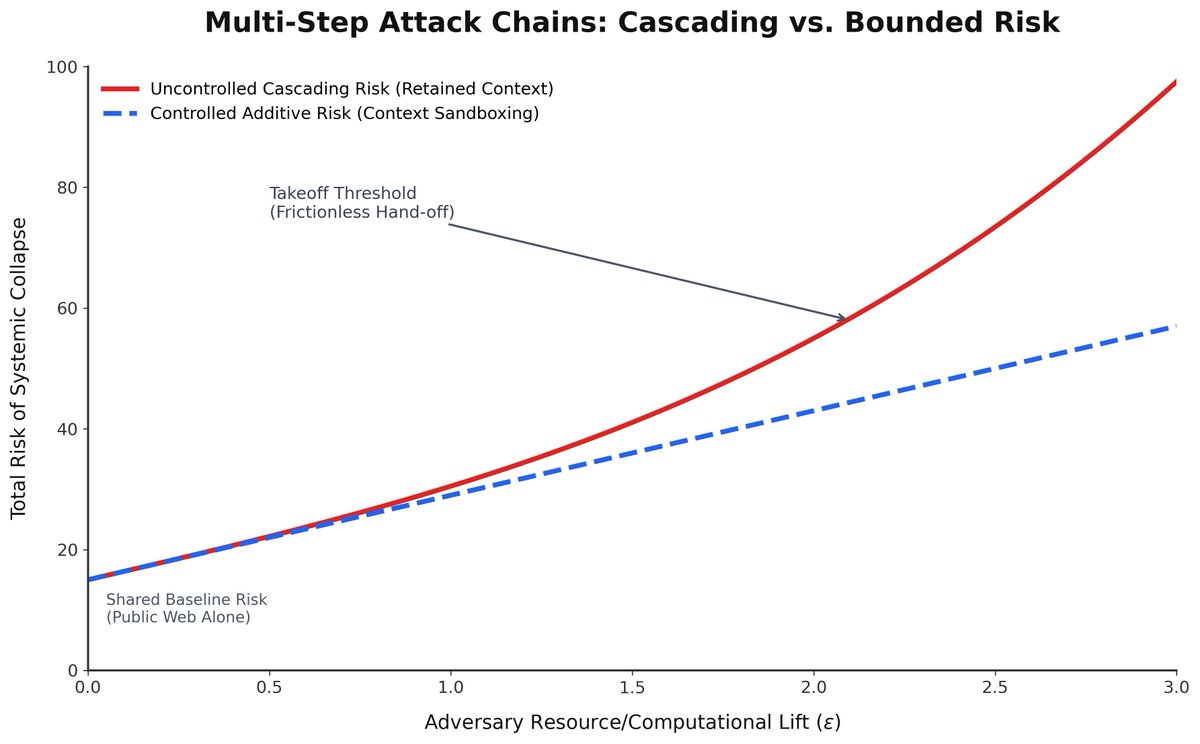
We can implement two mechanisms to bound the cascade:
1. Semantic Circuit Breakers: Audit prompt trajectories and force a halt if the cumulative semantic budget is breached.
2. Context Sandboxing: Wipe context memory between steps to flatten the exponential curve and trap δ.
This is δ: the Catastrophic Breakthrough Probability.
It measures the likelihood that a model independently discovers a novel vector of harm (like a zero-day exploit) that was absolutely impossible in the baseline environment. In a safe model, δ must be kept negligibly small.
This creates the Uncontrolled Cascading Risk curve.
When an AI agent assists across a sequential chain (eg., Map Vulnerability ─> Write Payload ─> Evade Firewall), it keeps structural context.
A breakthrough in Step 1 dynamically amplifies the success probability of Step 2.
Without strict structural intervention, the risk curves sharply upward as cross-step friction drops to zero.
There is also a second, deadlier risk: Approximate (ε, δ)-Marginal Harm.
We must account for a sudden, unpredictable capability jump.
We measure ε on a logarithmic scale because real-world exploitation is rarely a single step.
It is a pipeline of multiple dependent tasks where individual advantages compound multiplicatively.
This brings us to our first formal model: Pure ε-Marginal Lift.
If ε ≈ 0, the model provides zero marginal utility beyond public data. The model multiplies the baseline probability by exactly 1.
Instead of capability, we should look at Marginal Lift (ε).
Start by defining an adversary's resources:
- Timespan
- Compute budget
- Expertise
Then measure the delta in success probability between an attacker using only the open web vs. an attacker equipped with the model.
For example, a model doesn't need massive intelligence to automate mass phishing, build low-level malware pipelines, or execute targeted misinformation campaigns at zero marginal cost.
The baseline risk starts exceptionally high, even if the model's raw capability score is low.
My core research thesis on AI safety: measuring general model capability to predict harm is an outdated paradigm.
Instead, we need an adversary-centric framework modeled exactly like computational cryptography.
Here is how we can redefine the model capability vs. harm curve. 🧵
My bet is that ZK proving for LLMs specifically is well-positioned to keep improving, since both rely on the same underlying primitive: large-scale parallel linear algebra that maps naturally onto GPUs and ASICs.
I've been researching how Zero-Knowledge technology can cryptographically prove that a model actually produced a given output, without revealing its weights. Here's what I learned about ZK x Verifiable AI 🧵
TL;DR on scaling: the more a method relies on actually redoing the underlying math (ZK), the more proving time balloons with model size, unless it's purpose-built for the architecture.