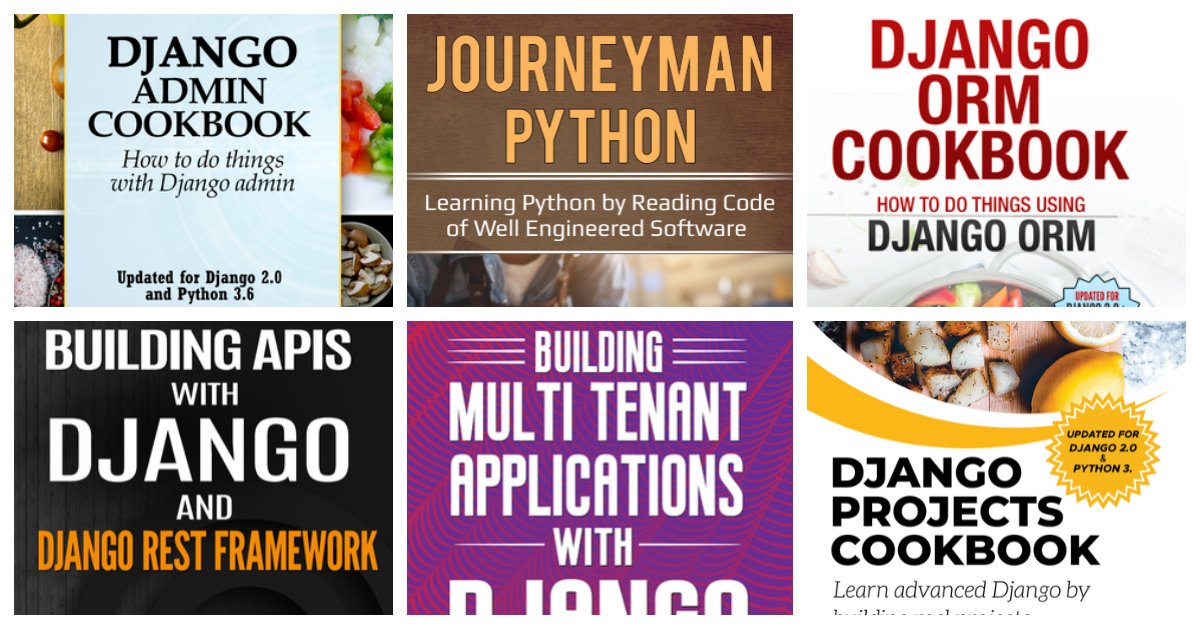
Read 10+ Free Django and Python books https://t.co/jAJ0Oyqobd
Includes
Django admin cookbook
Building Multi Tenant Applications with Django
Building APIs with Django and DRF
(And more)
Genie: I will give you 100Million. You have to spend it in 24 hours. Three rules, no throwing it away, no giving it away, no gambling.
Me: Can I use Anthropic?
Genie: There are 4 rules.
Let's not forget that Education Minister Dharmendra Pradhan’s daughter studied at Tufts University in Massachusetts, USA.
They have ZERO stakes in the game!
Gurugram-based Vivek Agarwal and seven of his family members were staying at Hotel Flourish Stays because Vivek's father was undergoing treatment in the ICU at the nearby Max Hospital.
All eight died. Entire family wiped out!
And now the ritual begins, ₹4 lakh compensation, an inquiry, promises of strict action. None of it matters now.
These were not accidental deaths. They were preventable deaths caused by greed, negligence, and a complete collapse of accountability. If the hotel owners had even a shred of conscience, if the officials responsible for inspections and enforcement had done their jobs honestly instead of looking the other way, this family might still be alive.
I have some advice for those impacted by what is looks like a CBSE scam. Please share this with those who are impacted:
A few days from now, maybe even today, a commission or a committee to probe this issue may be announced. Some bureaucrat will be transferred. Some minister might be moved to a different portfolio.
The system will now seek to calm this storm by doing pointless face-saving shit to buy time.
Media frenzy will die down. Journalists will move to a different story. Opposition will find a new issue to highlight.
You're not their priority. It's just how things work.
A few words of advice from an older hand who has done something to make things better re what you can do:
1. Don't give up. Don't stop till you get what you want. Identify a solution that you want. It could be a re-exam, or the demand for re-examination of marksheets. I don't know. Identify solutions and make a list. Demand outcomes.
2. Things will keep changing. Anticipate. Respond. Don't piss on anyone and don't make it personal. It's about the issue not the person.
3. Don't appoint a leader. Leaders get targeted, maligned and taken down. Don't give any lever to the dirty tricks departments. They're already rolling out their toolkits.
4. Twitter, YouTube and Insta are your turf. Don't go offline. Those rules are different. Cops are thugs. India is not Nepal / Bangladesh. Democratic process: Use your voice and the platforms you know better than the Ministry of censorship.
5. Mail your MP, MLA, political party people. Find their numbers and call them up. Calling really works. Flood the lines. Their emails and numbers are online. Tell them what you think. They'll need your votes in the future. Make them accountable to you by asking them to speak for you. Don't request. Demand that they do something. Be angry. That's how the message goes up the ladder. This should be your next step. If enough of you do this, things will change.
Find other ways to keep this alive without breaking the law.
There's an old blog post I've been thinking about a lot of late: Nobody cares. Just win.
I hope things work out for you.
Students are genuinely aggrieved. Trying to blame and fight them to dismiss their concerns must stop. They are India's future. In fact, they are the ones bringing to light many issues in advance. It's not a joke answer papers are changed, testing doesn't work, sites are insecure, and exam papers are leaked.
The first thing that came to my mind after the recent issues in CBSE, NEET, and NTA etc were those old days when we had scams after scams in exams. India can't let itself degrade back into that era. IT and cybersecurity can't be taken lightly. Top level accountability at Edu Min and humbleness in addressing the issues is needed.
CBSE’s May 2025 tender required answer sheets to be scanned with automatic robotic scanners, spines preserved, at a minimum of 300 DPI.
The tender re-issued in August quietly removed all of it. “Scanners” became generic. Resolution dropped to 200 DPI.
Now we know what that meant in practice. It has been exposed that COEMPT scanned the answer sheets using mobile phones.
The blurred copies, the missing pages, the unscanned books - they are not “errors.” They are the predictable outcome of a contract written to fit a vendor.
This is fraud. And every child whose marks were wrongly evaluated is a victim of it.
This morning, the Prime Minister had time to speak about mangoes. He has not had time to speak about 18.5 lakh children whose answer sheets were scanned with phones.
Dharmendra Pradhan ji still sits in office.
Modi ji’s silence is no longer indifference. It is complicity.
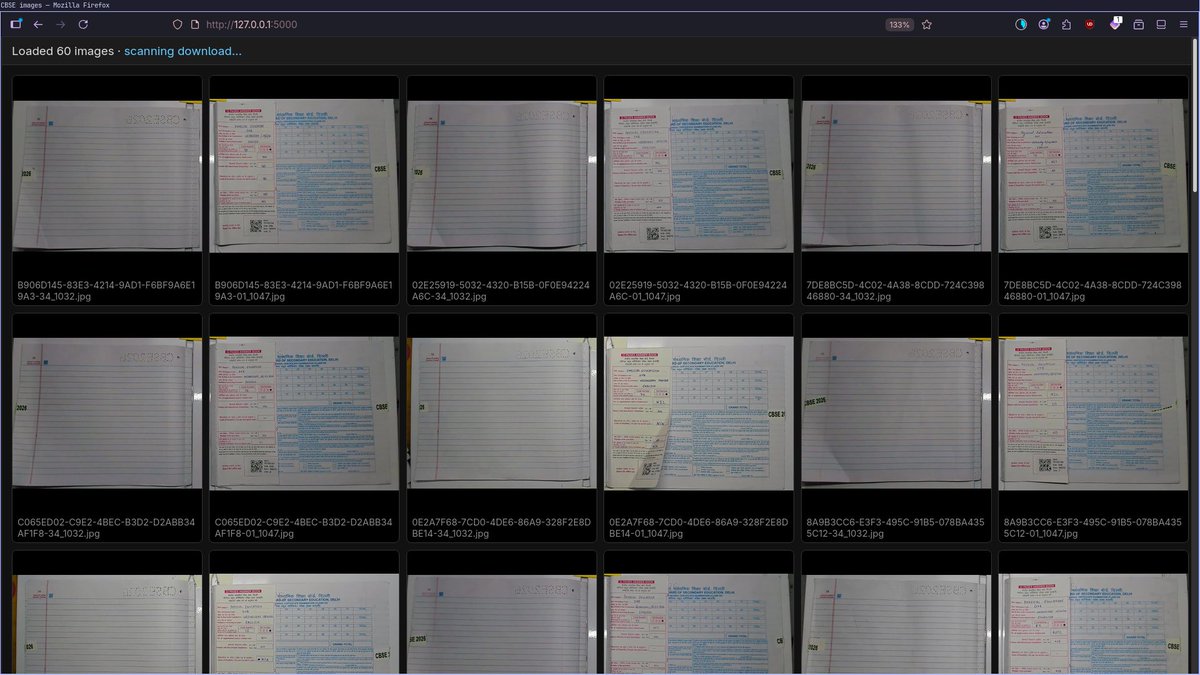
CBSE people didn't configure their AWS bucket properly and now we can paginate & enumerate all their media which has 2026 answersheets & question papers. ListObjectsV2 works without any auth and the bucket root is listable too — anyone on the internet can download any scanned booklet — across institutions. Multiple institutions are using the same bucket, insanely insecure.
In any sane nation, the news headline would be-
" Young sensation Meenakshi Goyat, daughter of a farmer from Chhabri village in Jind, defeats Vinesh Phogat, Congress MLA who gained notoriety for forcing her way into different weight category in Olympic and costing India her chance at medal. The short-lived victory of Meenakshi ended with her defeat by Antim Panghal, the youngest of the three (19). Antim is two-times senior Bronze medalist, and 2022 Asiad Bronze medalist. The young rising star from Haryana represents hopes for Indian women wrestling in times to come.
Meet Vedant Shrivastava, Nisarga Adhikary, and Sarthak Sidhant ,they exposed CBSE in every possible way :
17 years old Vedant Shrivastava :
> Applied for the CBSE re-evaluation process
> Got a different Physics answer sheet
> Posted it on X
> Got labelled "Pakistani" by the BJP IT cell
> Brought CBSE to its knees and proved them wrong
19 years old Nisarga Adhikary :
> Bro hacked the CBSE website
> Reported the vulnerability to them
> But they didn't take any action
> Then bro posted it on X
> Showed everyone that it could be hacked
18 years old Sarthak Sidhant :
> Bro exposed a CBSE tender
> Took it to X
> Wrote a detailed thread
> Explained how the CBSE OSM tender conditions allegedly favoured COEMPT
> And today came on the media
> Exposed them with facts
These three boys are doing what whole media failed to do, all of them took x to expose CBSE .
My name is Harsh, and I am a victim of @cbseindia29's absolute failure. I received my Class 12 result to find I scored just 5 marks in Chemistry—forcing an "Essential Repeat" in theory. Like Vedant and Sarthak, I KNOW this is a system error, not my hard work. #CBSE
Indian babies have been sleeping with parents for centuries. Same with babies in many parts of Asia & Africa.
The West forgot the basics & started separate rooms, controlled crying & all that nonsense. That was blindly followed by the "progressive" set in India. Now it seems common sense is coming back in fashion
This is an unbelievable piece of work by Sarthak and something that requires amplification.
Let me explain what he found, in simple terms.
Sarthak is a Class 12 student from the 2025-26 batch, one of the 17 lakh students whose answer sheets went through CBSE's new On-Screen Marking system.
He spent days reading through CBSE's evaluation tenders, scraped all 576 tenders CBSE has issued, and tracked how the rules changed across three versions of the same tender.
The core finding is that the company that won the contract to scan and grade 17 lakh students' answer sheets is Coempt Eduteck.
Coempt used to be called Globarena Technologies. Globarena was the company behind the 2019 Telangana intermediate exam disaster, where software failures led to 3.8 lakh students getting wrong or missing marks, and 23 students died by suicide.
A government committee found systemic failure and negligence. Six months later, Globarena rebranded to Coempt Eduteck.
So a company with that track record won a contract to handle 17 lakh CBSE students. Sarthak's investigation is about how the rules were rewritten to let that happen.
The tender was issued three times.
> First tender, February 2025. It existed, then disappeared from the public GeM portal. Sarthak scraped all 576 CBSE tenders and this one was missing from the archive entirely.
> Second tender, May 2025. Four companies applied including TCS and Coempt. All four failed the technical evaluation. Cancelled.
> Third tender, August 2025. Coempt won. Between the second and third tender, a series of rule changes happened, and every single one made it easier for Coempt to qualify.
Here is what changed, one by one.
01. The old rules disqualified any company with a history of abandoning work, failing to complete contracts, or financial weakness. The new rules deleted this clause entirely. Coempt's Telangana history stopped being a barrier.
02. The old rules disqualified any company that was "blacklisted earlier." The new rules changed this to "currently blacklisted." Because Globarena rebranded after Telangana, removing the word "earlier" effectively erased their past.
03. The rules required Rs 50 crore average turnover over three years. Coempt's exact average came to Rs 50.86 crore. They cleared the bar by less than 1%. Earlier, a smaller company had asked CBSE to lower the bar to Rs 30 crore for fairer competition. CBSE refused. So the bar was kept high enough to block small players, but sat exactly low enough for Coempt to scrape through.
04. Software maturity is measured on the CMMI scale, 1 to 5. The old rules required Level 5. The new rules dropped it to Level 3. Coempt is a Level 3 company.
05. The cooling-off period for engaging retired CBSE officials was cut from two years to one. This makes it easier to use recently retired insiders to influence the process.
06. The old rules required experience with large projects of at least 5 lakh students each. The new rules removed the student count and counted cumulative answer-book volume across small projects instead. Coempt has many small fragmented university contracts. This helped Coempt and hurt TCS.
07. The old rules required bidders to own their own data centre and disaster recovery centre on Indian soil. The new rules allowed third-party MeitY-empanelled cloud hosting. Coempt runs on AWS and Azure. This helped Coempt and hurt TCS, which owns its own data centres. It also means student data is no longer on sovereign, Indian infrastructure.
08. The old rules required the bidder to own or control the complete source code of its software. The new rules deleted this. Coempt's platform runs on Microsoft's proprietary IIS, which they don't own.
09. A last-minute corrigendum, issued right before bid submission, removed CBSE's own power to blacklist the firm if its software failed catastrophically. So even a Telangana-scale failure couldn't get Coempt banned from future government tenders.
10. The penalty structure shifted from punishing mistakes to punishing delays. The old rules fined the vendor for wrong scanning, merged pages, and unscanned books. The new rules dropped those and instead levied Rs 50,000 per day for delays. This incentivises rushed scanning over accurate scanning.
11. The old rules had a hard accuracy threshold, error rate not to exceed 0.5%. The new rules removed this number entirely.
12. The old rules specified proper book and robotics scanners. The new rules just say "sufficient scanners." The definition was vague enough that, as Sarthak notes, the scanning could be done with a phone on a stand.
13. On the security side, the contract required a VAPT (vulnerability and penetration test) certified by CERT-In before go-live, and a restricted beta phase before launch. The system clearly wasn't restricted, because the other researcher, Nisarga, was able to access it and find vulnerabilities four days before go-live. So the mandatory security audit appears to have been bypassed.
These are more than a dozen rule changes, all between the failed tender and the winning tender, all pushing in the same direction, all benefiting the one company with the worst track record in the field.
The security holes Nisarga found last week now have an explanation. The system was built by a vendor that was specifically allowed to skip the security certification, the source code ownership, the data sovereignty, and the quality thresholds the original rules demanded.
Following things need to happen immediately;
1. An immediate CAG audit of the tender process.
2. A parliamentary debate on the topic.
3. An independent investigation into
> Why the first tender vanished?
> Why the disqualification clauses were deleted?
> Why the turnover bar was held exactly where it was?
> Why the security level was dropped?
> Why the blacklisting power was removed at the last moment?
Sarthak, this is genuinely exceptional investigative work. Far better than most journalists with full resources ever manage. Take a bow. :)
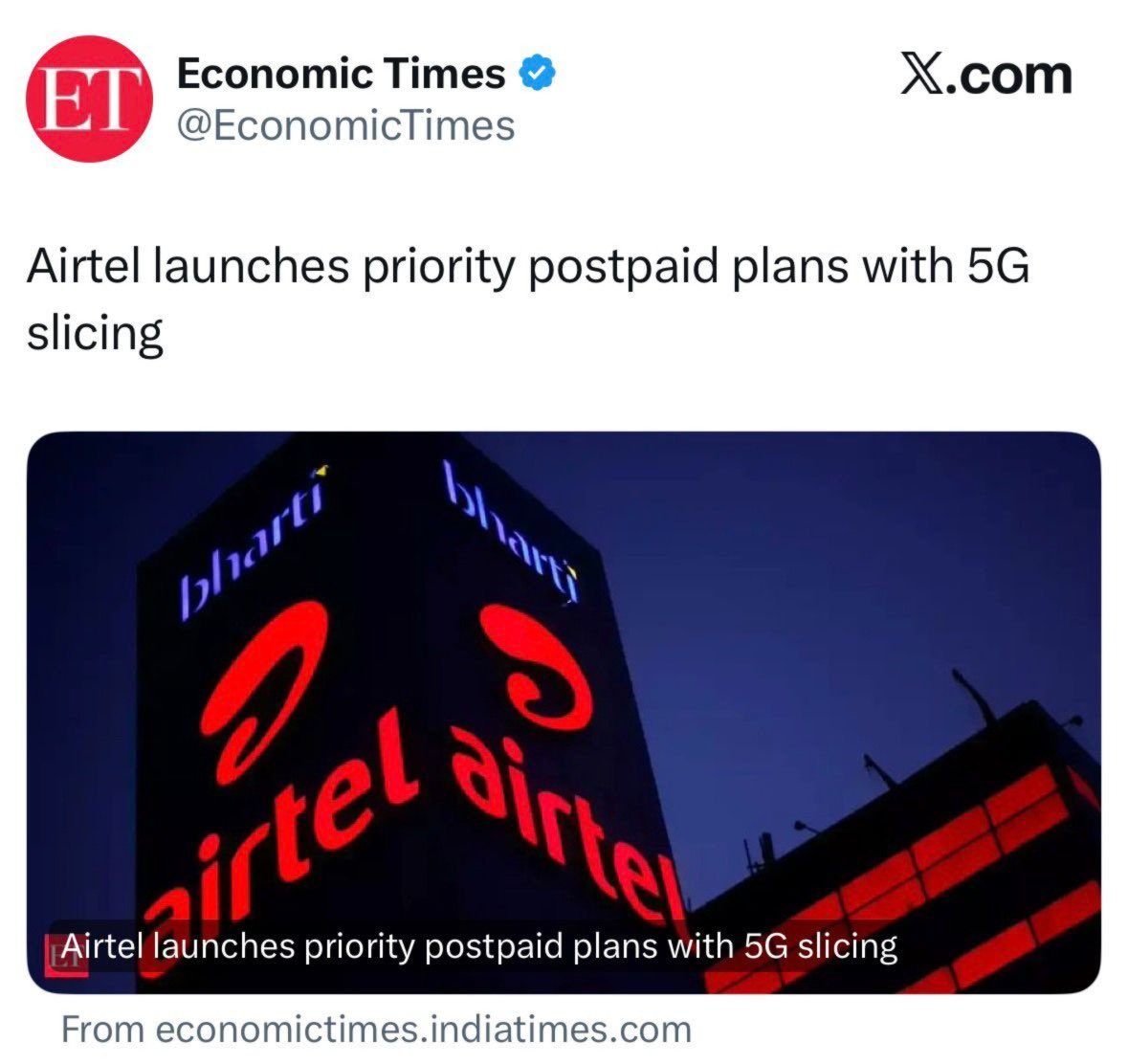
India’s internet has been officially split into two classes, and the announcement came from .@airtelindia itself.
Postpaid users now get “priority 5G.” Prepaid users get whatever is left on the same towers, the same spectrum, the same network. The deciding factor is not technology, not infrastructure, not even fairness. It is the size of your monthly bill.
The most dangerous part is not the policy itself, it is the precedent. Once a tiered internet gets normalised in India, every telecom in the market will follow the playbook. First speed will be sold, then app access, then connectivity itself. The open internet that built digital India will disappear quietly, one corporate announcement at a time.
Public spectrum is being sliced by wallet size, and the regulator has not said a word. .@Dot_India@JM_Scindia silence is not neutrality, it is complicity.
Europeans travel more because:
• Their countries are tiny and connected like Indian states
• They get stronger passports, cheaper flights, student hostels, work permits and social security
• Average salaries are much higher relative to travel costs
An Indian middle-class kid often carries family responsibilities much earlier. Supporting parents, saving for home, education loans etc.
And calling temple visits or family trips “not travel” is peak elitism. If a family saves for 2 years to visit Kedarnath, Goa or Kerala, that experience matters just as much as a backpacker smoking weed in Bali “finding himself”.
Also funny how people romanticize European gap years but ignore:
• Indians already migrate, struggle and adapt more than most populations globally
• Millions leave hometowns at 18 itself for coaching, jobs and survival
• Indians work in every continent on earth
Travel doesn’t automatically make someone deep, cultured or intelligent.
Some people return from 12 countries with only fake accents.
And honestly, there’s nothing wrong with wanting stability either. For many Indians, that stability is the result of one generation’s sacrifice.
Travel should expand your mind, not your superiority complex.
As I already said, we need a bribe tracker website, where people can enter the rate of bribe amount goverment officers for each process.
This way we can know what's the standard rate and not get scammed.
🏃🏻♂️🏃🏻♂️🏃🏻♂️