WBTC Explored Institutional Lending, Confidential Applications, and Multichain Expansion. Which Developments Matter Most?
WBTC's September recap highlights institutional lending, confidential WBTC applications, new integrations, and expansion across multiple blockchain environments.
These themes suggest that Bitcoin-linked assets are being considered for increasingly diverse financial workflows.
But the announcement provides a high-level summary rather than detailed implementation results.
That makes it useful to examine what meaningful progress in each area would require.
Institutional lending needs dependable operations
An institution considering WBTC as collateral may care about custody, liquidity, risk limits, and redemption procedures.
A programmable token can potentially simplify certain financial interactions.
However, actual adoption would need to be demonstrated through completed integrations and measurable activity.
The supplied recap doesn't identify specific lending volumes.
Confidential applications require clear technical definitions
Some financial participants may want greater privacy for transaction details.
But confidentiality can mean different things.
It might concern transaction amounts, participant identities, or application-level information.
The announcement doesn't explain which mechanisms are involved.
Users should avoid assuming complete privacy without reviewing the actual implementation.
New integrations should provide usable functionality
A protocol announcing WBTC support is only the beginning.
Users need sufficient liquidity, clear documentation, and reliable transactions.
An integration that exists technically but attracts little activity may provide limited practical value.
Multichain expansion increases access and dependencies
Availability across more blockchains may make WBTC useful to additional applications.
However, cross-chain transfers can introduce bridges and other infrastructure with distinct security assumptions.
Those dependencies need to be evaluated.
Look for evidence beyond announcements
Useful indicators include active integrations, deployed liquidity, actual transaction activity, and documented custody arrangements.
The September summary doesn't provide enough information to quantify these outcomes.
My perspective
WBTC's September developments point toward a broader role for Bitcoin-linked assets.
Institutional applications, confidentiality, and multichain access could all expand utility.
But meaningful progress depends on reliable implementation, transparent risks, and demonstrated user demand.
The goal shouldn't simply be making WBTC available in more places.
It should be making Bitcoin-linked value genuinely useful within those environments.
@justinsuntron@WrappedBTC #TRONEcoStar
September brought new developments across Bitcoin and DeFi.
From institutional lending and confidential WBTC applications to new integrations and multichain expansion, WBTC continued to find new use cases across the on-chain ecosystem.
Here’s what happened in September.
https://t.co/rDcs0Cu5J5
What Is a Smart Contract? Think of It as a Financial Rulebook That Executes Through Code.
WBTC's educational series explains smart contracts as code deployed on a blockchain that can execute predefined actions when the necessary conditions are met.
This concept makes many DeFi applications possible.
But understanding smart contracts doesn't require starting with complicated programming terminology.
Imagine a lending agreement
In a conventional financial arrangement, institutions and employees may handle collateral checks, interest calculations, and repayment procedures.
A blockchain lending protocol can encode parts of those rules into smart contracts.
When a user submits a valid transaction, the contract applies its programmed conditions.
That is the basic idea behind automated execution.
The contract doesn't make independent judgments
A smart contract follows code.
It doesn't automatically understand whether a financial decision is wise or whether an external event is accurately represented.
If the contract depends on market prices, it may need data supplied through an oracle mechanism.
Incorrect inputs or flawed code can affect outcomes.
Where does WBTC fit?
WBTC represents Bitcoin-linked value in a token format compatible with supported smart-contract networks.
That allows applications to recognize and interact with the asset.
For example, a lending protocol may accept WBTC as collateral under its specific rules.
Automation doesn't eliminate the need for users
Some actions still require a participant to submit transactions.
Other operations may depend on external services or network participants.
A contract being automated doesn't mean every process occurs without any trigger.
Security remains essential
Smart contracts can contain vulnerabilities.
A protocol may also have economic risks even when its code operates as designed.
Users should evaluate the specific application rather than assuming blockchain execution guarantees safety.
My perspective
Smart contracts make financial processes programmable, while WBTC allows Bitcoin-linked assets to participate in those processes.
The benefit is flexibility and transparent rule execution.
But the responsibility shifts toward understanding software, data dependencies, and protocol design.
Automation can reduce certain forms of friction without eliminating financial risk.
@justinsuntron@WrappedBTC #TRONEcoStar
A smart contract is code deployed on a blockchain that can automatically execute predefined actions when its conditions are met.
But what does that actually mean?
This WBTC Decoded explains smart contracts, how they work, and where they fit into the WBTC ecosystem.
One WBTC, Several DeFi Applications. How Can Bitcoin-Linked Value Move Through an On-Chain Workflow?
WBTC recently illustrated a 24-hour journey in which Bitcoin-linked value moves through wallets, collateral positions, liquidity markets, and different blockchain environments.
The concept demonstrates how tokenized Bitcoin can interact with multiple financial applications.
But each step changes the user's operational responsibilities.
Step one: hold WBTC in a compatible wallet
The wallet provides access to the token on its supported blockchain.
Users need to verify the network, token contract, and destination address before transferring funds.
Sending assets through an unsupported network or incorrect address can create serious recovery problems.
Step two: interact with a lending protocol
A user may supply WBTC as collateral and borrow another asset.
This can provide liquidity while maintaining Bitcoin-linked exposure.
However, the borrowed position introduces interest costs and liquidation risk.
The collateral must be monitored according to the protocol's rules.
Step three: explore liquidity provision
WBTC may be deposited into a supported decentralized exchange pool.
Depending on the pool, participants may earn fees or incentives.
But they can also face impermanent loss and smart-contract vulnerabilities.
The economic outcome depends on market conditions and pool design.
Step four: consider cross-chain movement
Some applications operate on different blockchains.
Moving tokenized assets between environments may require bridges or other infrastructure.
Those mechanisms can introduce additional security assumptions and transaction costs.
Step five: understand how to exit
Before entering a DeFi position, users should know how withdrawals, debt repayment, and any required token conversions work.
A strategy isn't complete without an exit plan.
My perspective
WBTC's 24-hour example demonstrates the flexibility of tokenized Bitcoin.
But I wouldn't interpret it as a recommendation to move through as many protocols as possible.
Every additional interaction can introduce fees and risk.
The best workflow is the one that achieves a clear objective with manageable complexity.
@justinsuntron@WrappedBTC #TRONEcoStar
24 hours in the life of WBTC.
One Bitcoin moves through wallets, protocols, collateral, liquidity and multiple chains.
Here’s a glimpse of what that activity can look like on-chain.
WBTC's Market Cap Grew From Launch to a Historical Peak. How Much Was Bitcoin Price, and How Much Was Adoption?
WBTC has shared a look at its market-cap evolution from launch to its historical peak.
The supplied announcement doesn't include exact chart values or dates.
But the topic raises a useful analytical challenge: distinguishing Bitcoin's market-price effects from changes in demand for tokenized Bitcoin.
Market capitalization has two main components
The basic calculation is circulating supply multiplied by market price.
Because WBTC tracks Bitcoin, its price generally moves with BTC.
This means WBTC's market capitalization can rise even if its circulating supply doesn't change.
Consider a simplified example
Imagine 100,000 WBTC in circulation at a hypothetical price of $50,000.
The resulting market capitalization would be $5 billion.
If Bitcoin's price doubled while WBTC supply remained unchanged, the market capitalization would rise to $10 billion.
That increase wouldn't require any additional WBTC issuance.
Now consider supply growth
If the amount of WBTC in circulation increases, market capitalization can also rise.
That may reflect greater demand for Bitcoin-linked tokens.
However, it doesn't establish how the newly issued tokens are being used.
Some may remain in wallets, while others may enter DeFi protocols.
DeFi adoption needs separate evidence
To evaluate actual usage, examine lending-market deposits, liquidity pools, trading activity, and supported integrations.
These indicators provide information that market capitalization alone cannot reveal.
Historical peaks can be misleading
A peak market cap may coincide with a high Bitcoin price, a large circulating supply, or both.
Without the chart's underlying data, we shouldn't assign the peak to a specific cause.
My perspective
WBTC's market-cap history is interesting because it reflects the interaction between Bitcoin valuation and tokenization.
But measuring adoption requires separating those effects.
A larger market capitalization shows more dollar value represented by WBTC.
Understanding why that value increased is a different analytical task.
@justinsuntron@WrappedBTC #TRONEcoStar
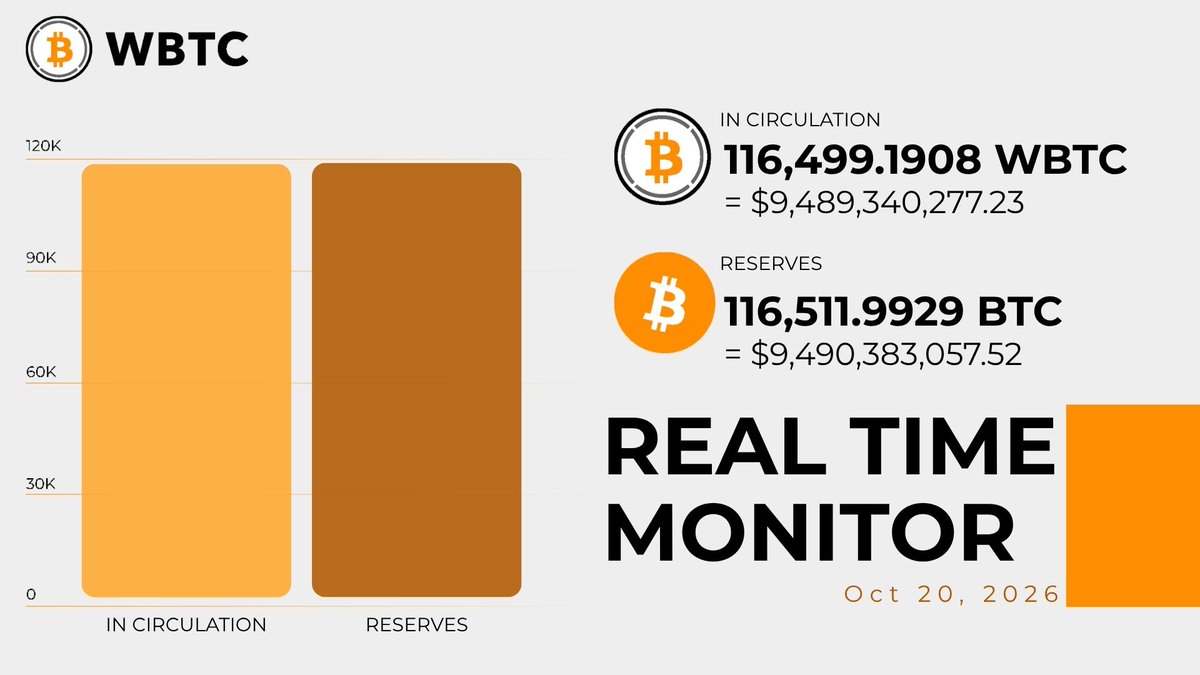
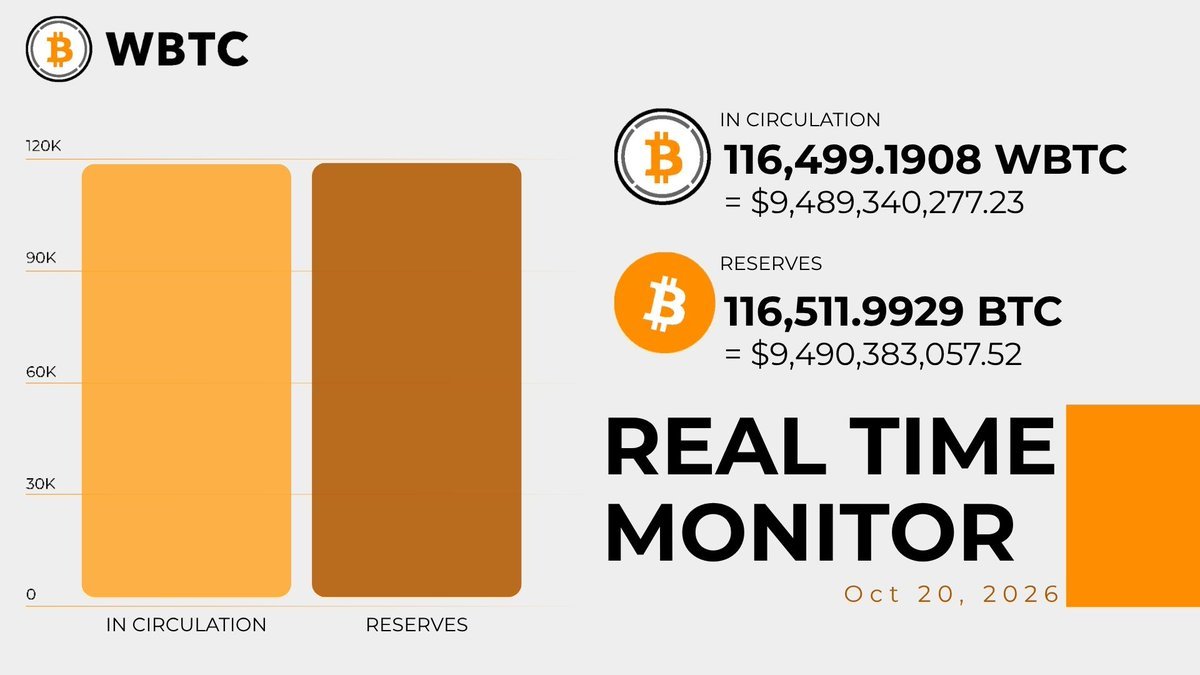
WBTC's October 20 Proof of Reserves: Why I'd Compare Multiple Reports Instead of Trusting One Snapshot
WBTC published a Proof of Reserves update dated October 20, 2026, reaffirming that WBTC remains backed one-to-one by Bitcoin held in custody.
The announcement states that reserve and supply information can be verified on-chain.
For someone holding WBTC, this is relevant because the token depends on an underlying BTC reserve structure.
But reserve analysis becomes more useful when performed consistently.
Start with the correct reporting date
A reserve statement should be evaluated using the balances associated with its stated observation period.
Comparing reserve data from one date with circulating supply from another can produce misleading differences.
The supplied October 20 announcement doesn't include exact quantities.
Those should be obtained from the relevant records.
Examine the reserve-to-supply relationship
A one-to-one structure is intended to ensure that issued WBTC corresponds to an equivalent amount of underlying BTC.
Users can investigate whether the reported balances support that relationship.
However, the calculation depends on correctly identifying the included assets and outstanding tokens.
Compare reports over time
A later reserve update can help establish whether the reported backing relationship remains consistent.
But changes in reserves or supply aren't automatically suspicious.
Minting and redemption activity can legitimately alter both balances.
The important issue is whether the relationship remains properly maintained.
Understand the custody layer
On-chain records can provide evidence of asset balances.
They don't automatically establish every legal or operational detail of custody.
Users should understand who controls the reserves and what conditions apply to redemption.
Backing doesn't eliminate technical risk
WBTC may be used in smart contracts or transferred through supported blockchain infrastructure.
Those activities can introduce risks separate from reserve coverage.
My perspective
The October 20 update provides another point in WBTC's public reserve-reporting history.
I would treat it as part of a sequence rather than an isolated guarantee.
Regular verification, clear custody disclosures, and reliable redemption procedures are all important for evaluating the trustworthiness of tokenized Bitcoin.
@justinsuntron@WrappedBTC #TRONEcoStar
WBTC 20/10/26 Proof of Reserves Update
WBTC remains held in 1:1 custody against Bitcoin, with reserve and supply data publicly verifiable on-chain.
View the latest reserve and supply data below.
WBTC Ranks #18 by Market Cap. Why That Doesn't Automatically Make It the 18th Most Useful Crypto Asset
WBTC has reported a ranking of 18th among cryptocurrencies by market capitalization, citing CoinGecko.
Because WBTC is designed to track Bitcoin's price, its market value is closely connected to BTC movements.
The ranking provides useful information about the scale of tokenized Bitcoin.
But market capitalization is only one way to evaluate an asset.
Understand the calculation
Market capitalization generally equals circulating supply multiplied by market price.
For WBTC, that means the reported value can increase when Bitcoin's price rises.
It can also increase if more WBTC enters circulation.
Those two developments have different implications.
Imagine BTC rises without new WBTC issuance
If Bitcoin's price increases while WBTC supply stays unchanged, WBTC's market capitalization can rise.
That doesn't necessarily mean more users have entered DeFi.
It may simply reflect the higher valuation of the existing supply.
Now imagine supply increases
Additional WBTC issuance may indicate greater demand for tokenized Bitcoin exposure.
But even then, we need to understand where the tokens are held and how they are used.
Not every WBTC holder necessarily participates in lending or liquidity provision.
Rankings can change quickly
Other cryptocurrencies also experience price and supply changes.
A token can move up or down the rankings without a major change in its underlying functionality.
The reported 18th position should therefore be understood as a snapshot.
Utility requires different metrics
To evaluate WBTC's practical role, users could examine protocol integrations, liquidity, circulating supply, and actual DeFi participation.
Reserve backing and redemption reliability are also essential.
My perspective
WBTC's ranking highlights the economic scale of Bitcoin-linked tokenization.
But size and usefulness aren't identical.
A more complete evaluation considers whether the asset is transparently backed, sufficiently liquid, and genuinely useful across supported financial applications.
Market cap tells us how large the tokenized position is. It doesn't explain everything that position can do.
@justinsuntron@WrappedBTC #TRONEcoStar
WBTC is now ranked #18 by market cap across all cryptocurrencies.
With WBTC tracking the price of Bitcoin, BTC’s market moves are reflected across the WBTC market too.
Source: CoinGecko
Bitcoin Started With a Block in 2009. Its History Offers a Lesson About Building Durable Technology.
WBTC recently revisited Bitcoin's early history, beginning with the first block on January 3, 2009.
The timeline includes the first transaction on January 12, 2009, an early real-world use case on May 22, 2010, and Satoshi Nakamoto's withdrawal from public involvement later that year.
More than 17 years after launch, Bitcoin continues to influence financial technology.
What makes this history interesting is how a relatively focused system developed into the foundation for a much broader ecosystem.
The first milestone was functional
Bitcoin's early network demonstrated that value could be recorded and transferred through a decentralized system.
The initial achievement wasn't a complex financial application.
It was the operation of the underlying protocol.
Real-world use came later
The May 22, 2010 milestone is associated with Bitcoin being used to purchase physical goods.
That event demonstrated a practical use beyond transfers between early participants.
It also became part of Bitcoin's cultural history.
The network continued evolving
The source highlights Satoshi's disappearance from public involvement in December 2010.
Bitcoin's continued development illustrates how an open-source network can persist beyond its original creator.
However, the precise timeline of Satoshi's final public activities is more nuanced than a single date.
New applications emerged over time
Bitcoin later became an asset used across trading markets and financial products.
Wrapped representations such as WBTC expanded its compatibility with smart-contract applications.
This didn't require replacing Bitcoin's original network.
Instead, additional infrastructure developed around its economic value.
Innovation introduces new responsibilities
Every new application adds technical and operational considerations.
Tokenized Bitcoin, for example, introduces custody and smart-contract dependencies.
Progress should therefore be evaluated through both functionality and risk.
My perspective
Bitcoin's history shows that important technologies can evolve far beyond their earliest use cases.
But durable development depends on reliable foundations.
WBTC represents one extension of Bitcoin's utility, and its success should be judged by how responsibly it connects that value with new financial applications.
@justinsuntron@WrappedBTC #TRONEcoStar
First block - Jan 3, 2009
First bitcoin - Jan 3, 2009
First transaction - Jan 12, 2009
First use case - May 22, 2010
Then Satoshi disappeared - Dec 12, 2010
More than 17 years later, Bitcoin is still evolving.
From a 9-page whitepaper to an asset used across global markets and on-chain finance.
Hold Bitcoin, Borrow Against It, or Provide Liquidity? Three Strategies With Very Different Risks
WBTC recently asked an interesting question: what do you want your Bitcoin to do?
For some people, Bitcoin is a long-term holding.
For others, tokenized Bitcoin may become collateral or liquidity within decentralized finance.
These strategies can involve similar price exposure, but they shouldn't be evaluated in the same way.
Strategy one: hold for long-term exposure
Imagine someone who wants to maintain Bitcoin exposure without managing a lending position.
Holding may be the simplest approach.
The main concerns include price volatility, storage security, and the specific asset's custody structure.
Using WBTC instead of native BTC adds wrapped-token dependencies.
Strategy two: use WBTC as collateral
Suppose someone holds WBTC and wants liquidity without immediately selling it.
A lending protocol may allow borrowing against the position.
This creates a debt obligation.
If Bitcoin's price falls, the collateral value may decline relative to the borrowed amount.
Liquidation risk can become significant.
Strategy three: provide liquidity
A WBTC holder may participate in a decentralized liquidity pool.
The position could earn fees or incentives depending on the pool.
But returns are not guaranteed.
Impermanent loss, changing trading activity, and contract vulnerabilities can affect results.
Compare the operational complexity
Holding requires relatively few ongoing decisions.
Borrowing may require monitoring collateral and interest.
Liquidity provision may require understanding pool composition and market behavior.
The more complex strategies can introduce additional monitoring requirements.
Avoid choosing based only on advertised yield
A higher potential return doesn't necessarily mean a better risk-adjusted outcome.
Users should consider possible losses, transaction expenses, and their ability to manage the position.
My perspective
WBTC expands what Bitcoin-linked assets can do, but it doesn't make every strategy suitable for every holder.
The most sensible choice depends on the objective.
If additional complexity doesn't provide a meaningful benefit, there may be little reason to accept the additional risk.
@justinsuntron@WrappedBTC #TRONEcoStar
Your Bitcoin can be more than just a store of value.
It can be a long-term position, collateral for a loan, or liquidity in an on-chain market.
Different uses. Different risks.
The question isn't just why you hold BTC. It's what you want it to do.
WBTC Says Its November 2 Reserves Remain 1:1. How Should Users Evaluate That Claim?
WBTC published a Proof of Reserves update dated November 2, 2026, stating that outstanding tokens remain backed one-to-one by Bitcoin held in custody.
The announcement also says reserve and supply data are publicly verifiable on-chain.
For users holding tokenized Bitcoin, understanding this relationship is important.
But the right approach involves more than reading the headline.
Begin with the reserve balance
A reserve report should identify the amount of underlying BTC associated with the issued WBTC.
Users need to understand which addresses or records are included in the calculation.
The supplied announcement doesn't provide exact numerical balances.
Those figures should be checked in the relevant official records.
Compare reserves with token supply
A one-to-one backing structure requires the outstanding token supply to be supported by equivalent underlying assets.
The comparison should use consistent units and an appropriate observation time.
Otherwise, differences in reporting timestamps may create confusion.
Understand the custody arrangement
Publicly visible BTC doesn't automatically explain who controls it or how redemption requests are processed.
Custody arrangements, authorization procedures, and legal rights remain important.
Consider the limitations of snapshots
A reserve statement reflects information at a particular point or reporting period.
It doesn't guarantee that operational conditions can never change.
Repeated reporting can provide additional confidence, but it isn't a substitute for understanding the underlying structure.
Don't confuse backing with market liquidity
A token may be fully backed while experiencing temporary differences in market price or available exchange liquidity.
Reserve coverage and secondary-market trading conditions are related but distinct issues.
My perspective
WBTC's November 2 update provides an opportunity for users to examine the backing relationship directly.
The strongest evaluation combines reserve data, circulating supply, custody arrangements, and redemption conditions.
A one-to-one claim is meaningful when users can understand how the relationship is maintained and independently examine the supporting evidence.
@justinsuntron@WrappedBTC #TRONEcoStar
WBTC 02/11/26 Proof of Reserves Update
WBTC remains held in 1:1 custody against Bitcoin, with reserve and supply data publicly verifiable on-chain.
View the latest reserve and supply data below.
WBTC Explored Multi-Custodian Infrastructure in October. What Would Meaningful Progress Look Like?
WBTC's October recap highlights exploration of a multi-custodian model, broader wallet access, and continued discussion of Bitcoin's role in decentralized finance.
These developments could influence how users interact with tokenized Bitcoin.
But I think the most useful approach is to evaluate what each theme would mean in practice.
Custody diversification needs clear responsibilities
A multi-custodian arrangement could potentially distribute custody-related responsibilities across more than one institution.
However, the effectiveness of such a structure depends on how authority, access, and recovery procedures are designed.
Simply adding custodians doesn't automatically eliminate operational concentration.
The supplied announcement describes exploration rather than confirmed implementation.
Wallet support should improve actual usability
Expanded wallet access can make it easier for users to manage WBTC.
But support should be evaluated through practical functions.
Can users view balances correctly?
Can they send and receive the token on supported networks?
Can they connect to relevant applications?
A wallet listing alone doesn't answer every question.
DeFi integrations need liquidity
A new lending or trading integration may expand where WBTC can be used.
But functionality doesn't guarantee that meaningful liquidity will be available.
Users need to understand market depth, costs, and applicable risks.
Security assumptions should remain visible
As WBTC becomes available through more interfaces and protocols, users may encounter different smart-contract and bridge dependencies.
Those should be clearly documented.
Look for measurable outcomes
Useful indicators could include completed custody changes, supported wallet functionality, actual protocol liquidity, and reliable redemption operations.
The October summary doesn't provide all these measurements.
My perspective
WBTC's October themes point toward broader access and potential infrastructure changes.
But strategic progress should be judged through implemented functionality and transparent risk management.
The strongest expansion is one that makes tokenized Bitcoin easier to use without making its underlying trust model harder to understand.
@justinsuntron@WrappedBTC #TRONEcoStar
October brought new developments across WBTC, from exploring a multi-custodian model to expanding wallet access and examining Bitcoin’s role in DeFi.
Here’s a look at the updates, insights, and milestones that shaped the month. 👇
https://t.co/7GNzI01Xan
You Hold Bitcoin. What Changes When You Convert That Exposure Into WBTC?
Bitcoin is widely recognized as an asset that can be held and transferred through its native blockchain.
WBTC introduces another possibility: using Bitcoin-linked value within compatible smart-contract applications.
That creates access to lending, trading, and liquidity markets.
But moving from native BTC to WBTC changes the structure of the position.
Start with the purpose
Imagine holding BTC for long-term exposure.
If your only objective is to maintain that exposure, adding DeFi interactions may introduce complexity without providing a clear benefit.
But if you want to use Bitcoin-linked value as collateral or liquidity, WBTC may provide additional functionality.
The important question is whether those functions serve a real objective.
Understand what you're holding
Native BTC exists on the Bitcoin network.
WBTC is a tokenized representation backed through a custody and issuance arrangement.
The two assets are designed to maintain closely related economic values.
However, their operational dependencies differ.
Borrowing introduces leverage-related risks
Using WBTC as collateral may allow someone to borrow another asset.
But the borrower must manage interest obligations and collateral requirements.
If Bitcoin's price declines, the collateral position may become vulnerable to liquidation.
Liquidity provision has its own tradeoffs
Providing WBTC to a decentralized exchange may generate trading fees or incentives.
However, returns depend on the pool's design and market conditions.
Impermanent loss and smart-contract vulnerabilities can affect outcomes.
Every additional protocol creates another dependency
A WBTC holder may face custody-related risks.
Depositing WBTC into a lending protocol introduces another layer.
Moving it through a bridge may add further exposure.
These risks should be considered together.
My perspective
WBTC can make Bitcoin-linked capital more flexible.
But flexibility is only useful when the additional function justifies the complexity.
Before using WBTC in DeFi, define the objective, understand the custody model, and evaluate the risks of every application involved.
@justinsuntron@WrappedBTC #TRONEcoStar
Bitcoin changed how we think about money, but for years, it couldn't interact with DeFi.
That's where WBTC comes in. WBTC is a version of BTC that lives on smart contract blockchains, allowing Bitcoin to be used across lending, trading, liquidity, and more.
WBTC's September Recap Points to Institutional Lending, Confidential Applications, and Multichain Expansion
WBTC's September recap highlights developments involving institutional lending, confidential WBTC applications, new integrations, and expansion across blockchain environments.
These themes suggest that tokenized Bitcoin is being considered for a broader range of financial and technical applications.
However, the supplied announcement provides only a high-level overview.
It doesn't identify every partner, integration, or completed milestone.
Institutional lending introduces different requirements
Institutions evaluating Bitcoin-linked collateral may require clear custody arrangements, risk controls, and operational procedures.
A tokenized asset can potentially support programmable lending workflows.
But institutional interest doesn't automatically establish that large-scale adoption has occurred.
Actual lending volumes and implemented agreements would provide stronger evidence.
Confidential applications address information exposure
Public blockchains make many transaction details visible.
Some financial users may require additional confidentiality.
The recap references confidential WBTC applications, but doesn't explain their specific mechanisms.
It would be premature to claim that particular privacy guarantees have been achieved without more technical detail.
Integrations expand potential utility
Supporting WBTC in additional applications can create more opportunities for lending, trading, or collateral use.
However, integrations differ in their functionality and security assumptions.
The announcement doesn't provide enough detail to evaluate each one individually.
Multichain expansion increases both reach and complexity
Availability across multiple blockchain environments can improve accessibility.
But cross-chain infrastructure introduces additional technical dependencies.
Users should examine the relevant transfer and custody mechanisms.
Progress requires measurable evidence
A monthly recap can identify strategic direction.
Evaluating outcomes requires specific information about deployed products, transaction activity, liquidity, and user participation.
My perspective
WBTC's September themes reflect the continuing evolution of tokenized Bitcoin.
Institutional finance, confidentiality, and multichain access could expand its range of applications.
But the strongest evidence of progress will come from implemented infrastructure, transparent risk disclosures, and measurable usage rather than broad descriptions alone.
@justinsuntron@WrappedBTC #TRONEcoStar
September brought new developments across Bitcoin and DeFi.
From institutional lending and confidential WBTC applications to new integrations and multichain expansion, WBTC continued to find new use cases across the on-chain ecosystem.
Here’s what happened in September.
https://t.co/rDcs0Cu5J5
Smart Contracts Make WBTC Useful in DeFi. But What Does Automatic Execution Really Mean?
WBTC's educational series recently introduced smart contracts as blockchain-deployed code that executes predefined actions when specified conditions are satisfied.
This concept is fundamental to decentralized finance.
Without smart contracts, many automated lending, trading, and liquidity applications would be difficult to operate in their current form.
But the word "automatic" can create misunderstandings.
A smart contract follows programmed rules
A smart contract is code deployed to a compatible blockchain.
When a valid transaction invokes its functions, the blockchain executes the relevant logic according to the contract's rules.
The contract doesn't independently understand every real-world event.
It operates on the information and inputs available to it.
Automation can reduce manual coordination
Imagine a lending protocol where collateral conditions and borrowing limits are defined in code.
The contract can apply those rules consistently when users interact with it.
This can reduce reliance on manual processing.
However, the correctness of the outcome depends on the contract's design and available data.
WBTC provides an asset smart contracts can use
Native BTC isn't directly represented as a standard token on every smart-contract blockchain.
WBTC provides Bitcoin-linked value in a compatible token format.
That allows supported applications to accept it as collateral, exchange it, or include it in liquidity pools.
Code doesn't eliminate risk
Smart contracts can contain vulnerabilities or unexpected behavior.
External price feeds can also become important dependencies.
A contract executing exactly as written doesn't guarantee that its economic design is safe.
Automation has boundaries
Some smart-contract actions require users, external services, or other participants to submit transactions.
The code doesn't necessarily execute spontaneously without a triggering interaction.
My perspective
Smart contracts are important because they make financial rules programmable.
WBTC extends Bitcoin-linked value into that environment.
But users should understand that automated execution replaces certain manual processes with software-based dependencies.
The result can be more flexible and transparent, provided the underlying code and economic mechanisms are designed responsibly.
@justinsuntron@WrappedBTC #TRONEcoStar
A smart contract is code deployed on a blockchain that can automatically execute predefined actions when its conditions are met.
But what does that actually mean?
This WBTC Decoded explains smart contracts, how they work, and where they fit into the WBTC ecosystem.
One Bitcoin, Multiple Financial Roles: Understanding WBTC's Journey Through DeFi
WBTC recently described a hypothetical 24-hour journey in which Bitcoin-linked value moves through wallets, protocols, collateral positions, liquidity markets, and multiple blockchains.
The idea illustrates why tokenized Bitcoin exists.
Instead of remaining limited to its native network, Bitcoin exposure can interact with applications built around smart contracts.
But each stage of that journey introduces different mechanisms and risks.
Wallets provide the starting point
A user may hold WBTC in a compatible wallet.
The wallet allows interaction with supported token contracts and applications.
However, wallet security remains essential because compromised private keys can lead to asset loss.
Lending protocols introduce collateral functionality
WBTC may be deposited into a lending market and used as collateral.
This can allow users to borrow other assets while retaining Bitcoin-linked exposure.
But collateralized borrowing introduces interest expenses and liquidation risk.
Liquidity pools create another role
WBTC can potentially be supplied to decentralized trading pools.
Participants may receive fees or incentives depending on the protocol.
However, liquidity provision can involve impermanent loss, smart-contract vulnerabilities, and changing market conditions.
Moving across chains requires infrastructure
WBTC can exist within supported blockchain environments.
Cross-chain movement may require bridges or other transfer mechanisms.
Those systems can introduce additional technical and operational dependencies.
A token's presence on multiple chains doesn't mean every transfer path has identical security assumptions.
The same economic exposure can support different activities
WBTC allows Bitcoin-linked value to participate in multiple financial contexts.
But the asset's role changes depending on how it is deployed.
Passive holding, borrowing, and liquidity provision involve different obligations.
My perspective
The 24-hour WBTC concept is a useful way to explain composability in decentralized finance.
One tokenized asset can interact with several applications without losing its underlying Bitcoin-linked purpose.
However, every additional interaction adds complexity.
The strongest DeFi strategies use that flexibility selectively rather than treating every available opportunity as automatically beneficial.
@justinsuntron@WrappedBTC #TRONEcoStar
24 hours in the life of WBTC.
One Bitcoin moves through wallets, protocols, collateral, liquidity and multiple chains.
Here’s a glimpse of what that activity can look like on-chain.
From Launch to Peak Market Cap: What Drives WBTC's Growth Over Time?
WBTC has shared a historical perspective on how its market capitalization evolved from launch to its peak.
Although the supplied post doesn't include the chart's numerical values or specific peak date, the topic raises an important question about how tokenized Bitcoin markets grow.
WBTC's market capitalization is influenced by both the value of Bitcoin and the amount of WBTC in circulation.
These factors should be analyzed separately.
Bitcoin's price is one major driver
Because WBTC is designed to track BTC, changes in Bitcoin's market price generally influence the token's dollar valuation.
If the circulating supply remains unchanged, a higher BTC price can increase WBTC's market capitalization.
The reverse can happen when Bitcoin declines.
Tokenized supply is another driver
WBTC supply can expand when additional BTC is represented through the relevant issuance process.
It can contract through redemption and token removal.
Changes in circulating supply can therefore influence market capitalization independently of Bitcoin's price.
Market cap doesn't directly measure user activity
A growing market capitalization may reflect higher Bitcoin prices rather than an increase in the number of WBTC holders or DeFi users.
Similarly, a decline doesn't necessarily mean participants are abandoning the token.
Price and supply effects need to be separated.
DeFi demand may influence supply decisions
Users may seek WBTC for collateral, liquidity provision, or other smart-contract applications.
Such demand can contribute to the economic reasons for minting or holding WBTC.
However, the supplied announcement doesn't quantify how much historical supply growth came from specific DeFi uses.
Peak capitalization requires context
A historical peak is a useful reference point.
But without its date, price, and circulating supply, we cannot determine which factors contributed most to that milestone.
My perspective
WBTC's market-cap history is best understood as the interaction between Bitcoin valuation and tokenized supply.
A chart can show the scale of growth.
But explaining that growth requires separating market-price effects from actual changes in WBTC circulation and utilization.
@justinsuntron@WrappedBTC #TRONEcoStar
WBTC's October 20 Reserve Update Highlights Why Repeated Verification Matters
WBTC published a Proof of Reserves update dated October 20, 2026, reaffirming that outstanding WBTC remains backed by Bitcoin held in custody at a one-to-one relationship.
The announcement states that reserve and supply information can be publicly verified on-chain.
This update is especially relevant because a wrapped asset depends on the relationship between tokens circulating across supported networks and the underlying asset held in custody.
Backing must correspond to outstanding obligations
A one-to-one reserve structure is intended to ensure that each issued WBTC corresponds to an equivalent amount of BTC.
That relationship is central to the token's economic design.
However, verifying the relationship requires identifying the relevant reserve assets and circulating token liabilities.
Repeated disclosures create a historical record
A single reserve statement provides information about one observation period.
Publishing updates over time allows users to compare the reported backing relationship across different dates.
That can make unexpected changes easier to identify.
Public data supports independent examination
On-chain records can help observers inspect token supply and designated reserve addresses.
But public visibility doesn't automatically explain every legal or operational aspect of custody.
Users still need to understand how the underlying BTC is controlled and how redemptions work.
The source doesn't provide numerical balances
The October 20 announcement describes one-to-one backing but doesn't include exact reserve or supply quantities in the supplied text.
Those values should be obtained from the relevant records rather than assumed.
Reserve coverage is not the entire risk assessment
Even a fully backed wrapped token can face operational risks.
Smart-contract vulnerabilities, custody arrangements, and redemption restrictions can affect users independently of the reported reserve ratio.
Why the distinction matters
A token may be economically designed to track BTC while operating through a different technical and institutional structure.
Understanding both layers is essential.
My perspective
WBTC's October 20 reserve update reinforces the value of regular public reporting.
The important principle isn't simply that a project publishes a one-to-one backing statement.
It's that users have a way to examine the relationship between issued tokens and underlying reserves over time.
Transparent reserves are a foundation of trust, but they should be evaluated alongside operational reliability.
@justinsuntron@WrappedBTC #TRONEcoStar
WBTC 20/10/26 Proof of Reserves Update
WBTC remains held in 1:1 custody against Bitcoin, with reserve and supply data publicly verifiable on-chain.
View the latest reserve and supply data below.
WBTC Ranks #18 by Crypto Market Capitalization. What Does That Ranking Actually Represent?
WBTC has reported a position of 18th among cryptocurrencies by market capitalization, citing CoinGecko.
The announcement also emphasizes that WBTC tracks Bitcoin's price movements, meaning changes in BTC's market value are reflected in the WBTC market.
This provides an opportunity to examine how market capitalization works for wrapped assets.
Market capitalization combines price and supply
A token's market capitalization is generally calculated by multiplying its circulating supply by its market price.
For WBTC, the price is intended to remain closely aligned with Bitcoin.
Therefore, BTC price movements can influence WBTC's market capitalization even if the amount of WBTC in circulation remains unchanged.
Supply changes matter too
WBTC supply can change through the relevant minting and redemption processes.
If additional tokens are issued against underlying BTC, circulating supply may increase.
If tokens are redeemed and removed from circulation, supply may decline.
Both mechanisms can affect market capitalization.
A ranking is a relative measurement
Being ranked 18th indicates WBTC's position within CoinGecko's reported market-cap ordering at the relevant observation.
It doesn't mean WBTC has the 18th-largest number of users or the 18th-highest trading volume.
Rankings can also change as asset prices and supplies fluctuate.
Wrapped Bitcoin differs from native Bitcoin
WBTC provides Bitcoin-linked exposure through a tokenized structure.
But it also introduces custody and smart-contract dependencies.
A similar market price doesn't imply identical operational risks.
Ranking alone doesn't measure DeFi adoption
A large market capitalization may reflect substantial tokenized Bitcoin value.
However, it doesn't show how much WBTC is actively deployed into lending, liquidity pools, or other applications.
Those measurements require separate data.
My perspective
WBTC's reported ranking highlights the scale that tokenized Bitcoin can reach within cryptocurrency markets.
But market capitalization should be interpreted alongside reserve backing, circulating supply, liquidity, and actual DeFi utilization.
A high ranking provides context about size, not a complete assessment of utility or risk.
@justinsuntron@WrappedBTC #TRONEcoStar
WBTC is now ranked #18 by market cap across all cryptocurrencies.
With WBTC tracking the price of Bitcoin, BTC’s market moves are reflected across the WBTC market too.
Source: CoinGecko
From Bitcoin's First Block in 2009 to DeFi: Why Its Evolution Matters
Bitcoin's history contains several milestones that continue to shape how people understand the asset.
The source highlights January 3, 2009, as the date of Bitcoin's first block and initial issuance.
It identifies January 12, 2009, as the date of the first Bitcoin transaction, May 22, 2010, as an early real-world use-case milestone, and December 12, 2010, as a point associated with Satoshi Nakamoto's departure from public involvement.
These dates illustrate how Bitcoin developed from an experimental network into an asset used across global markets.
The first block established the network's beginning
Bitcoin's launch introduced a system for recording and transferring value through a decentralized ledger.
Its design combined cryptographic verification, network consensus, and a predetermined issuance framework.
This created an alternative to payment systems dependent on a central operator.
Early transactions demonstrated functionality
The first transfers showed that Bitcoin could move between participants.
The May 22, 2010 milestone is commonly associated with Bitcoin being used to purchase physical goods.
That event became culturally significant because it illustrated a practical application beyond the network itself.
Bitcoin continued without its creator's direct leadership
The source references Satoshi's disappearance from public involvement in December 2010.
Bitcoin's subsequent development highlights the importance of open-source participation and decentralized network operation.
However, the precise historical interpretation of Satoshi's final activities requires more detailed sources than this brief timeline.
Financial applications expanded over time
Bitcoin's original network wasn't built as a general-purpose DeFi platform.
Wrapped representations such as WBTC later created ways to use Bitcoin-linked value within smart-contract ecosystems.
That represents an expansion of possible applications rather than a replacement of Bitcoin's original design.
Evolution brings additional tradeoffs
New financial uses may introduce custody, contract, and lending risks.
The broader range of applications doesn't eliminate the need to evaluate those dependencies.
My perspective
Bitcoin's history demonstrates how a technology can develop beyond its earliest applications.
From network transfers to global market participation and tokenized DeFi access, its role continues to evolve.
The most important question is whether new applications preserve clear risk boundaries while adding genuine utility.
@justinsuntron@WrappedBTC #TRONEcoStar
First block - Jan 3, 2009
First bitcoin - Jan 3, 2009
First transaction - Jan 12, 2009
First use case - May 22, 2010
Then Satoshi disappeared - Dec 12, 2010
More than 17 years later, Bitcoin is still evolving.
From a 9-page whitepaper to an asset used across global markets and on-chain finance.
Your Bitcoin Can Be Collateral, Liquidity, or a Long-Term Holding. Each Choice Changes the Risk.
WBTC recently raised a useful question: instead of asking only why someone holds Bitcoin, consider what they want that Bitcoin exposure to do.
The announcement identifies three possible roles: a long-term position, collateral for borrowing, and liquidity within on-chain markets.
These uses can involve the same underlying economic exposure while producing very different outcomes.
Holding is the simplest strategy to understand
A long-term Bitcoin holder generally accepts exposure to BTC's market price.
The position doesn't require borrowing or providing liquidity.
However, the holder remains exposed to price volatility and the risks associated with storing and controlling the asset.
Using WBTC for passive exposure also introduces the wrapped token's custody structure.
Collateral creates borrowing capacity
A user may deposit WBTC into a lending protocol and borrow another asset against it.
This can provide liquidity without immediately selling the Bitcoin-linked position.
But borrowing creates debt.
If collateral values decline, the position may approach liquidation thresholds.
Interest expenses can also accumulate.
Liquidity provision introduces market-making exposure
Providing WBTC to an on-chain liquidity pool may generate fees or other incentives under the protocol's rules.
However, returns depend on trading activity and pool design.
Participants may face impermanent loss, smart-contract vulnerabilities, and changing market conditions.
The same asset can support different objectives
Someone prioritizing simplicity may prefer holding.
Someone seeking temporary liquidity may consider collateralized borrowing.
Someone comfortable with more complex exposure may investigate liquidity provision.
None of these strategies is universally superior.
Productive doesn't mean risk-free
Deploying Bitcoin-linked assets into DeFi can create additional opportunities.
But higher functionality usually introduces more dependencies.
My perspective
WBTC's question highlights an important principle of financial strategy.
An asset's usefulness depends on the objective it serves.
Before deploying Bitcoin into DeFi, users should understand whether they want exposure, liquidity, or potential income—and what risks accompany that choice.
@justinsuntron@WrappedBTC #TRONEcoStar
Your Bitcoin can be more than just a store of value.
It can be a long-term position, collateral for a loan, or liquidity in an on-chain market.
Different uses. Different risks.
The question isn't just why you hold BTC. It's what you want it to do.
WBTC Publishes Its November 2 Proof of Reserves. What Does 1:1 Bitcoin Backing Actually Mean?
WBTC has published a Proof of Reserves update dated November 2, 2026.
The announcement states that WBTC remains backed by Bitcoin held in custody at a one-to-one relationship, with reserve and supply information publicly verifiable on-chain.
This is an important feature of a wrapped asset because users need confidence that issued tokens correspond to underlying collateral.
The basic relationship is straightforward
If a tokenized Bitcoin system issues one WBTC for each BTC held in reserve, the outstanding supply should be supported by an equivalent quantity of underlying Bitcoin.
That relationship is central to the asset's intended design.
However, maintaining the relationship requires dependable custody, issuance, and redemption procedures.
Transparency helps users examine the backing
Public reserve and supply records allow observers to compare the reported amount of BTC held against the amount of WBTC outstanding.
This can make the backing arrangement more observable than a system relying only on unsupported statements.
But interpreting the records still requires understanding which addresses and liabilities are included.
Proof of Reserves has limitations
A reserve snapshot can help establish that specified assets were present at a particular time.
It doesn't automatically prove that every operational process is risk-free.
Questions about asset control, legal arrangements, redemption procedures, and possible liabilities remain relevant.
The supplied announcement doesn't include exact quantities
The November 2 post confirms the reported one-to-one backing relationship but doesn't provide numerical reserve and supply balances in its text.
Those figures shouldn't be invented or inferred from another reporting date.
Continuous verification is more useful than a single snapshot
Repeated disclosures allow users to observe whether the reported relationship remains consistent over time.
They also create opportunities to investigate unexpected changes.
My perspective
WBTC's November 2 update reinforces the importance of transparent backing for tokenized assets.
Publicly verifiable records can strengthen accountability.
But users should distinguish evidence of reserve coverage from a complete assessment of custody and redemption risk.
Trustworthy tokenization depends on both observable assets and reliable operational arrangements.
@justinsuntron@WrappedBTC #TRONEcoStar
WBTC 02/11/26 Proof of Reserves Update
WBTC remains held in 1:1 custody against Bitcoin, with reserve and supply data publicly verifiable on-chain.
View the latest reserve and supply data below.