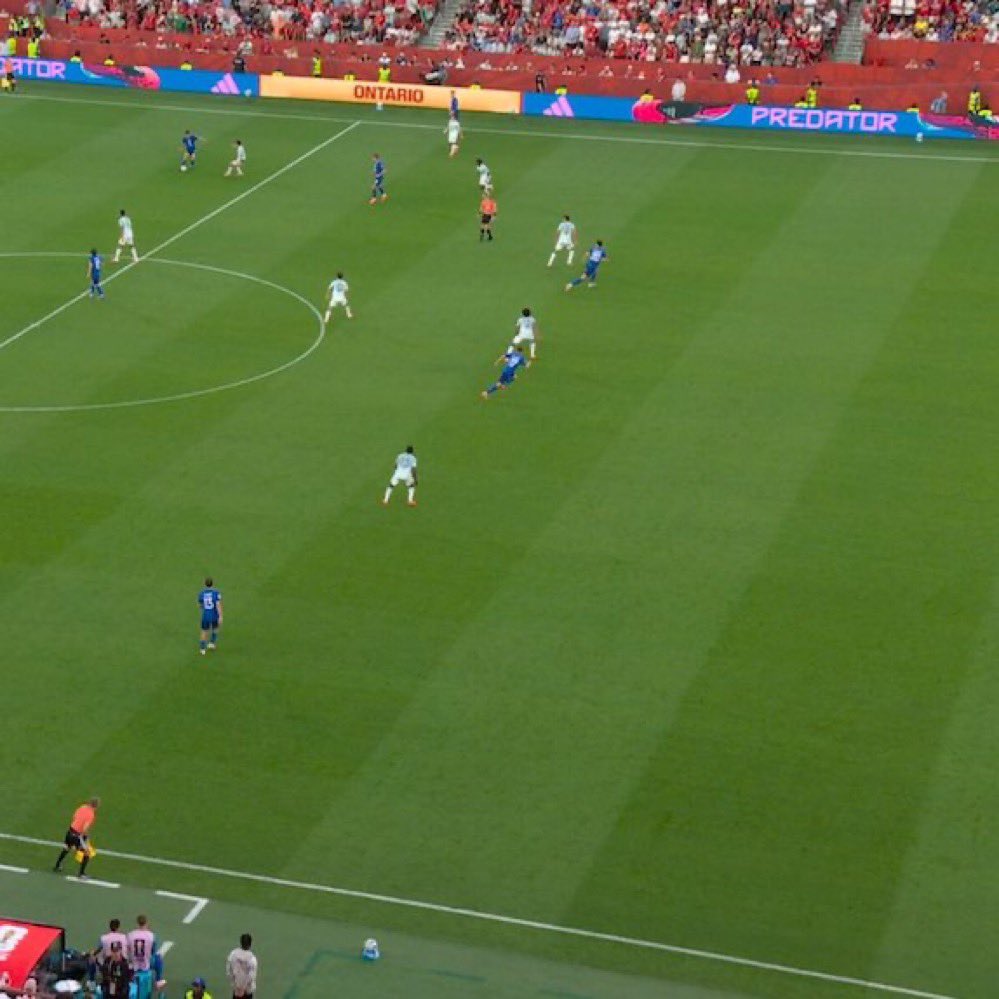
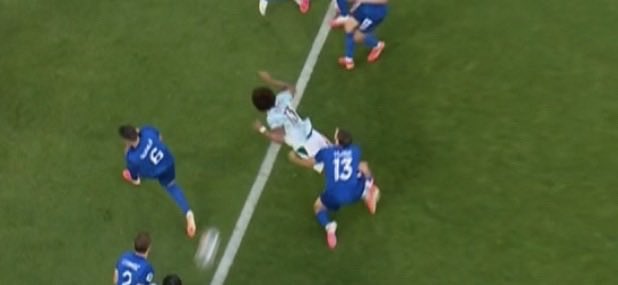
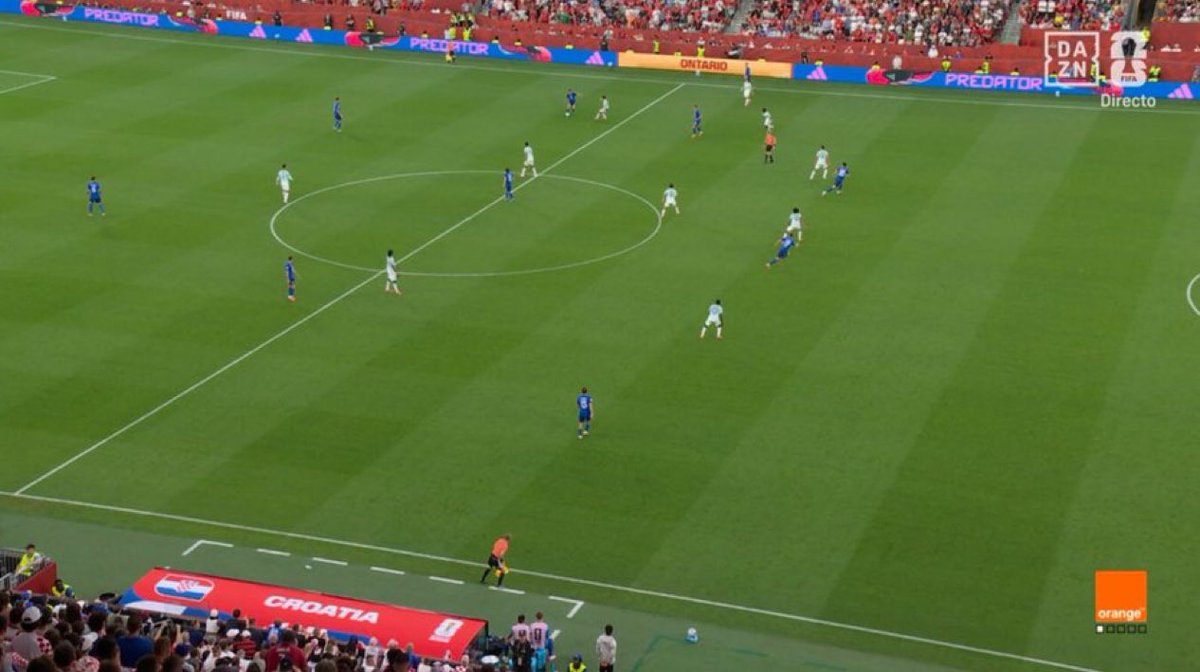
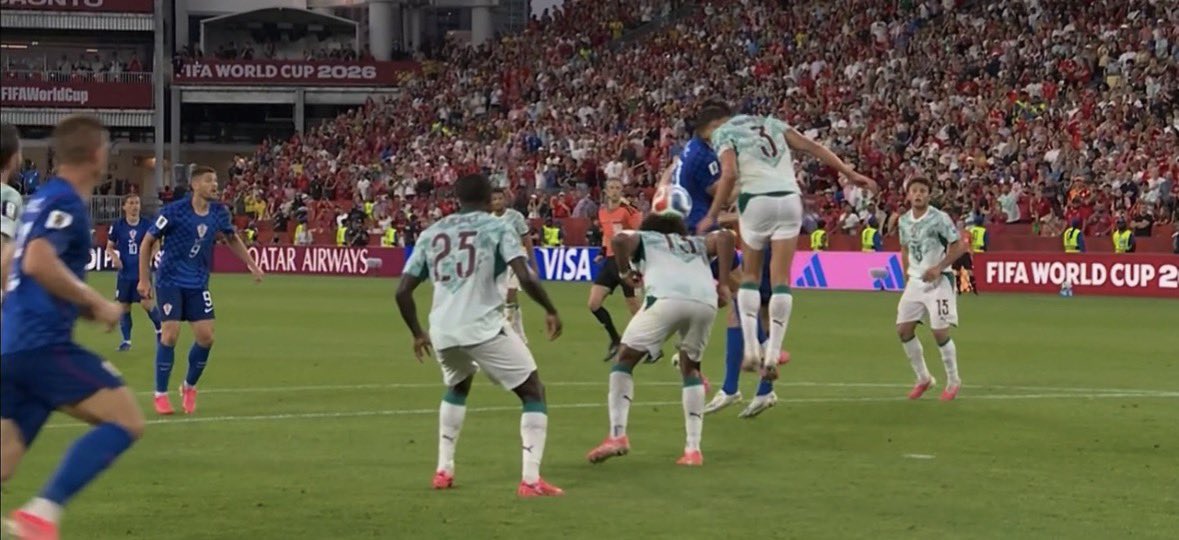
-they don't show another angle to see if the Croatian touches it
-The referee doesn't have to go check an Offside
-The Croatian never touches it and they don't show it in the VAR
HISTORIC ROBBERY TO CROATIA
Croatia completely shut CR7 and Bruno down, played better football, fought ‘til the death, equalized against all odds.
But it doesn’t matter.
FIFA always wins.
I cannot believe we have got to the point where a ball lightly touching the tips of someone’s hair is being measured by a Snickometer in order to disallow a goal.
The ball’s trajectory and spin were not affected at all.
The offside law was created to stop goal-hanging - it was never intended to be an exact science.
It was never created so that one day artificial intelligence could measure toenails offside and use a snicko to check if someone’s touched a ball.
It was created to stop strikers from man-marking goalkeepers all game.
VAR was meant to be reserved for clear and obvious decisions.
We used to understand that football is better and more entertaining when goals are scored.
That meant that for offsides: in case of doubt, the benefit was given to the attacker while in-line was always onside.
Now we’re using 3D generated AI technology to check toes to the millimetre and extreme microphones to measure minuscule decibels with the aim of disallowing goals and ruining football as a spectacle.
Do they ever ask if we want these changes, do they market test any of it?
What an extra time awaited us for the #Portugal v #Croatia game, unfortunately we will never get to see it thanks to the madness that VAR has descended into.
I have been watching football for more than 20 years, and believe me when I tell you this is the biggest robbery I’ve ever witnessed in a football match.
How do you call this offside?
FIFA releasing a statement proudly saying that their special ball technology picked up a tiny Croatian touch in the build up to their last goal v Portugal rendering it offside - makes that decision worse. They may as well release a statement proudly saying “we have invented an even more sophisticated way of ruining the game.”
The sensor (chip in the ball) is actually against FIFA rules
There was ABSOLUTELY no external force (significant contact) affecting the movement of the ball!
FIFA released a statement to clarify but forgot that they have a standing rule.
Disgrace!
@MatthuAsia Idk man but fifa needs to learn from ICC third umpire rules (basically VAR for cricket)
The final decision always favors the on field umpires call unless there is clear evidence to turn over the on field decision
All these off side by half a finger of half a players foot aint it
ROBO A CROACIA: Errores en física.
Si nos vamos a poner detallistas con el tema de los sensores de las pelotas, de si hubo un mínimo roce y aplicar el reglamento al milímetro, también tenemos que aplicar física al milímetro.
La pelota Trionda usa tecnología de balón conectado con un sensor de movimiento de 500 Hz que da información al VAR sobre movimiento/contactos del balón. Ese sensor no “ve” una cabeza: mide aceleraciones, rotaciones y patrones de movimiento. Por eso, si la pelota pasa muy cerca de una cabeza, puede haber perturbaciones aerodinámicas, vibraciones o ruido mecánico. En principio, eso puede generar una señal pequeña. Que el algoritmo la clasifique como contacto ya es otra cosa.
Si el sensor muestra una señal típica de impacto —pico brusco, alta frecuencia, cambio instantáneo de rotación o trayectoria, sincronizado con la posición de la cabeza—, entonces la anulación es defendible aunque en TV no se vea. Las cámaras tienen parallax, motion blur, pocos frames comparado con el sensor, y un contacto mínimo puede ser invisible.
Si el sensor solo muestra una oscilación ínfima y no hay cambio coherente de trayectoria, ni deformación, ni imagen compatible, ni firma de impacto, entonces NO se debe anular un gol. Ahí se estaría convirtiendo una herramienta probabilística en un oráculo.
A Croacia le anularon un empate tardío tras una revisión del VAR polémica vinculada a una detección marginal del balón. Una cosa es una señal clara de impacto; otra es un “blip” diminuto.
Sobre los árbitros: no necesitan ser físicos, pero sí deberían tener formación suficiente en limitaciones de medición, la cual OBVIAMENTE NO TIENEN. Un árbitro moderno que usa sensores, semiautomático, tracking 3D y VAR debería entender conceptos básicos: margen de error, falso positivo, calibración, umbral, sincronización temporal y diferencia entre dato bruto e interpretación algorítmica. Si no, termina pasando esto: la tecnología deja de asistir al arbitraje y empieza a reemplazar el juicio crítico.
En conclusión, no se ve contacto y el único argumento es “el sensor detectó un roce ínfimo” que, como ya mencioné, por el gráfico se puede ver que está mas relacionada a diferencias de presión en el aire al pasar cerca de una cabeza que por un toque con la misma (si la hubiera tocado se vería un pico muy alto y brusco en la imagen).
Se está usando tecnología muy avanzada con árbitros que no la saben comprender (ni el propio VAR). Ningún físico diría que ese gráfico muestra un toque.
En una jugada decisiva, la carga de la prueba debería ser altísima. Sensor sí, fe ciega en el sensor, NO.
The 3 controversial calls against Croatia:
1. The offside on Sucic.
2. The penalty dive by Veiga.
3. The offside on Matanovic.
This has to go down as one of the biggest scandals in World Cup history.
Portugal vs Croatia
The decision to disallow Joško Gvardiol’s late equalizer for Croatia against Portugal relies on a fundamentally flawed and contradictory interpretation of the rules of football. The official ruling states that a microscopic sensor spike inside the ball registered a touch from Igor Matanović, constituting a "pass" that put Mario Pašalić offside. This logic falls apart under intense scrutiny when evaluating intent, physics, and the game's established precedents.
1. Completely Clean Initial Onside Positioning
First and foremost, when Ivan Perišić initiated the original ball into the box, every single Croatian player was in a completely legal, onside position. The entire sequence built toward a legitimate scoring play. Stripping away a critical goal based on a microscopic, invisible inflection point later in the sequence violates the spirit of fair play.
2. Contradictory Logic Regarding Intent
The VAR interpretation relies on a paradox. The officials claim that the touch from Portugal defender Renato Veiga was "irrelevant" and a mere deflection because he was not the intended recipient and was oblivious to the ball hitting his back. Yet, they simultaneously label Igor Matanović's headbutt attempt as a "pass" to Mario Pašalić. Matanović was clearly making a direct attempt on goal, not trying to pass. If the referee rules that a player's deliberate intent does not matter for Matanović, they cannot logically turn around and use a lack of intent to excuse Veiga.
3. The Precedent of Defender Liability and the "Block"
Ruling that Renato Veiga's touch was irrelevant directly contradicts basic football rules regarding defensive liability. Consider an identical physical scenario on the pitch: an attacker fires a shot or cross full force at a defender who has his back turned and has no idea the ball is coming. If that ball hits the oblivious defender's back and goes out of bounds over the goal line, the attacking team is awarded a corner kick. The defender is held fully liable for the touch simply by taking up space on the field.
Veiga did not stand in the 18-yard box by happenstance; he placed himself there deliberately to block the path to the net and take up critical space. If the microchip dictates that Matanović's goal attempt counts as a conscious play on the ball, then Veiga's body placement must be counted as a defensive block.
4. A Loose Ball Interception, Not a Pass
Because Matanović's action was a clear attempt to score, the resulting collision with Veiga’s back was a physical block that completely disrupted the ball's original speed and trajectory. Once the ball deflected off a defender who was actively acting as a human shield, the phase of play changed. Mario Pašalić did not receive a calculated, deliberate pass from his teammate; he intercepted a loose ball resulting directly from a defender’s physical block. Therefore, no offside offense occurred, and Joško Gvardiol’s goal should have stood.
#croatia #portugal @FOXSports@barstoolsports
#fifa #portugalvscroatia
@FIFAWorldCup