Military and technology analyst. Fellow @BGCCIH. PhD from
@GWtweets. Previously @BelferCenter, @UofT.
Press inquiries: send a DM and include your email
@JohnH105 Thanks. One of the changes seen in Ы 80,000 concerns how the wing stabilizer is mounted. I'd be curious to know when Alabuga started doing this. The image in the quoted post below is from earlier this year of specimen 70,000 (with a different CRPA panel).
https://t.co/1vQEvNh634
🇷🇺🇺🇦 This may be the best publicly available image of an intact late model/recent production Alabuga-produced Geran-2 strike drone with the distinct central fuselage-mounted 16-element CRPA GNSS antenna. Recently displayed at an industrial exhibition in Tatarstan.
@JohnH105 They keep modifying the airframe (at the production line), and I am not referring to the nose-mounted sensor. Do you keep tabs on imagery of Ы series specimens?
@OneDadsFinance exactly do you have in mind as the maritime/naval threats? Russian or Chinese icebreakers or warships? Large ships are slow, generally no more than max 20-30 knots. Plenty of time to sortie aircraft w/ standoff munitions + PrSM has a small warhead/isn't going to sink large ships.
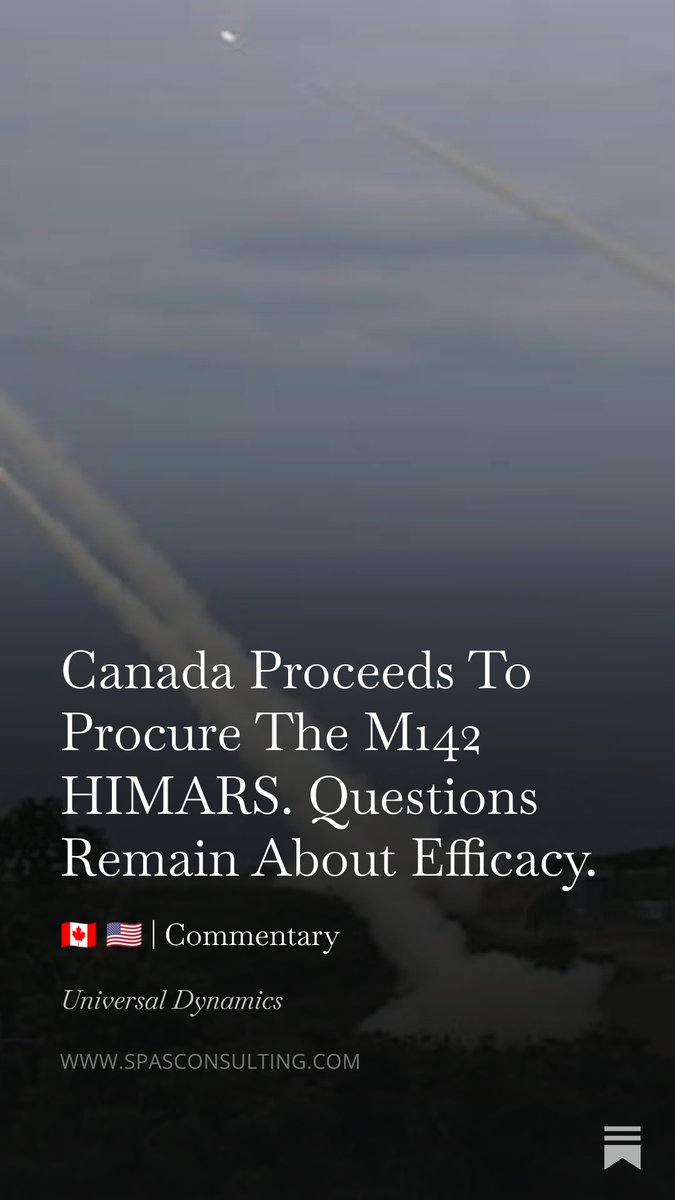
🇨🇦🇺🇸 Canada has placed an order for some number of M142 HIMARS launchers and associated munitions. Leaving aside how these are American-built, we are dealing with potent and proven systems. There are, however, major questions about the efficacy of this procurement choice in terms of the Canada-NATO angle. See the next post for the link. 1/
@OneDadsFinance The 800 km figure refers to R&D efforts to increase range, inc via ramjet. Extant is Incr. 1 is ~500 km. Directives can say anything, but someone - Canadian taxpayers - will have to pay the bill. If you can't fund it, you are wasting time even discussing it. Above all, what
@macrurdn There are enduring advantages to interoperability with the United States and European NATO allies operating American-built systems, including M142 HIMARS. Current tensions with DC notwithstanding, there is a whole world with TBD Canada-US relations after 20 January 2029.
@OneDadsFinance Did the DSCA notice indicate Canadian interest in ordering PrSM? How much of the Arctic can the extant baseline ~500 km range PrSM even cover? More to the point, what are the maritime/naval targets envisaged, and why is a PrSM-type capability better than air-delivered standoff?
@justinmassie1@NoahGairn Canada's security, not least on account of what little Canada offers can and should be covered by the more proximate/more skin in the game Euro NATO states themselves (including re HIMARS). There are many other ways to go about this that are a better deal for Canada & NATO itself
@justinmassie1@NoahGairn after all, NATO's "sanctuary" from which American mil power flows. Needless to say, Trump 2.0 took a very different turn re "51st state" etc. MNB-LVA is, in my view, contributing to NATO's (collective) security, but I am not of the view that it is a good investment for Canada and
@Njopling1 I can't speak to the details, and there are ofc multiple potential and plausible explanations re motives here. My piece focused on the unavoidable implications of sourcing reservists from this labour pool, and how it makes little sense in such terms unless the US invades Canada.
🇨🇦🇺🇸 This important issue has not been adequately addressed in public debate thus far. I have little doubt that NATO-Russia dynamics are primarily motivating proposals to expand Canada's military reserves, but some of the proposals only make sense if a hypothetical American invasion scenario is the primary concern. Hopefully, @Murray_Brewster, @davidpugliese, and others will press our elected representatives and CAF officials for clarification. I have gotten around to writing down my thoughts on the still pertinent issue of why the Canadian Armed Forces even considered targeting federal public servants for recruitment into the proposed 300,000-strong Supplementary Reserve. It makes a lot of sense if one is concerned about an American invasion, but otherwise makes little sense. A link can be found in the following post. 1/
A key issue not addressed here: for what specific purposes and threat scenarios do the Canadian Armed Forces need 85,500 regular force members, 100,000 primary reservists and 300,000 lightly trained citizen soldiers?
@HenryWi86212968 Trump is profoundly mercurial. That, coupled with an institutional matter, namely the increasingly unconstrained nature of the American executive branch, is primarily what makes him and his threats to Canada so dangerous, even though the threat of an invasion remains quite low.
I agree in terms of an all-out defence, which I do not consider to be either viable or prudent. There is nothing to romanticize about a "fight to the death," not least against a contiguous neighbour/invader with the capabilities and resources of the US. I do, however, think there are "insurance policies" that Ottawa should give serious consideration to (short of turning the GTA into an urban battlefield), but I've said about as much as I am comfortable saying in a public forum. We are fortunate to live in a society where most can blissfully remain aloof from such matters. That said, the threat environment has changed since January 2025, and I find myself frustrated with how such a gravely important issue receives so little in the way of serious attention.
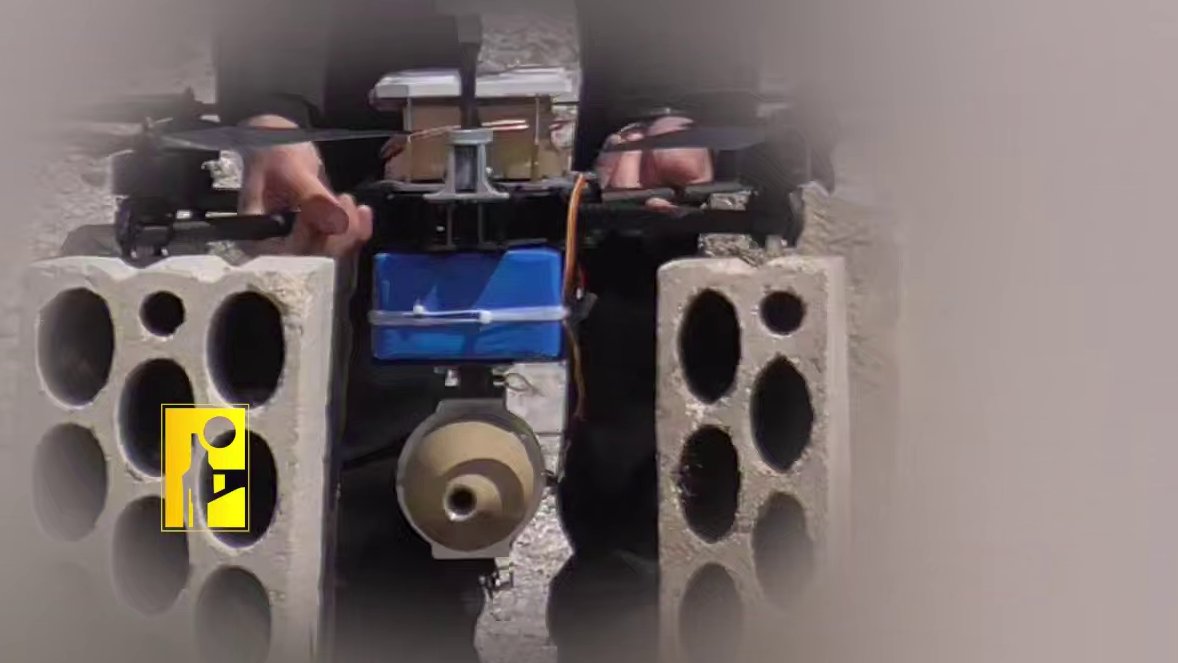
Lebanese Hezbollah published are many videos with strikes by FPV-drones against various Israeli vehicles, but IMHO these are first videos which shows the start of the FPV-drones.
@41646f6c66 The situation on the oil, natural gas/LNG, urea, fertilizer, helium, etc fronts demands the resumption of normal shipping traffic in the Persian Gulf. The Saudi and Emirati pipelines only allow some of the normal oil flows to bypass the Strait of Hormuz.
https://t.co/dXcneh2fY8
🇮🇷🇮🇱🇺🇸 On balance, Iran has likely benefited more from the several-day-long ceasefire, which may or may not hold given recent developments/comments by Vance. Access to Iran's underground military bases, including the underground military bases, has likely been at least partially restored; these underground bases have likely been at least partially resupplied; and Iran may well be ready for at least several weeks of "more of the same."
Meanwhile, the worldwide oil, natural gas/LNG, urea, fertilizer, heldium, etc., etc., physical supply shortages remain essentially unchanged since the start of the ceasefire, and the prospects for the world economy look bleaker. Following the world economy will likely be the American economy and, with that, Trump's/Republican prospects in the November 2026 midterm, which may well lead to the Democrats controlling Congress, initiating impeachment proceedings against Trump, and so forth. Someone will have to throw in the towel and call it quits. It may end up being Iran. It may well end up being Trump and the United States. To be determined.
🇮🇷🇮🇱🇺🇸 If I were in charge "in Tehran," and if I were "certain" that a return to full-scale war was inevitable in the coming days, I would (try to) strike first. An Iran that attempts to strike first may be able to launch one or more salvos before American and Israeli, and perhaps Gulf Arab, combat aircraft return to the skies above Iran (all such aircraft will transit toward Iran at a high subsonic speed). Iran may even catch some American aircraft, among others, on the ground at places including but not limited to Muwaffaq as-Salti airbase in Jordan. As always, Iran's propeller-driven strike drones are much slower than its cruise missiles, let alone its ballistic missiles, so it will be difficult to coordinate "complex strikes" without giving the United States, Israel, and others early warning.
Again, if I were in charge "in Tehran," and if I were "certain" that a return to full-scale war was inevitable in the coming days, I would climb up the escalation ladder on the oil and gas front. At this stage of the conflict, it is not enough to merely damage oil and gas infrastructure via harassment/nuisance-level strikes. The damage must be lasting, if not more or less permanent, in the manner that Iran wreaked upon Ras Laffan. Similar things can be said about taking other forms of infrastructure offline, including but not limited to large international airports.
It is important to bear in mind that Trump will likely climb the escalation himself so as to bring Iran to heel as soon as possible. There are major first-strike incentives at play for Iranian decision-makers, incentives that are not, of course, without very major and very grave risks. War is ultimately a negotiation through violence. We are well beyond platitudes in this war. It goes without saying that Iran will likely face reciprocal strikes, perhaps from the Gulf Arabs. Such is life, and this war will likely end up being determined by who has the greatest appetite to suffer and sustain losses, not merely inflict violence upon the other.
To be determined.
🇮🇷🇮🇱🇺🇸 On balance, Iran has likely benefited more from the several-day-long ceasefire, which may or may not hold given recent developments/comments by Vance. Access to Iran's underground military bases, including the underground military bases, has likely been at least partially restored; these underground bases have likely been at least partially resupplied; and Iran may well be ready for at least several weeks of "more of the same."
Meanwhile, the worldwide oil, natural gas/LNG, urea, fertilizer, heldium, etc., etc., physical supply shortages remain essentially unchanged since the start of the ceasefire, and the prospects for the world economy look bleaker. Following the world economy will likely be the American economy and, with that, Trump's/Republican prospects in the November 2026 midterm, which may well lead to the Democrats controlling Congress, initiating impeachment proceedings against Trump, and so forth. Someone will have to throw in the towel and call it quits. It may end up being Iran. It may well end up being Trump and the United States. To be determined.
🇮🇷🇵🇰🇸🇦🇺🇸 There is a wrinkle in the Persian Gulf theatre of this war: Pakistan, which has a formal military alliance with Saudi Arabia, has deployed combat aircraft to Dhahran/King Abdulaziz airbase, which is situated near Bahrain and along the Persian Gulf coast. I expect Pakistan's role to be limited to air-to-air missions and intercepting Iranian cruise missiles and strike drones. Even so, Iranian planners now have to account for the presence of Pakistani military personnel and aircraft.
تُعلن #وزارة_الدفاع عن وصول قوة عسكرية من جمهورية باكستان الإسلامية إلى قاعدة الملك عبدالعزيز الجوية بالقطاع الشرقي ضمن اتفاقية الدفاع الإستراتيجي المشترك الموقعة بين البلدين الشقيقين.
وتتكون القوة الباكستانية من طائرات مقاتلة ومساندة تابعة للقوات الجوية الب��كستانية، بهدف تعزيز التنسيق العسكري المشترك، ورفع مستوى الجاهزية العملياتية بين القوات المسلحة في البلدين، وبما يدعم الأمن والاستقرار على المستويين الإقليمي والدولي.