🚨 U.S. forces release footage of ATACMS missiles being launched from Kuwait 🇰🇼 toward #Iran.
This is how Washington wants to drag Iran and the Gulf states into a mutual war of attrition, after it and Israel had already been in a state of attrition. This is how the U.S. wants a long-term war of attrition that paves the way for handing over the banner and the Strait to Israel 🇮🇱. And the fact that Iranian missiles are landing in Kuwait, Bahrain, Qatar, and Jordan is not a sign of U.S. weakness—it is a dirty American ploy.
Stay tuned for the next analysis: How the U.S. turned the Memorandum of Understanding into a repositioning strategy, how it devised the trap of authorizing the administration of the Strait through Article V, and how it managed to change the nature and objective of the war to turn it into a conflict between Iran and the Gulf states that refused to enter the war.
And how Israel 🇮🇱 and Abu Dhabi 🇦🇪 now stand safe, while the countries that refused to join forces with Israel in a single operations room have found the war becoming their own. Meanwhile, the countries that fought Iran—or pretended to wage a phony war against Iran—are now left watching this dirty game unfold.
America is a tool for Israel, and any war will serve only to achieve Israel’s objectives. Stay tuned for the analysis 🦅🔥
Iranian retaliatory attacks are causing a rise in US military casualties, after the US bombed Iran for an eighth night in a row.
Middle East analyst Ross Harrison says Trump’s war lacks any real strategic logic.
🚨 What is the connection between the targeting of bridges in Iran and the official narrative? Are there nuclear weapons hidden under these bridges?
No. What is happening has nothing to do with a nuclear program. What is happening is an obsession with controlling the Strait of Hormuz and imposing fees and costs on ships. The goal of Trump and Israel is to control the Strait. They are the ones who planted the illusion in Iran that it has the right to manage it under Article 5 of the Memorandum of Understanding — which pushed Tehran to take a risk, only to be struck afterward. The targeted bridges are not military. And anyone who believes this course will lead to the overthrow of the regime is delusional. 🦅🔥
قام جندي أمريكي أحمق بالتقاط فيديو يظهر مكان إطلاق صواريخ أمريكية على إيران من الكويت ونشره، ظنًا منه أنه من المستحيل تحديد موقعه الجغرافي.
استغرق الأمر حوالي ساعة.
تعرضت المنطقة لوابل من الصواريخ الباليستية الإيرانية قصيرة المدى.
Before Dangote…
there was another king of wealth...
Bookmark this and watch later. The fascinating story of the man who was once the richest Nigerian before Aliko Dangote took the crown.
There is simply no justification for the United States pushing through vessels along the Omani coastline in the Strait of Hormuz. You can cry and scream about "freedom of navigation", but at the end of the day, the Memorandum of Understanding was very clear that Iran would control the traffic through the Strait of Hormuz during the initial 60-day window.
Time and time again, the United States has shredded the MOU by attempting to retroactively alter the terms because they didn't "like them". Of course you didn't like them. They suck... because you LOST.
Oil sanction waivers a la Article 10? Torched.
No new sanctions a la Article 9? Blown up.
Iranian administration of traffic a la Article 5? Nope.
You can whine all day long about how it's "wrong" for Iran to strike those vessels, but this is a rational response to a war of choice from the United States. You don't get to claim "right vs. wrong" when the Trump Administration is solely to blame for this situation in the first place. The Strait of Hormuz was open before this war started.
The REASON that the United States was attempting an Operation Freedom 2.0 along the Omani Route was BECAUSE they were trying to actively undermine the Iranian control of the Strait. They were trying to actively push through enough vessels in a short enough period of time to shift the strategic landscape of the conflict.
I have seen time and time again people claim, "Iran doesn't know what's best for them. If they just didn't strike vessels, they would get massive sanctions relief"... No, they wouldn't. Because President Trump and the United States had no INTENTION of sticking to the MOU. The goal was to use this 60-day window to shift the landscape so that they could topple the regime or secure outcomes they could not have in the initial MOU.
This isn't "the US operating in good faith and those pesky Iranians messed everything up".
This is the United States blatantly trying to unilaterally alter the terms of the MOU by shredded the oil waivers, sanctioning new entities, and pushing vessels through the Omani Route.
این متن، بازتاب صدای ملتی است که عزت و استقلال خود را با هیچ تهدید و فشاری معامله نکرد.
آنچه امروز به ثبت رسید، نتیجه استقامت ملی، عقلانیت سیاسی و دیپلماسی مسئولانه بود.
این یک سند تاریخی و پیامی از ایران مقتدر است: صلح در سایه احترام متقابل تحقق خواهد یافت.
جمهوری اسلامی ایران به صلح جهانی با حفظ عزت و استقلال، پیشرفت و همکاری منطقهای همواره متعهد و پایبند است.
🇺🇸🇮🇷 BREAKING!!!! The White House has released the full text of 14-point MoU
The points summarised are as follows:
1. The U.S. and Iran, and their allies in the current war, by signing this MoU, declare the immediate and permanent termination of military operations on all fronts, including in Lebanon, and undertake from now on not to initiate any war or any military operation against each other, and to refrain from the threat or use of force against each other, and ensuring the territorial integrity and sovereignty of Lebanon.
2. The U.S. and Iran will respect each other's sovereignty and territorial integrity and refrain from interfering in each other's internal affairs.
3. The U.S. and Iran commit to achieving a final deal in a maximum of 60 days, extendable with mutual consent.
4. The U.S. will immediately begin the removal of its naval blockade and any disturbances or impediments against Iran, and will fully end the naval blockade within 30 days. During this period, the traffic will be in proportion to the number of pre-war traffic being restored by Iran. The U.S. further undertakes to remove its military forces from the proximity of Iran within 30 days after the final deal.
5. Iran will make arrangements for the safe passage of commercial vessels with no charge for 60 days from the Persian Gulf to the Sea of Oman, and vice versa. The traffic of commercial vessels will immediately start, considering the need for removing the technical and military obstacles and demining, within 30 days. Iran will conduct a dialogue with Oman to define the future administration and maritime services in the Strait of Hormuz in discussion with other Persian Gulf littoral states in line with international law and the sovereign rights of coastal states of the Strait of Hormuz.
6. The U.S. undertakes with its regional partners to develop a definitive, mutually agreed plan with at least USD 300 billion for the reconstruction and economic development of Iran, as part of the final deal after 60 days. All required licenses, waivers, and permissions will be granted.
7. The U.S. will terminate all types of sanctions against the Islamic Republic of Iran, including the UNSC resolutions, IAEA Board of Governors resolutions, and all unilateral US sanctions, primary and secondary, in an agreed-upon schedule as part of the final deal.
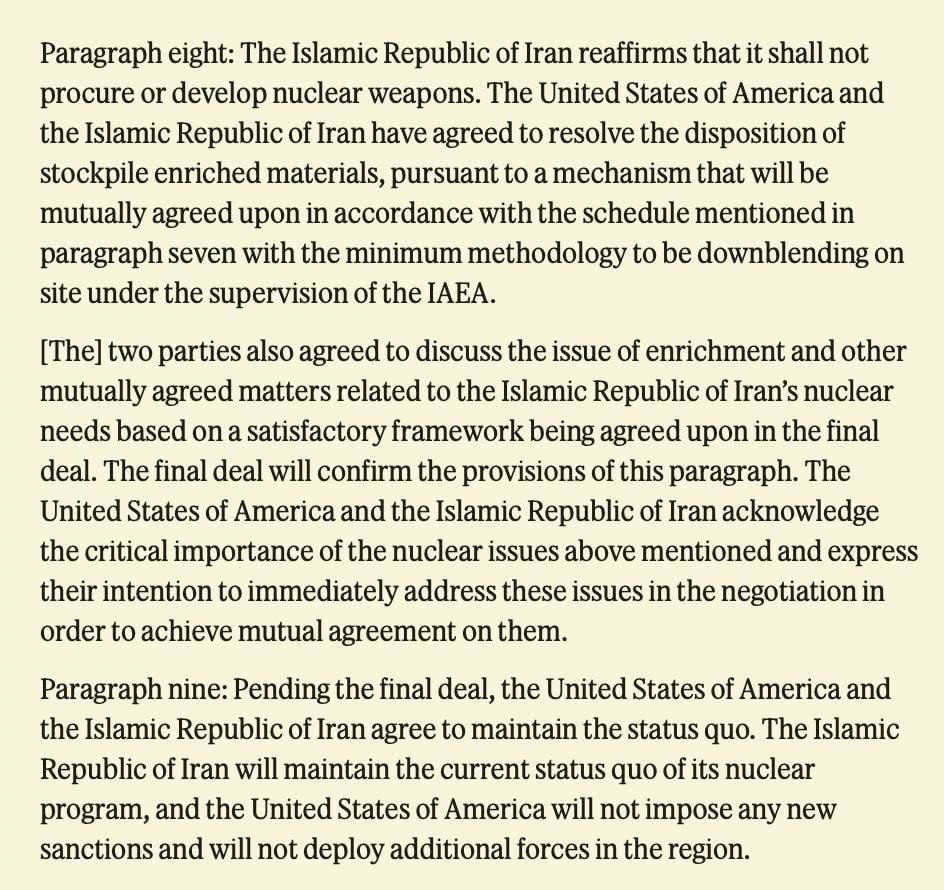
8. Iran reaffirms that it shall not procure or develop nuclear weapons. The U.S. and Iran have agreed to resolve the disposition of stockpile enriched materials, pursuant to a mechanism that will be mutually agreed upon in accordance with the schedule mentioned in paragraph seven, with at a minimum a downblending on site under the supervision of the IAEA. The two parties also agreed to discuss the issue of enrichment and other mutually agreed matters related to Iran's nuclear needs.
9. Pending the final deal, the U.S. and Iran agree to maintain the status quo. Iran will maintain the current status quo of its nuclear program, and the U.S. will not impose any new sanctions and will not deploy additional forces in the region.
10. The U.S. undertakes that immediately upon the signing of this MoU, waivers will be issued for the export of Iranian crude oil, petroleum products, and derivatives, and all associated services, including banking transactions, insurances, transportation, etc.
11. The U.S. undertakes to make fully available for use the frozen or restricted funds of the Islamic Republic of Iran upon the implementation of this MoU. The U.S. and Iran will mutually agree on the procedures related to the release of these funds during the negotiations.
12. A monitoring mechanism will be established to supervise the implementation of this MoU and the subsequent deal.
13. After signing this MoU and subject to the beginning of the implementation of paragraphs 1, 4, 5, 10, and 11, and the continuing implementation of these measures, the U.S. and Iran will start negotiations regarding the final deal.
14. The final deal will be endorsed by a UNSC Resolution.
🇺🇸🇮🇷 White House released full text of the MoU
The points summarised are as follows:
1. The U.S. and Iran, and their allies in the current war, by signing this MoU, declare the immediate and permanent termination of military operations on all fronts, including in Lebanon, and undertake from now on not to initiate any war or any military operation against each other, and to refrain from the threat or use of force against each other, and ensuring the territorial integrity and sovereignty of Lebanon.
2. The U.S. and Iran will respect each other's sovereignty and territorial integrity and refrain from interfering in each other's internal affairs.
3. The U.S. and Iran commit to achieving a final deal in a maximum of 60 days, extendable with mutual consent.
4. The U.S. will immediately begin the removal of its naval blockade and any disturbances or impediments against Iran, and will fully end the naval blockade within 30 days. During this period, the traffic will be in proportion to the number of pre-war traffic being restored by Iran. The U.S. further undertakes to remove its military forces from the proximity of Iran within 30 days after the final deal.
5. Iran will make arrangements for the safe passage of commercial vessels with no charge for 60 days from the Persian Gulf to the Sea of Oman, and vice versa. The traffic of commercial vessels will immediately start, considering the need for removing the technical and military obstacles and demining, within 30 days. Iran will conduct a dialogue with Oman to define the future administration and maritime services in the Strait of Hormuz in discussion with other Persian Gulf littoral states in line with international law and the sovereign rights of coastal states of the Strait of Hormuz.
6. The U.S. undertakes with its regional partners to develop a definitive, mutually agreed plan with at least USD 300 billion for the reconstruction and economic development of Iran, as part of the final deal after 60 days. All required licenses, waivers, and permissions will be granted.
7. The U.S. will terminate all types of sanctions against the Islamic Republic of Iran, including the UNSC resolutions, IAEA Board of Governors resolutions, and all unilateral US sanctions, primary and secondary, in an agreed-upon schedule as part of the final deal.
8. Iran reaffirms that it shall not procure or develop nuclear weapons. The U.S. and Iran have agreed to resolve the disposition of stockpile enriched materials, pursuant to a mechanism that will be mutually agreed upon in accordance with the schedule mentioned in paragraph seven, with at a minimum a downblending on site under the supervision of the IAEA. The two parties also agreed to discuss the issue of enrichment and other mutually agreed matters related to Iran's nuclear needs.
9. Pending the final deal, the U.S. and Iran agree to maintain the status quo. Iran will maintain the current status quo of its nuclear program, and the U.S. will not impose any new sanctions and will not deploy additional forces in the region.
10. The U.S. undertakes that immediately upon the signing of this MoU, waivers will be issued for the export of Iranian crude oil, petroleum products, and derivatives, and all associated services, including banking transactions, insurances, transportation, etc.
11. The U.S. undertakes to make fully available for use the frozen or restricted funds of the Islamic Republic of Iran upon the implementation of this MoU. The U.S. and Iran will mutually agree on the procedures related to the release of these funds during the negotiations.
12. A monitoring mechanism will be established to supervise the implementation of this MoU and the subsequent deal.
13. After signing this MoU and subject to the beginning of the implementation of paragraphs 1, 4, 5, 10, and 11, and the continuing implementation of these measures, the U.S. and Iran will start negotiations regarding the final deal.
14. The final deal will be endorsed by a UNSC Resolution.
Lies detected 🤗🤗
2010: “Not only that I will never leave APGA, we will die with APGA.” — PitObi
2026: “I didn’t say I will never leave APGA; I only told Ojukwu I would never leave APGA as long as you are alive.” — PitObi
Abeg which church does Agulu lying fraud worship? 👀
Xenophobic and Afrophobic South Africans shut down a Nigerian man’s business in South Africa despite the fact that he had all the necessary legal documentation, paid taxes, employed 25 South Africans, and had lived in the country for 13 years.
🇺🇸🇮🇷 The Iran-U.S. Memorandum of Understanding: Full Details
Phase 1 | Upon announcement of the MoU (effective immediately):
– Upon announcement of the MoU, both sides declare an immediate, complete and permanent end to all hostilities in the region, including Lebanon.
– Upon announcement of the MoU, the United States declares the immediate and complete lifting of the U.S. naval blockade against Iran.
Phase 2 | After Signing of the MoU (30-day period):
– Upon signing the MoU, the United States confirms its commitment to non-interference in Iran’s domestic affairs and respect for the sovereignty of the Islamic Republic of Iran.
– Upon signing the MoU, the United States affirms that it will not increase the amount of troops or military assets present in the region, nor impose any new sanctions during the negotiations.
– Upon signing the MoU, Iran reaffirms its commitment to the Non-Proliferation Treaty (NPT) and confirms that it will never produce, develop, or acquire a nuclear weapon.
– Upon signing the MoU, the United States declares that it will provide Iran with half of its frozen funds, amounting to a value of $12 Billion, to be made available in a non-reversible manner within 30 days, with a commitment to make the remaining half available during the subsequent 60 days.
– Upon signing the MoU, the United States will issue sanctions waivers for Iranian oil, gas, and petrochemical exports, effective immediately, with a commitment to extend these waivers permanently once a final agreement is reached.
– Upon signing the MoU, the U.S. will begin immediate consultations with Israel to present a short term timeframe for a full Israeli withdrawal from Lebanon, including points occupied following the 2024 Israel-Hezbollah agreement.
– Upon signing the MoU, Iran confirms it will reopen the Strait of Hormuz to commercial maritime traffic, according to certain specified arrangements determined by Iran, within 30 days.
Phase 3 | Negotiations on a Final Deal (60-day period + possible extension):
– The 60-day negotiating period will begin once all the terms of the MoU have been met in the previous 30 days.
– The 60-day negotiating period can be extended by mutual agreement of both parties.
– During these 60 days, the U.S. will make the remaining $12 Billion of Iran’s frozen assets available.
– During these 60 days, the U.S. will present plans for a reconstruction fund for Iran, amounting to a value of at least $300 Billion, funded partially by Gulf states.
– The U.S. and Iran will begin detailed discussions on a permanent solution to nuclear-related matters, including enrichment, the existing uranium stockpile, and the fate of the nuclear sites.
– The U.S. and Iran will begin detailed discussions regarding the lifting of all economic sanctions on Iran, including primary, secondary, U.S. and UN sanctions, as well as the withdrawal of all UN Security Council and IAEA Board of Governors resolutions against Iran.
– A monitoring mechanism will be established to supervise the implementation of a final agreement.
– The final agreement will be approved by a UN Security Council Resolution.
@Middle_East_Spectator
Sudanese influencer Amjad Al-Nour drops a viral satirical song, pretending to be Israel’s “sugar daddy,” sending cash, spreading fake news, and using veto power to save them.
The fact that it’s all true is the most embarrassing part