Associate Technical Director at viu | Founder - JavaScripters & IxDF Pune Community Leader | UI/UX Strategist | Frontend Architect | Community Builder | 🇮🇳
AI Is No Longer Optional for Leaders. It's the New Productivity Sidekick. 🚀
A few years ago, leaders were expected to rely primarily on experience, intuition, and team discussions to make decisions.
Today, the pace of business has changed.
Information moves faster.
Decisions happen quicker.
Expectations are higher.
The leaders who are thriving are not replacing their judgment with AI.
They're amplifying it.
Over the last year, I've seen AI significantly reduce the time spent on repetitive tasks, allowing leaders to focus on what truly matters: strategy, people, innovation, and business outcomes.
Here are a few practical ways leaders can start leveraging AI today:
🧰 Choose the right tools
• ChatGPT / GPT-5 for brainstorming, strategic thinking, and first drafts
• Notion AI for knowledge management and meeting summaries
• Microsoft Copilot or Google Gemini for documents, presentations, and emails
• https://t.co/JVtbEQSj8n for accurate meeting transcriptions
📋 High-impact leadership use cases
• Prepare executive briefs in minutes
• Generate pros and cons before key decisions
• Summarize lengthy meetings and action items
• Draft routine communications faster
• Simulate stakeholder questions before important presentations
✅ What works best
• Write clear prompts
• Always verify critical information
• Create reusable prompt templates
• Stick to 2–3 core AI tools
• Keep human judgment for final decisions
The biggest mistake I see?
Many leaders are waiting for the "perfect AI strategy."
Instead, start with one workflow this week.
Measure the time saved.
Refine the process.
Scale what works.
Leadership isn't being replaced by AI.
Leadership is being enhanced by leaders who know how to use AI effectively.
What is one leadership task you would happily delegate to AI today?
👇 Share your thoughts in the comments.
👉 Follow for more insights on AI, Technology Leadership, Product Thinking, UX, and Digital Transformation
👉 https://t.co/z9IlICMoi6
#Leadership #ArtificialIntelligence #AI #Productivity #FutureOfWork #TechnologyLeadership #DigitalTransformation #Innovation #ExecutiveLeadership #AIDriven
🚀 AI Tokens Explained Like a Mobile Data Plan
Most professionals obsess over which AI model to use.
Very few understand what actually drives their AI costs.
The real answer?
👉 Tokens.
Think of AI tokens like your mobile data plan.
Every time you use AI, you're consuming data.
📥 Input Tokens
These are the words, documents, instructions, and prompts you send to the AI.
The longer your prompt, the more input tokens you consume.
📤 Output Tokens
These are the words the AI generates in response.
Longer answers = more output tokens.
Interestingly, output tokens often cost more than input tokens. (FinOps)
🧠 Context Window
Think of this as the AI's memory capacity.
A larger context window allows the model to remember more information during a conversation, document analysis, or coding session. (Coursera)
💰 Why AI Costs Increase
Many people blame the model.
But in reality:
• Longer prompts
• Large documents
• Excessive conversation history
• Repeated instructions
• Long AI-generated responses
All increase token consumption and cost. (Braintrust)
🎯 How Prompts Impact Spending
Prompt A:
"Summarise this report."
Prompt B:
"Act as a senior management consultant. Analyse the attached 50-page report, compare it with industry benchmarks, identify risks, opportunities, and provide a detailed action plan."
Same model.
Very different token usage.
The lesson?
Before upgrading to a more expensive AI model, optimise your prompts first.
Better prompts often save more money than switching models.
💡 Did you know tokens affect AI cost more than model selection in many real-world AI workflows?
Share your answer in the comments.
👉 Follow for more insights
👉 https://t.co/z9IlICMoi6
#ArtificialIntelligence #GenerativeAI #AI #ChatGPT #ClaudeAI #PromptEngineering #AITools #MachineLearning #TechLeadership #AIConsulting #ProductLeadership
Most companies don’t have a technology problem.
They have an alignment problem.
Modern organizations already invest heavily in:
* cloud infrastructure
* AI tools
* engineering platforms
* automation
* modern frameworks
* digital transformation initiatives
Yet many teams still struggle with:
* delayed execution
* roadmap confusion
* platform fragmentation
* delivery inefficiencies
* constant escalations
* disconnected priorities
Why?
Because engineering, product, business, and leadership teams are often moving in different directions.
Technology alone cannot solve organizational misalignment.
AI cannot fix:
* unclear ownership
* silo-driven execution
* conflicting priorities
* poor communication
* fragmented decision-making
* lack of shared outcomes
High-performing organizations are not successful only because they have better technology.
They succeed because they align:
* people
* platforms
* priorities
* customer experience
* product strategy
* engineering execution
The future of engineering leadership is becoming deeply cross-functional.
Leaders who can connect business goals with platform thinking, engineering execution, and AI-enabled experiences will create the biggest impact.
Because scalable technology without organizational alignment only creates scalable confusion.
What do you think creates the biggest alignment challenge inside modern organizations today?
#EngineeringLeadership #DigitalTransformation #AI #TechnologyLeadership #ProductEngineering
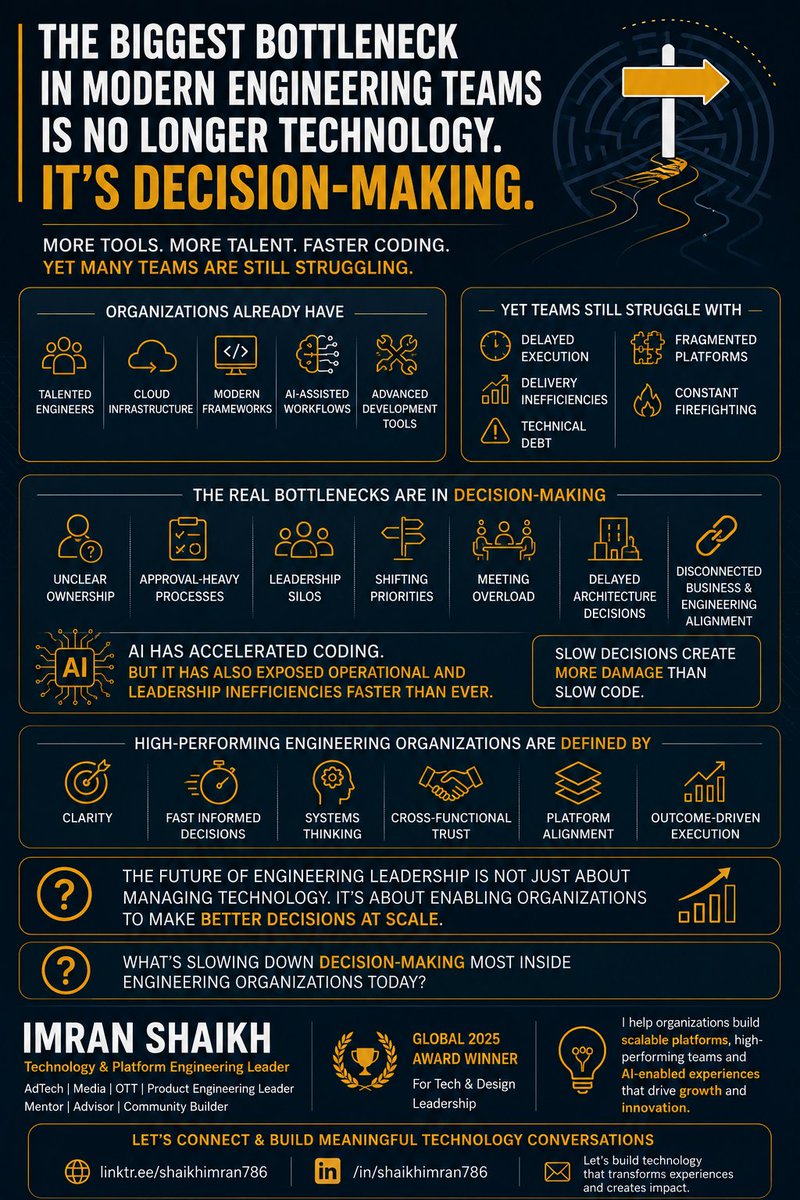
The biggest bottleneck in modern engineering teams is no longer technology.
It’s decision-making.
Most organizations already have:
* talented engineers
* modern frameworks
* cloud infrastructure
* AI-assisted workflows
* advanced development tools
Yet many teams still struggle with:
* delayed execution
* delivery inefficiencies
* technical debt
* fragmented platforms
* constant firefighting
Why?
Because engineering speed means very little when decisions move slowly.
In many organizations, the real bottlenecks are:
* unclear ownership
* approval-heavy processes
* leadership silos
* shifting priorities
* meeting overload
* delayed architecture decisions
* disconnected business and engineering alignment
AI has accelerated coding.
But it has also exposed operational and leadership inefficiencies faster than ever.
High-performing engineering organizations are not defined only by technical capability.
They are defined by:
* clarity
* fast informed decisions
* systems thinking
* cross-functional trust
* platform alignment
* outcome-driven execution
The future of engineering leadership is not just about managing technology.
It’s about enabling organizations to make better decisions at scale.
Because in modern digital ecosystems, slow decisions create more damage than slow code.
What’s slowing down decision-making most inside engineering organizations today?
#EngineeringLeadership #AI #TechnologyLeadership #DigitalTransformation #ProductEngineering
AI increased engineering speed.
But did it improve engineering quality?
That’s the question many organizations are still avoiding.
Today, teams can generate code faster than ever using AI-assisted workflows.
But faster development does not automatically mean:
* better architecture
* sustainable systems
* cleaner scalability
* stronger engineering decisions
* improved customer experience
In many organizations, AI adoption is accelerating delivery speed while silently increasing:
* technical debt
* fragmented implementations
* inconsistent patterns
* shallow system understanding
* operational complexity
The real risk is not AI itself.
The real risk is adopting AI without evolving engineering leadership, governance, and systems thinking.
Future-ready engineering organizations will not compete only on coding velocity.
They will compete on:
* engineering effectiveness
* architectural clarity
* platform resilience
* AI governance
* cross-functional alignment
* long-term scalability
Because in the AI era, sustainable engineering matters more than rapid engineering.
The organizations that balance speed with quality will lead the next generation of digital platforms.
How is your organization balancing AI-driven productivity with long-term engineering quality?
#AI #EngineeringLeadership #ProductEngineering #DigitalTransformation #TechnologyLeadership
Frontend Engineering is no longer just about building interfaces.
The industry has quietly shifted from “Frontend Development” to “Product Engineering”.
And many organizations still haven’t realized it.
Modern engineering teams are now expected to think beyond screens and components.
Today’s engineers influence:
• Customer experience
• Platform scalability
• Performance and observability
• AI-driven workflows
• Business outcomes
• Experimentation and personalization
• Accessibility and digital trust
This shift is becoming even more visible in AI-first product ecosystems.
AI tools can accelerate coding.
But they cannot replace:
• Product thinking
• System design decisions
• Human experience understanding
• Engineering judgment
• Cross-functional collaboration
The engineers creating the highest impact today are not just implementing tickets.
They are solving business problems through technology, platform thinking, and user experience understanding.
That’s why I believe the future belongs to Product Engineers and Experience Engineering leaders who can bridge:
* technology
* scalability
* customer experience
* AI transformation
* business impact
The role of engineering leadership is also evolving rapidly.
Organizations now need leaders who can connect platforms, people, products, and AI-enabled experiences together.
This transition is already happening across AdTech, OTT, SaaS, MediaTech, and digital platforms globally.
The question is no longer:
“How good are we at coding?”
The real question is:
“How effectively can we build scalable digital experiences that create measurable impact?”
How do you see this shift evolving inside your organization?
#EngineeringLeadership #ProductEngineering #AI #AdTech #DigitalTransformation
Regard's
Imran Shaikh
Global 2025 Award Winner for Tech & Design Leadership | Advisor & Mentor
https://t.co/z9IlICMoi6
Frontend Engineering is no longer just about building interfaces.
The industry has quietly shifted from “Frontend Development” to “Product Engineering”.
And many organizations still haven’t realized it.
Modern engineering teams are now expected to think beyond screens and components.
Today’s engineers influence:
• Customer experience
• Platform scalability
• Performance and observability
• AI-driven workflows
• Business outcomes
• Experimentation and personalization
• Accessibility and digital trust
This shift is becoming even more visible in AI-first product ecosystems.
AI tools can accelerate coding.
But they cannot replace:
• Product thinking
• System design decisions
• Human experience understanding
• Engineering judgment
• Cross-functional collaboration
The engineers creating the highest impact today are not just implementing tickets.
They are solving business problems through technology, platform thinking, and user experience understanding.
That’s why I believe the future belongs to Product Engineers and Experience Engineering leaders who can bridge:
* technology
* scalability
* customer experience
* AI transformation
* business impact
The role of engineering leadership is also evolving rapidly.
Organizations now need leaders who can connect platforms, people, products, and AI-enabled experiences together.
This transition is already happening across AdTech, OTT, SaaS, MediaTech, and digital platforms globally.
The question is no longer:
“How good are we at coding?”
The real question is:
“How effectively can we build scalable digital experiences that create measurable impact?”
How do you see this shift evolving inside your organization?
#EngineeringLeadership #ProductEngineering #AI #AdTech #DigitalTransformation
Regard's
Imran Shaikh
Global 2025 Award Winner for Tech & Design Leadership | Advisor & Mentor
https://t.co/z9IlICMoi6
🚀 Turn Your Passion into Paycheck with IxDF - Interaction Design Foundation!
If you’ve been thinking about joining the Interaction Design Foundation (IxDF) or renewing your membership, here’s your chance to enjoy a special referral discount!
Imran has personally invited you to get a 3 months discount on your yearly membership to kickstart your journey with us.
🔗 Use my referral link: https://t.co/WxFL7M4HWb
Why join IxDF? As a member, you get:
✅ Access to 150+ UX/UI courses by top industry experts
✅ Membership in a global community of designers
✅ Exclusive webinars, talks, and workshops
✅ Networking opportunities with mentors, peers, and leaders
✅ Certification to enhance your professional profile
💡 Don’t wait! If you’ve been looking for a referral link, your search ends here. Take membership now and start transforming your design passion into real impact.
#UXDesign #InteractionDesign #IxDFPune #IxDFIndia #IxDF #DesignCommunity #ProfessionalGrowth #ReferralDiscount
🚀 Turn Your Passion into Paycheck with IxDF - Interaction Design Foundation!
If you’ve been thinking about joining the Interaction Design Foundation (IxDF) or renewing your membership, here’s your chance to enjoy a special referral discount!
Imran has personally invited you to get a 3 months discount on your yearly membership to kickstart your journey with us.
🔗 Use my referral link: https://t.co/WxFL7M4HWb
Why join IxDF? As a member, you get:
✅ Access to 150+ UX/UI courses by top industry experts
✅ Membership in a global community of designers
✅ Exclusive webinars, talks, and workshops
✅ Networking opportunities with mentors, peers, and leaders
✅ Certification to enhance your professional profile
💡 Don’t wait! If you’ve been looking for a referral link, your search ends here. Take membership now and start transforming your design passion into real impact.
#UXDesign #InteractionDesign #IxDFPune #IxDFIndia #IxDF #DesignCommunity #ProfessionalGrowth #ReferralDiscount
🚀 UX Audit Mastery: Find Problems in Apps & Websites
Most apps and websites fail not because of a lack of features, but because of bad user experience.
A single usability issue can frustrate users, reduce conversions, and hurt business growth.
This is where UX Audits make the difference.
By systematically evaluating design, usability, accessibility, and user flow, you can uncover the hidden problems that teams often overlook.
Whether you’re a designer, developer, product manager, or entrepreneur, mastering UX Audits will help you:
✅ Identify usability bottlenecks
✅ Improve customer satisfaction
✅ Boost conversions and retention
✅ Build products users truly love
If you want to sharpen this skill and take your expertise to the next level, check out this practical program:
👉 UX Audit : https://t.co/S4KbNeMGrj
Level up your ability to spot, fix, and prevent UX issues before they cost you.
#UXDesign #UXAudit #UserExperience #ProductDesign #UIUX
Standing Between Two Roads
Yesterday, I made a big decision — I resigned voluntarily. My role was impacted due to restructuring, and the market is tough. CVs are going unnoticed, opportunities are limited, and the question of “what’s next?” keeps echoing louder each day.
I’m full of confidence, energy, and motivation, with 20+ years of expertise and leadership experience. Yet, I find myself standing between two voices:
✨ One voice says — “Stay disciplined. Keep preparing. Land the right leadership role.”
🔥 The other voice says — “Break your comfort zone. You have the experience, the network, and the ability to create something meaningful — a product and service that empowers people to earn a second income, build skills, and achieve financial freedom. You can solve today’s unemployment challenges while giving talented professionals a platform to thrive.”
I’ve already built the business strategy and application architecture. Everything is ready. And yet… fears of funding, financial pressure, and time constraints hold me back.
I know I’m not alone in this dilemma.
👉 Have you faced a crossroads like this?
👉 How did you choose between playing safe and taking the leap?
Your thoughts, experiences, and stories will mean a lot as I shape my next 3–6 month plan.
Let’s stay connected! I’m open to opportunities — feel free to reach out anytime.
https://t.co/z9IlICMoi6
#CareerCrossroads #LeadershipJourney #EntrepreneurMindset #EmotionalStorytelling #CareerDecisions #BreakingComfortZones #FinancialFreedom #CommunityImpact #SkillDevelopment #ProfessionalGrowth #NextChapter
🌟 Open to Work & New Opportunities 🌟
Hello Connections,
As I step into my next professional chapter, I am excited to share that I am open to work and available to join immediately. With 20+ years of expertise in UI/UX, Web Development, Technology Leadership, Product Strategy, and Community Building, I am exploring opportunities in:
✅ Leadership Roles – Director / Head / Technical Leadership positions
✅ New Business Ventures – Collaborations, partnerships, or co-founding ideas
✅ Consulting & Advisory – Helping organizations build high-performing teams and impactful digital products
I believe in creating value-driven solutions and building ecosystems where technology, design, and people thrive together. 🚀
If you know of opportunities or would like to collaborate, please feel free to connect with me here or reach out directly.
📩 [email protected]
Stay in touch
https://t.co/z9IlICMoi6
#OpenToWork #Leadership #UIUX #WebDevelopment #Innovation #BusinessPartnership
JavaScripters Community is a hub for JavaScript developers to connect, learn, and grow. Join meetups, webinars, and discussions to stay ahead in JavaScript development. - https://t.co/f6bJuGTYYc