🚨MASSIVE WORLD CUP GIVEAWAY🚨
This is your chance to get FREE year of the Prediction Traders tool + $500 to trade with.
Free entry 👇
https://t.co/rDF6pI2iqv
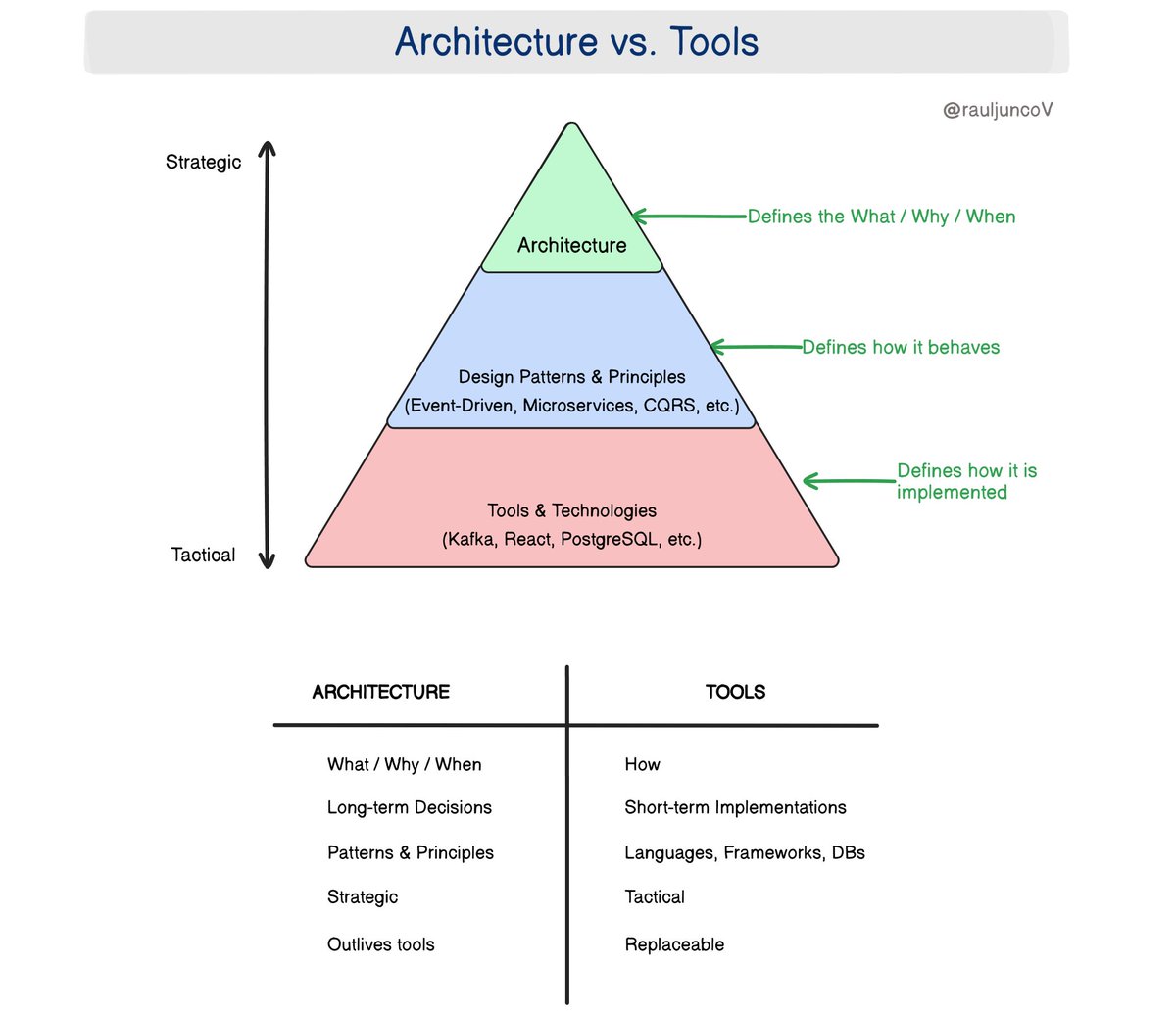
Too many people confuse architecture with tools.
This is a common mistake in interviews.
❌ "Our data architecture is React + Node.js + MongoDB"
✅ "We use a microservices architecture with event-driven communication, RESTful APIs, and a document-oriented database for scalability and flexibility"
You will lose points if you describe your stack instead of explaining your architectural approach and reasoning behind decisions.
A better way to approach architecture in interviews:
1. Start with the core principles – e.g., "Our system follows event-driven principles to enable loosely coupled services."
2. Explain the trade-offs – e.g., "We chose eventual consistency over strong consistency to ensure high availability."
3. Then talk about tools, if necessary – e.g., "We use Kafka to facilitate this event-driven approach."
Architecture is strategic → The what, why, and when.
Tools are tactical → The how.
Architecture is strategic; tools are tactical.
Great architecture outlives tools.
4 must-know Microservice Design Patterns:
✅ Database per service
- In this pattern, each microservice manages its own data.
- This means that no other service can access that data directly.
- Communication or exchange of data can only happen through the owner service.
- The success of this pattern depends on how well you’ve defined the bounded context of your application.
✅ Shared Database
- Avoid this pattern as much as possible
- But sometimes, it’s the only viable option to incrementally move to a microservice architecture.
- This approach is lenient in the sense that multiple services use a shared database.
- However, it creates a bigger impact surface and chances of run-time issues.
✅ API Composition
- This pattern tries to solve the problem of implementing complex queries in a microservices architecture.
- An API Composer invokes other services in the required order.
- After fetching the results, it performs an in-memory join of the data before returning it to the caller.
- This is an inefficient approach due to in-memory joins on potentially large datasets.
✅ CQRS + Event Sourcing
- Next, we have CQRS
- It can help get around the issues with the API Composition Pattern.
- An application listens to domain events from other services and updates a separate query database. This makes it easy to serve complex aggregation queries.
- CQRS can also be combined with Event Sourcing where you store the state of the entity (aggregate) as a sequence of events.
- Of course, this pattern can sometimes be unfamiliar to the developers.
At the end of the day, no pattern is perfect.
Learn about the trade-offs with each pattern and choose what works for you.
👉 So - which patterns have you used?
If you are working with databases, you should know about ACID.
ACID in databases stands for Atomicity, Consistency, Isolation, and Durability.
Here’s what each term means:
✅ Atomicity (A)
Atomic means something that cannot be broken down.
Atomicity describes what happens to a Transaction that’s executing multiple write operations and something goes wrong halfway.
Think of a Transaction as a bridge between two states of data named A and B.
No intermediate states are allowed.
It’s all or nothing.
So, if you can’t complete the entire transaction successfully, you don’t complete any part of it. and the transaction is completely aborted.
Without atomicity, a mid-way error during multiple updates, the entire database state can turn into a mess.
Retrying the transaction would be risky because it can result in duplicate data.
Atomicity saves you from all this trouble.
✅Consistency (C)
Consistency in ACID is all about the context of your application.
In any application or system, some statements must be true. For example, credits and debits in a bank must always be balanced.
A consistent transaction is one where statements are true at the beginning as well as the end of the transaction.
But most of it depends on your application.
A database cannot save you if you write bad data that violates the invariants.
In a nutshell, Consistency is the property of your application.
✅ Isolation (I)
Isolation is the trickiest guarantee.
It’s a given that your database will be accessed by multiple clients at the same time.
Databases can handle this quite well if they are reading and writing different parts of the database.
But the plot thickens when different clients try to access the same database records.
This ends up creating concurrency issues.
An example of this issue is two clients simultaneously trying to increment a counter that is stored in a database.
Despite two increment requests, the counter was only incremented by 1 because of race conditions.
The goal of Isolation is that concurrently executing transactions are isolated from each other. But it’s more of a degree than an absolute value.
There are multiple isolation levels ranging from weak to strong. Some common ones are:
- Read Uncommitted
- Read Committed
- Repeatable Read
- Serializable
✅ Durability (D)
Lastly, the purpose of a database system is to let you store data without any fear of losing it.
Durability is the guarantee that promises this safety.
The guarantee holds even in case of a hardware fault or database crash.
There are two ways databases achieve this:
- Disk storage and write-ahead logs for single-node databases
- Replication for multiple nodes.
Of course, there is no perfect durability.
It’s all about risk-reduction techniques.
👉 So - what would you add to make the concept of ACID even more clear?
10 Must-know best practices for optimizing API endpoints:
Optimizing API endpoints is critical for achieving optimal performance in robust, scalable applications.
By following best practices, we can significantly enhance performance, strengthen security, and improve user and developer experience of APIs.
Let's look at 10 core best practices for optimizing API endpoints:
Performance best practices:
🔹 Optimize SQL queries
Ensure your queries are performant. Use query execution plans to identify bottlenecks. Optimize and implement caching for frequent queries to minimize database load.
🔹 Caching
Store frequently requested data at the client, server, or CDN level using caching headers or tools like Redis. This reduces response time and lightens backend load. Be mindful of stale data and implement cache invalidation strategies.
🔹 Payload optimization
Compress large responses with Gzip, remove unnecessary fields from payloads, and use efficient formats like JSON for faster data transmission. Keep payloads lightweight, but don’t compromise on essential details for the client.
🔹 Pagination
Break large datasets into smaller chunks with tools like limit and offset parameters. This improves performance and avoids crashing clients with oversized responses. Combine with cursors for better consistency in real-time data.
🔹 Asynchronous processing
For time-intensive operations like file uploads or report generation, use background jobs with tools like RabbitMQ or Celery to keep APIs responsive. Return task IDs so clients can check the operation's status.
Security best practices:
🔹 Rate limiting and throttling
Set limits on requests per user or client to prevent abuse, avoid server overload, and ensure consistent performance during traffic spikes. Customize thresholds based on endpoint sensitivity.
🔹 Input validation and sanitization
Validate and sanitize all user inputs to protect against injection attacks (e.g., SQL injection, XSS) and ensure data integrity.
🔹 Monitoring and logging
Track API metrics like response times, error rates, and usage patterns using tools like Datadog or New Relic. Comprehensive logs simplify debugging and help predict scaling needs. Regularly review logs to identify trends or anomalies. This is also important to identify performance bottlenecks.
🔹 Authentication and authorization
Implement robust mechanisms like OAuth2, API keys, or JWT to ensure secure access and restrict resource usage to authorized users.
🔹 Encrypting data in transit
Use HTTPS to secure data exchanges between clients and servers, ensuring sensitive information remains protected from interception.
💬 What’s your favorite API optimization tip? 💭
~~
P.S. If you like this post, then you'll love our newsletter. Subscribe here: https://t.co/zFn968t07t
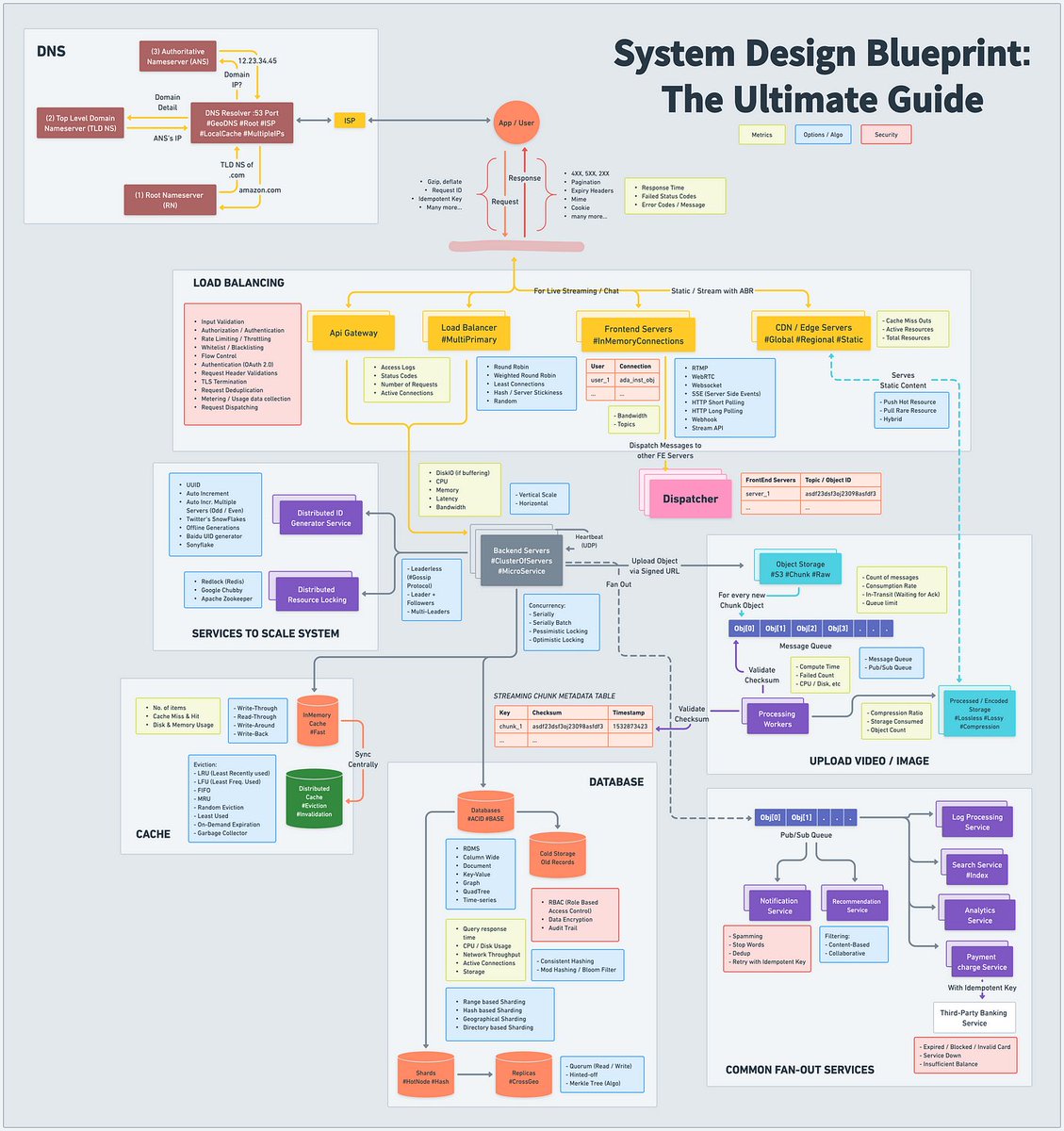
10 Best System Software Concepts
➡️Load balancers
➡️APIs
➡️Caches
➡️Databases
➡️Network Protocols
➡️Message queues
➡️CDNs
➡️High-level details about ML and Big data
➡️CAP Theorem
➡️Monitoring and analytics
read - https://t.co/wR2asRpocW
My 401k is my biggest single asset:
2016 = $119.5k
2017 = $182.1k
2018 = $210.1k
2019 = $312.0k
2020 = $422.1k
2021 = $568.9k
2022 = $498.5k
2023 = $661.1k
2024 = $861.3k
Below are 5 keys to growing it to almost $1m:
In an interview room for System design round ?
Do this 👇
1. Begin with a high-level architecture covering the main components. As the discussion progresses, focus on specific aspects like scaling, fault tolerance, or algorithms.
2. Ask questions to define the scope (e.g., real-time updates, global availability). This shows you're thinking critically about trade-offs.
3. Always discuss pros and cons of your design choices.
For example:
SQL vs. NoSQL databases.
Event-driven vs. REST-based communication.
4. Highlight strategies like caching, sharding, and asynchronous processing to handle millions of users or requests.
5. Very important to show how data moves through the system:
clients → load balancers → APIs → services → databases.
6. Address edge case scenarios like service failures, data corruption, and retries. Use idempotent APIs and retry mechanisms.
7. Be ready with knowledge of :
Kafka (message queues).
Redis (caching).
AWS/GCP/Azure (cloud).
Load Balancers, CDNs, and DBs.
8. Use frameworks like RESALE:
Requirements
Estimation
System components
API design
Latency and scaling
Extensions
𝐏𝐥𝐚𝐲 𝐰𝐢𝐭𝐡 𝐃𝐨𝐜𝐤𝐞𝐫 & 𝐊𝐮𝐛𝐞𝐫𝐧𝐞𝐭𝐞𝐬 🎯
(Focus on Practice without Installation → Save Time)
If you want to learn & practice "Docker & Kubernetes" without installation (setup) then you can use below ready labs to get hands-on and save time.
1. Docker: https://t.co/jaJlmS1bB3
2. Kubernetes: https://t.co/pW3P9eaOEG
Found helpful? Then share 🔁
How to Choose the Right Database in a System Design Interview (based on the use case):
1. Structured Data + Need ACID Compliance
→ Use Relational Databases (e.g., MySQL, PostgreSQL)
2. Need Flexible Schema
→ Use Document Databases (e.g., MongoDB, Couchbase)
3. Need Caching
→ Use In-Memory Key-Value Stores (e.g., Redis, Memcached)
4. Searching Through Large Textual Data
→ Use Text Search Engines (e.g., Elasticsearch, Apache Solr)
5. Storing Media Content
→ Use Blob Storage (e.g., Amazon S3) for storing files and pair it with a CDN (e.g., Cloudflare, CloudFront) for faster delivery.
6. Highly Connected Data
→ Use Graph Databases (e.g., Neo4j)
7. Metrics Data
→ Use Time-Series Databases (e.g., InfluxDB) or Wide-Column Databases (e.g., Cassandra)
8. Analytics
→ Use Columnar Databases (e.g., Redshift, Snowflake) or Wide-Column Stores (e.g., Cassandra, HBase)
9. Location Data
→ Use Spatial Databases (e.g., PostgreSQL with PostGIS)
If you want to learn these in more detail, checkout my recent article: https://t.co/3COCObN48z
Subscribe for more such articles every week.
7 Undervalued Stocks That Could Dominate In 2025:
1. Uber $UBER
2. Advanced Micro $AMD
3. Snowflake $SNOW
4. Nu Holdings $NU
5. Alibaba $BABA
6. Marathon Digital $MARA
7. Snowflake $SNOW
What would you add?