@bajaregurunatam If I were you, won't comment on such intricate matters - this is premised I have no info or knwdg on your scholarship to comment - if on contrary, you could choose to comment - I recall HH Bharathi Theertha Swamigal's words while selecting Successor - Sharada ma selected!
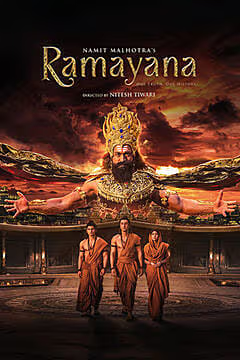
Watched #RamayanaMovie - the #Kannada version.
Detailed Review of the movie.
-- OVERALL --
-- Heart is in the right place, details in the wrong place. Despite several shortcomings movie is a net positive. An element of Shraddhaa permeates through the movie and makes you feel it all times.
-- The strength is not in the brilliance of individual elements but the coming together all diverse elements.
-- Movie makes it clear that it is not entirely based on Valmeeki, draws inspirations from other standard versions, and is a reimagination. There is no scope for expecting fidelity to Valmeeki. There are issues here we will come to that later.
-- VFX is the main character of the movie. Well, all characters are VFX. Human beings are a mere property.
-- CHARACTER ETCHING --
-- All characters are not well etched. The negative ones stand out. The positive ones dont. It's the story itself that elevates those positive ones not the cinematic imagination. This shortcoming is on Nitesh Tiwari. This is a vision failure.
-- My personal opinion is that BWood has lost its ability to imagine traditional Indian positive characters through years of urbanization, secularization, and westernization. This needs some deep immersion into Indian literature - Kavya, Purana, Adhunika all inclusive. It has to learn from regional Indian cinema.
-- Sita's character is a least well etched whereas Ravana is the most well etched. Kaikasi is surprisingly well etched. Maricha, Manthara, Kaikeyi, Shoorphanakha all standout. Wonder why Malyavan, Sumali, Mali are left out having gone into the Rakshasa past of Ravana.
-- One won't even remember Kausalya. Unnecessary time waste around Vidyujjihva. A slight tinge of playfulness has been thrust onto Lakshmana's role which does not add much value.
-- ACTING --
-- Acting overall is very average to above average. There is no bad performance neither is there any excellence. But certainly, leaves one expecting more. No performance absolutely stands out.
-- Best Actor award goes to Jatayu. The imagination, VFX, voice everything is exceptional. Yash shines as Ravana - as is well known now. Knowing the past masters of the Rakshasa craft I still feel Yash has fallen short, but it is still outstanding.
-- Shobhana as Kaikasi comes next best. Kaikasi is the surprise package of the movie. They chose the best person to essay it. Even when she appears on the screen without a word to speak, she steals the show. Seasoned actress.
-- Only Shobhana and Yash live the enormity of their respective roles. Ravi Dubey as Lakshmana does full justice to the role that is given to him. Gorakhpur will proud of another illustrious son.
-- Ranbir Kapoor has tried his best. The effort shows (which it should not have). The movie adds a new shade into his role where keeps a strong intrigue about why all this is happening to him. That makes the character interesting. Interestingly, his performance as Parashurama is better than his as Rama.
-- Ranbir needed some more insight into Indian life and epics to have essayed this role with more depth. Arun Govil, as Rama, lived that enormity amazingly in the past. He does it Dasharatha again. Yet, I must say I had not expected even this much from Ranbir Kapoor. In the last few minutes, Ranbir Kapoor shows signs of wearing the enormity.
-- Sai Pallavi as Sita is very underwhelming bordering on disappointing but that's the consequence of a very bad character etching. For all the talk of agency her character has the least of it in the movie. Lost opportunity. The Director has put out his confusion for full public view. Injustice for a good actress.
-- Creative Liberty --
-- The movie is creative liberty galore. I am all for it. But they must serve something valuable/significant. But none of those Liberties standout. Wasted liberties. Except 1-2 they don't add anything significant. Will deal with them in a separate post.
-- Taken in isolation some of them were potentially dangerous. But they get well positioned and woven in the overall composition and lose their otherwise damage potential. Only a discerning eye can even recognize. Most people won't.
-- One of them certainly causes a damage we will see if that will get compensated in Part-2.
-- The whole creative liberty thing is intriguing. What is their trouble to stick to one text and show it in its full perspective I have failed to understand. What is the difficulty in sticking to Valmeeki? Sita's agency is far better depicted through Valmeeki than any other ill-thought-through reimagination as the one in this movie.
-- MOMENTS IN THE MOVIE --
-- All Moments in the movie belong to the wonderful deployment of VFX. This is not a small achievement. This is a modern technology put to a creative use to represent civilizational sensibilities. We already a round of success in Yugo Sako's Ramayana. Of course, characterisation too was better in the latter.
-- Representation and Depiction of all surrounding/ecosystem/environment (City, Palace, Living Spaces, Wall Art, Forest, River, Sea, Mountain) everything adds value to the context, story, narrative and civilizational ethos. It does not fail a single moment.
-- Wonderful reimagination of Pushpaka Vimaana. Even in its mechanization its mystic wonder is not lost. Extraordinarily well-done Fights. Depiction of Dandakaranya worth a special mention.
-- Two scenes stood out for me. A) Rama immersing Dasharatha's ashes in the river B) Devendra going deep into the Ksheera-Sagara to meet Mahavishnu.
-- There is an element of Shraddha/Bhakti within the environment itself which you feel so strongly that you end up almost missing several deviations/mistakes etc., What you miss in characters you end up forgetting because you almost didnt notice - thanks to the way the VFX brings the Ramayana world to you.
Will come to controversy-elements tomorrow.
Sharing an old article I had written on Creative Liberty.
https://t.co/4wPAgGcjEH
Nitesh Tiwari’s Ramayana is now in theatres, and the conversation has begun. Some will celebrate it and some will object. Before either, it may be worth pausing to ask how a civilisation should receive a retelling of its most revered story.
Let us remember that Creative liberty is a genuine need of the artist. Even when that is wasted and underperformed. The viewer’s concern about that liberty is just as genuine. Rules alone will not hold the balance between them. Engagement between creator and audience will.
The Mahābhārata gives us the model. Vyāsa asks Gaṇapati to understand each verse before he writes it, and Gaṇapati asks Vyāsa never to falter. The responsibility runs both ways. This relationship could be extended to the maker of the film and its viewers. In their critique, viewers are recreating parts of the movie in different forms. It is reasonable to first see the film before judging it.
Does not mean one should not criticize what one has learnt so far. Partial notes can't become clarion calls for bans and not watching etc., Intimidation ought to be avoided. Let that be civil and impersonal. A cultish attitude is not #IKS. All 'churns' must be come from organic, sincere, heartfelt, and embodied origins.
The Rāmāyaṇa has always been retold, by Kālidāsa and Bhāsa, by Kamban, and Tulasīdāsa. The legendary Kumāravyāsa, who rewrote Mahabharata in Kannada, says 'Phaniraya (Adishesha) is struggling under the weight of the Ramayana Kavi-s' - his defence for retelling Mahabharata.
Bhasa's Uttara Ramacharita, Bhyrappa's Parva, Kuvempu's Sriramayana Darshanam will shock people for the kind of creative liberties taken. The tradition never feared retelling. It certainly feared distortion that claims to be the tradition, that settles political scores. Ideological retellings have deeply harmed our understanding of the text. But exploring contemporary realities through the lens of ancient texts does have a healthy past of its own.
Did this film retell with reverence? Did it hold the larger metaphor and dhvani of the Ādikāvya or other well known versions? Did the liberties assumed add something worthwhile? Was there any harm? Were they wasted opportunities? Those are the questions worth asking.
And the right way to answer them is the Bhāratīya one, through understanding, commentary, exposition, not through shrill, denunciation, intimidation, jeering and booing. Every reteller and every critic must remember that one is answerable to that Adi-Scribe Gaṇapati who was also the Adi-Critic.
Vishnu Purana shows how Indians solved this as early as 2K years back.
It says in the midst of all this diversity, across time and geography, one can see the following (as a consequence of Dharma consciousness)
- The performance of Yagna
- The observance of Karma
- The Striving of Tapas
- The Offering of Daana
- The Faith in Punarjanma
- The Perspective of Yuga
- The Distinction between Moksha and Swarga
- The Sense of Yuga
- The existence of Rishis and Munis (pursuing Moksha)
Vishnu Purana, Part 2, Chapter 3
Prof Anima Avare,
Many of us know. At least in Karnataka most certainly Shri. Shamashastri remains popular.
There is a renewed interest in Arthashastra since a decade both in India and Abroad, so not a day goes without people remembering the great man.
All IITs, including your Alma Mater, have a new Centre for Indian Knowledge Systems where Arthashastra is being studied and a future explored.
I am sure some are following you on SM out of this civilisational gratitude as well.
How should Bharat confront religious extremism without allowing history to repeat itself?
Countering radical ideologies requires more than condemnation. #GharWapsi offers a path towards cultural reconnection, national integration and preventing another Partition. @RahulDewanV2