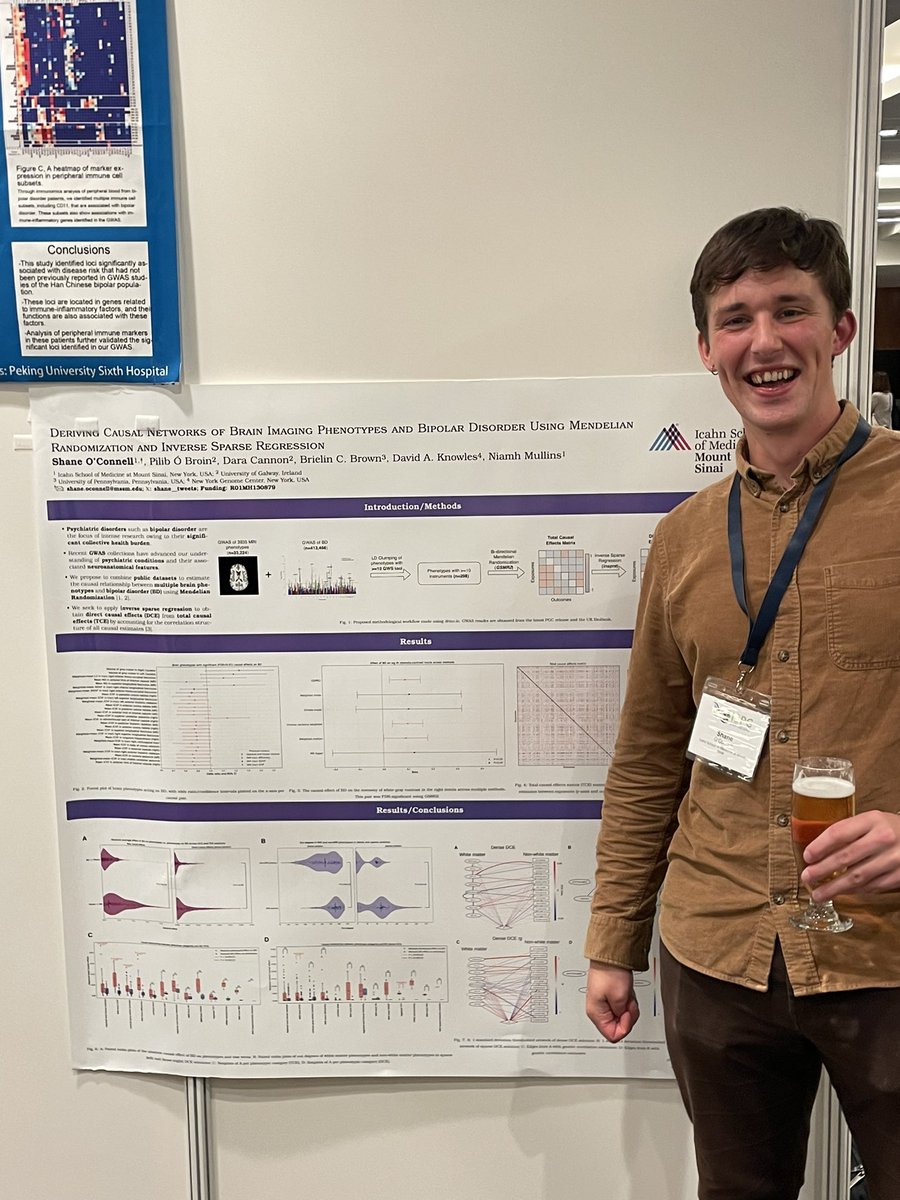
very happy to share our latest work which is online today! we carried out bi-directional mendelian randomization analyses of multiple brain imaging phenotypes and bipolar disorder. a short thread on some of our main findings (much more in main text) 1/ https://t.co/vsMqexB6KD
very happy to share our latest work which is online today! we carried out bi-directional mendelian randomization analyses of multiple brain imaging phenotypes and bipolar disorder. a short thread on some of our main findings (much more in main text) 1/ https://t.co/vsMqexB6KD
this work was made possible by the efforts of a great many people, particularly my wonderful PI @NiamhAMullins. read the full manuscript for more details and recreate all figures using our github repo notebook https://t.co/UR29ipOULV (interactive networks also available!) 13/
It’s a proof at least of the prediction/inference dichotomy between deep learning and statistics in practice - solving by definition in the deep learning world means an accurate output, whereas a solution looks very different from a classical statistical perspective (both are ok)
Can these AI approaches tell you anything meaningful about the data-generating distribution? most deep learning approaches require a large degree of reverse engineering to even approximate the parameters of the underlying distribution. very subjective definition of a solution
Generating new samples from an unknown distribution given a finite set of samples (training dataset) is a fundamental statistical problem.
Yet Statisticians haven't touched the problem, while AI researchers have solved it (diffusion, GANs, VAE, LLMs). 🤷♀️