From Manufacturing to Technology: Is the West Repeating the Same Strategic Mistake?
If the West wants to win today’s technology competition, it should first revisit what happened to global manufacturing after China entered the World Trade Organization in 2001.
The conventional narrative is that China climbed the value chain because it gradually mastered more advanced technology.
I think the sequence was, to a significant extent, the reverse.
China first captured the mass market by producing goods that were substantially cheaper and “good enough” for most customers, often supported by massive state subsidies and industrial policy.
Scale then generated cash flow, engineering talent, supplier networks, manufacturing know-how and continuous learning. Those advantages enabled Chinese companies to move steadily up the value chain.
Mass market → Scale → Capability → Higher-value products → Technological leadership
After WTO accession, China displaced competitors across one industry after another. It began with textiles, garments, toys and furniture before moving into consumer electronics, telecommunications equipment, solar panels, batteries, electric vehicles, drones and advanced industrial machinery.
China did not become a technological power because it first achieved technological leadership.
It acquired much of that capability because it first achieved manufacturing scale.
That history increasingly resembles what we are seeing across technology today.
Western companies still lead at the frontier, producing many of the most important breakthroughs.
Chinese companies, meanwhile, are rapidly improving while driving costs sharply down.
For most customers, they do not need to offer the best product.
They only need to offer one that is good enough at a much lower price.
Whether in AI models, robotics, electric vehicles or industrial technology, a product delivering 75–80% of the performance at a fraction of the cost can capture an enormous market. Once enough customers adopt it, revenues grow, ecosystems develop, engineering capability improves and the frontier becomes progressively easier to challenge.
The strategic question for the West is whether occupying only the very tip of the pyramid is sustainable while the entire base beneath it gradually migrates elsewhere.
Manufacturing suggests the answer is NO.
Interestingly, the CCP has long understood this strategic logic.
Mao Zedong’s strategy of “using the countryside to surround the cities” (农村包围城市) emphasised controlling the periphery before taking the centre. Today’s technology competition is commercial rather than military, but the strategic logic bears comparison.
Chinese companies do not necessarily need to win first at the frontier. By dominating the much larger lower and middle segments of the market, they accumulate the scale, capital and industrial capabilities needed to challenge the top.
The lesson for the West is equally clear: frontier leadership rests on a broad industrial base. Manufacturing showed what happens when that base erodes. Lose enough of it, and eventually you lose the frontier as well.
The West therefore needs to protect the entire pyramid.
The objective is to preserve the industrial base that makes the next generation of technological leadership possible.
Lose the base of the pyramid, and eventually you lose the summit.
I believe greater market protection and trade frictions are inevitable when competing against a mercantilist system.
The bigger challenge for Western governments is to come to terms with the consequences of allowing so much of their manufacturing base to migrate to China under a largely laissez-faire philosophy that assumed markets alone would produce the right outcome.
That assumption proved costly in manufacturing.
The West cannot afford to make the same mistake in technology.
🎯 Too much to ask? Biden beat Trump because Trump was unpopular and chaotic and people wanted boring and normal. Trump is still unpopular and chaotic, but the Dems embracing "exciting" far-leftists and weirdos would risk blowing up all their advantages in the midterms.
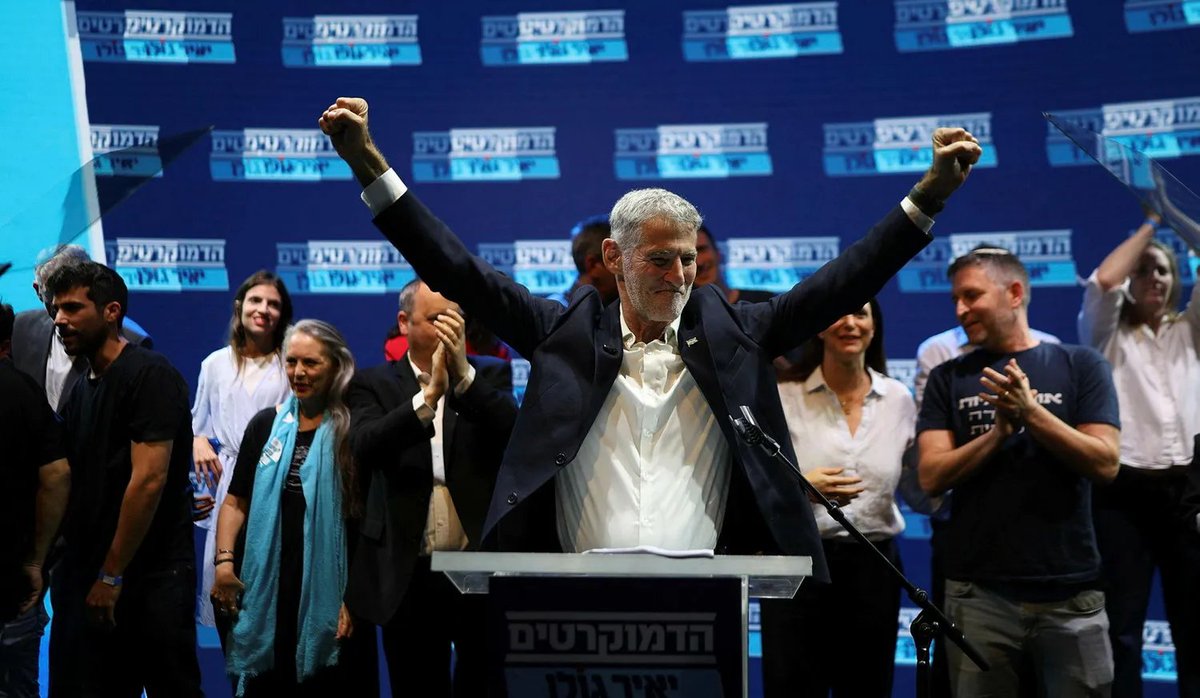
1/ The party that built Israel nearly died. Labor — Ben-Gurion's movement, the party that founded the state — was down to 4 seats. Now, merged into HaDemokratim, it just pulled 112,000+ members and 87% turnout into an open primary. A real sign of life on the Israeli left. 🧵
On This Day — July 18, 1290
King Edward I of England (“Longshanks”) ordered every Jew in his kingdom to leave or die.
The Edict of Expulsion gave Jews (who had lived in England since 1066) until November 1 to depart. They could take what they could carry. Most tried to cross the Channel. Many were robbed by ship captains, stripped of everything, and thrown overboard. Those who survived swam ashore.
This was the culmination of more than 200 years of growing hatred: blood libels, ritual murder accusations, forced badges, crushing taxation, synagogue closures, and pogroms.
For more than 350 years, the expulsion stood until Oliver Cromwell quietly allowed Jews to return in 1656.
“Tolerance” of Jews in diaspora lands was always conditional … and ultimately revocable.
Only Jewish sovereignty offers real protection from the whims of rulers.
In terms of examples of academic anti-Semitism, Steven Prawer’s case is particularly noteworthy:
1. Mere collaboration with an Israeli university is now deemed as “pro-genocide” and “war criminal”, without regard to (i) the remoteness of such claims and, more importantly, (ii) to Prawer’s personal views on the Israel-Palestine issue. Analogously, not even the staunchest critics of China would treat mere fact of western university links with Chinese universities as “pro-authoritarian”, “pro-forced labour”, “pro-Uyghur and Tibetan genocide”, “pro-Hong Kong crackdown”. China realists are cautious about such collaborations, but we also know you can’t paint everything with a broad brush.
2. The protest action against Prawer in his office involved vandalism and verbal threats against him. This went much further than peaceful protests at the university’s lawn or even the protests inside campus buildings which disrupted classes.
3. This takes my mind back to the Hong Kong protests or 2019, which were over a series of causes which impacted on the populace much more personally, such that one would expect even more inflamed passions. When Hong Kong universities were turned into war zones at the time with police firing tear gas, rubber bullets and the like on students (who then reacted with various forms of violence), no one went to the offices of a number of prominent overtly pro-Beijing academics, who played official roles in assisting in the weakening of Hong Kong’s autonomy (ie much more “culpable” than even the very worst that can objectively be said about Prawer), to vandalise or to threaten personal safety.
3. Of course, the Hong Kong experience also makes me more lenient than some in terms of disciplinary actions against students. But even so, there is a difference between supporting students’ underlying causes and their specific actions. Thinking again back to 2019, even university academics (I won’t name them now given Hong Kong’s post-National Security Law landscape) who supported the students’ underlying causes were both publicly and privately calling for calm on the students’ parts, and tried to mediate between students and the police, rather than egging students on in their pitched battles on campus.
4. By contrast, Prawer had to contend with the disappointment of seeing academic signatories of the Overland Journal letter, which not only backed the students’ complaints against Prawer, but also backed their actions against him. I leave it to others to judge whether this was anti-Semitism. But at the very least, the signatories were irresponsible as scholars and educators with moral duties to their brethren (of which Prawer is one) and to their students. In particular, the duties to students apply both to non-protesting students affected by the protests, and to the protesting students, as it is them who potentially “face the music” for their actions, rather than the academic signatories who were endorsing and thereby encouraging them.
https://t.co/4MOnwixxQC
I first met Xi Jinping in 1986, when he was vice mayor of Xiamen. Great to speak with @ezraklein about China, its leadership, and the years that shaped its direction. My full interview with the @nytimes is out now.
It's kind of ironic that Beavis & Butthead here said that voters don't want candidates "grown in vats," but their entire process of recruiting Platner was a sort of mad science experimenet/talent search based solely on outward appearances with no vetting whatsoever.
Andrew Wilkie, now independent, is an old-school type of Green where you might not agree with some of his stances, but you respect his consistency on principles like human rights, unlike the identitarian reflexive “America bad therefore China good” type of modern Green.
In other words--Democrats will go after the most corrupt administration in the history of the USA and one of the most corrupt administrations anywhere in the world today.
Sign me up.
There is something deeply sinister about a group of academics demanding - via the now disgraced Overland journal - that a fellow historian renounce one of the world’s most prestigious scholarly prizes because of its country of origin.
You need not agree with the policies of the Israeli government. You need not support every action of the Dan David Foundation. But the proposition that an individual scholar’s work on medieval concepts of time is morally contaminated because the prize is associated with an Israeli institution is an extraordinary descent into political puritanism.
The old word for this was guilt by association.
Indeed, it has a distinctly McCarthyite flavour: ideological tests, public denunciations, demands for ritual repudiation, and the insistence that silence or insufficient enthusiasm for a political cause constitutes complicity.
What these intellectual binrats cannot comprehend is that anti-intellectualism is a hungry beast. Once scholarship is judged not on its merits but on the political acceptability of its institutional connections, nobody is safe. Today’s heretic is a medieval historian accepting a prize; tomorrow it is a scholar collaborating with the wrong university, citing the wrong author or asking the wrong question.
History is littered with movements that believed censorship and ideological purification would stop at their enemies. It never does. The logic of denunciation invariably turns inward.
Universities exist precisely because knowledge cannot flourish under systems of political litmus tests. The academy should be a place where argument defeats argument, not where petitions are organised to intimidate scholars into recantations.
The tragedy is that many of those applauding this campaign imagine themselves defenders of academic freedom. In reality, they are patiently constructing the intellectual machinery that will one day be used against them.
Congratulations to Matthew Champion and to Glynn Davis for refusing to bend the knee to this latest outbreak of academic bullying.
There is an uncomfortable truth here. Much of this moral grandstanding is being carried out by C grade scholars whose political activism far exceeds their intellectual contribution. For some, public denunciation and ideological policing appear to have become a substitute for genuine scholarly achievement and engagement with ideas.
https://t.co/AbUQeCIlKU
Biden: The reflecting pool reflects something even worse than the narcissism and incompetence at the core of this administration. It’s the corruption. The corruption. The brazen, blatant corruption. Corruption on a scale never seen before in American history in any administration.
Trump has made billions of dollars since returning to the White House. Simply stunning to me.
He has no shame. Frankly, it’s embarrassing for the country. Trump couldn’t care less.
Making money off the presidency is one of the reasons he wants to be president
Hamas issued a religious Fatwa through one of its Muslim Brotherhood–linked proxy groups in Turkey to criminalize protests against its rule in Gaza, branding demonstrators as collaborators with Israel and declaring protests "haram." Yet, no Fatwas ever condemned October 7 kidnapping of children or the elderly, sexual violence, the destruction of Gaza, the theft of humanitarian aid, the conversion of hospitals into sites of intimidation and torture, or the sabotage of millions of Muslim lives in Gaza and beyond - apparently, that's "halal."
This exposes a core and intractable problem: political and radical Islam, in much of the Arab and Muslim worlds, especially the Palestinian territories, has become less about faith or spirituality and more about mind control, manipulation, and the justification of brutal acts. Muslims in Gaza and elsewhere who remain under the sway of these nefarious and devious Imams, Sheikhs, Mullahs, and clerics will continue to live in backwards societies and under regressive systems unless they reject these so-called religious authorities and the coercive power they wield.
HORRIFIC: The Fatwa Committee of the Association of Muslim Scholars of Palestine has issued a statement declaring that participating in the June 26 anti-Hamas protests is forbidden, accusing protesters of betraying Islam, collaborating with Israel, and calling for them to be publicly denounced.
This is exactly how peaceful dissent is demonized: first by branding ordinary Palestinians as traitors and collaborators, then by creating a religious and political justification to execute and persecute them.
The people planning to protest are not foreign agents. They are Palestinians demanding the right to speak, to live with dignity, and to express their views without fear.
Threatening civilians for exercising their right to peaceful expression is unacceptable and disgusting.