I am a member of the Norwegian Nobel Committee.
There are five of us. Five people, appointed by a parliament most of the planet could not find on a map, who decide, once a year, which human being the world has agreed to call good.
I know. I know. I think about it on the tram.
We meet in a building on Henrik Ibsens gate, a street named after a man who wrote almost exclusively about people discovering they are frauds, which nobody on the committee finds funny except me. There is a room with a long table and the portraits of the dead laureates looking down, Mandela, the Dalai Lama, a great many earnest men in spectacles, and one portrait we do not discuss, which is Kissinger, 1973, awarded while the bombs were still falling, after which two of our predecessors resigned and the satirist Tom Lehrer said political satire was now obsolete. We keep him on the wall. A reminder. Every family has the uncle.
It is October in Oslo, which means the sun gives up around four in the afternoon like a civil servant, and it rains the particular Norwegian rain that isn’t quite falling, just hanging there, judging you. I arrive with wet shoes. I always arrive with wet shoes. There is coffee, because this is Norway and there is always coffee, we drink more of it per person than almost anyone alive, and someone’s wife has sent kanelboller, the cinnamon buns, and we sit, five Norwegians, damp, caffeinated, sugared, and we decide the moral standing of the entire species.
Let me tell you how it actually works, because the world imagines a cathedral and it is, I promise you, a book club with a mandate.
287 nominations this year. 208 people, 79 organizations. Anyone can nominate, that’s the secret nobody understands: a professor, a parliamentarian, a former laureate, so the “nominee” list is meaningless, it’s a suggestion box, and every autumn some congressman nominates his own golden retriever and the press writes “SHORTLISTED.” Nobody is shortlisted. There is no short list the public ever sees. There is us, and the coffee, and the rain, and the portraits, and a Norwegian stubbornness that is older than the prize itself.
We read reports. The institute’s advisers write them, thick dull documents, and we argue. Our chairman told the BBC once that in the final meeting “there is a high temperature.” High temperature, for a Norwegian, means someone slightly raised an eyebrow and then apologized for it. We don’t do high temperature. We do a long silence, and then Kristin says “well,” and everyone knows exactly what “well” meant, and it’s settled. That’s our shouting. “Well.” You’d have to be raised here to hear the violence in it.
Now. This year. I will not say the name, because we never say the name, but you know the name.
A certain head of state wanted this prize the way a child wants a thing in a shop window, which is to say loudly, and in public, and with the full belief that wanting it was itself the argument. He said he deserved it. He said he’d ended eight wars, a number that grew most times he said it, like a fish. He had other heads of state phone us. Israel’s prime minister posted it on the internet, “Give him the Nobel.” The leaders of Cambodia and Pakistan announced they’d nominated him, as though announcing it were part of it, as though we tally mentions. A man flew around the globe collecting endorsements for a Norwegian committee the way you’d collect signatures for a petition to the council about a noisy dog.
And here, uff da, is the detail I treasure, the one that makes me smile into my coffee. The nomination deadline is the 31st of January. He took office on the 20th. So for all the phone calls, all the posts, all the gilded lobbying, the only nominations that could possibly count for this year’s prize were filed in the first eleven days of his term, before he had, by his own arithmetic, ended a single one of the eight wars. He campaigned all year for a prize whose window had shut while he was still hanging up his coat. We didn’t have to reject him. The calendar did. We just watched. Norwegians are very good at watching. We have long winters.
People think we sit there weighing his deeds. We don’t. That’s the thing I can’t make the world understand. We’re not grading his homework. We don’t owe anyone the prize for a ceasefire, however real, however loud the announcement. “He made peace” is not a sentence that ends in a medal, the way he believes it does, the way he believes every good thing ends in his name on it. The will of a dead Swede says the prize goes to whoever did the most for fraternity between nations. A dead Swede, I should add, who made his entire fortune inventing dynamite and selling arms, and spent his last years horrified at his own obituary, which called him a merchant of death, and so bought his way to immortality as a man of peace. The whole prize is one guilty arms dealer’s attempt to launder his name. We are, all of us, administering a dead man’s public relations. I find this clarifying. It keeps me humble. It should keep everyone humble, and it keeps, by my count, no one humble at all.
So who did we give it to?
An eighty-five-year-old woman. A judge. Born in Durban, under apartheid, granddaughter of a Tamil man who came to South Africa as indentured labor, a bus driver’s daughter from the poor Indian quarter, who became the first non-white woman to run a law practice in her province, who defended Mandela’s people when defending them was dangerous, who sat on the Rwanda tribunal and the court at the Hague, and who, at eighty-five, is right now a judge weighing whether a genocide is a genocide. When we told the world, our chairman said the rule of law “underpins the system we have set up to ensure peace,” and that “peace requires justice.” She wasn’t even in Oslo. She was in Nuremberg. In courtroom 600. The actual room where they tried the Nazis. You cannot stage that. God staged that, and God, it turns out, is a better satirist than any of us.
She did not phone us. She did not post. No prime minister demanded it for her on the internet. She had, as far as our deliberations are concerned, the one qualification the loud man could never manufacture, which is that she wanted the work and not the medal. The medal finds those people. It flees the ones who chase it. This is not a rule we wrote. It’s just the only pattern the hundred-odd years of our mistakes has ever shown.
The reaction from across the ocean was immediate. His spokesman posted that we “place politics over peace.” Ja. Perhaps. We’re five damp pensioners in a rainy city; of course it’s political, it was always political, it was political when we gave it to a sitting American president nine months into his first term for the promise of things he had not yet done, and we have been quietly embarrassed about that one for fifteen years, so believe me, we had a particular reason this year to prefer a woman with fifty years of verdicts behind her over a man with eight wars in front of him and a deadline already behind him.
Here is what he will never understand, the thing I’d tell him on the tram if he ever took one. We are the one prize he cannot buy, cannot post his way to, cannot have a friendly dictator phone in for him. Not because we’re incorruptible, nei, we’re as vain and wrong and human as the portraits on our wall. But because the entire point of the thing, the only power a small cold country’s book club has ever held, is that it goes to the person not performing the wanting. The moment you demand it, you’ve proven you don’t understand what it’s for, and proving that is itself the disqualification. He ran the most expensive campaign in the history of the prize and the campaign was the reason. He was never losing to Navi Pillay. He was losing to the concept.
It’s dark now. Four o’clock dark. The buns are gone. Kristin said “well” an hour ago and we all went home. I’m on the tram with my wet shoes, and somewhere across the water a very powerful man is explaining to a camera that the prize is rigged, that we’re corrupt, that he’ll win it next year, and he genuinely might, we’re only five idiots and we’ve been wrong before, Kissinger is still on the wall.
But not this year. This year an old woman in Nuremberg, in the room where the law once stared down the exact kind of man who thinks wanting a thing loudly enough should make it his, got a phone call she didn’t ask for.
That’s the job. We don’t reward the man who ends the war and announces it.
We reward the woman who spent fifty years deciding what a war was.
He’ll never see the difference. That’s rather the whole point of him.
Takk for i dag. I have to change trams.
Mr. @SecRubio, I write this as an educator at one of your Ivy League schools, the University of Pennsylvania, and as someone who has spent years teaching Persian history and culture and their intersections with Greek and Western history and culture.
Your dangerously Eurocentric account of Perso-Greek history is not only distorted and misleading; it also ignores the most basic facts about centuries of cultural exchange between civilizations you frame as fundamentally opposed.
Greek civilization did not develop in isolation from its eastern neighbors, nor did what we now call Western civilization emerge independently of the intellectual and cultural worlds to its east. The Persians and Greeks were not simply enemies locked in an eternal civilizational struggle. They were also neighbors whose worlds intersected through diplomacy, trade, art, religion, literature, philosophy, science, and political thought. The Achaemenid Empire itself was a vast, multicultural world connecting the Mediterranean to Central Asia. Greek thinkers lived and traveled in the wider Persian world, while Greek knowledge, art, and political ideas circulated across the eastern Mediterranean and beyond. These encounters were complex, reciprocal, and often shaped by both conflict and cooperation.
Yes, there were imperial wars between Persians and Greeks, just as there were wars between other ancient empires. But reducing their history to military invasions while erasing centuries of cultural contact and exchange is not historical analysis. It is ideological mythmaking.
Had you engaged seriously with the histories of Persian and Greek philosophy, mathematics, astronomy, mythology, art, and literature, you might have recognized how inadequate and dangerous it is to reproduce the crude civilizational binaries popularized by the notoriously racist movie 300. Invoking this caricature of ancient history to mobilize support for contemporary military aggression is not an innocent historical error. It is a way of manufacturing an enemy by presenting an entire civilization as an existential threat.
History shows us where such rhetoric can lead. The Nazis exploited myths of national humiliation and betrayal after the First World War, scapegoating Jews to legitimize exclusion, persecution, and ultimately genocide. The historical circumstances are different, but the broader warning remains: the deliberate construction of civilizational enemies can help normalize dehumanization and mass violence.
When a senior US official selectively weaponizes a complex history he demonstrably misrepresents, he does more than spread misinformation. He helps advance a worldview in which war between civilizations appears inevitable and aggression becomes defensible. That is how dangerous political narratives are built, and how human catastrophes are made easier to justify.
Your speech is historically uninformed, aggressively Eurocentric, and deeply troubling. At a moment when the consequences of military escalation are measured in human lives, we need historical literacy and intellectual responsibility, not racist caricatures dressed up as civilizational history.
Prime Minister Mark Carney of Canada came into @nytimes headquarters today & sat for a 1-hour on-the-record interview with 10 NYT journalists & top editors. We'll be publishing a number of stories from this conversation.
Here's the 1st. #cdnpoli
https://t.co/pIgftVDcj0
I suspect Nikita is correct, but also suspect this is a bad development for aesthetics and will make our world uglier. Most people have no eye or talent for design. They lack the education necessary to make coherent choices. Thus, they are better off being led by experts.
Look at the world of custom clothing. 150 years ago, clothes were made by tailors, who were technicians informed on the cultural practices of dress (e.g., design practices that created better looking attire). The world has indeed gotten better; I am not nostalgic for the early 1900s. I celebrate the fact that people can no wear whatever they want and there are limitless choices.
At the same time, look at how this development has impacted tailoring specifically. Since the market for quality bespoke tailoring has shrunk, there are fewer people entering this trade. Fewer people means less talent and less competition, which means even top-end tailoring today is not as good as it was in the past.
Instead, most of the market is filled with less skilled people, often made-to-measure clothiers driven by profit. They will happily make whatever you want. "Yes sir, a contrast buttonhole will look dashing." "Look sir, we have all of these crazy fabrics." "Sir, how about a monogram? It will be free and show off your taste."
The world has improved in many ways and I vastly prefer 2026 to 1906. But within this very specific niche, it's harder now to get a quality custom suit. Most people who get custom suits end up in disasters because they are aided by this "do whatever you want" custom tailoring world. They would benefit from constraint — an educated group of people, in this case tailors, who gently guide them towards better choices.
The name Lake Ontario comes from the Wendat word Ontari’io, which, appropriately, means “the lake is beautiful, the lake is big”.
The name is more than 400 years old, predating both the Confederation of Canada and the Declaration of Independence of the United States of America.
We know that America is changing. Their trading relationships, their foreign policies, their national monuments, their hydronyms.
Canadians also know that naming reality means calling it Lake Ontario – then, now and always.
Donald Trump came into the war with Iran on a high, with overconfidence. Now he finds himself unable to end a war that none of Iran’s Arab neighbors wanted them to start. None of the initial aims touted by Trump—including the shuttering of Iran’s nuclear program and the dismantling of its ballistic-missile capabilities—have been realized; and, instead, the U.S. finds itself trying to figure out how to deprive Iran of a tool—the Strait of Hormuz—that is in play only because of Trump’s intervention. Read more about the current state of the U.S.’s war with Iran: https://t.co/P7vFFuQ85q
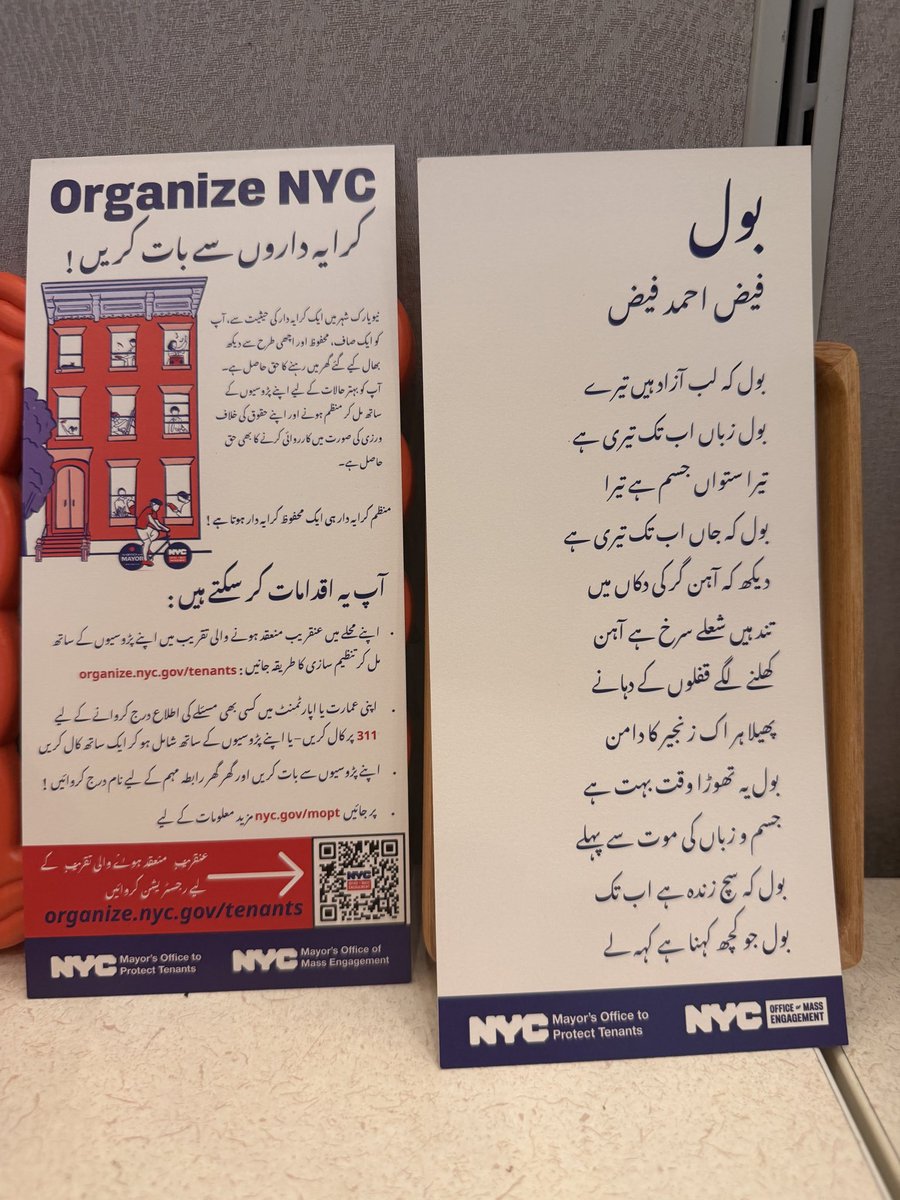
Mayor Mamdani handed out some tenant organizing fliers in Urdu last week, with a famous early 1940s Faiz Ahmed Faiz poem on the back.
“Speak, for your lips are still free.
Speak, for truth is still alive.
Speak, say whatever you have to say!”
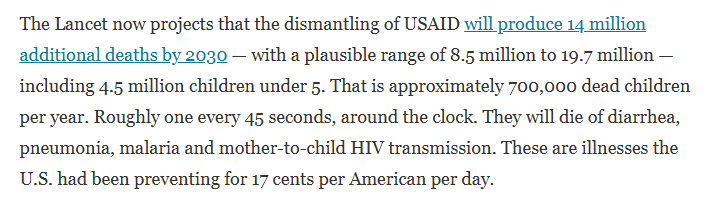
Can't stop thinking about Elon Musk, the wealthiest man alive worth $828 billion, spending $290 million to elect Trump, becoming $563 billion richer since Trump was elected and ending humanitarian aid that will lead to the deaths of 4.5 million of the poorest kids on the planet.
You can smell rain better than a shark can smell blood. 200,000 times better. Your nose picks up the compound behind petrichor (that smell after rain) at levels so tiny it's like finding one teaspoon spilled across 200 Olympic swimming pools.
That compound is called geosmin. It comes from soil bacteria. And the word "petrichor" itself didn't exist until 1964, when two Australian scientists, Isabel Joy Bear and Richard Thomas, published a paper in Nature trying to figure out why rocks smell after rain. They took the Greek words for stone and "the blood of the gods" and stuck them together. Blood of the stone.
When soil stays dry for weeks, certain plants leak an oil that the clay soaks up like a sponge. At the same time, soil bacteria called Streptomyces start making spores (tiny survival pods that can sprout into new bacteria later) and give off geosmin while they do it. The smell just sits there in the dirt, waiting.
Then rain hits. A 2015 MIT paper figured out the physics of what happens next. Raindrops land on dry soil and trap tiny air bubbles in the soil's pores. The bubbles rise up through the raindrop and pop out the top, flinging thousands of tiny droplets into the air. Each one carries a piece of the oil, some bacterial spores, and some geosmin. Wind does the rest. Light rain releases the most of these droplets. Heavy rain releases very few, which is why a drizzle smells more than a downpour. MIT estimated that rain across the planet throws between 10,000 and 800,000 trillion bacterial cells into the air every single year.
In 2020, scientists in Sweden and the UK published a paper in Nature Microbiology that explained why this smell exists at all. Streptomyces bacteria only release geosmin when they're about to die and make spores. The smell is a bacterial ad. It attracts tiny 1.5mm bugs called springtails, which eat the bacteria. Springtails have evolved enzymes that let them survive the antibiotics Streptomyces produce to kill everything else. In exchange, the bacterial spores pass through the springtail's gut alive and stick to its body, hitching a ride to new soil. This deal has been running for about 400 million years.
Same molecule, different stories. Geosmin is why raw beets taste like dirt. It's why catfish and tilapia taste muddy when raised in bad water. Acid breaks it down, which is why every recipe for muddy fish starts with vinegar or lemon juice.
Your nose catches all of this at parts-per-trillion. You're smelling a 400-million-year-old conversation between soil bacteria and the bugs that eat them.
Interesting to me that when you see men on the global stage, beautiful Western-style tailoring is often worn by men from non-Western countries. Pictured here is Shehbaz Sharif (Pakistan), Akinwumi Adesina (Nigeria), and Naruhito (Japan).
Media reporter @kerrymflynn joined @AJEnglish’s Listening Post to examine how concentrated media ownership and Trump’s reshaping of the press are changing US journalism.
🔗: https://t.co/oDNr8mhVh3
If I can get you to stop what you’re doing for one minute. This is beautiful. Please share it widely to any and all on our “amazing spaceship” called earth.
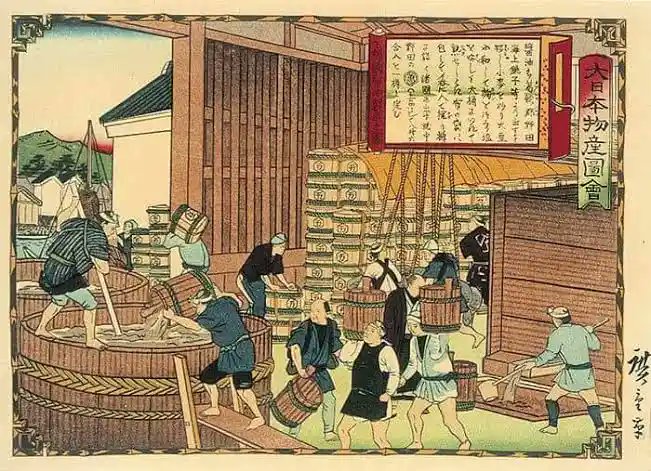
There are over 33,000 Japanese companies with histories of 100 years or more. These long-standing firms are known as 'shinise'. They are governed by a management philosophy that prioritizes long-term continuity and generational succession over short-term profits.
Japan is home to an extraordinary number of long-lived businesses, often referred to as shinise (老舗). Many are small, family-run enterprises that have survived wars, economic upheaval, and technological change by focusing on stewardship rather than expansion.
At the heart of shinise culture is a different idea of success. Instead of maximizing short-term profit, these businesses prioritize generational succession, reputation, and stability. Leadership is often passed down, or even adopted into, families to ensure continuity. In fact, Japan has a long tradition of adult adoption (mukoyōshi), where capable successors are brought into the family to carry the business forward.
Some companies have operated for centuries. The construction firm Kongō Gumi lasted over 1,400 years before being absorbed in 2006. Others, like traditional inns, tea houses, and sake breweries, have quietly persisted for 200–300 years or more.
This long-view mindset reflects a broader cultural principle: a business is not just an asset to be optimized, but a legacy to be preserved.
Japan accounts for over 40% of the world’s companies older than 100 years, more than any other country by a wide margin.
#drthehistories
Best piece I've read on the US assault on Iran:
"Those who loathe the clerical establishment may still recoil at the spectacle of foreign jets in Iranian skies and the explicit declaration that their state is to be dismantled."
https://t.co/2sYaIvHx6K
Prediction: In the AI age, taste will become even more important. When anyone can make anything, the big differentiator is what you choose to make.
https://t.co/3GQUlfH58t