Assistant Professor of Computer Science at @NJIT
PhD in Computer Science from Ben-Gurion Univ. @Israel @bengurionu
Interested in databases, security/privacy.
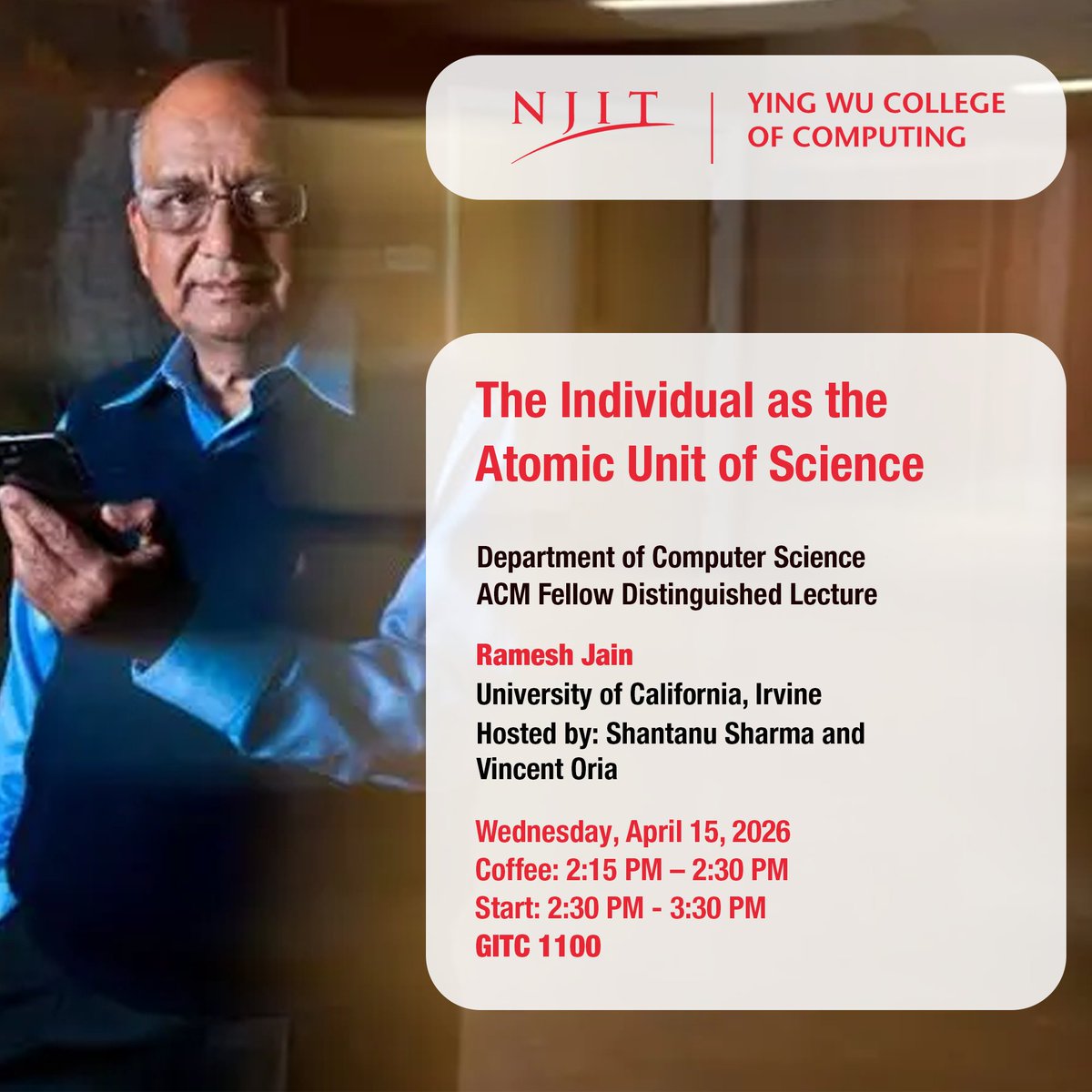
Save the Date! We invite you to attend this program on The Individual as the Atomic Unit of Science by @jain49, Emeritus Donald Bren Professor and Founding Director of the Institute for Future Health at the University of California Irvine on Wednesday, April 15 at 2:30 p.m.
The Dept. of Computer Science is pleased to welcome Professor Amr El Abbadi from the University of California at Santa Barbara to present on the subject of Taming Big Data: Stream Summarization and its Many Applications this Friday, November 21st. All are welcome to attend.
Join the Department of Computer Science for a presentation on the subject of Vantage Points and Sign Patterns by 2024 Wolf Prize in Mathematics award recipient Professor Noga Alon from Princeton University on Wednesday, November 12. All are welcome to attend.
Join the Department of Computer Science for a presentation on the subject of Smoothed Complexity of Local Search Algorithms by Professor of Mihalis Yannakakis from @Columbia University this Friday, November 7th. All are welcome to attend.
NJIT has climbed to No. 80 — its highest-ever placement — in the 2026 U.S. News & World Report Best National Universities rankings, continuing its steady ascent among the nation’s leading institutions.
https://t.co/xfWPLGwBt4
Traditional vs. Agentic RAG, clearly explained!
The future is Agentic RAG, and it's because a traditional RAG setup has some major limitations...👇
1) Retrieve once and generate once.
↳ This means if the retrieved context isn't enough or correct, the LLM can not dynamically search for more information.
2) Inability to reason through complex queries.
↳ If a query requires multiple retrieval steps or CoT (chain of thought), traditional RAG falls short.
3) Limited adaptability
↳ The system can't modify its strategy based on the problem at hand. Eg. Whether to do vector search, web search or call an API.
Agentic RAG addresses these issues.
The core idea is to introduce agentic behaviors at each stage of RAG.
Agents can actively think through tasks—planning, adapting, and iterating to find the best solution, rather than just following a set of instructions, and LLMs enable this.
The image below illustrates the workflow of an agentic RAG. Refer to it as you continue reading...
Steps 1-2) The user inputs a query, and an agent refines it (corrects spelling, simplifies for embedding, etc.)
Step 3) Another agent decides if more details are needed.
↳ Step 4) If not, the refined query is sent to the LLM.
↳ Steps 5-8) If yes, the agent selects the relevant sources (vector database, tools/APIs, internet), retrieves context, and sends it to the LLM.
Step 9) A response is generated.
Step 10) A final agent checks if the answer is relevant.
↳ Step 11) If yes, return the response.
↳ Step 12) If no, restart from Step 1. This process repeats until the system provides an acceptable answer or concedes it cannot respond.
This makes the RAG much more dynamic and robust.
However, it's important to note that building RAG systems often comes down to design preferences and choices.
The diagram below is just one of many blueprints an agentic RAG system may have.
You can adapt it to suit your specific use case.
Enjoyed this? You should also my RAG series! From building and optimizing RAG apps to evaluating performance and crafting agentic & multi-modal systems—it's all here.
Link in the next tweet!
_____
Find me → @akshay_pachaar ✔️
For more insights and tutorials on AI and Machine Learning!