I run partnerships for 2 newsletters read by 125K+ founders, CEOs & investors.
50%+ open rate across both
75% US, then India & Europe
→ Venture Curator: https://t.co/xWU9WknnGA
→ Venture Daily Digest: https://t.co/u8aLTKoMv9
Brands looking to reach this crowd → DM me.
What does an AI startup landing page that converts look like?
We analyzed the landing pages of 34 funded AI startups to understand what makes an effective startup homepage.
And we found some interesting patterns that most early-stage founders could learn from.
We went through the homepages of companies like Harvey, Sierra, Cursor, Lovable, Clay, and others, studying their headlines, CTAs, social proof, pricing, and page structure.
Here's what stood ou
→ 76% display customer or partner logos near the top of the page.
→ 50% highlight a specific number, such as users, customers, or product usage.
→ Only 12% feature customer testimonials near the top.
→ The average headline is just 6 words long.
→ Every self-serve and developer-focused startup in our sample had pricing in its navigation.
→ 21% featured interactive demos directly in their hero sections.
But the most useful finding was how simple the overall structure could be.
Based on these 34 websites, we created a practical landing page framework:
1. Navigation: Product, customers, pricing, and primary CTA.
2. Hero: A clear headline, one-sentence explanation, and product demo or screenshot.
3. Social proof: Customer logos, usage numbers, or integrations.
4. How it works: Three simple steps explaining the product.
5. Results: Real customer outcomes with numbers.
6. Trust or pricing: Security credentials or pricing plans.
7. Closing CTA: Give visitors another opportunity to sign up or book a demo.
One important distinction: These are patterns from successful companies, not proof that a particular layout will increase conversions.
Still, if you're building an AI startup, you don't need to reinvent your entire website.
Start by making it immediately obvious what your product does, who it's for, and why someone should try it.
We published the complete research, including the 34 startup homepage examples, headline breakdowns, and a ready-to-use landing page template.
Read it here 👇
https://t.co/O5aDmeUtJi
/1
📍By the way, here're STARTUPS & AI RESOURCES you would love 👇
1️⃣40+ investor contact databases and 50+ fundraising templates every founder needs. https://t.co/OwrerCIzIR
2️⃣How do you build a seed deck that actually raises money? (We analysed 50+ Y-Combinator decks). https://t.co/RK8H1IytzD
3️⃣How to automate your startup fundraising with Claude (And avoid this autopilot trap). https://t.co/kGT9377O8W
4️⃣How did emerging AI startups get their first customers? An analysis of 50 companies. https://t.co/lhPWfSkC3L
5️⃣How are new-age AI startups pivoting and what do VCs make of it?
https://t.co/3WHPbPl1j9
For more resources, check out our Venture Curator newsletter, read by 55,000+ founders and investors.
Read it here: https://t.co/wHlyYiFP0A
What does an AI startup landing page that converts look like?
We analyzed the landing pages of 34 funded AI startups to understand what makes an effective startup homepage.
And we found some interesting patterns that most early-stage founders could learn from.
We went through the homepages of companies like Harvey, Sierra, Cursor, Lovable, Clay, and others, studying their headlines, CTAs, social proof, pricing, and page structure.
Here's what stood ou
→ 76% display customer or partner logos near the top of the page.
→ 50% highlight a specific number, such as users, customers, or product usage.
→ Only 12% feature customer testimonials near the top.
→ The average headline is just 6 words long.
→ Every self-serve and developer-focused startup in our sample had pricing in its navigation.
→ 21% featured interactive demos directly in their hero sections.
But the most useful finding was how simple the overall structure could be.
Based on these 34 websites, we created a practical landing page framework:
1. Navigation: Product, customers, pricing, and primary CTA.
2. Hero: A clear headline, one-sentence explanation, and product demo or screenshot.
3. Social proof: Customer logos, usage numbers, or integrations.
4. How it works: Three simple steps explaining the product.
5. Results: Real customer outcomes with numbers.
6. Trust or pricing: Security credentials or pricing plans.
7. Closing CTA: Give visitors another opportunity to sign up or book a demo.
One important distinction: These are patterns from successful companies, not proof that a particular layout will increase conversions.
Still, if you're building an AI startup, you don't need to reinvent your entire website.
Start by making it immediately obvious what your product does, who it's for, and why someone should try it.
We published the complete research, including the 34 startup homepage examples, headline breakdowns, and a ready-to-use landing page template.
Read it here 👇
https://t.co/O5aDmeUtJi
/1
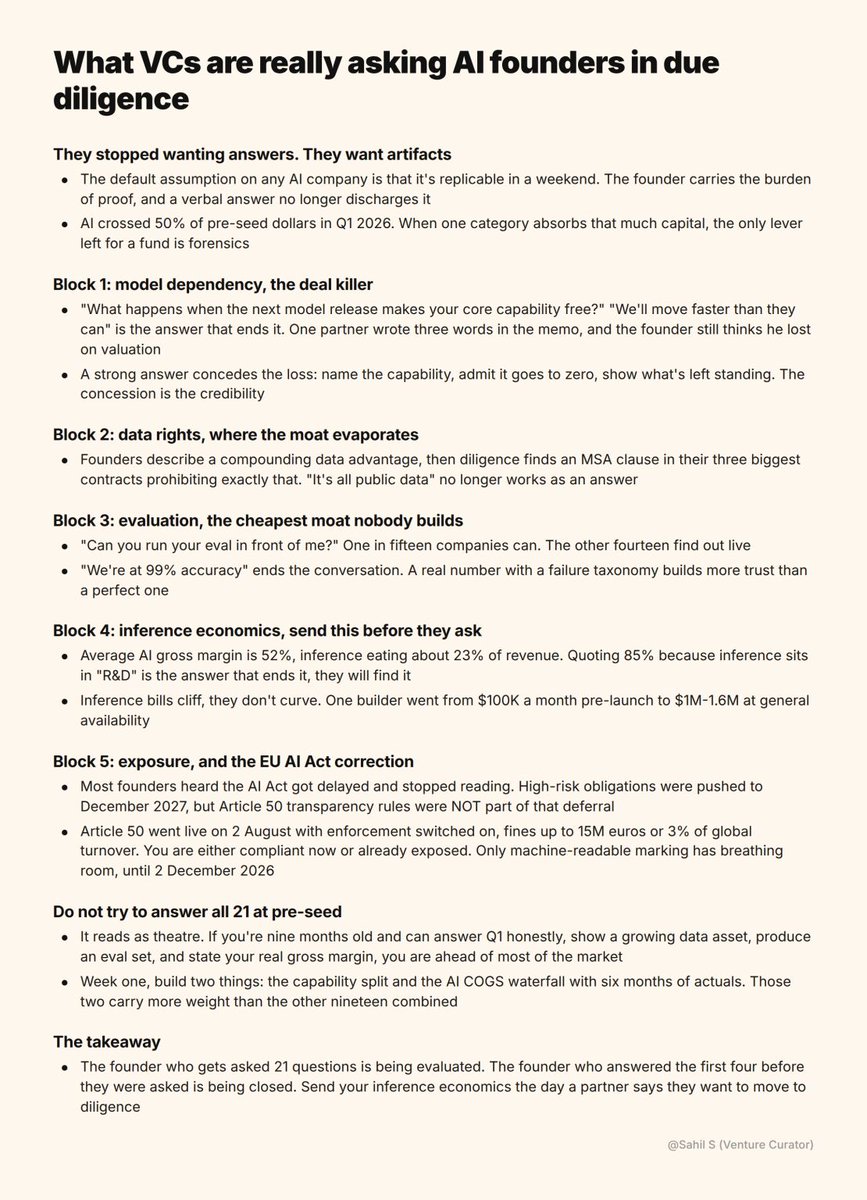
We asked investors writing $400K to $4M checks into AI startups one question: What are you asking founders today that you weren’t asking a year ago?
Several pulled up their actual diligence lists. And what they’re looking for has changed significantly.
A year ago, founders could spend most of the meeting talking about market, team, traction, and vision.
Now investors are asking questions like:
→ What happens when the next frontier model makes your core capability free?
→ How quickly could you switch model providers?
→ Is your advantage actually the prompt, the pipeline, or proprietary data?
→ Can you run your eval live, right now?
→ What is your real failure rate?
→ What does a human still do behind the scenes?
→ What’s your gross margin after including inference costs?
→ What happens to your inference bill at 10x usage?
→ Which customers are actually unprofitable?
→ Do you legally have the right to use customer data to improve the product?
One investor told us she now asks founders to run their eval harness live during the meeting.
She estimated maybe 1 in 15 companies can actually do it.
Another founder answered almost everything well until the investor asked what would happen if the next frontier model shipped the feature his startup was built around.
His answer? “We’ll move faster than the model companies.”
The deal died within a week.
This points to a much bigger change in AI fundraising:
→ VCs increasingly don’t just want answers. They want evidence.
→ Don’t tell them your model is accurate. Run the eval.
→ Don’t tell them your margins will improve. Open the cost model.
→ Don’t tell them your data is proprietary. Show where it came from and what rights you have.
→ Don’t tell them you have a moat. Show what remains valuable if the underlying model becomes dramatically better tomorrow.
We collected 21 questions AI investors are asking founders right now, what each question is really testing, the answers that can quietly kill a deal, and the documents founders should have ready before diligence starts.
Full analysis 👇
https://t.co/6KpgRHuk7X
📍By the way, here're STARTUPS & AI RESOURCES you would love 👇
1️⃣40+ investor contact databases and 50+ fundraising templates every founder needs. https://t.co/OwrerCIzIR
2️⃣How do you build a seed deck that actually raises money? (We analysed 50+ Y-Combinator decks). https://t.co/RK8H1IytzD
3️⃣How to automate your startup fundraising with Claude (And avoid this autopilot trap). https://t.co/kGT9377O8W
4️⃣How did emerging AI startups get their first customers? An analysis of 50 companies. https://t.co/lhPWfSkC3L
5️⃣How are new-age AI startups pivoting and what do VCs make of it?
https://t.co/3WHPbPl1j9
For more resources, check out our Venture Curator newsletter, read by 55,000+ founders and investors.
Read it here: https://t.co/wHlyYiFP0A
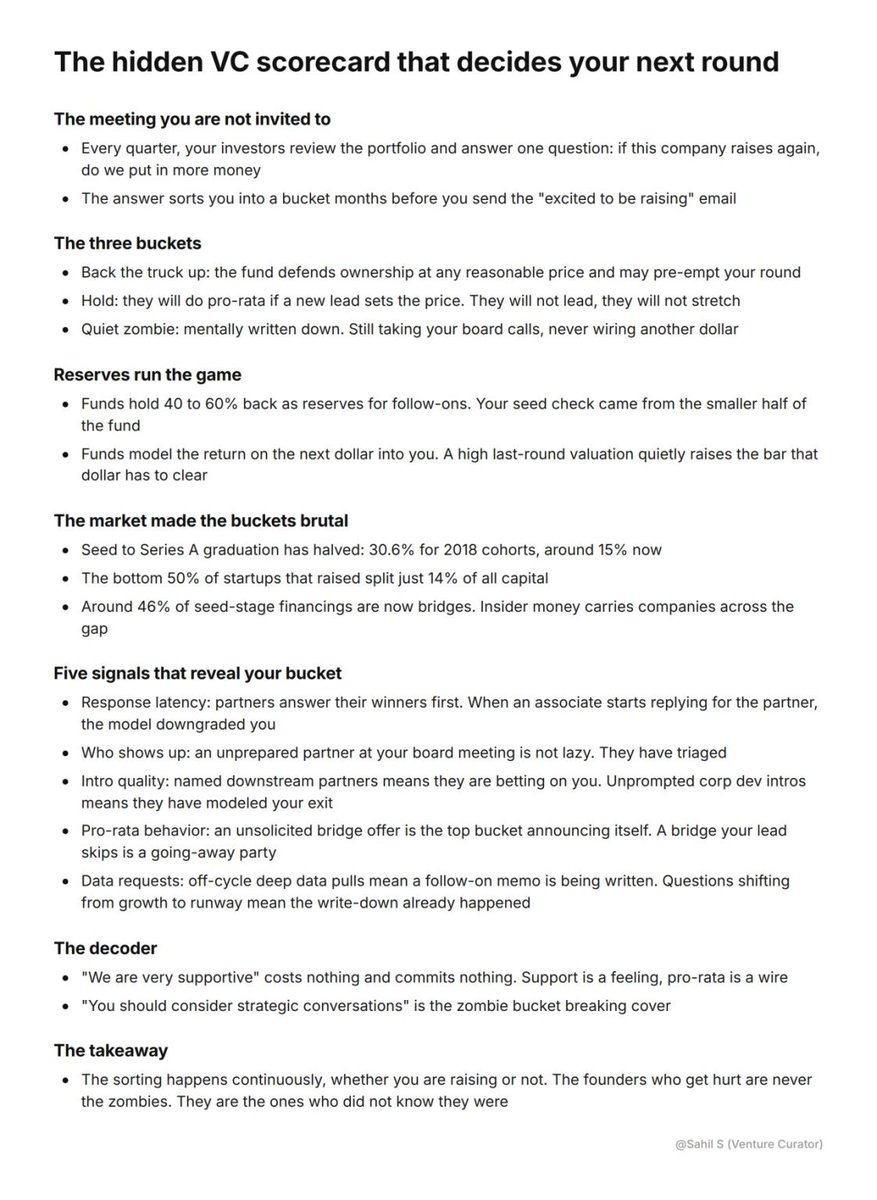
𝗛𝗼𝘄 𝗩𝗖𝘀 𝗱𝗲𝗰𝗶𝗱𝗲 𝘄𝗵𝗼 𝗴𝗲𝘁𝘀 𝗳𝗼𝗹𝗹𝗼𝘄-𝗼𝗻 𝗳𝘂𝗻𝗱𝗶𝗻𝗴?
There is a meeting your investors hold that you will never be invited to. Usually every quarter, partners sit down, open the portfolio, and go company by company.
The question is simple: If this company raises again, do we put in more money?
And every startup gets sorted into one of three buckets.
1️⃣ Back the truck up - They defend ownership at any price and may pre-empt your round.
2️⃣ Hold - They do pro-rata if a new lead sets the price. They never lead.
3️⃣ Quiet zombie - Written down internally. Still taking your calls. Never wiring another dollar.
The sorting happens before your fundraise, not during it. By the time you announce you are raising, your most important investors decided months ago.
And the math around it got brutal:
Seed to Series A graduation dropped from 30.6% to around 15%. The bottom 50% of startups that raised split just 14% of all capital. 46% of seed-stage financings are now bridges, funded by insiders.
So the bucket you sit in is no longer a detail. In this market, it often is the fundraise.
The good news: your bucket leaks through five observable signals. How fast partners reply. Who shows up to your board meetings. The quality of intros you get. Pro-rata behavior. What data they ask for.
For the full breakdown, check out our recent newsletter.
We published the complete scoring system and the six-month playbook for changing buckets before you raise 👇
https://t.co/IcHFavLe52
📍By the way, here're STARTUPS & AI RESOURCES you would love 👇
1️⃣40+ investor contact databases and 50+ fundraising templates every founder needs. https://t.co/OwrerCIzIR
2️⃣How do you build a seed deck that actually raises money? (We analysed 50+ Y-Combinator decks). https://t.co/RK8H1IytzD
3️⃣How to automate your startup fundraising with Claude (And avoid this autopilot trap). https://t.co/kGT9377O8W
4️⃣How did emerging AI startups get their first customers? An analysis of 50 companies. https://t.co/lhPWfSkC3L
5️⃣How are new-age AI startups pivoting and what do VCs make of it?
https://t.co/3WHPbPl1j9
For more resources, check out our Venture Curator newsletter, read by 55,000+ founders and investors.
Read it here: https://t.co/wHlyYiFP0A
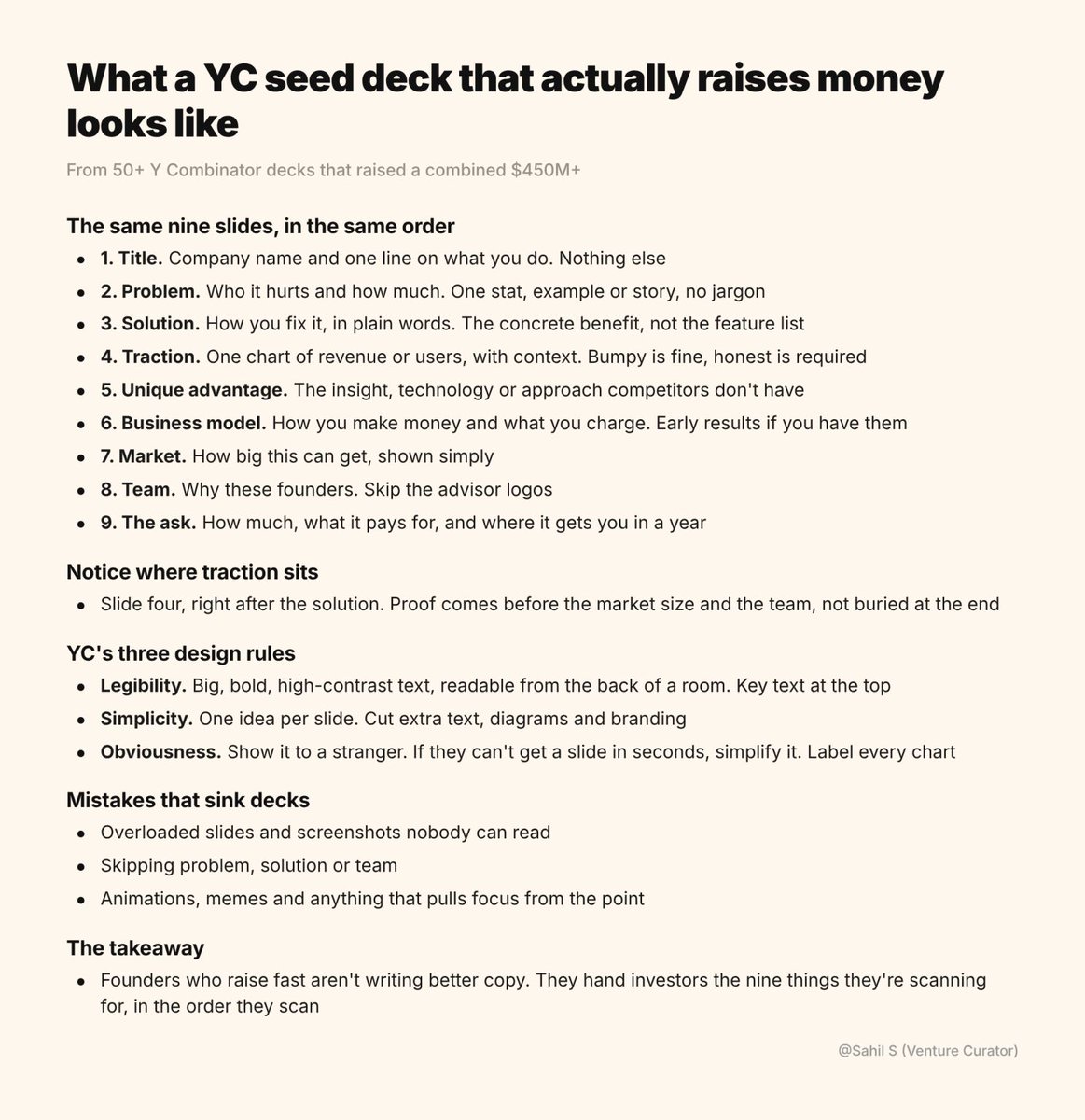
What does a Y-Combinator seed deck that actually raises money look like?
We went through 50+ YC decks from startups that went on to raise a combined $450M+. Different industries, different founders, different cheque sizes.
The same nine slides kept showing up. In the same order.
1. Title
2. Problem
3. Solution
4. Traction
5. Unique advantage
6. Business model
7. Market
8. Team
9. The ask
One thing that stood out from our research:
The strongest decks don't try to explain everything about the business.
They make the most important information easy to understand.
YC also emphasizes three simple design principles:
→ Legibility: Make every slide easy to read.
→ Simplicity: Focus on one main idea per slide.
→ Obviousness: Investors should understand your point within seconds.
Of course, a nine-slide structure alone won't get you funded. The underlying business, traction, and founder insight still matter.
But a clear deck makes it much easier for investors to understand why your startup deserves attention.
We put together the complete breakdown with slide examples and access to 50+ YC startup pitch decks.
Read it here: https://t.co/aHbCbfdv5T
How did emerging AI startups get their early customers? An analysis of 50 companies.
Only 5 of the 50 companies we studied got their first paying customers primarily through a public launch.
The bigger pattern was much more interesting.
The first customers usually came from places where trust already existed, or where the product could prove itself before the customer had to believe the pitch.
Look at a few examples:
→ Cursor started with developers the founders already knew. Those users recommended it to other developers, with Discord becoming an early community hub.
→ Harvey ran 100 legal questions through GPT-3, had lawyers grade the answers, and sent the results to OpenAI. Later, instead of chasing small law firms, it landed Allen & Overy as an early major customer.
→ Decagon won early customers by competing directly against larger vendors on the customer’s actual support tickets. Instead of saying the product was better, it let the results prove it.
Across the 50 companies, three newer customer acquisition patterns kept appearing:
→ Proof-of-work cold emails
→ Bake-offs against existing vendors
→ Short demo clips showing the product doing something impressive
But the playbook also changed depending on the company.
Enterprise AI leaned heavily on founder networks, investors, anchor customers, outbound, and bake-offs.
Developer tools leaned more on communities, free products, word of mouth, and building in public.
Consumer AI leaned heavily on communities and making the product’s output naturally shareable.
The biggest takeaway from the research:
Your launch might get you signups. It probably won’t get you your first 10 paying customers.
The best founders found ways to let customers judge the product on its work before asking them to trust the company.
We mapped all 50 companies, their first-customer channels, real examples, outreach templates, and a practical playbook for finding your first 10 customers. Check out here 👇
https://t.co/c1zSpd9FyZ
𝗖𝗼𝘂𝗹𝗱 𝗰𝗮𝗹𝗹𝗶𝗻𝗴 𝘆𝗼𝘂𝗿 𝘀𝘁𝗮𝗿𝘁𝘂𝗽 “𝗔𝗜-𝗻𝗮𝘁𝗶𝘃𝗲” 𝗮𝗰𝘁𝘂𝗮𝗹𝗹𝘆 𝗵𝘂𝗿𝘁 𝘆𝗼𝘂𝗿 𝘃𝗮𝗹𝘂𝗮𝘁𝗶𝗼𝗻? 𝗧𝗵𝗲 𝗱𝗮𝘁𝗮 𝗺𝗶𝗴𝗵𝘁 𝘀𝘂𝗿𝗽𝗿𝗶𝘀𝗲 𝘆𝗼𝘂 👇
For the last couple of years, putting “AI-native” on your pitch deck could immediately make a startup more interesting.
That premium still exists.
Carta's H1 2026 data suggests AI startups at seed are raising similar amounts to non-AI startups, but at roughly 50% higher valuations.
But underneath that average, something more interesting is happening.
Investors are increasingly separating AI startups into very different buckets.
A thin AI wrapper with no proprietary data might be valued very differently from a vertical AI company with sticky workflows.
And both might be valued very differently from a company with real technical IP and proprietary data.
Same “AI-native” label. Completely different company.
That means investors are increasingly asking questions like:
→ What happens if we replace your underlying model tomorrow?
→ Does usage create proprietary data that makes the product better?
→ How difficult would it be for customers to rip you out of their workflow?
→ What happens to gross margins when inference volume grows 10x?
This is where I think many AI founders are making a mistake.
They’re spending too much time trying to explain their moat on a slide.
But investors increasingly want to see evidence of it.
Run the model-swap test.
Show how product performance improves as proprietary data compounds.
Show that customers with deeper integrations retain or expand more.
Model your inference economics at 10x usage.
Those artifacts can tell an investor much more than writing “proprietary AI” on slide three.
The pitch deck gets you into the meeting.
The evidence in the data room can determine which valuation bucket you end up in.
And that might be one of the biggest changes happening in AI fundraising right now.
If you’re building an AI startup, ask yourself one uncomfortable question:
If your competitors can access the same foundation models tomorrow, what becomes stronger about your company every time a customer uses your product?
That answer may matter more than the “AI-native” label on your deck.
I shared a deeper breakdown of the investor checklist, how to score your own AI startup, and what founders can actually build over the next 90 days to strengthen their defensibility here 👇
https://t.co/JwzaiBY1KT
📍By the way, here're STARTUPS & AI RESOURCES you would love 👇
1️⃣40+ investor contact databases and 50+ fundraising templates every founder needs. https://t.co/OwrerCIzIR
2️⃣How do you build a seed deck that actually raises money? (We analysed 50+ Y-Combinator decks). https://t.co/RK8H1IytzD
3️⃣How to automate your startup fundraising with Claude (And avoid this autopilot trap). https://t.co/kGT9377O8W
4️⃣How did emerging AI startups get their first customers? An analysis of 50 companies. https://t.co/lhPWfSkC3L
5️⃣How are new-age AI startups pivoting and what do VCs make of it?
https://t.co/3WHPbPl1j9
For more resources, check out our Venture Curator newsletter, read by 55,000+ founders and investors.
Read it here: https://t.co/wHlyYiFP0A
𝗖𝗼𝘂𝗹𝗱 𝗰𝗮𝗹𝗹𝗶𝗻𝗴 𝘆𝗼𝘂𝗿 𝘀𝘁𝗮𝗿𝘁𝘂𝗽 “𝗔𝗜-𝗻𝗮𝘁𝗶𝘃𝗲” 𝗮𝗰𝘁𝘂𝗮𝗹𝗹𝘆 𝗵𝘂𝗿𝘁 𝘆𝗼𝘂𝗿 𝘃𝗮𝗹𝘂𝗮𝘁𝗶𝗼𝗻? 𝗧𝗵𝗲 𝗱𝗮𝘁𝗮 𝗺𝗶𝗴𝗵𝘁 𝘀𝘂𝗿𝗽𝗿𝗶𝘀𝗲 𝘆𝗼𝘂 👇
For the last couple of years, putting “AI-native” on your pitch deck could immediately make a startup more interesting.
That premium still exists.
Carta's H1 2026 data suggests AI startups at seed are raising similar amounts to non-AI startups, but at roughly 50% higher valuations.
But underneath that average, something more interesting is happening.
Investors are increasingly separating AI startups into very different buckets.
A thin AI wrapper with no proprietary data might be valued very differently from a vertical AI company with sticky workflows.
And both might be valued very differently from a company with real technical IP and proprietary data.
Same “AI-native” label. Completely different company.
That means investors are increasingly asking questions like:
→ What happens if we replace your underlying model tomorrow?
→ Does usage create proprietary data that makes the product better?
→ How difficult would it be for customers to rip you out of their workflow?
→ What happens to gross margins when inference volume grows 10x?
This is where I think many AI founders are making a mistake.
They’re spending too much time trying to explain their moat on a slide.
But investors increasingly want to see evidence of it.
Run the model-swap test.
Show how product performance improves as proprietary data compounds.
Show that customers with deeper integrations retain or expand more.
Model your inference economics at 10x usage.
Those artifacts can tell an investor much more than writing “proprietary AI” on slide three.
The pitch deck gets you into the meeting.
The evidence in the data room can determine which valuation bucket you end up in.
And that might be one of the biggest changes happening in AI fundraising right now.
If you’re building an AI startup, ask yourself one uncomfortable question:
If your competitors can access the same foundation models tomorrow, what becomes stronger about your company every time a customer uses your product?
That answer may matter more than the “AI-native” label on your deck.
I shared a deeper breakdown of the investor checklist, how to score your own AI startup, and what founders can actually build over the next 90 days to strengthen their defensibility here 👇
https://t.co/JwzaiBY1KT
NEC X is offering up to $200,000 in funding to early-stage startup founders. Applications are now open...
Ignite, a tech incubator designed to help founders turn early ideas and prototypes into businesses with real customers.
And what's interesting is that the program offers more than just capital.
Founders get access to NEC's global R&D resources, engineering expertise, Silicon Valley networks, and potential enterprise customers.
Here's how the program works:
1. Phase 1: Business design and customer discovery
→ Equity-free support to refine your business model
→ Identify customer problems and validate your solution
→ Work with mentors to strengthen your product strategy
2. Phase 2: $20,000 SAFE investment
→ Receive $20K through a SAFE
→ Validate your product with potential Silicon Valley customers
→ Get technical and go-to-market support
3. Phase 3: Up to $200,000 investment
→ Selected teams can receive up to $200K
→ Access enterprise and strategic partner connections
→ Get investor introductions and fundraising support
Who can apply?
→ Early-stage B2B and B2G startup founders
→ Solo founders and founding teams
→ Startups working on AI, automation, robotics, fintech, cybersecurity, digital health, and related technologies
→ Founders who can build and test functional prototypes
→ No existing revenue required
One thing worth noting: The initial phase is equity-free, but the $20K SAFE and subsequent investment are financing arrangements, not no-strings-attached grants.
For early-stage founders, access to engineering resources, enterprise customers, and product validation can be just as valuable as the investment itself.
Application link here - https://t.co/U35DHpKqv0
Recently, we analyzed 50+ YC decks which raised $500M and shared the full slide-by-slide framework, common mistakes, and design templates in this week's Venture Curator edition. (including 50+ Y-Combinator startups pitch deck links) 👇
https://t.co/e73FzUSltG
What does a Y-Combinator seed deck that actually raises money look like?
We went through 50+ YC decks from startups that went on to raise a combined $450M+. Different industries, different founders, different cheque sizes.
The same nine slides kept showing up. In the same order.
1. Title
2. Problem
3. Solution
4. Traction
5. Unique advantage
6. Business model
7. Market
8. Team
9. The ask
One thing that stood out from our research:
The strongest decks don't try to explain everything about the business.
They make the most important information easy to understand.
YC also emphasizes three simple design principles:
→ Legibility: Make every slide easy to read.
→ Simplicity: Focus on one main idea per slide.
→ Obviousness: Investors should understand your point within seconds.
Of course, a nine-slide structure alone won't get you funded. The underlying business, traction, and founder insight still matter.
But a clear deck makes it much easier for investors to understand why your startup deserves attention.
We put together the complete breakdown with slide examples and access to 50+ YC startup pitch decks.
Read it here: https://t.co/aHbCbfdv5T
📍By the way, here're STARTUPS & AI RESOURCES you would love 👇
1️⃣40+ investor contact databases and 50+ fundraising templates every founder needs. https://t.co/OwrerCIzIR
2️⃣How do you build a seed deck that actually raises money? (We analysed 50+ Y-Combinator decks). https://t.co/RK8H1IytzD
3️⃣How to automate your startup fundraising with Claude (And avoid this autopilot trap). https://t.co/kGT9377O8W
4️⃣How did emerging AI startups get their first customers? An analysis of 50 companies. https://t.co/lhPWfSkC3L
5️⃣How are new-age AI startups pivoting and what do VCs make of it?
https://t.co/3WHPbPl1j9
For more resources, check out our Venture Curator newsletter, read by 55,000+ founders and investors.
Read it here: https://t.co/wHlyYiFP0A
NEC X is offering up to $200,000 in funding to early-stage startup founders. Applications are now open...
Ignite, a tech incubator designed to help founders turn early ideas and prototypes into businesses with real customers.
And what's interesting is that the program offers more than just capital.
Founders get access to NEC's global R&D resources, engineering expertise, Silicon Valley networks, and potential enterprise customers.
Here's how the program works:
1. Phase 1: Business design and customer discovery
→ Equity-free support to refine your business model
→ Identify customer problems and validate your solution
→ Work with mentors to strengthen your product strategy
2. Phase 2: $20,000 SAFE investment
→ Receive $20K through a SAFE
→ Validate your product with potential Silicon Valley customers
→ Get technical and go-to-market support
3. Phase 3: Up to $200,000 investment
→ Selected teams can receive up to $200K
→ Access enterprise and strategic partner connections
→ Get investor introductions and fundraising support
Who can apply?
→ Early-stage B2B and B2G startup founders
→ Solo founders and founding teams
→ Startups working on AI, automation, robotics, fintech, cybersecurity, digital health, and related technologies
→ Founders who can build and test functional prototypes
→ No existing revenue required
One thing worth noting: The initial phase is equity-free, but the $20K SAFE and subsequent investment are financing arrangements, not no-strings-attached grants.
For early-stage founders, access to engineering resources, enterprise customers, and product validation can be just as valuable as the investment itself.
Application link here - https://t.co/U35DHpKqv0
Recently, we analyzed 50+ YC decks which raised $500M and shared the full slide-by-slide framework, common mistakes, and design templates in this week's Venture Curator edition. (including 50+ Y-Combinator startups pitch deck links) 👇
https://t.co/e73FzUSltG
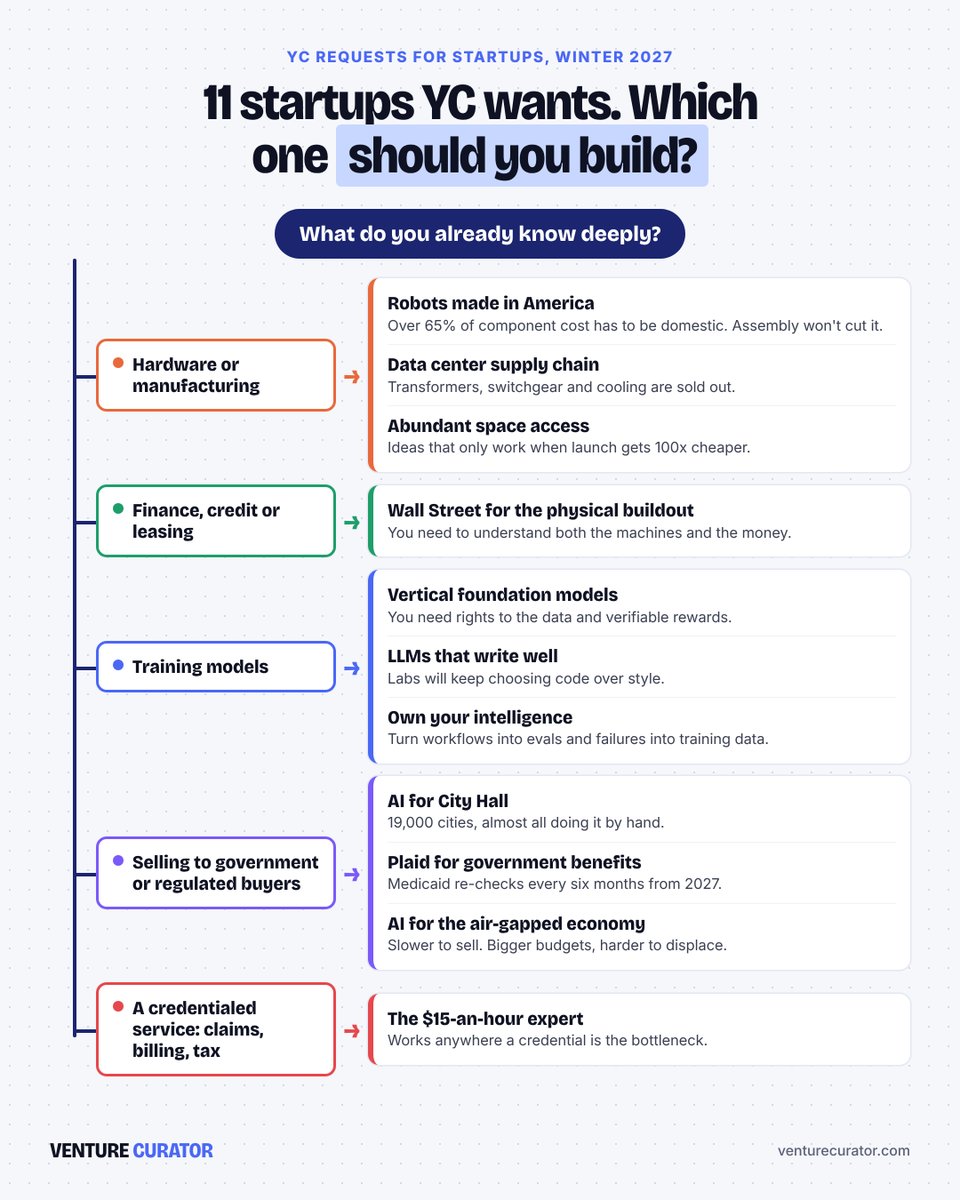
Y-Combinator just dropped its Winter 2027 Requests for Startups....
And the shift is hard to miss. Less about what AI can do. More about what it takes to actually DEPLOY it.
Fall 2026 had 13 themes. Multiplayer AI, consumer agents, self-maintaining APIs.
Winter 2027 has 11. Magnets, transformers, loans, permits.
A few that stood out to me:
Robots Made in America. China made 94% of the world's sintered rare-earth magnets in 2024. The FCC now wants 65% of a new connected robot's component cost to be domestic, rising to 75% by 2029. Assembling imported parts won't get you there.
Data Center Supply Chain. Large power transformers have a three-year lead time. The steel in their cores is made in a single US plant, and it can't keep up.
Wall Street for the Physical Buildout. Banks still underwrite a robot like a forklift. Every big buildout, railroads, electricity, telecom, created giant financial companies alongside it.
AI for City Hall. 19,000 US cities still review permits mostly by hand. YC's math says approving them in 10% of the time would add $16B a year in tax revenue.
And one I didn't expect: LLMs That Write Well. YC says models have got better at code and worse at writing, and the big labs will keep picking code.
The pattern across all 11: the bottleneck has moved past the model.
I put all 11 on one page.
Also recently, we analyzed 50+ YC decks which raised $500M and shared the full slide-by-slide framework, common mistakes, and design templates in this week's Venture Curator edition. (including 50+ Y-Combinator startups pitch deck links) 👇
https://t.co/e73FzURNE8